
Dream Lab 🧪
Click the mic, speak, then click again to see the tags.
Live Transcript
...
Detected Tags

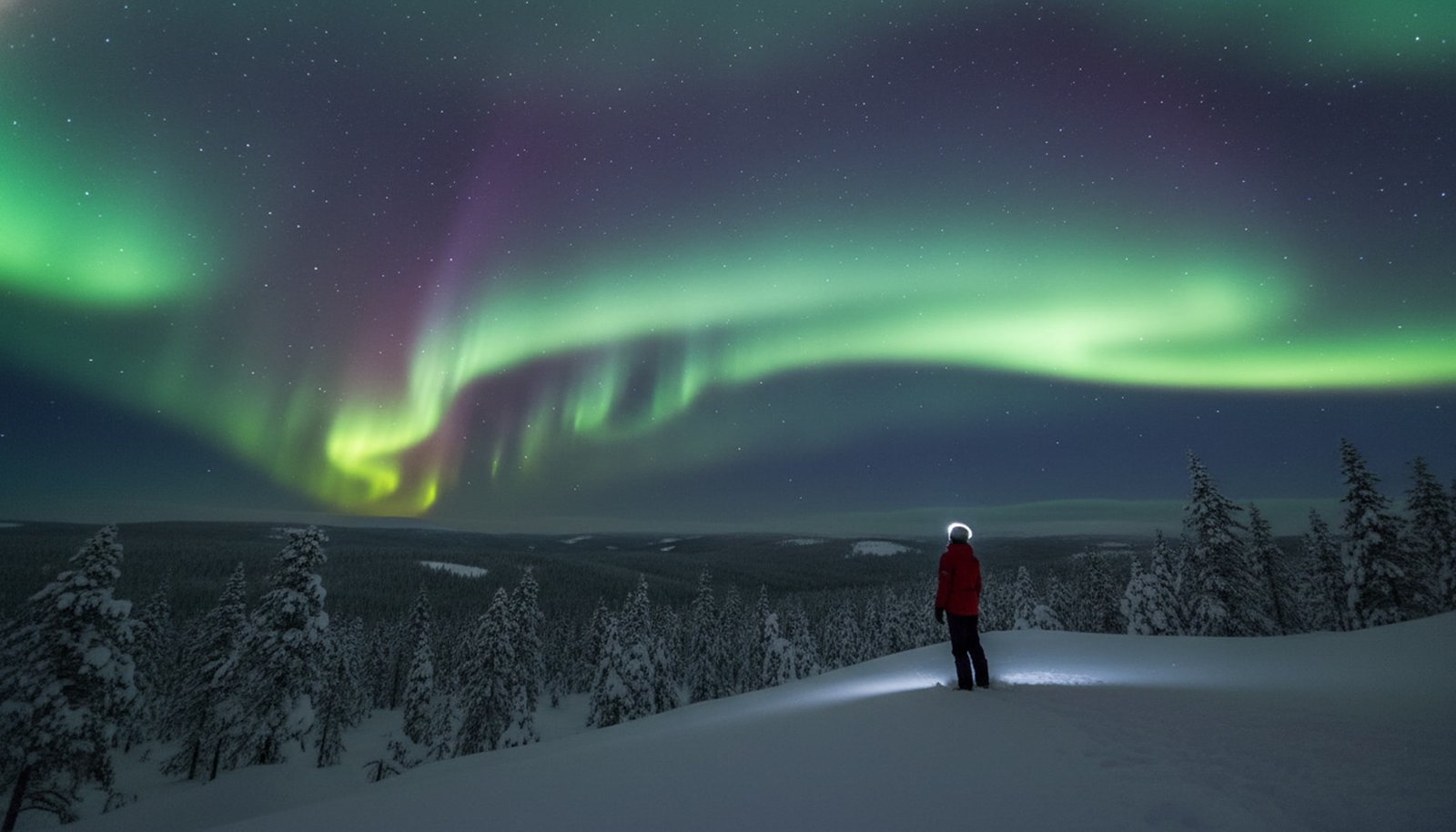
How Can You See the Northern Lights?
How Can You See the Northern Lights? A Practical Guide
Witnessing the Aurora Borealis is a breathtaking experience that tops many travel bucket lists. These ethereal ribbons of light dancing across the night sky are a reward for those who venture into the cold, dark north. But seeing them isn’t just about luck; it’s about preparation and understanding what creates the perfect viewing opportunity.
This guide breaks down the essential elements for a successful aurora hunt, from choosing your destination to reading the forecasts. By combining the right location, conditions, and timing, you can dramatically increase your chances of experiencing one of nature’s most spectacular displays.
The Three Pillars of Aurora Hunting
Successfully seeing the Northern Lights depends on three critical factors aligning perfectly. If one of these is missing, your chances drop significantly. Think of them as the essential pillars supporting your viewing experience.
Pillar 1: The Right Location (Geomagnetic Latitude)
The aurora occurs in a ring around the Earth’s magnetic poles, known as the auroral oval. To see it, you need to be underneath or very close to this oval. This zone generally falls between 65 and 72 degrees North geomagnetic latitude. Key destinations within this zone include Fairbanks, Alaska; Yellowknife, Canada; most of Iceland; and the northern parts of Norway, Sweden, and Finland. It’s important to note that geomagnetic latitude is slightly different from geographic latitude. The further north you go, the better your chances, as the aurora can appear directly overhead rather than just on the horizon. Choosing a location within this prime viewing band is the single most important decision you’ll make.
Pillar 2: The Right Conditions (Darkness & Clear Skies)
The aurora is a relatively faint phenomenon, so you need two environmental conditions: darkness and clear skies. For darkness, you must get away from city light pollution, which can easily wash out the display. Even a bright full moon can diminish the visibility of fainter auroras, so planning your trip around the new moon phase is ideal. Clear skies are non-negotiable; clouds will block the view completely, as the aurora happens far above them in the upper atmosphere. This is why checking the local weather forecast is just as important as checking the aurora forecast. The best viewing season is from September to March, simply because the nights are longest and darkest.
Pillar 3: The Right Activity (Solar Forecast)
The aurora’s intensity is directly linked to activity on the Sun. A strong solar wind or a Coronal Mass Ejection (CME) hitting Earth’s magnetic field will produce a vibrant and active display. Scientists measure this geomagnetic activity using the Kp-index, a scale from 0 to 9. A Kp of 1-2 might produce a faint glow in the far north, while a Kp of 5 or higher indicates a geomagnetic storm, making the lights brighter and visible from lower latitudes. You can check short-term forecasts using apps and websites like NOAA’s Space Weather Prediction Center. A strong forecast significantly boosts your odds, turning a potential no-show into an unforgettable night.
Practical Tips for Your Viewing Night
Once you’ve planned your trip and the forecasts look promising, it’s time to head out. Here’s how to make the most of your night under the stars.
What to Bring and Wear
Patience is the most important thing to bring, but proper gear is a close second. Dress in warm layers, as you may be standing outside in freezing temperatures for hours. Insulated boots, gloves, a hat, and a thermal base layer are essential. For photographers, a tripod is non-negotiable to get sharp, long-exposure shots. A camera with manual settings (or a modern smartphone with a good night mode) is required. Also, bring a headlamp with a red light setting; red light preserves your night vision, allowing you to see the faint aurora more clearly. A thermos with a hot drink can also make the wait much more comfortable.
How to Look and What to Expect
When you arrive at your dark-sky location, turn off all lights and allow your eyes at least 15-20 minutes to fully adjust to the darkness. The aurora most commonly appears in the northern part of the sky, so orient yourself in that direction. Be aware that a faint aurora can initially look like a wispy, greyish cloud to the naked eye. Your camera’s sensor is more sensitive to the green light and will often pick up the color before you can. Be patient. Auroral displays often come in waves, with periods of calm followed by bursts of intense activity. The show can last for a few minutes or go on for hours, so don’t leave after the first sighting.
Quick Facts
- The best viewing locations are inside the ‘auroral zone’, between 65-72° North latitude.
- Travel between September and March for the longest and darkest nights, which are essential for viewing.
- You must have clear, cloud-free skies and be far away from city light pollution.
- Check both the weather forecast and the aurora forecast (Kp-index) before heading out.
- A faint aurora can look like a grey, moving cloud to the naked eye; a camera will reveal its color.
- Patience is crucial. Be prepared to wait for hours in the cold for the lights to appear.
- A tripod is essential for photography, and a headlamp with a red light helps preserve your night vision.
Frequently Asked Questions (FAQ)
Q: Can I see the Northern Lights with a full moon? A: Yes, it’s possible to see the aurora during a full moon, especially if the display is very strong. However, the bright moonlight will wash out fainter details and make the overall experience less vibrant.
Q: Do I need a special camera to photograph the aurora? A: A camera with manual controls (DSLR or mirrorless) is ideal for high-quality photos. However, many modern smartphones have excellent ‘Night Mode’ capabilities that can capture impressive images of the aurora, especially when mounted on a tripod.
Q: How long does an aurora display typically last? A: The duration is highly variable. A minor display might last only 15-30 minutes. A major geomagnetic storm can produce waves of auroral activity that last for several hours through the night.
Q: What is the best time of night to see the aurora? A: While the aurora can appear at any time during the dark hours, the most active displays often occur between 10 PM and 2 AM local time. However, it’s best to be ready anytime after true darkness falls.
Other Books
- NOAA Space Weather Prediction Center – Official Aurora Forecast
- Space.com – A Guide to Aurora Viewing
- Icelandic Met Office – Cloud Cover and Aurora Forecast


Ganymede's Broken Auroras
Summary
Scientists using the Hubble Space Telescope created the first complete map of the aurora on Ganymede, Jupiter’s largest moon. They discovered its auroral lights aren’t complete ovals like Earth’s, but are split into two glowing crescents, a pattern unique in our solar system.
Quick Facts
- Ganymede is the largest moon in our solar system, bigger than the planet Mercury.
- It's the only moon known to have its own magnetic field.
- Its aurora is created by glowing oxygen atoms, visible in ultraviolet light.
- The auroral lights form two bright 'crescents' instead of a continuous ring.
- This map was created using 46 observations from the Hubble Space Telescope over 19 years.
The Discovery: Mapping a Moon's Crescent Lights
For years, scientists knew Ganymede had an aurora, a faint glow powered by its unique magnetic field. But seeing the whole picture was impossible. Using a massive dataset of 46 observations from the Hubble Space Telescope spanning from 1998 to 2017, a team of researchers painstakingly stitched together the first-ever global brightness map of Ganymede’s ultraviolet aurora. The result was a huge surprise. Instead of a continuous oval of light at each pole, like the ones we see on Earth or even Jupiter, Ganymede’s aurora is distinctly broken. The map revealed two intensely bright auroral crescents on opposite sides of the moon, while the regions in between were dramatically dimmer. This structure had never been seen anywhere else and points to the strange and complex physics happening around Jupiter’s giant moon.
Read the original research paper on arXiv
Our map reveals Ganymede’s auroral ovals are structured in upstream and downstream ‘crescents’.
— Joachim Saur, Corresponding Author
The Science Explained Simply
Imagine Ganymede as a large rock in a fast-moving river. The ‘river’ is the plasma—a gas of charged particles—that fills Jupiter’s enormous magnetosphere and flows past Ganymede at incredible speed. The brightest parts of the aurora, the crescents, appear on the upstream side (where the plasma hits the moon head-on) and the downstream side (in its wake). This is where the interaction is most intense, accelerating particles into Ganymede’s thin oxygen atmosphere and making it glow. The sides of the ‘rock’ parallel to the flow—the flanks facing toward and away from Jupiter—experience a much weaker interaction. This causes the aurora to be 3 to 4 times fainter in these regions, creating the ‘broken’ or crescent shape. It’s a visual map of how Ganymede battles the constant stream of plasma from its parent planet.
The Aurora Connection
Auroras are the ultimate sign that a planet or moon has a magnetic field. Ganymede is the only moon in our solar system with one, creating what scientists call a mini-magnetosphere. This map of its broken aurora is a stunning visualization of that mini-magnetosphere in action. Unlike Earth’s global magnetic field which stands strong against the solar wind, Ganymede’s field is tiny and completely embedded within Jupiter’s colossal magnetosphere. The crescent shape shows us exactly where Ganymede’s magnetic field lines connect with Jupiter’s, creating channels for energetic particles to slam into its atmosphere. Studying this unique, ‘sub-Alfvénic’ interaction helps scientists understand the physics of magnetism on a smaller scale and provides clues about how moons can protect a fragile atmosphere even in the harshest environments.
This map will be useful to understand the processes that generate the aurora in Ganymede’s non-rotationally driven, sub-Alfvénic magnetosphere.
— The Research Team
A Peek Inside the Research
Creating this map was a cosmic puzzle. The researchers used the Space Telescope Imaging Spectrograph (STIS) on Hubble, which observes in ultraviolet light invisible to the human eye. Each of the 46 exposures only captured one hemisphere of Ganymede at a time. The science team had to precisely determine Ganymede’s position and orientation for each image, carefully subtract the glare of reflected sunlight from its icy surface, and correct for the viewing angle. They then projected each clean image onto a flat, global map, similar to how a map of Earth is made from satellite photos. By averaging all 46 maps together, weighted by their exposure time, they built up a complete, high-quality picture of the entire auroral system. This meticulous process turned nearly two decades of snapshots into the first definitive atlas of Ganymede’s alien auroras.
Key Takeaways
- Ganymede's auroral ovals are not continuous rings like Earth's.
- The brightest parts are two crescents on the sides facing into and away from the plasma flow from Jupiter.
- The sides facing directly toward and away from Jupiter are 3-4 times fainter, creating a 'broken' appearance.
- This unique shape is caused by the interaction between Ganymede's small magnetic field and Jupiter's giant one.
- The map serves as a blueprint for understanding 'mini-magnetospheres' and their plasma interactions.
Sources & Further Reading
Frequently Asked Questions
Q: What color are Ganymede’s auroras?
A: Ganymede’s auroras glow primarily in ultraviolet (UV) light, which our eyes cannot see. The color comes from oxygen atoms in its thin atmosphere being excited by charged particles. If we could see in UV, they would likely appear as a purple or faint whitish glow.
Q: Why is Ganymede the only moon with a magnetic field?
A: Scientists believe Ganymede has a molten iron core, similar to Earth’s. The churning motion within this liquid metallic core generates a magnetic field. Other moons are either too small to have retained enough internal heat, or their core composition is different.
Q: Why is it important to map Ganymede’s aurora?
A: The aurora acts like a giant TV screen, showing us what’s happening in Ganymede’s invisible magnetic field and how it interacts with Jupiter. Mapping its brightness and shape helps scientists test their models of plasma physics and understand how this unique ‘mini-magnetosphere’ works.
Q: Will we get a closer look at these auroras?
A: Yes! The European Space Agency’s JUICE (JUpiter ICy moons Explorer) mission is on its way to the Jupiter system and will eventually orbit Ganymede. It carries instruments designed to study Ganymede’s magnetic field and aurora in unprecedented detail, giving us an up-close view of these amazing crescent lights.
