
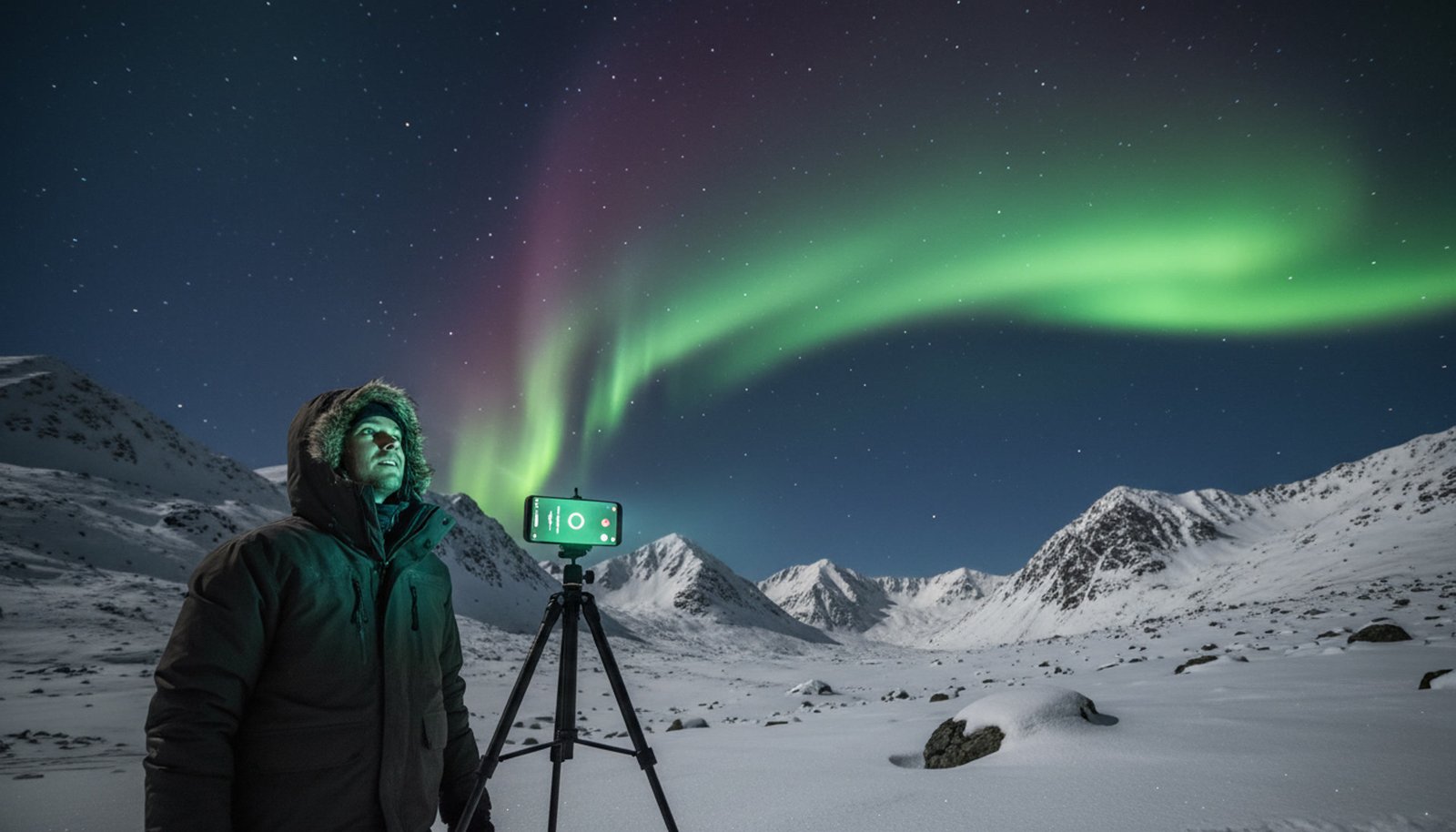
How to capture northern lights with Samsung?
How to Photograph the Northern Lights with a Samsung Phone
Gone are the days when you needed a bulky DSLR to capture the magic of the Aurora Borealis. Modern smartphones, especially high-end Samsung Galaxy devices, have incredibly capable cameras that can produce breathtaking astrophotography. With the right knowledge and a few key settings, you can turn your phone into a powerful tool for Northern Lights photography.
This guide will walk you through the essential gear, the exact camera settings in Pro Mode, and pro tips to help you bring home unforgettable images of the celestial dance. Get ready to master your Samsung’s camera and capture the night sky like never before.
Essential Gear and Preparation
Before you even touch your phone’s camera settings, having the right accessories is crucial. The techniques for aurora photography rely on stability and long exposure times, which are impossible to achieve handheld.
A Sturdy Tripod is Non-Negotiable
This is the single most important piece of gear. To capture the faint light of the aurora, your phone’s camera shutter needs to stay open for several seconds. Any movement during this time, even the slightest hand shake, will result in a blurry, smeared photo. A sturdy tripod with a secure phone mount eliminates this movement, allowing the camera sensor to soak in the light and produce a sharp, clear image. Don’t try to prop your phone on a rock or a car hood; the stability of a tripod is essential for crisp, professional-looking results. Invest in a decent one—it will make all the difference.
Remote Shutter or Built-in Timer
Even with a tripod, the simple act of tapping the shutter button on your screen can introduce a tiny vibration that blurs the image. To avoid this, you need a hands-free way to take the picture. The easiest method is to use the built-in camera timer. Set it to 2 or 5 seconds; this gives the phone enough time to stop vibrating after you press the button. If you have a Samsung phone with an S Pen, you can use its button as a wireless remote shutter, which is an excellent option. Alternatively, a cheap Bluetooth remote shutter works perfectly as well.
Power Bank and Warm Gear
Cold weather is the enemy of battery life. The freezing temperatures common during aurora viewing can drain your phone’s battery in a fraction of the normal time. A fully charged portable power bank is a lifesaver, ensuring you don’t run out of juice at a critical moment. It’s also wise to keep your phone in a warm pocket when you’re not actively shooting. Remember to dress warmly yourself! Patience is key in aurora photography, and you’ll be standing outside in the cold for a long time.
Mastering Samsung's Pro / Expert RAW Mode
Auto mode won’t work for the Northern Lights. You need full manual control, which is found in Samsung’s ‘Pro’ or ‘Expert RAW’ camera modes. Here are the exact settings to dial in.
Step 1: Set Shutter Speed (S)
Shutter speed determines how long the camera’s sensor is exposed to light. For the aurora, you need a long exposure. Start with a shutter speed of 10 seconds. If the aurora is faint and slow-moving, you can increase this to 15, 20, or even 30 seconds to gather more light and make it appear brighter. If the aurora is very bright and dancing quickly, a shorter shutter speed of 5-8 seconds might be better to capture its detailed shapes without them blurring together. Experiment to see what works best for the conditions.
Step 2: Adjust ISO
ISO measures the sensor’s sensitivity to light. A higher ISO makes the image brighter but also introduces more digital ‘noise’ or graininess. A good starting point for aurora photography is ISO 800 or 1600. If your photo is still too dark with a 15-second shutter, you can try pushing the ISO up to 3200, but be aware that image quality will start to degrade. The goal is to find the right balance between a bright enough image and an acceptable amount of noise. Always start with a lower ISO and only increase it if necessary.
Step 3: Nail Manual Focus (MF)
Your phone’s autofocus will fail in the dark; it will hunt for something to lock onto and never find it. You must use manual focus (MF). In Pro Mode, slide the focus control all the way to the infinity symbol (it looks like a small mountain). This sets the focus for distant objects, like the stars and the aurora. To confirm your focus is sharp, point your phone at the brightest star or a distant light, zoom in on the screen, and make sure it looks like a sharp point of light. Once set, don’t touch the focus again.
Step 4: Set White Balance (WB)
Leaving white balance on auto can sometimes result in the sky looking brownish or yellow. To get those classic deep blues and vibrant greens, set your white balance manually. A good starting point is a Kelvin temperature between 3500K and 4500K. This cooler temperature will counteract light pollution and render the colors of the aurora more accurately. You can adjust this setting live to see what looks best on your screen before you take the shot. Avoid the ‘AWB’ (Auto White Balance) setting for the most consistent results.
Quick Facts
- A sturdy tripod is absolutely essential to prevent blurry photos during long exposures.
- Use Pro Mode or Expert RAW to get full manual control over the camera.
- Set a long shutter speed, typically between 10 and 30 seconds.
- Start with an ISO between 800 and 1600, increasing only if necessary.
- You must use Manual Focus (MF) and set it to infinity (the mountain icon).
- Shoot in RAW format for maximum flexibility when editing your photos later.
- Use the 2-second timer or an S Pen to trigger the shutter without shaking the phone.
Frequently Asked Questions (FAQ)
Q: Can I just use Night Mode instead of Pro Mode? A: While Night Mode is great for cityscapes, it’s not ideal for the aurora. It often tries to brighten shadows too much and can produce unnatural-looking results. Pro Mode gives you the precise control needed to capture the aurora accurately.
Q: What is the ‘Expert RAW’ app and do I need it? A: Expert RAW is a separate, free app from Samsung for newer Galaxy S-series phones. It offers even more advanced controls and saves files with more image data, making it perfect for those who want to seriously edit their photos in software like Adobe Lightroom.
Q: My photos are still blurry, even on a tripod. What’s wrong? A: If your photo is blurry, it’s almost always due to one of two things: camera shake or incorrect focus. Ensure you are using a timer or remote shutter to take the picture. Then, double-check that your manual focus is set precisely to infinity.
Q: Should I turn my screen brightness down? A: Yes, it’s a great idea. A bright phone screen will ruin your night vision, making it harder to see the faint aurora with your own eyes. Turn your screen brightness down as low as you can while still being able to see the controls.
Other Books
- Samsung’s Official Guide to the Expert RAW App
- NOAA Space Weather Prediction Center – Aurora Forecast
- PetaPixel Guide to Smartphone Astrophotography


Jupiter's Secret Auroral Engine
Summary
NASA’s Juno spacecraft has uncovered a new twist in the mystery of Jupiter’s super-powered auroras. Scientists found they’re not just powered by steady electric currents, but also by turbulent, chaotic magnetic waves that surf electrons into the atmosphere.
Quick Facts
- Jupiter has the most powerful auroras in the entire solar system.
- They are mainly powered by the planet's rapid rotation and volcanic moon Io, not the solar wind like Earth's.
- Scientists found two power sources: steady electric currents (DC) and turbulent magnetic waves (AC).
- These magnetic waves, called Alfvén waves, act like cosmic surfers, accelerating electrons into the atmosphere.
- Juno's magnetometer had to be more than 4 Jupiter radii away to be sensitive enough to detect these tiny waves.
The Discovery: More Than a Simple Circuit
For decades, scientists had a leading theory for Jupiter’s auroras, based on a giant electric circuit. The idea was that Jupiter’s fast rotation creates a steady, direct current (DC) along its magnetic field lines, funneling electrons into the atmosphere to create the light show. But data from NASA’s Juno mission showed the picture was more complicated. By analyzing data from three different instruments simultaneously—the JEDI particle detector, the UVS auroral camera, and the MAG magnetometer—scientists found a second, more chaotic process at play. Alongside the steady currents, they detected fast, small-scale wiggles in the magnetic field. These fluctuations are the signature of powerful plasma waves, suggesting that Jupiter’s auroral engine is a hybrid, powered by both steady currents and turbulent waves.
Read the original research paper on arXiv
The consistent presence of small-scale magnetic field fluctuations supports that wave-particle interaction can dominantly contribute to Jupiter’s auroral processes.
— A. Salveter et al., Research Paper Authors
The Science Explained Simply
Imagine trying to power a light bulb. You could use a battery, which provides a steady, direct current (DC). This is like the old model for Jupiter’s aurora: a smooth river of electrons flowing in one direction. This process creates very organized auroras with electrons all at a similar energy level. But you could also power the bulb with the alternating current (AC) from a wall socket, which pushes and pulls electrons back and forth rapidly. On Jupiter, the equivalent of this AC power comes from Alfvén waves. These are magnetic waves that travel along field lines like a vibration on a guitar string. Instead of a smooth river, they create a turbulent ocean, sloshing electrons around and accelerating them to a wide range of energies. Juno’s data shows that most of Jupiter’s auroral electrons are of this mixed-energy ‘broad-band’ type, suggesting the turbulent wave-particle interactions are a key part of the story.
The Aurora Connection
Here at NorthernLightsIceland.com, we know Earth’s auroras are created when our planet’s magnetic field guides particles from the solar wind into our atmosphere. Jupiter’s system is on a whole different level. Its massive magnetic field and rapid 10-hour day create an internal powerhouse, with its volcanic moon Io supplying most of the particles. The discovery that turbulent Alfvén waves are a major power source for Jupiter’s aurora has huge implications for Earth too. While our auroras are less intense, we also see evidence of these waves contributing to the most dynamic and colourful displays. By studying the extreme case at Jupiter, where the waves are supercharged, scientists can build better models for how these magnetic vibrations transfer energy in space. This helps us understand not just the beauty of auroras, but also the fundamental physics that protects our planet from cosmic radiation.
The coexistence of these acceleration mechanisms underscores Jupiter’s magnetospheric variability and helps us understand similar processes at Earth.
— NorthernLightsIceland.com Science Team
A Peek Inside the Research
This discovery was a huge scientific challenge, requiring incredible precision. The team used Juno’s Fluxgate Magnetometer (MAG) to measure the magnetic field. The problem is that Jupiter’s main magnetic field is immensely powerful. When Juno was close to the planet, the background field was so ‘loud’ that the tiny, whispering fluctuations from Alfvén waves were completely drowned out by the instrument’s digital noise. It’s like trying to hear a pin drop during a rock concert. But when Juno’s orbit took it farther away (beyond 4 Jupiter radii), the background field became weaker. In this quieter environment, the magnetometer’s sensitivity was high enough to finally detect the ‘whisper’ of the small-scale waves. By correlating these faint signals with intense UV aurora and energetic electron data, the team confirmed that these waves were indeed powering the light show below.
Key Takeaways
- Jupiter's auroras are powered by a complex mix of processes, with wave-particle interactions being a major contributor.
- Most of the electrons creating the aurora have a wide range of energies ('broad-band'), which points to a chaotic, wave-like acceleration mechanism.
- Large-scale, steady currents are associated with some auroral features, but turbulent, small-scale magnetic fluctuations are present over the main emission zone.
- Technological limits, like instrument sensitivity, play a huge role in discovery; the key magnetic waves were only detectable when Juno was far from Jupiter.
- Studying Jupiter's extreme auroras helps us understand the fundamental physics of magnetic fields and particle acceleration throughout the universe.
Sources & Further Reading
Frequently Asked Questions
Q: What’s the main difference between Jupiter’s and Earth’s auroras?
A: The biggest difference is the power source. Earth’s auroras are primarily powered by the solar wind, a stream of particles from the Sun. Jupiter’s auroras are mostly self-generated by its incredibly fast rotation and particles spewed out from its volcanic moon, Io.
Q: What are Alfvén waves in simple terms?
A: Think of a magnetic field line in space like a guitar string. An Alfvén wave is a vibration or a ‘pluck’ that travels along that string. These waves are made of plasma (hot, ionized gas) and can carry huge amounts of energy across space, eventually dumping it into a planet’s atmosphere to create auroras.
Q: Why was it so hard to detect these magnetic waves?
A: Jupiter’s main magnetic field is thousands of times stronger than Earth’s. The magnetic waves are tiny fluctuations on top of this giant field. When Juno was close, the instrument’s measurements were dominated by the main field, making the small wiggles impossible to resolve, like trying to measure a ripple in a tidal wave.
Q: So are all auroras powered by waves?
A: Not entirely, but we’re learning waves play a much bigger role than we thought! Both Earth and Jupiter use a mix of steady electric currents and wave acceleration. This Juno research suggests that for the most powerful auroral systems like Jupiter’s, these turbulent waves might be the dominant engine.