
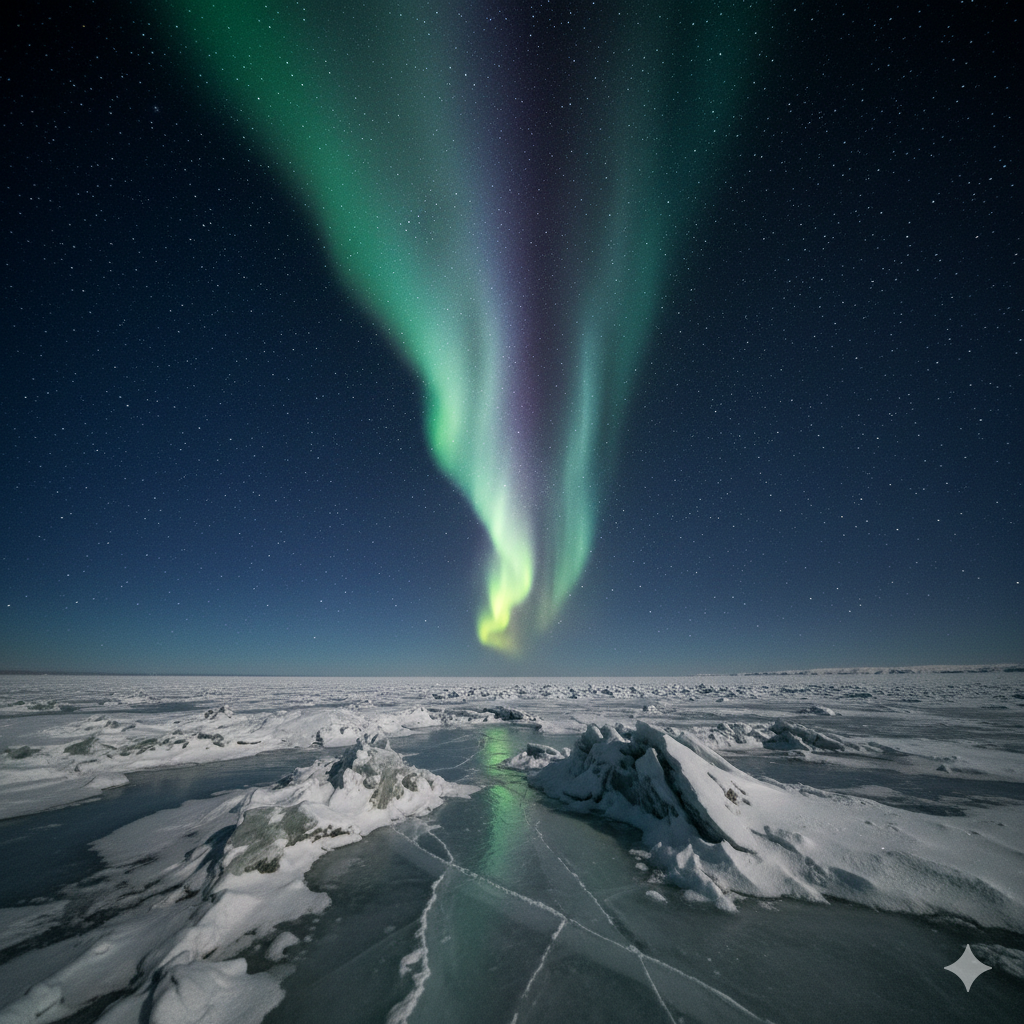
What are northern lights and solar flares?
What Are the Northern Lights and Solar Flares?
The serene, dancing lights of the Aurora Borealis seem a world away from the violent, fiery surface of the Sun. Yet, these two phenomena are directly connected in a cosmic cause-and-effect relationship that spans 93 million miles of space. The story of the Northern Lights doesn’t begin in our atmosphere, but with powerful explosions on our home star.
Understanding the Northern Lights requires looking at two key solar events: solar flares and their powerful cousins, Coronal Mass Ejections (CMEs). This guide will break down what each phenomenon is and how they work together to create Earth’s most spectacular natural light show.
The Sun's Activity: Cause and Effect
To understand the aurora, we first need to understand the Sun’s dynamic and sometimes explosive behavior. The Sun constantly sends out a stream of particles, but certain events can turn this gentle stream into a powerful storm.
What is a Solar Flare?
A solar flare is a tremendous explosion on the surface of the Sun, occurring when magnetic energy that has built up in the solar atmosphere is suddenly released. This event releases a massive burst of radiation, which travels at the speed of light. This means the light and energy from a solar flare reach Earth in just over eight minutes. While flares are incredibly powerful, they are not the main cause of the aurora. Think of a flare as the ‘muzzle flash’ of a cannon—an incredibly bright and intense burst of light and energy that signals an event has happened. It’s what comes next that truly powers the Northern Lights.
What is a Coronal Mass Ejection (CME)?
Often accompanying a solar flare is a Coronal Mass Ejection (CME). If the flare is the cannon’s flash, the CME is the ‘cannonball’. A CME is a massive cloud of plasma and magnetic field that is hurled from the Sun’s corona into space. This cloud of charged particles travels much slower than a flare’s radiation, taking anywhere from 1 to 3 days to cross the vast distance to Earth. It is this enormous, energetic cloud of solar material that, when aimed at Earth, dramatically interacts with our planet’s magnetic field and is the primary driver behind strong, widespread, and vibrant auroral displays.
The Solar Wind: A Constant Flow
Even when there are no flares or CMEs, the Sun constantly emits a stream of charged particles called the solar wind. This wind flows outward in all directions at speeds of around one million miles per hour. The solar wind is responsible for the ‘everyday’ auroras that occur regularly in the polar regions, often visible only from high-latitude locations like northern Scandinavia, Alaska, and Canada. A CME is essentially a massive, fast-moving, and dense wave within this solar wind, capable of overpowering Earth’s defenses and creating a geomagnetic storm that lights up the sky.
From Solar Storm to Earthly Light Show
The journey of particles from the Sun to our atmosphere is a multi-step process, culminating in the beautiful lights we see. Earth’s own magnetic field plays the crucial role of both protector and guide.
The Collision with Earth’s Magnetosphere
When a CME or a fast solar wind stream reaches Earth, it first collides with our planet’s protective magnetic shield, the magnetosphere. This invisible field, generated by Earth’s molten core, deflects the vast majority of harmful solar particles. However, a powerful CME can compress and rattle this shield, transferring huge amounts of energy into it. The magnetosphere channels this influx of energetic particles along its magnetic field lines, directing them down towards the weakest points in the shield: the North and South magnetic poles.
Creating the Aurora’s Glow
The grand finale occurs in Earth’s upper atmosphere, at altitudes of 60 to over 200 miles (100-320 km). As the captured solar particles are funneled towards the poles, they slam into atoms of oxygen and nitrogen. These collisions ‘excite’ the atmospheric atoms, giving them a temporary boost of energy. To return to their normal state, the atoms must release this excess energy in the form of light particles called photons. Billions upon billions of these collisions create the shimmering, dancing curtains of light we know as the aurora. The intensity of the solar event directly impacts the brightness and extent of the display.
Quick Facts
- Solar flares are bursts of radiation (light) that reach Earth in 8 minutes.
- Coronal Mass Ejections (CMEs) are clouds of particles that are the primary cause of strong auroras, taking 1-3 days to reach Earth.
- The Northern Lights are caused by these solar particles colliding with oxygen and nitrogen in our upper atmosphere.
- Earth’s magnetic field (the magnetosphere) protects us and funnels these particles toward the poles.
- A stronger solar event, like a large CME, leads to a more intense and widespread aurora, sometimes visible at much lower latitudes.
- The Sun operates on an ~11-year cycle of activity, with a ‘solar maximum’ period featuring more frequent flares and CMEs.
- The everyday, faint aurora is caused by the Sun’s constant ‘solar wind’.
Frequently Asked Questions (FAQ)
Q: Does every solar flare cause Northern Lights? A: No. A solar flare itself doesn’t cause the aurora. It’s the associated CME that does, and the CME must be aimed towards Earth to have an effect. Many flares and CMEs are directed away from our planet.
Q: Are solar flares and CMEs dangerous to people on Earth? A: No, people on the ground are protected by the magnetosphere and atmosphere. However, very strong geomagnetic storms can disrupt satellites, radio communications, and power grids. Astronauts in space are more exposed.
Q: What is the ‘solar cycle’? A: The solar cycle is the Sun’s approximately 11-year cycle of magnetic activity. It goes from a quiet period (solar minimum) to a very active period (solar maximum), where flares and CMEs are much more common, resulting in more frequent auroras.
Other Books
- NASA – What Is a Solar Flare?
- NOAA Space Weather Prediction Center – Coronal Mass Ejections (CME)
- Space.com – Solar Flares: What Are They & How Do They Affect Earth?


How To Capture Northern Lights With Camera?
How To Capture Northern Lights With Camera
Professional aurora photography isn’t just about camera settings; it’s about Atmospheric Physics.
Your settings must change based on the speed of the solar wind and the clarity of the air.
- Fast Aurora: Needs fast shutter (2-5s) or it blurs.
- High Humidity: Needs lens heaters or careful checking for fog.
- High Clouds: Diffuse the stars, requiring sharper focus checks.
Below is the Aurora Photographer’s Cockpit. It pulls live data from 4 separate weather and space APIs to calculate the exact constraints you are shooting under right now.
LIVE DATA
505 km/s
Active Dancing
-12.0 nT
Explosive Brightness
Crystal Clear
Visibility: 11.5km
Clear
Dew Point Spread: 4.8°C
APERTURE
MAX SHUTTER
ISO
FOCUS
Deep Dive: The Data Points
1. Aurora Speed vs. Shutter Speed
Our cockpit analyzes the Solar Wind Speed (km/s). If this number is high (>600 km/s), the aurora curtains are moving rapidly. If you use a standard 15-second exposure, those beautiful curtains will turn into a green smear. The cockpit calculates the “Max Shutter” to freeze that motion.
2. The Dew Point Spread (Lens Safety)
Look at the “Lens Safety” metric above. This calculates the difference between the Air Temperature and the Dew Point. If this number is small (<2°C), moisture will condense on your cold front lens element within minutes. Pro Tip: If the alert is flashing, keep hand warmers attached to your lens barrel.
3. Magnetic Power (Bz)
The “Bz” value tells us the brightness intensity. A negative number means bright aurora. If the number is positive (North), the aurora will be faint. The cockpit adjusts the recommended ISO automatically: High ISO (3200+) for faint aurora, Low ISO (800-1600) for bright storms to reduce noise.
How strong are the northern lights right now?
How Strong Are The Northern Lights Right Now?
If you are only looking at the Kp Index, you are looking at old data. To know exactly how strong the aurora is right now, you need to look at the magnetic field data coming from satellites 1 million miles away.
Specifically, we look at the Bz (Interplanetary Magnetic Field). Think of this as a “Magnetic Door.”
- Bz is Negative (South): The door is OPEN. Solar wind pours in. Aurora is strong.
- Bz is Positive (North): The door is LOCKED. Solar wind bounces off. Aurora is weak.
Below is our Pro-Level Magnetic Dashboard showing the live status of this door.
🧲 Live Magnetic Gate Status
Real-time DSCOVR Satellite Data
-12.0 nT
South (Open)
505 km/s
Fast
2.8 p/cm³
Normal
16.0 nT
Total Field
Extreme Storm
How To Read This Data (Like a Pro)
1. The Bz (Direction) – The Most Important Number
This is the “Latch” on the door.
– If you see a Negative Number (e.g., -10 nT), get your camera ready. The further negative it goes, the stronger the storm.
– If you see a Positive Number (e.g., +10 nT), the aurora will likely fade away, even if the Kp index is high.
2. The Bt (Strength)
This is how hard the wind is pushing on the door. A high Bt (over 15 nT) combined with a negative Bz creates the most violent and colorful displays.
3. Speed & Density
This is the fuel. High speed (>500 km/s) creates purple/pink colors. High density (>10 p/cm³) creates brightness.
Frequently Asked Questions
Q: Can the Bz change quickly?
A: Yes. It can flip from North to South in seconds. This is why the aurora often “dances” or explodes suddenly, then fades away just as fast.
Q: What is a “Substorm”?
A: When the Bz stays South (Negative) for a long time, energy builds up in Earth’s magnetic tail. Eventually, it snaps back like a rubber band, releasing massive energy. This is a substorm, and it creates the brightest, fastest-moving auroras.
What Are The Northern Lights Colors?
What Are The Northern Lights Colors?
Most people expect the Northern Lights to be green. And usually, they are. But during intense solar storms, the sky can explode into shades of pink, purple, red, and even blue.
The colors you see depend on two invisible factors happening in space right now:
1. Which gas is being hit (Oxygen or Nitrogen).
2. How hard it is being hit (Solar Wind Speed).
Below is our Live Aurora Palette, which analyzes real-time satellite data to predict which colors are physically possible in the sky at this exact moment.
🎨 Live Aurora Palette
Based on real-time Solar Wind Speed (521.5 km/s) and Density (5.13 p/cm³).
95% Chance
Dominant. The standard color caused by excited Oxygen.
50% Chance
Possible. Elevated wind speeds may cause pink fringes at the bottom of curtains.
5% Chance
Very Rare. Requires a massive geomagnetic storm.
The Science of Aurora Colors
💚 Green (The Most Common)
Cause: Low-altitude Oxygen (60-150 miles up).
Why: Our eyes are most sensitive to green light, and oxygen is abundant at this altitude. When the solar wind hits these atoms, they emit a specific wavelength of green light (557.7 nm).
💜 Purple & Pink (The Fast Movers)
Cause: Nitrogen (below 60 miles).
Why: To get this low in the atmosphere, the solar wind particles need to be moving very fast (usually over 600 km/s). They “punch” through the oxygen layer and hit the nitrogen below, causing it to glow pink or purple. This is often seen at the very bottom of aurora curtains.
❤️ Red (The Rare Beauty)
Cause: High-altitude Oxygen (above 150 miles).
Why: At very high altitudes, oxygen is less dense. It takes a long time for these atoms to emit red light. If the solar wind is too dense or active, it interrupts this process. Therefore, pure red auroras are rare and usually only seen during massive geomagnetic storms.
Frequently Asked Questions
Q: Why do cameras see more color than my eyes?
A: Human eyes are not good at seeing color in the dark (our “cones” shut down). Cameras use long exposures to collect light over several seconds, revealing the true vibrant colors that our eyes perceive as faint grey or white.
Q: What is the rarest color?
A: Blue. It requires nitrogen to be hit at very high energies during extremely violent solar storms. It is almost never seen by the naked eye.
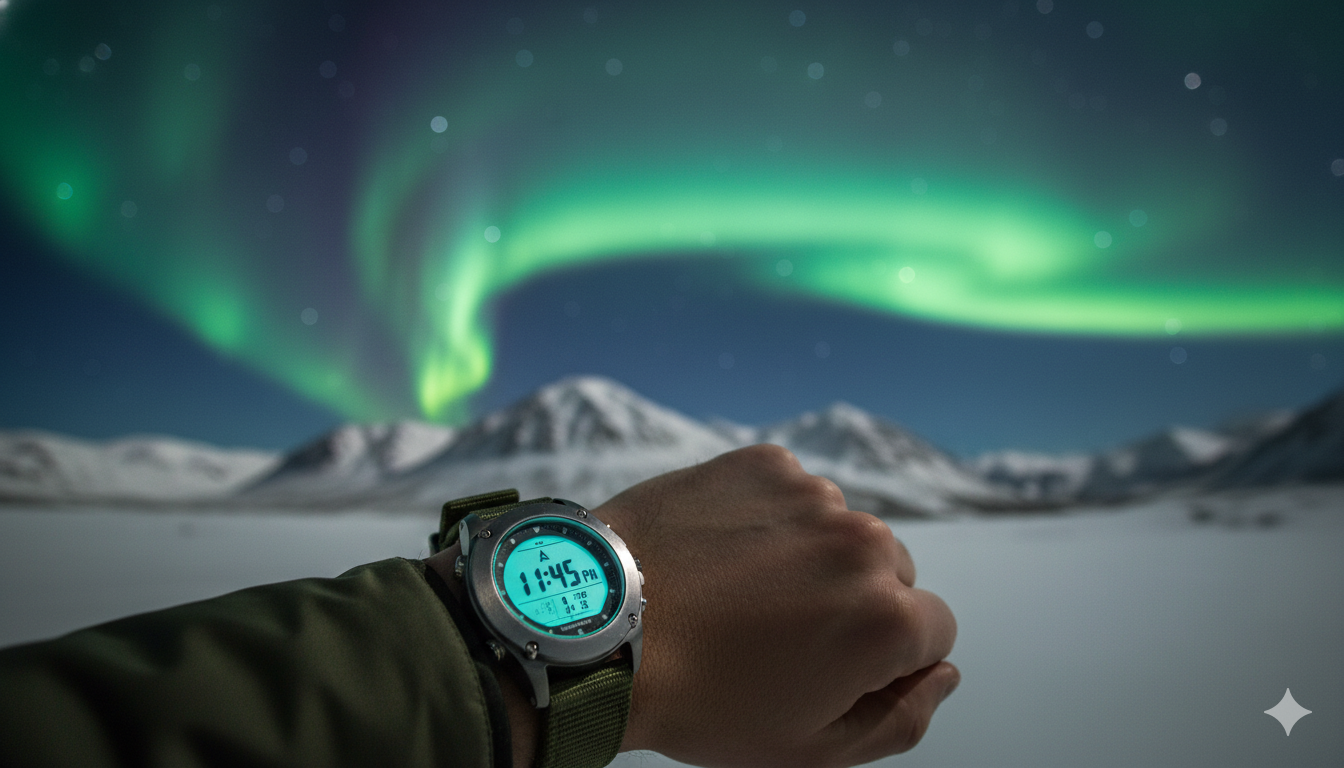
What Time Are Northern Lights Visible Tonight?
What Time Are Northern Lights Visible Tonight?
Knowing exactly what time to go outside is the difference between freezing in the cold for hours or seeing the show of a lifetime.
Unlike a standard weather forecast, seeing the aurora requires a “Triple Lock” of conditions:
1. Darkness: It must be post-sunset (nautical twilight).
2. Activity: The Kp index must be high enough.
3. Clarity: Cloud cover must be low.
Below is our real-time Hourly Aurora Forecast for tonight, which automatically processes these three factors to give you the best viewing window.
🕐 Tonight’s Hourly Forecast
Reykjavik Time
Data: NOAA & Open-Meteo
Understanding The Timing
The “Magnetic Midnight” Rule
Scientifically, the aurora is most active during “Magnetic Midnight.” This is not 12:00 AM on your clock. In Iceland and much of Northern Europe, Magnetic Midnight usually occurs between 22:00 (10 PM) and 01:00 (1 AM). This is when the Earth’s magnetic field lines are best aligned to funnel solar particles into the atmosphere.
Why Early Morning can be Good
If a “substorm” occurs, the aurora can explode into color at any time of darkness. We often see massive displays at 3:00 AM or 4:00 AM when most people have gone to sleep. Check the graph above—if you see green bars in the early morning hours, set an alarm!
Frequently Asked Questions
Q: Can I see them as soon as the sun sets?
A: Usually, no. You need “True Darkness.” Even if the sun sets at 5 PM, you might need to wait until 6:30 PM for the sky to be dark enough for the aurora colors to pop.
Q: Does the timeline update?
A: Yes, this page updates every hour with the latest data from NOAA satellites and local weather stations.

JUICE: ESA's Epic Voyage to Jupiter
Summary
The European Space Agency’s JUICE mission is embarking on a decade-long journey to Jupiter. It will create the most detailed picture ever of the gas giant’s chaotic atmosphere, powerful auroras, and mysterious depths, helping us understand giant planets across the universe.
Quick Facts
- JUICE stands for JUpiter ICy moons Explorer.
- The mission will study Jupiter for over three and a half years.
- It will create a '4D' map of Jupiter's atmosphere: 3D space plus time.
- JUICE will work in tandem with NASA's Juno mission to get a complete view.
- It will investigate Jupiter's 'energy crisis'—why its upper atmosphere is mysteriously hot.
The Discovery: Journey to a Giant
Jupiter isn’t just a planet; it’s a miniature solar system, a churning ball of gas so massive it shaped the orbits of all its neighbors. For centuries, we’ve gazed at its stripes and its famous Great Red Spot, but we still have fundamental questions about how it works. The ESA’s JUICE mission is designed to answer them. Building on the discoveries of missions like Galileo and Juno, JUICE will conduct a long-term stakeout of the gas giant. While Juno flies in a tight, polar orbit for close-up snapshots, JUICE will observe from further out, allowing it to monitor the entire planet over weeks and months. This will enable scientists to track storms as they evolve, map the global circulation, and create a complete, four-dimensional ‘climate database’ for Jupiter. It’s a mission to understand the entire Jovian system—from its deep, churning interior to the top of its electrically charged atmosphere.
Read the original research paper: ‘Jupiter Science Enabled by ESA’s Jupiter Icy Moons Explorer’
JUICE will provide our best four-dimensional characterisation of this archetypal giant planet.
— Leigh N. Fletcher, JUICE Interdisciplinary Scientist
The Science Explained Simply
Jupiter’s atmosphere is a chaotic masterpiece. The distinct reddish belts and white zones are bands of rising and sinking gas, stretched around the planet by its incredibly fast 10-hour rotation. These bands are separated by powerful jet streams, some blowing faster than 500 km/h. Giant storms, like the centuries-old Great Red Spot, are vortices larger than Earth, swirling in the upper cloud decks. Unlike Earth’s weather, which is driven by the Sun, Jupiter’s meteorology is powered mostly by internal heat left over from its formation billions of years ago. JUICE will use its cameras and spectrometers to track cloud movements, measure temperatures, and identify the chemical makeup of different regions. By observing in different wavelengths of light, from ultraviolet to infrared, it can probe different depths of the atmosphere, essentially creating a vertical weather report for this giant world and figuring out what makes it tick.
The goal is to understand the mechanisms driving zonal jets and meteorological activity.
— Ricardo Hueso, Atmospheric Scientist
The Aurora Connection
Like Earth, Jupiter has spectacular auroras, but they are thousands of times more powerful and they never stop. This is because Jupiter’s auroras have a dual power source. While some energy comes from the solar wind, most of it comes from Jupiter’s own system. Its volcanic moon, Io, spews tons of sulfur and oxygen into space every second. These particles get trapped by Jupiter’s immense magnetic field and funneled towards the poles, creating a constant, powerful light show. This process dumps a colossal amount of energy into Jupiter’s upper atmosphere, making it hundreds of degrees hotter than it should be—a mystery known as the ‘energy crisis’. JUICE will directly study this connection. Its UVS instrument will watch the auroras flicker and dance, while other instruments measure the temperature and wind changes below, revealing how this cosmic light show drives the climate of the entire upper planet.
A Peek Inside the Research
To untangle Jupiter’s secrets, JUICE is equipped with a suite of ten powerful instruments that work together. It’s a true multi-disciplinary mission. The JANUS camera will take high-resolution visible-light images of storms and clouds, allowing scientists to track winds. The MAJIS spectrometer will analyze infrared light to map the chemical composition of the atmosphere and measure the temperature of the auroras. The UVS spectrograph will look at the ultraviolet light from the auroras to understand the energy of the particles crashing into the atmosphere. Meanwhile, the RPWI instrument will act like a radio receiver, listening for the ‘whistler’ signals produced by powerful lightning strikes deep within Jupiter’s clouds. By combining data from all these instruments, scientists can see how lightning in the deep cloud layers might be connected to waves that travel up and influence the auroras high above. This synergistic approach will give us the most complete view of Jupiter ever obtained.
Key Takeaways
- JUICE will provide a comprehensive, long-term look at Jupiter's atmosphere and weather systems.
- A primary goal is to understand the connection between Jupiter's deep interior, its weather layer, and its magnetosphere.
- The mission will study Jupiter's powerful auroras to see how they dump energy into the planet's atmosphere.
- By observing Jupiter's clouds, storms, and composition, scientists can learn more about how our solar system formed.
- Understanding Jupiter, our local gas giant, provides a crucial blueprint for studying giant exoplanets in other star systems.
Sources & Further Reading
Frequently Asked Questions
Q: Why is it called the ‘Icy Moons Explorer’ if it also studies Jupiter?
A: Because the planet and its largest moons—Ganymede, Callisto, and Europa—are a deeply connected system. Material from the moons feeds Jupiter’s magnetosphere, which in turn powers the auroras. JUICE will study both the planet and its moons to understand how the whole system works together.
Q: How is the JUICE mission different from NASA’s Juno mission?
A: They are like teammates with different jobs! Juno flies in a close, polar orbit to study Jupiter’s deep interior and gravity field. JUICE will orbit further out, allowing it to stare at the planet for long periods to monitor weather and atmospheric changes, focusing on how the whole atmosphere is connected.
Q: Does Jupiter have auroras like the Northern Lights on Earth?
A: Yes, but they are much bigger, more powerful, and permanent! Unlike Earth’s auroras, which are mostly powered by the solar wind, Jupiter’s are mainly fueled by particles from its volcanic moon Io. This means Jupiter’s light show is always on.
Q: What is the ‘energy crisis’ on Jupiter?
A: It’s a long-standing mystery where Jupiter’s upper atmosphere is hundreds of degrees hotter than sunlight alone can explain. Scientists suspect the extra energy is dumped there by the powerful auroras or by atmospheric waves traveling up from deep inside the planet. JUICE’s instruments are designed to help solve this puzzle.