
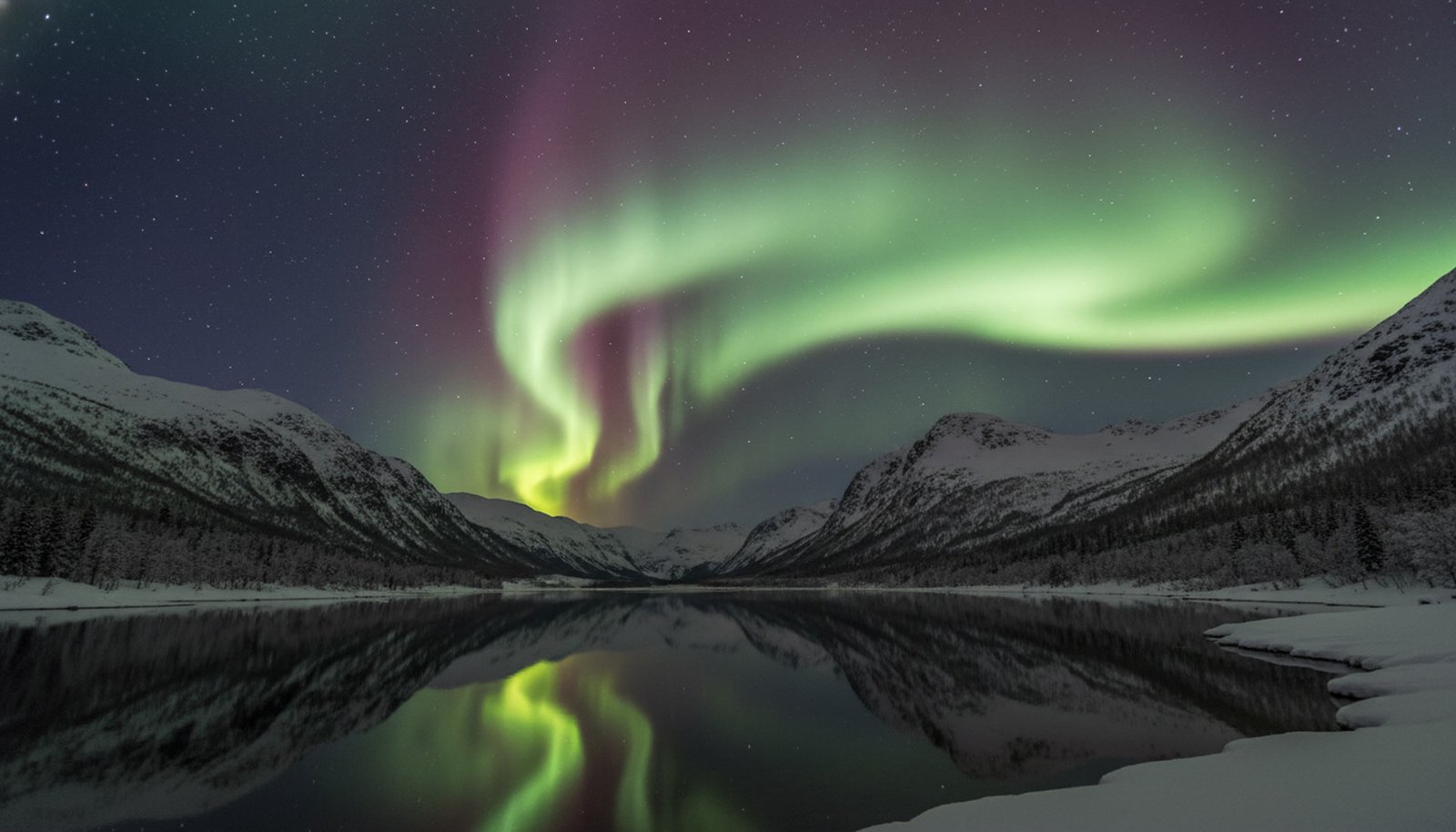
What are northern lights (science explanation)?
What Are the Northern Lights? A Scientific Explanation
The shimmering, dancing curtains of light known as the Northern Lights are a breathtaking spectacle that has captivated humanity for millennia. While they may seem magical, the aurora is not a weather phenomenon like clouds or rain; it’s a ‘space weather’ event. The entire process is a grand cosmic interaction between our planet and the Sun, beginning 93 million miles away.
This guide breaks down the science of what the Northern Lights are, explaining the journey of solar particles and the atmospheric collisions that result in this incredible display. Understanding the science behind the glow only adds to its wonder.
The Anatomy of an Aurora: From Sun to Sky
To understand what an aurora is, we need to look at four key components: the Sun’s emissions, Earth’s magnetic shield, our atmosphere, and the resulting light. It’s a chain reaction that connects our star directly to our sky.
The Engine: The Sun and the Solar Wind
The process begins at the Sun. Our star is a massive ball of hot gas that constantly emits a stream of charged particles, mostly electrons and protons. This stream is called the solar wind, and it flows outward through the solar system at speeds of around one million miles per hour. During more intense solar events, like a Coronal Mass Ejection (CME), the Sun releases a much larger and faster cloud of these particles. These CMEs are often the cause of the most spectacular and widespread aurora displays, as they carry a huge amount of energy toward Earth.
The Guide: Earth’s Magnetic Field
As the solar wind approaches Earth, it encounters our planet’s protective magnetic field, the magnetosphere. This invisible field, generated by the molten iron in Earth’s core, deflects the majority of the harmful solar particles, shielding life on the surface. However, the magnetosphere is weakest at the North and South Poles. Here, the magnetic field lines curve back down towards the planet, acting like a giant funnel. This funnel captures some of the solar wind particles and channels them down into the upper atmosphere above the polar regions.
The Canvas: Collisions in the Upper Atmosphere
The final stage of the process happens high above our heads, typically between 60 and 200 miles (100-320 km) in altitude. As the captured solar particles are accelerated down the magnetic field lines, they slam into the gas atoms and molecules in Earth’s upper atmosphere. The two most common gases involved are oxygen and nitrogen. This high-speed collision transfers energy from the solar particle to the atmospheric gas atom, putting the atom into an ‘excited’ state. This is similar to how a neon sign works, where electricity is used to excite neon gas atoms.
The Result: A Luminous Glow
An atom cannot stay in an ‘excited’ state for long. To return to its normal state, it must release the extra energy it gained during the collision. It does this by emitting a tiny particle of light, called a photon. When billions upon billions of these atoms release photons simultaneously, the combined effect is the beautiful, shimmering light display we see from the ground. The constant stream of incoming solar particles and the dynamic nature of the magnetic field cause the lights to move and ‘dance’ across the sky, creating the famous curtains, arcs, and rays of the aurora.
Decoding the Aurora's Appearance
The science also explains why the aurora looks the way it does—from its stunning array of colors to its ever-changing shapes.
Why Are There Different Colors?
The color of the aurora is determined by two factors: the type of gas atom being struck and the altitude of the collision. The most common color, a brilliant green, is produced by collisions with oxygen atoms at altitudes of about 60 to 150 miles. Rarer, all-red auroras are caused by collisions with high-altitude oxygen (above 150 miles). Hitting nitrogen atoms can produce blue or purplish-red light, often seen on the lower edges of the green curtains during intense displays. Our eyes are most sensitive to the green wavelength, which is why it’s the color we see most often.
Why Do They ‘Dance’ and Change Shape?
The aurora’s movement is a direct visual representation of the invisible forces at play. The ‘dancing’ is caused by the constant fluctuations in the incoming solar wind and the complex way it interacts with Earth’s magnetosphere. As the density, speed, and magnetic orientation of the solar wind change, the flow of particles into the atmosphere also changes. This creates the famous moving curtains, rays, and spirals. During a powerful geomagnetic storm, these movements can be incredibly fast and dramatic, filling the entire sky with motion.
Quick Facts
- The Northern Lights are a light phenomenon caused by solar particles colliding with gases in Earth’s atmosphere.
- Earth’s magnetic field (the magnetosphere) plays a crucial role by funneling these particles toward the poles.
- The most common green color comes from collisions with oxygen atoms at altitudes of 60-150 miles.
- Red, blue, and purple auroras are caused by collisions with high-altitude oxygen or nitrogen.
- The aurora’s ‘dancing’ movement reflects the dynamic interaction between the solar wind and our magnetic field.
- The same phenomenon in the Southern Hemisphere is called the Aurora Australis or ‘Southern Lights’.
- Intense auroras are often caused by major solar events called Coronal Mass Ejections (CMEs).
Frequently Asked Questions (FAQ)
Q: Are the Northern Lights visible from space? A: Yes, astronauts aboard the International Space Station (ISS) often see the aurora. From their perspective, it appears as a glowing ribbon of light curving around the polar regions of the Earth.
Q: Do other planets have auroras? A: Yes! Any planet with a substantial atmosphere and a strong magnetic field can have auroras. Jupiter and Saturn, for example, have auroras that are much larger and more powerful than Earth’s.
Q: Is the aurora hot? A: No, you cannot feel any heat from the aurora. While the particles involved are very high-energy, the collisions happen in the thermosphere where the air is incredibly thin, so there is not enough matter to transfer any noticeable heat to the ground.
Q: What is the Kp-index? A: The Kp-index is a global scale from 0 to 9 that measures geomagnetic activity, which is directly related to aurora strength. A higher Kp-index (e.g., 5 or above) means a stronger geomagnetic storm and a higher probability of seeing the aurora at lower latitudes.
Other Books
- NASA Science: The Aurora
- NOAA Space Weather Prediction Center – Aurora Dashboard
- Space.com: What are the northern lights?


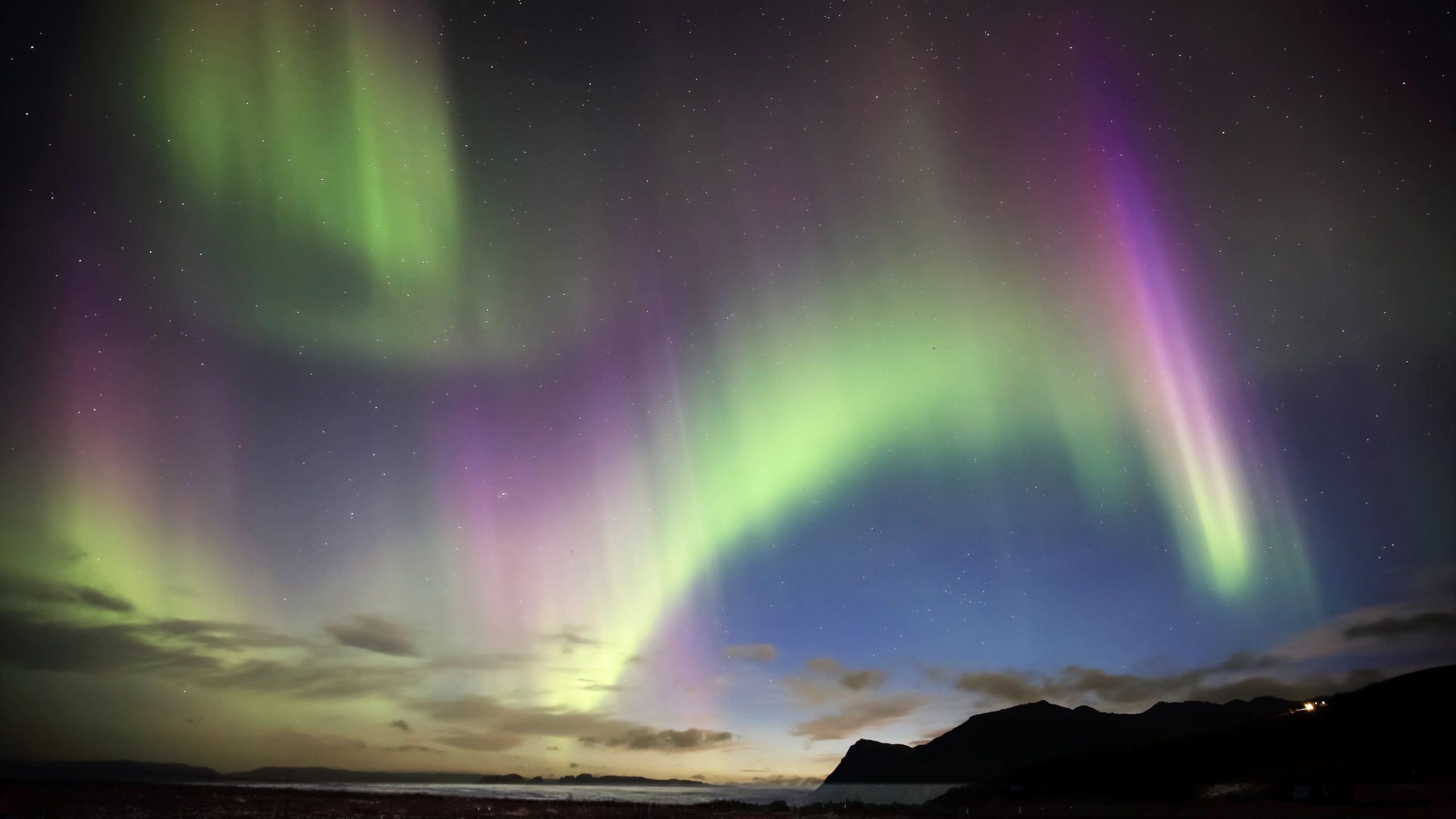
What colors will I actually see tonight?
What Are Northern Lights Colors? (Live Spectrum Analysis)
Most people think the Northern Lights are just green. If you look at a standard photo, that is usually what you see. But if you are lucky enough to witness a powerful geomagnetic storm, the sky can explode into a rainbow of Crimson Red, Neon Pink, and Deep Purple.
But here is the secret: The colors aren’t random.
The colors you see depend entirely on two things: Altitude and Gas Composition. Think of the atmosphere like a layer cake. Different gases live at different heights, and they glow in different colors when hit by solar particles.
We developed the Live Spectral Analyzer below. It reads real-time solar wind data (Speed and Density) to calculate which atmospheric layers are being hit right now, and predicts which colors are likely visible to the human eye.
The Science: Why Do These Colors Happen?
To understand the colors, you have to understand the collision. The Northern Lights are essentially a neon sign on a planetary scale. Solar particles smash into atoms in our atmosphere, exciting them. When the atoms calm down, they release a photon of light.
1. Green (The Standard)
Element: Oxygen
Altitude: 100km – 150km
This is the most common color. Our eyes are most sensitive to green light, and Oxygen at this altitude is abundant. It takes a “standard” amount of energy to excite these atoms. If the Kp index is 2 or higher, you will almost certainly see green.
2. Pink & Purple (The High-Speed Hammer)
Element: Nitrogen
Altitude: Below 100km
This is the “Holy Grail” for aurora chasers. Nitrogen is a heavy molecule that lives low in the atmosphere. To get the aurora to glow pink, the solar wind particles need to be moving incredibly fast (usually >500 km/s) to punch through the upper layers and smash into the Nitrogen at the bottom.
Check the “Pink” bar in the tool above. If it is high, look for a purple fringe at the very bottom of the aurora curtains.
3. Red (The High Altitude Ghost)
Element: Oxygen
Altitude: Above 200km
Red is actually very common, but it is often too faint for the human eye to see. It happens at the very edge of space. Because the air is so thin up there, the red light is easily drowned out by the brighter green below it. However, during massive storms, the entire sky can turn blood red. This was historically seen as a bad omen!
How to Photograph the Colors
Your eyes are not as good as your camera sensor. At night, human eyes struggle to see color (we mostly see in black and white). You might see a greyish-white cloud, but your camera will see vibrant green and pink.
To capture the full spectrum:
- White Balance: Set to 3500K – 4000K. If you leave it on Auto, the camera might try to “correct” the purple nitrogen glow and turn it blue.
- Exposure: Keep it under 5 seconds. If you expose for too long, the movement of the aurora will blend the colors together, turning the distinct pink bottom into a muddy white.
- Look North: But also look Up. The Red aurora often appears directly overhead (the Corona), while the Pink appears at the bottom of the arcs on the horizon.
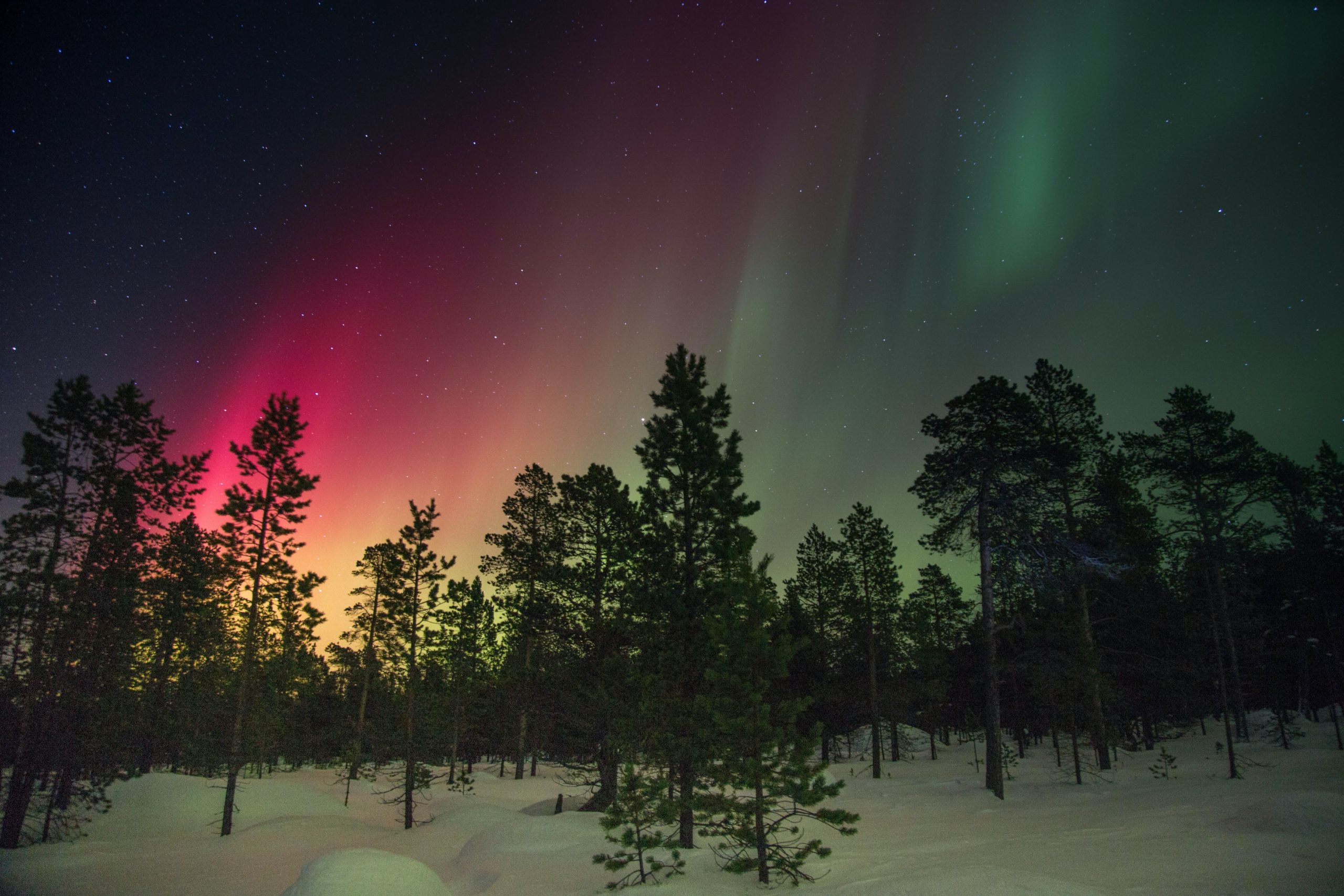
How to Photograph Northern Lights with iPhone? (Real-Time Calculator)
How to Photograph Northern Lights with iPhone? (Real-Time Calculator)
Stop guessing. Most “guides” give you static settings like “10 seconds exposure.”
This is often wrong.
The Northern Lights are a dynamic, moving subject. If the solar wind is fast, a 10-second exposure will result in a blurry green soup. If the moon is bright, high ISO will wash out your photo.
We built the Photon Engine below. It connects to 6 live data sources (NASA/NOAA) to calculate the exact shutter speed and ISO you need for the current conditions.
Why These Settings? (The Science)
Our engine made specific decisions based on the live environment. Here is the breakdown:
1. The Shutter Speed (1 – 2 SEC)
This was calculated based on the Solar Wind Velocity (462.4 km/s).
- If the wind is >500 km/s: The aurora is “dancing” rapidly. We force a short shutter speed (1-3s) to freeze the motion. This preserves the defined “pillars” and structure of the lights.
- If the wind is <350 km/s: The aurora is a slow, static arc. We allow a long shutter speed (10s+) to gather more light without blurring the image.
2. The ISO Sensitivity (400)
This was calculated based on the Moon Phase & Cloud Reflection.
- High ISO (3200): Used when the sky is pitch black. It maximizes sensor gain to see faint colors.
- Low ISO (400-800): Used when the Moon is bright (>50% illumination). If we used ISO 3200 tonight, the moonlight would turn the sky blue/white, ruining the contrast.
3. Hardware Safety (OPTIMAL)
Lithium-ion batteries rely on chemical reactions that slow down in the cold.
Current Temp: 1.4°C.
If the temperature drops below -10°C, your battery voltage will sag, potentially shutting down the phone at 30% charge. Keep the phone in an internal pocket against your body heat between shots.
3 Pro Tips for iPhone Aurora Photography
1. The “Cross” Focus Trick
The iPhone struggles to autofocus on the dark sky. Point your camera at the brightest star (or a distant street light) first. Tap and hold the screen until “AE/AF LOCK” appears in yellow. Then, recompose your shot towards the aurora.
2. Shoot in RAW (ProRAW)
Go to Settings > Camera > Formats and enable Apple ProRAW. A JPG image deletes 90% of the color data. A RAW file keeps it all, allowing you to bring out the deep purples and pinks in editing later.
3. The Timer Rule
Even tapping the screen causes micro-vibrations that blur the stars. Set a 3-second timer. Tap the shutter, remove your hand, and let the phone stabilize before it takes the picture.
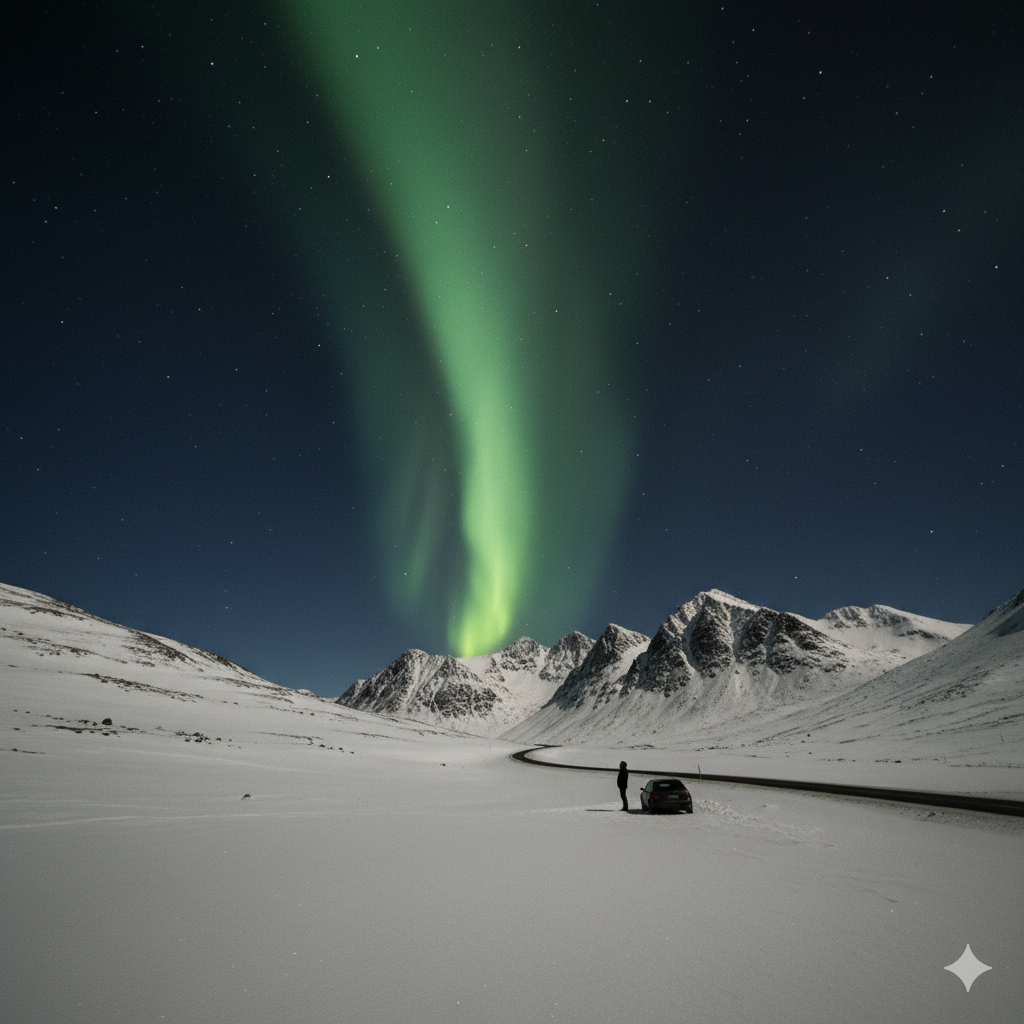
Where Are Northern Lights Visible Tonight?
Where Are Northern Lights Visible Tonight? (Global Leaderboard)
The question isn’t just “Where are they?” — it is “Where can I actually see them?”
Most websites just show you a green overlay on a map. This is misleading. A map doesn’t tell you if it is currently raining in Reykjavik, or if there is heavy fog in Tromsø, or if the sun is still up in Fairbanks. You could travel to the “perfect” spot on the map and see absolutely nothing but grey clouds.
To solve this, we developed the ACCI (Aurora Contrast & Clarity Index).
This proprietary algorithm runs a real-time competition between the world’s top Aurora Capitals. It fuses space weather data with hyper-local atmospheric data to tell you exactly where the viewing conditions are best right now.
The 3 Pillars of Visibility (How We Calculate This)
To see the Northern Lights, you need a “Triple Lock” of conditions. If even one of these is missing, you will not see the show.
1. The Energy Source (Hemispheric Power)
We monitor the Total Hemispheric Power (GW). This measures the sheer volume of electricity hitting the atmosphere.
- Below 15 GW: The aurora is weak and thin. You need to be directly under the oval (high latitudes) to see it.
- Above 50 GW: The aurora is roaring. It expands South and becomes brighter, capable of burning through light pollution.
2. The “Invisible” Blocker (Atmospheric Visibility)
This is the metric most apps ignore. You can have 0% clouds and still see nothing. Why? Mist, Haze, and Fog.
If the atmospheric visibility drops below 5km, the air itself becomes thick. The aurora light scatters, turning into a muddy grey soup. Our ACCI score heavily penalizes locations with low visibility, even if they report “clear skies.”
3. The Cloud Layering
Not all clouds are created equal.
- Low Clouds (Cumulus): These are thick and opaque. They block 100% of the view.
- High Clouds (Cirrus): These are thin and wispy. You can often see bright auroras through them. They act like a soft diffusion filter.
Our algorithm distinguishes between these layers, giving a better score to locations with only high clouds compared to those with low clouds.
Strategic Advice: What To Do With This Data
If your location has a High Score (>70):
Don’t wait. Go out immediately. These conditions (Clear air + Active Solar Wind) are fleeting. Look North, and if you don’t see anything with your eyes, try taking a test photo with your phone (Night Mode ON).
If your location has a Low Score (<30):
Check the “Reason” in the dashboard.
– If it says “Blocked by Clouds,” you need to drive. Look for a “hole” in the cloud map.
– If it says “Solar Activity Low,” be patient. Wait for a “Substorm” (a sudden burst of activity) which can happen even on quiet nights.
– If it says “Daylight,” go get some coffee. You need to wait for Nautical Twilight.
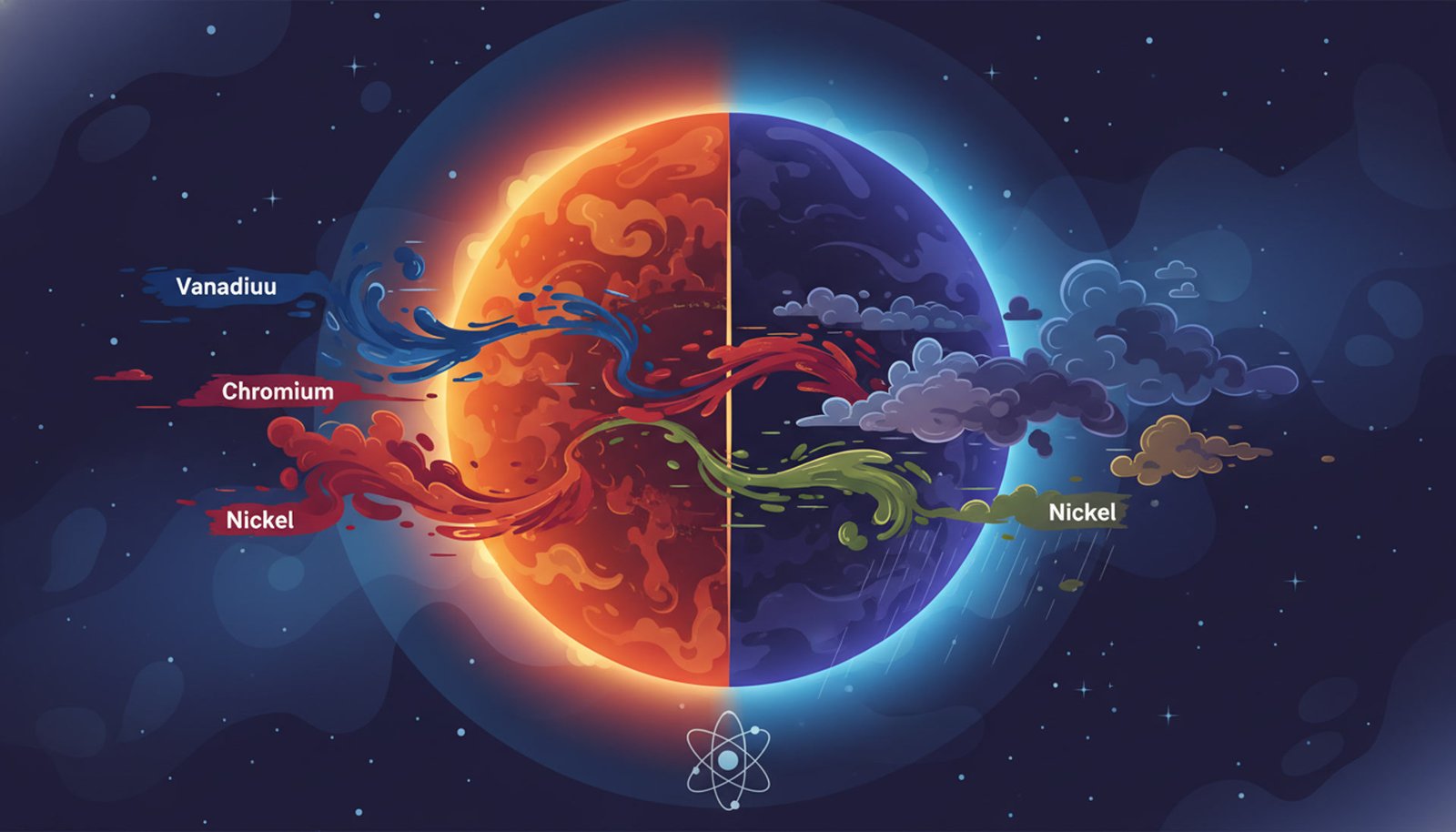
WASP-76b's Chemical Weather Map
Summary
By the end of this article, you will understand how astronomers analyze the light from a distant star to map the complex chemical weather on its planet, revealing a layered atmosphere where different metals condense and get blown around by different types of wind.
Quick Facts
- Five new elements were detected on WASP-76b for the first time: Vanadium, Chromium, Nickel, Strontium, and Cobalt.
- Key elements like Titanium and Aluminum are mysteriously missing, suggesting they've condensed into clouds of sapphire or other minerals.
- The atmosphere appears to have two zones: a lower layer with strong day-to-night winds and an upper layer with vertical winds or outflow.
- Some elements like Sodium and Potassium actually appear stronger on the cooler morning side because they are less ionized there.
- The planet's 'evening' terminator is significantly hotter than its 'morning' terminator, driving these extreme chemical changes.
The Discovery: Beyond the Iron Rain
After the groundbreaking discovery of iron rain on WASP-76b, scientists wondered: what else is in that atmosphere? Using the same high-resolution data from the ESPRESSO instrument, a team led by Aurora Kesseli went on a chemical survey. They used a technique called cross-correlation, essentially using a chemical ‘fingerprint’ for each element to hunt for its signal in the light filtering through the planet’s atmosphere. The Surprise was twofold: First, they found a whole new set of metals like Vanadium, Chromium, and Nickel behaving just like iron—disappearing on the cooler night side. Second, they *didn’t* find expected elements like Titanium and Aluminum. This told them the atmosphere was even more complex than imagined, a place where some metals rain out while others may have already formed permanent clouds.
These observations provide a new level of modeling constraint and will aid our understanding of atmospheric dynamics in highly irradiated planets.
— Aurora Y. Kesseli et al.
The Science Explained Simply
The asymmetry isn’t just one simple wind blowing from hot to cold. The data suggests two possibilities that could be happening at once. The first is chemical rain-out: as metal vapors are blown to the cooler night side, they hit a temperature where they condense and fall as liquid, removing their signature from the upper atmosphere. The second, more complex idea is a two-layered atmosphere. Imagine the lower atmosphere has strong day-to-night winds, which cause the Doppler shifts we see. But higher up, in the exosphere, the atmosphere is dominated by vertical winds or even a slow ‘outflow’ into space. This upper layer would broaden the spectral lines of elements found there (like Sodium and Lithium) but wouldn’t show the same strong day-to-night velocity shift. It’s a planet with different weather at different altitudes.
The lower atmosphere could be dominated by a day-to-night wind… while the upper atmosphere is dominated by a vertical wind or outflow.
— Abstract, Kesseli et al. 2022
The Aurora Connection
The paper’s suggestion of an ‘outflow’ from the upper atmosphere is a critical link. Planets this close to their star are blasted by intense radiation and stellar wind, which constantly tries to strip their atmospheres away. This process is called atmospheric escape. On Earth, our powerful magnetic field creates a shield—the magnetosphere—that protects our atmosphere, channeling stellar particles into the poles to create auroras. The evidence of outflow on WASP-76b shows this battle in action. Without a strong magnetic field of its own, its entire metal-rich atmosphere would have been scoured away long ago. Studying this extreme escape helps us appreciate the invisible magnetic shield that makes Earth’s stable climate, and beautiful auroras, possible.
A Peek Inside the Research
This discovery relies on Knowledge and Tools, not just a single observation. The core method is the cross-correlation function. Imagine you have a noisy radio station, and you want to know if it’s playing a specific song. You take a clean version of that song (the ‘template’) and slide it across the noisy signal. When it lines up perfectly, you get a huge spike in signal. Scientists do the same with light: they have a perfect spectral ‘template’ for iron, another for sodium, and so on. They compare these templates to the starlight that passed through WASP-76b’s atmosphere. This lets them detect the incredibly faint absorption signals—just a few parts per million—from each element and measure their precise velocity, revealing the atmospheric dynamics light-years away.
Key Takeaways
- High-resolution spectroscopy allows scientists to create a chemical 'weather map' of an exoplanet's atmosphere.
- The absence of an element can be as informative as its presence, pointing towards processes like cloud formation.
- Exoplanet atmospheres can be layered, with completely different wind dynamics at different altitudes.
- Chemical 'rain-out' is not uniform; different elements condense at different temperatures, creating a complex atmospheric chemistry.
- By studying the beginning vs. the end of a transit, we can probe the weather on the morning and evening sides of a tidally-locked planet.
Sources & Further Reading
Frequently Asked Questions
Q: Why can’t they find Titanium and Aluminum?
A: The leading theory is that it’s too ‘cold’ for them, even on WASP-76b! These elements condense at very high temperatures (~2000 K). They likely form clouds of minerals like Titanium Dioxide (TiO₂) and Aluminum Oxide (Al₂O₃)—the basis for sapphire—deep in the atmosphere, so we can’t see them as vapor higher up.
Q: What does a ‘vertical wind’ mean on a planet?
A: It means the atmospheric gas is moving up and away from the planet’s surface, rather than sideways across it. This can be caused by extreme heating from below or could be the beginning of the atmosphere ‘escaping’ into space due to the intense energy from the nearby star.
Q: Are all ‘hot Jupiters’ like this?
A: WASP-76b is an ‘ultra-hot Jupiter’, which is an extreme case. Cooler hot Jupiters have clouds made of different materials and don’t show such strong signatures of vaporized metals. Each one has its own unique atmospheric chemistry that scientists are just beginning to explore.