
How much are northern lights seeds?
Understanding the Two 'Northern Lights': Aurora vs. Cannabis Strain
A search for ‘Northern Lights’ can lead you down two very different paths. One is a journey to the Arctic Circle to witness the breathtaking Aurora Borealis, a natural light show powered by the sun. The other leads to information about a well-known cannabis strain. It’s a common point of confusion, and this article aims to clarify the difference.
While they share a name, they are entirely unrelated. This website is your expert guide to the scientific marvel that is the Aurora Borealis. Here, we’ll briefly acknowledge the cannabis strain to clear up any confusion before diving back into the celestial phenomenon we’re passionate about.
The 'Northern Lights' Cannabis Strain
To directly address the query, it’s important to acknowledge the famous cannabis strain that shares the name of the aurora. This is purely for informational clarity.
A Brief Overview of the Strain
The Northern Lights cannabis strain is one of the most famous indica strains in the world. It gained prominence in the 1980s and is known for its resilience and specific genetic characteristics. Its name was likely inspired by the sense of wonder and its potent effects, but it has no physical or scientific connection to the actual Aurora Borealis. It’s a product of agricultural cultivation, entirely separate from the space weather phenomenon that lights up the polar skies. Many other products and brands use ‘aurora’ or ‘northern lights’ in their names to evoke a sense of beauty and wonder, and this is a prime example.
Regarding Seeds and Pricing
This website does not provide information on the sale, pricing, or legality of cannabis seeds. The cost of ‘Northern Lights’ seeds varies widely based on the supplier, genetics, quantity, and your geographical location. The legality of purchasing and cultivating cannabis seeds is also highly dependent on local laws and regulations. If you are seeking this information, you must consult with legal, licensed dispensaries or reputable seed banks in your jurisdiction. We are an educational resource focused solely on astronomy and space science, and we encourage all users to adhere to their local laws.
The Aurora Borealis: The Natural Wonder
Now, let’s turn our attention to the celestial spectacle that is this website’s focus: the true Northern Lights, also known as the Aurora Borealis.
The Science Behind the Lights
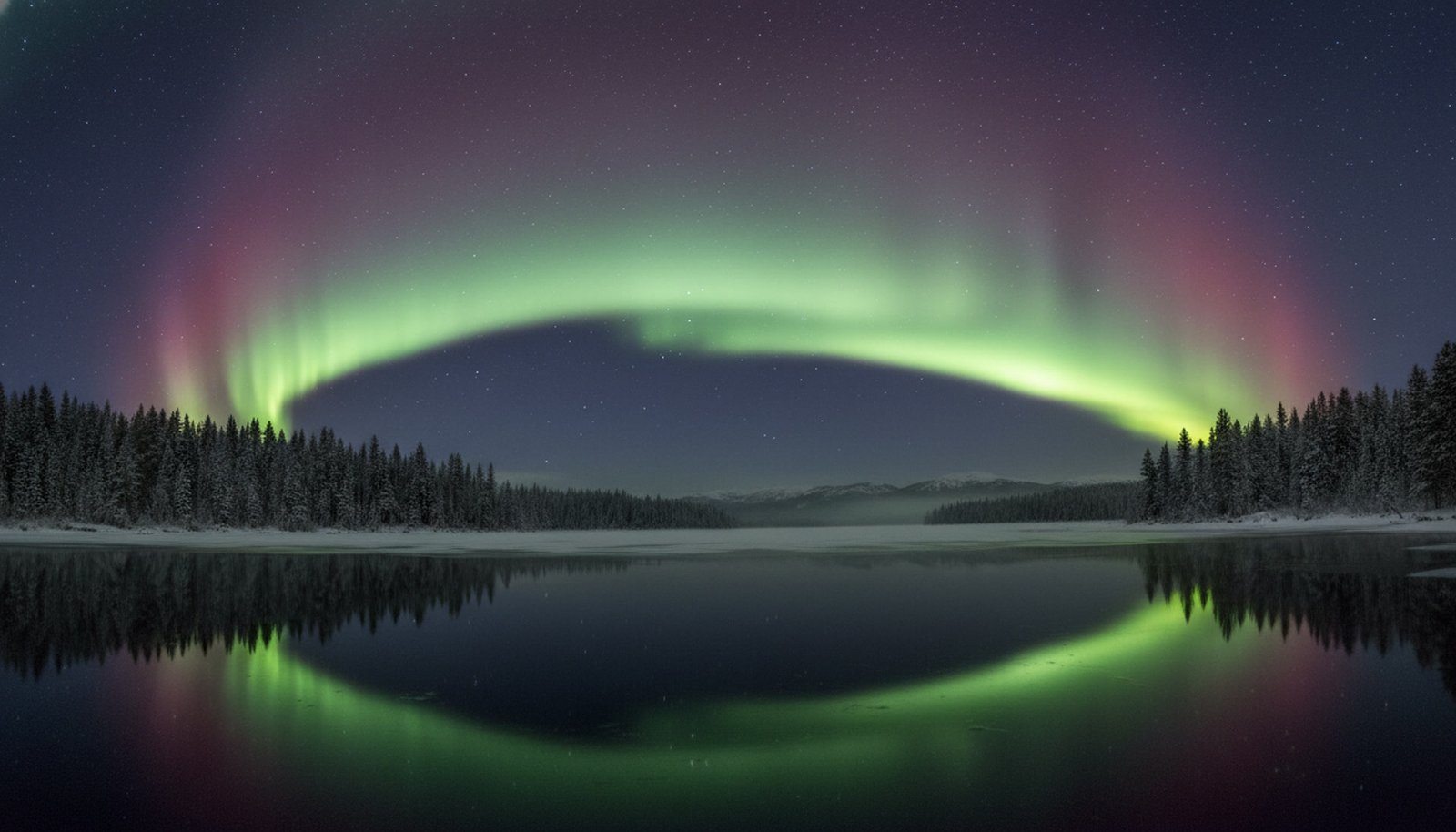
The Aurora Borealis is a natural light display that occurs in the high-latitude regions around the Arctic. It’s not a weather event; it’s a space weather event. The phenomenon is caused by electrically charged particles from the sun, traveling on the solar wind, colliding with gaseous particles in the Earth’s upper atmosphere. Our planet’s magnetic field, the magnetosphere, funnels these solar particles towards the poles. When they strike oxygen and nitrogen atoms, they ‘excite’ them, causing them to release energy in the form of light, creating the beautiful, dancing ribbons we see from the ground.
Why is it Called ‘Northern Lights’?
The scientific name, ‘Aurora Borealis’, was coined by Galileo in 1619. ‘Aurora’ is the Roman goddess of the dawn, and ‘Boreas’ is the Greek name for the north wind. However, the common name ‘Northern Lights’ is a simple, descriptive term used for centuries by people living in the northern latitudes who witnessed the phenomenon. It literally describes a beautiful light that appears in the northern sky. Its counterpart in the southern hemisphere is called the Aurora Australis, or the ‘Southern Lights’.
Quick Facts
- The term ‘Northern Lights’ can refer to the Aurora Borealis or a cannabis strain.
- This website is an educational resource exclusively about the astronomical phenomenon.
- The Northern Lights cannabis strain has no scientific connection to the aurora.
- We do not provide information on the price or legality of cannabis seeds.
- The Aurora Borealis is caused by solar particles interacting with Earth’s magnetosphere.
- The different colors of the aurora are caused by collisions with different gases at various altitudes.
- Always consult and adhere to local laws regarding cannabis products.
Frequently Asked Questions (FAQ)
Q: Is there any real connection between the aurora and the cannabis strain? A: No, there is no scientific or historical connection. The strain was likely named after the natural phenomenon to evoke a sense of wonder, beauty, or its powerful effects, which is a common marketing practice.
Q: So this website doesn’t have information on where to buy seeds? A: That is correct. We are a scientific and informational resource focused entirely on the Aurora Borealis. We do not provide any information related to cannabis products, their sale, or their legality.
Q: What is the best way to see the real Northern Lights? A: To see the Aurora Borealis, you need to travel to a high-latitude location within the ‘auroral oval,’ such as parts of Alaska, Canada, Iceland, or Scandinavia. The best viewing times are on dark, clear nights between September and April.
Other Books
- NASA’s In-Depth Guide to the Aurora
- NOAA Space Weather Prediction Center – Aurora Forecast
- What Are the Northern Lights? – Royal Museums Greenwich


A Rogue Planet with Three Storms at Once
Summary
By the end of this article, you will understand how astronomers use the JWST to create a ‘weather report’ for a planet without a star, revealing a complex atmosphere where clouds, auroral hot spots, and chemical changes all happen simultaneously at different altitudes.
Quick Facts
- This object, SIMP 0136, is a 'rogue planet' that doesn't orbit a star.
- A full day on this world is only 2.4 hours long, making it spin incredibly fast.
- Surprise: Despite having no star, it has powerful aurorae detected via radio waves.
- The weather isn't the same everywhere; different phenomena occur at different atmospheric depths, or pressures.
- No single explanation, like just clouds, could account for the complex changes in brightness JWST observed.
The Discovery: Decoding a Cosmic Weather Report
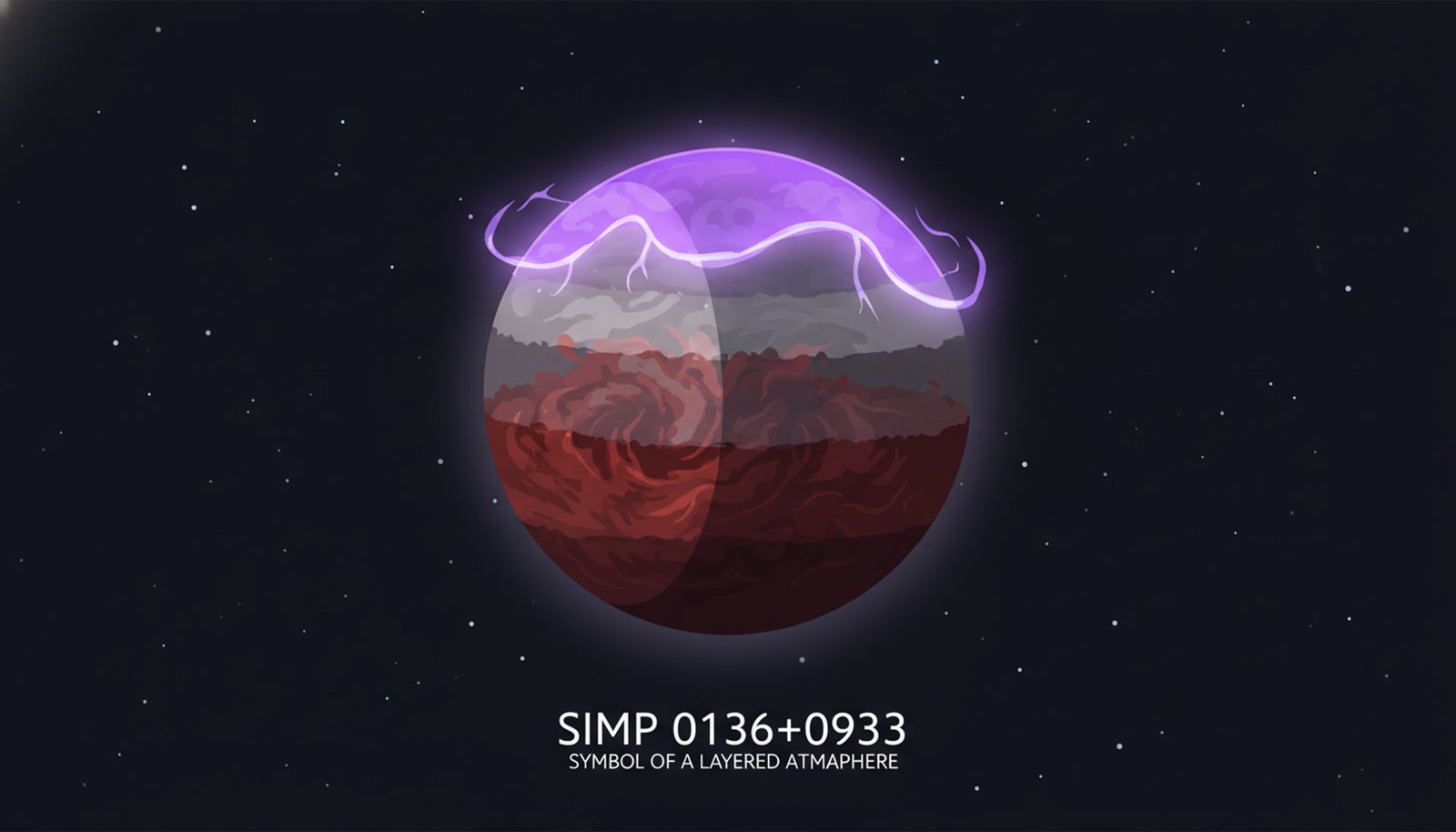
Scientists pointed the James Webb Space Telescope at SIMP 0136+0933, a well-known rogue planet, to watch its weather over one full 2.4-hour rotation. The Story they uncovered was far more complex than just the patchy clouds seen before. As the planet spun, its brightness changed, but the pattern of that change was different depending on the wavelength of infrared light they looked at. Some patterns had one dip in brightness, others had two. To solve this puzzle, they realized they weren’t seeing one weather system, but several stacked on top of each other. JWST’s power allowed them to see that deep in the atmosphere, iron and silicate clouds were swirling. But higher up, a completely different mechanism was at play: a ‘hot spot’ and shifting carbon chemistry, likely supercharged by the planet’s powerful aurorae.
Original Paper: ‘The JWST Weather Report from the Isolated Exoplanet Analog SIMP 0136+0933’
We show that no single mechanism can explain the variations… these measurements reveal the rich complexity of the atmosphere of SIMP J013656.5+093347.3.
— Allison M. McCarthy et al.
The Science Explained Simply
The key concept is ‘pressure-dependent variability’. This is NOT like looking at Earth and just seeing one layer of clouds. Imagine having multiple pairs of X-ray glasses, each tuned to a different material. One pair lets you see bones, another sees muscle. JWST does this with infrared light. Different wavelengths can escape from different depths of a planet’s atmosphere. Light from deep inside (high pressure) is blocked by clouds, so we see variations from those clouds. Light from high up (low pressure) is affected by other things, like aurora-driven hot spots. By tracking the brightness of each individual wavelength over time, scientists can essentially create a 3D weather map and assign different weather phenomena to different altitudes. It’s a way to dissect an atmosphere light-years away.
The Aurora Connection
How can a planet without a star have aurorae? While Earth’s aurorae are powered by the solar wind, rogue planets can generate them through other means. SIMP 0136’s powerful magnetic field could be interacting with interstellar plasma as it travels through the galaxy, or it could have an undiscovered moon creating an electrical circuit, similar to Jupiter and its moon Io. The paper suggests this powerful auroral activity is the best explanation for the ‘hot spots’ observed high in the atmosphere. This intense energy injection from the magnetic field heats the gas, causing it to glow brightly in the infrared and altering the local chemistry. This finding confirms that magnetic fields are crucial drivers of atmospheric phenomena, even on the loneliest worlds.
Strong aurorae in SIMP 0136+0933… suggest that an aurorally-driven temperature inversion may be plausible…
— Allison M. McCarthy et al.
A Peek Inside the Research
The researchers faced a deluge of data: hundreds of individual light curves, one for each specific wavelength JWST measured. Analyzing them one by one would be impossible. Their clever Tool was a machine learning algorithm called K-means clustering. They fed all the differently shaped light curves into the algorithm, which automatically sorted them into groups based on similarity. It found 9 distinct families of light curves in the data. This grouping was the crucial step. It allowed scientists to say, ‘All these wavelengths in Cluster 7 behave the same way, so they must be probing the same deep silicate cloud layer.’ This use of data science turned a chaotic dataset into a clear, layered map of the planet’s atmosphere.
Key Takeaways
- Salient Idea: Weather on other worlds can be driven by multiple, stacked mechanisms at once.
- JWST's spectroscopy acts like a CAT scan for atmospheres, probing different layers using different infrared wavelengths.
- Rogue planets are not inert; they have dynamic, complex weather systems.
- Auroral activity can create high-altitude 'hot spots' that significantly alter atmospheric chemistry and brightness.
Sources & Further Reading
Frequently Asked Questions
Q: What is an ‘isolated exoplanet analog’?
A: It’s a planet-sized object that is not gravitationally bound to a star, so it drifts through space on its own. They are also called rogue planets, and they are useful for studying planetary atmospheres without the blinding glare of a nearby star.
Q: Why does the weather change with depth?
A: Just like on Earth, temperature and pressure change dramatically with altitude. On SIMP 0136, it’s only deep enough and hot enough for iron and silicate to form clouds. Higher up, the pressure is too low for those clouds, but that’s where auroral energy can create hot spots.
Q: Is this weather similar to Jupiter’s?
A: Yes, in some ways! The paper notes that Jupiter and Saturn also have multiple cloud layers and high-altitude hot spots. This discovery suggests that complex, layered atmospheric phenomena are common on gas giants, both in our solar system and beyond.