
How much is northern lights tour in Iceland?
How Much Does a Northern Lights Tour in Iceland Cost?
Seeing the Aurora Borealis dance across the Icelandic sky is a bucket-list dream for many travelers. But what does this magical experience actually cost? The price of a Northern Lights tour in Iceland can vary significantly, so understanding the options is key to planning your budget.
This guide breaks down the different types of tours available, their typical price ranges, and the factors that influence the final cost. Whether you’re looking for a budget-friendly excursion or a once-in-a-lifetime private adventure, we’ll help you understand what to expect.
Breaking Down the Costs: Tour Types & Price Ranges
The single biggest factor determining the price of your tour is the type of vehicle you’re in and the size of your group. Each option offers a different balance of cost, comfort, and flexibility.
Budget-Friendly: Large Bus Tours ($50 – $90 USD)
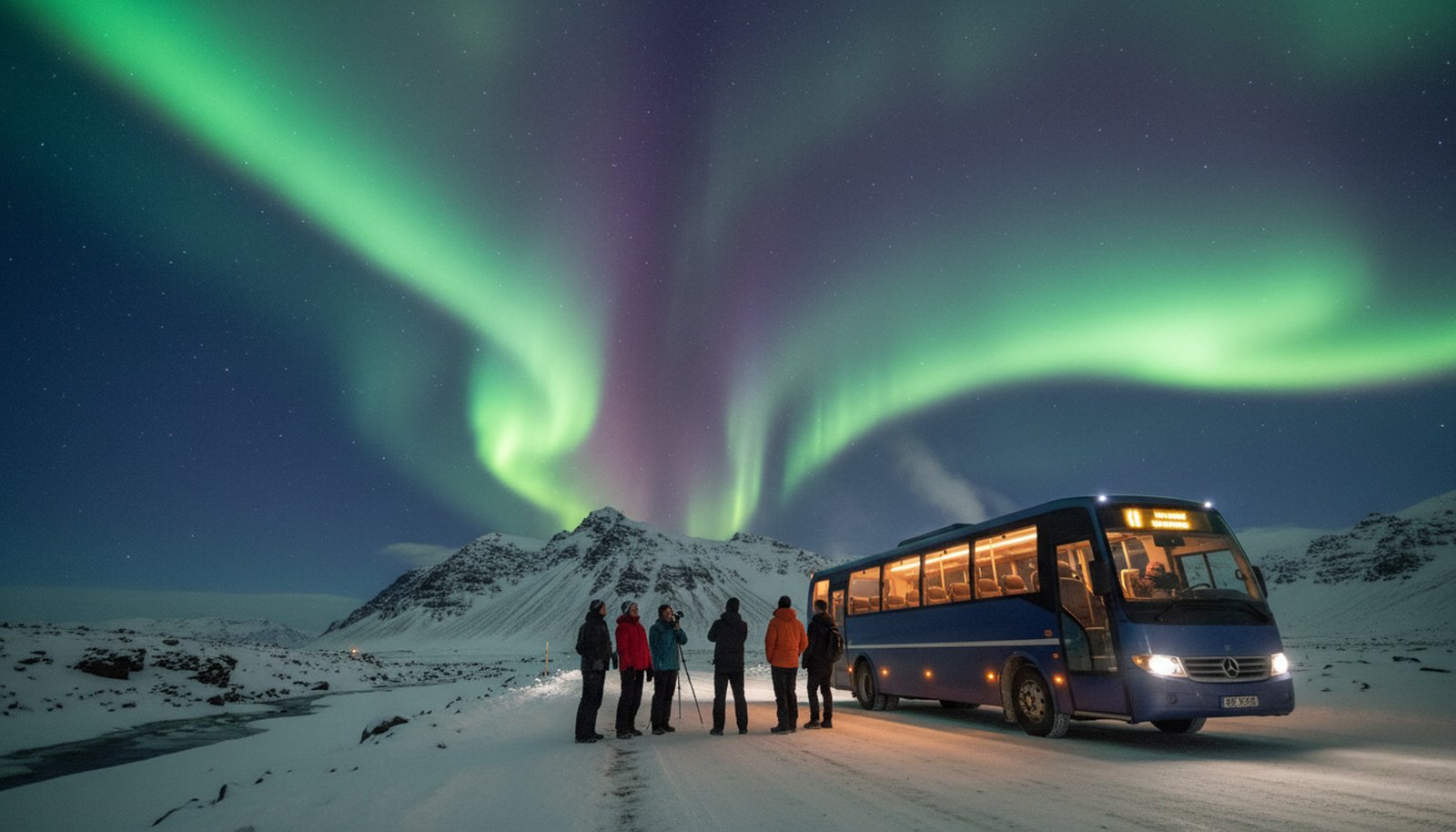
Large coach tours are the most common and most affordable way to hunt for the aurora. These tours accommodate 40-70 passengers and follow a set route to known viewing spots away from city lights. The primary advantage is the low cost. The main disadvantages are the large crowds, limited personal interaction with the guide, and less flexibility to change locations quickly if conditions are poor. A significant perk offered by most bus tour operators is a ‘free retry’ policy: if you don’t see the Northern Lights on your tour, you can join again on another night for free. This makes it a low-risk option for budget-conscious travelers.
Mid-Range: Small Group & Minibus Tours ($90 – $150 USD)
For a more personal and comfortable experience, small group tours using a minibus or van are an excellent mid-range choice. With group sizes typically under 20 people, there’s more opportunity to ask the guide questions and less time spent getting on and off the vehicle. These tours are more agile and flexible, able to change plans and chase clear skies more effectively than a large coach. Many operators also include complimentary hot chocolate and Icelandic snacks, and some may even provide tripods for photography. This option strikes a great balance between cost and a quality viewing experience.
Premium Experience: Super Jeep & Private Tours ($150 – $500+ USD)
For the ultimate adventure, super jeep and private tours offer unparalleled access and exclusivity. Super jeeps are heavily modified 4×4 vehicles with massive tires, capable of navigating rough, snowy terrain to reach remote locations inaccessible to buses. This means you’ll be far from any crowds. A private tour gives you complete control over the itinerary and the guide’s undivided attention. While these are the most expensive options, they provide the most intimate and unique aurora hunting experience, often including professional photography assistance and premium refreshments. The price for a super jeep tour is per person, while private tours are usually a flat rate for the vehicle.
Other Factors That Influence the Final Price
Beyond the tour type, a few other variables can affect the overall cost and value of your Northern Lights excursion.
Tour Duration and Inclusions
Most standard Northern Lights hunts last between 3 to 5 hours, including travel time to and from your pickup point in Reykjavík. Longer, more specialized tours will naturally cost more. Always check what’s included in the price. A basic tour includes transportation and a guide. Mid-range and premium tours might add warm overalls, crampons for icy conditions, hot drinks, snacks, or even professional photos of you with the aurora. These inclusions can add significant value, as renting winter gear separately can be expensive. Always read the tour description carefully to avoid unexpected costs.
Combination Tours
A popular way to maximize your time and budget is to book a combination tour. These packages pair a Northern Lights hunt with another popular Icelandic activity. For example, you might find tours that include an afternoon visit to the Golden Circle, a relaxing evening at the Sky Lagoon or Blue Lagoon, or even an ATV adventure before heading out for the aurora hunt. While the upfront cost is higher than a standalone aurora tour, these combos often offer a better overall value than booking each activity separately. This is a great option if your time in Iceland is limited.
Quick Facts
- Large bus tours are the cheapest option, typically costing $50-$90 USD.
- Small group minibus tours offer a better experience for a mid-range price of $90-$150 USD.
- Super jeep and private tours provide the most exclusive experience, costing $150 to over $500.
- Most standard aurora tours last between 3 and 5 hours.
- Many budget tours offer a ‘free retry’ policy if the Northern Lights are not seen.
- The price often reflects group size, vehicle capability, and included extras like hot drinks or photos.
- Combination tours that pair the aurora hunt with another activity can offer good value.
Frequently Asked Questions (FAQ)
Q: Is a more expensive tour guaranteed to see the Northern Lights? A: No, seeing the aurora is never guaranteed as it’s a natural phenomenon dependent on solar activity and clear skies. However, more expensive small-group or super jeep tours have experienced guides and the flexibility to travel further to chase clear weather, which can increase your chances.
Q: What is usually included in a basic tour price? A: A basic tour price almost always includes pickup and drop-off from a designated location in Reykjavík, transportation in the tour vehicle, and the services of an expert guide. Warm clothing, food, and drinks are not typically included at the lowest price point.
Q: Should I just rent a car and hunt for them myself? A: Renting a car is an option, but it’s only recommended if you are very confident driving in Iceland’s potentially treacherous winter conditions (ice, snow, high winds). Tour guides are experts at interpreting weather and aurora forecasts, know the safest roads, and can take you to the best dark-sky locations, which can be difficult to find on your own.
Other Books
- Guide to Iceland – Northern Lights Tours
- Visit Iceland – The Official Tourism Information Site
- Lonely Planet – Tips for Seeing the Northern Lights in Iceland


The Magnetic Key to Earth's Shield
Summary
By the end of this article, you will understand how the direction of the interplanetary magnetic field (IMF) acts like a key, either locking Earth’s magnetic shield tight or opening cosmic highways for solar particles to create auroras.
Quick Facts
- Störmer's original theory from 1907 described 'forbidden zones' that particles couldn't enter.
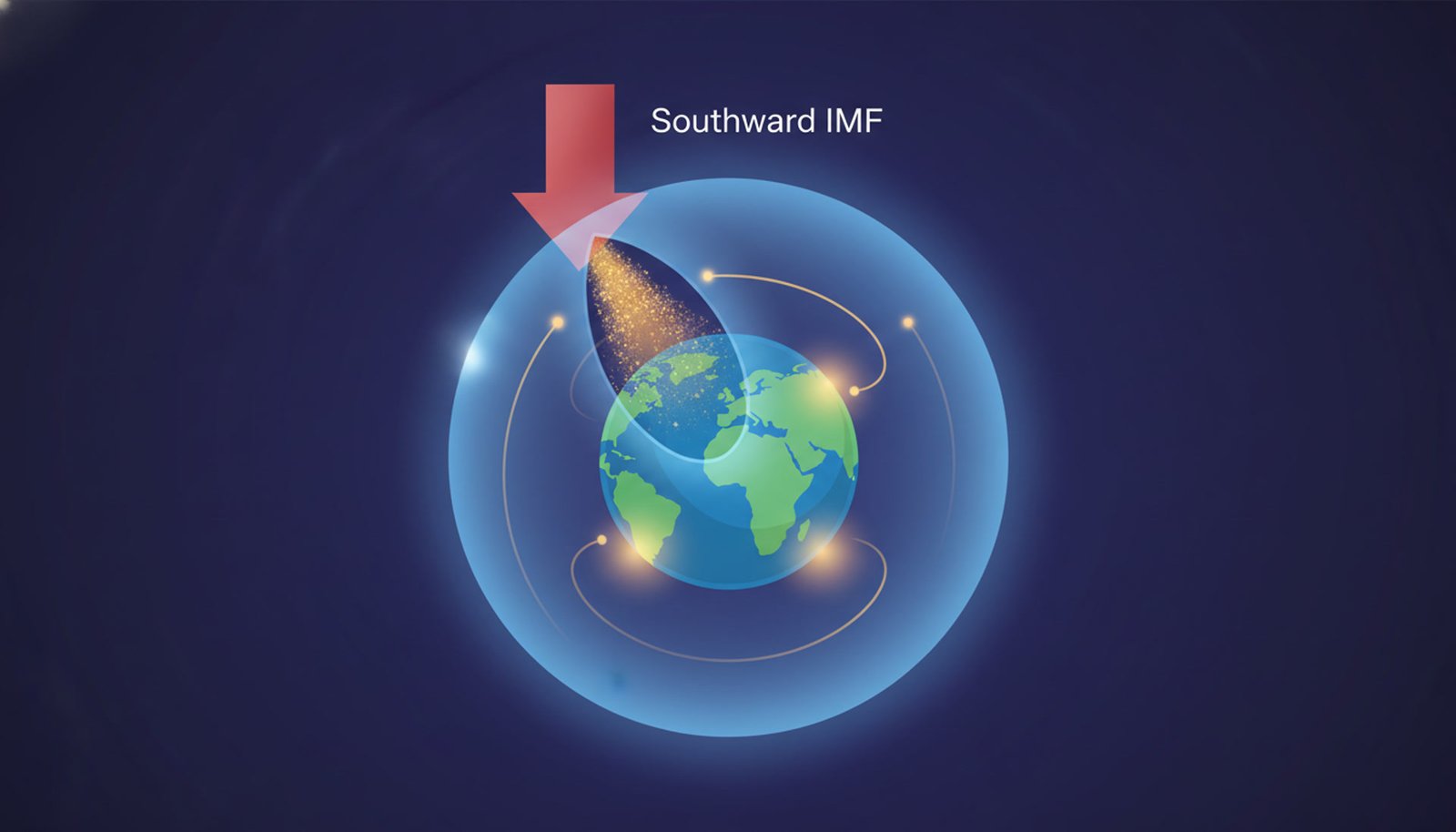
- A southward IMF can create interconnected magnetic field lines—a direct path from interplanetary space to Earth's polar caps.
- A northward IMF actually strengthens Earth's shield, making it harder for particles to get in and trapping existing particles more securely.
- The concept is visualized as a 3D 'potential landscape' where particles are like beads rolling around. A southward IMF carves a new valley into this landscape.
- This theory helps explain why auroras are so much more intense when the interplanetary magnetic field is oriented southward.
The Discovery: Updating a Century-Old Map
In 1907, Carl Störmer created a mathematical map for charged particles moving around Earth. His theory showed there were ‘allowed’ and ‘forbidden’ zones, explaining why some cosmic rays could reach us and others were deflected. But his model treated Earth’s magnetic field in isolation. The Story of this research is how J.F. Lemaire updated that map by adding one crucial detail: the Interplanetary Magnetic Field (IMF) carried by the solar wind. Lemaire showed that when the IMF points southward, it fundamentally changes the rules. It lowers the energy barriers and creates ‘interconnected’ pathways, allowing solar particles to flow into regions that were previously forbidden. This solved the long-standing problem of how auroral electrons could so effectively penetrate our defenses.
A southward turning of the IMF orientation makes it easier for Solar Energetic Particle and Galactic Cosmic Rays to enter into the inner part of the geomagnetic field.
— J.F. Lemaire, The Author
The Science Explained Simply
Imagine the space around Earth as a mountainous landscape of magnetic potential. In Störmer’s original theory, trapped particles, like those in the Van Allen belts, are stuck in a deep, closed-off valley called the ‘Thalweg’. To get in or out, a particle needs enough energy to climb over the high mountain pass. Now, let’s build a fence around this concept. This isn’t just about magnetic field lines guiding particles. It’s about an energy barrier. The Salient Idea is that a southward IMF doesn’t just nudge the particles; it lowers the entire mountain pass. Suddenly, particles with much lower energy can stream into the valley from interplanetary space, or escape from it. A northward IMF does the opposite: it raises the pass, locking the door even tighter.
The ‘pass’ between the inner and outer allowed zones opens up, when -F increases.
— J.F. Lemaire, The Author
The Aurora Connection
The aurora is the result of energetic particles from the sun hitting our upper atmosphere. But how do they get there? Lemaire’s work provides the answer. A southward IMF creates what he calls ‘interconnected magnetic field lines.’ Think of these as direct highways leading from the solar wind, over the lowered ‘mountain pass,’ and down into the polar regions (the cusps). Particles can then spiral freely down these highways without needing to overcome a huge energy barrier. This is why aurora forecasts are so dependent on the ‘Bz’ component of the IMF. A negative Bz (southward) means the cosmic highways are open for business, leading to a much higher chance of vibrant auroras.
A Peek Inside the Research
Instead of relying on massive, computer-intensive simulations that trace billions of individual particles, this study used a powerful analytical approach. Lemaire extended Störmer’s original mathematical framework, which assumed perfect cylindrical symmetry. By adding a uniform north-south magnetic field, he could derive a new, simple equation for the ‘Störmer potential.’ This elegant mathematical work allowed him to see the big picture: how the entire topology of allowed and forbidden zones shifts. It’s a prime example of how a deep understanding of the underlying physics and clever mathematics can reveal fundamental truths that might be missed in the complexity of a full simulation.
Key Takeaways
- Earth's magnetic field isn't a static shield; it's dynamically influenced by the Sun's magnetic field.
- The direction (north/south) of the Interplanetary Magnetic Field (IMF) is more important than its strength for particle entry.
- Störmer's theory was expanded to include the IMF, solving a century-old puzzle about particle access.
- A southward IMF lowers the 'geomagnetic cut-off,' allowing lower-energy particles to penetrate deeper into the magnetosphere.
- This model explains the entry mechanism for particles that cause strong auroras and populate the radiation belts.
Sources & Further Reading
Frequently Asked Questions
Q: What happens when the IMF is pointing northward?
A: When the IMF is northward, the magnetic ‘mountain pass’ gets higher. This makes it much harder for solar particles to enter the inner magnetosphere and makes it more difficult for particles already trapped in the radiation belts to escape.
Q: Is Störmer’s original theory wrong then?
A: No, it’s not wrong, just incomplete for describing real-world space weather. It’s a foundational model that works perfectly for a pure dipole magnetic field. Lemaire’s work is an extension that adds another layer of reality—the external IMF—to make it more accurate.
Q: Does this apply to other planets?
A: Absolutely! Any planet with a significant magnetic field, like Jupiter or Saturn, will experience similar effects. The interaction between their magnetospheres and the solar wind’s IMF will determine how particles get in and create their own massive auroras.