
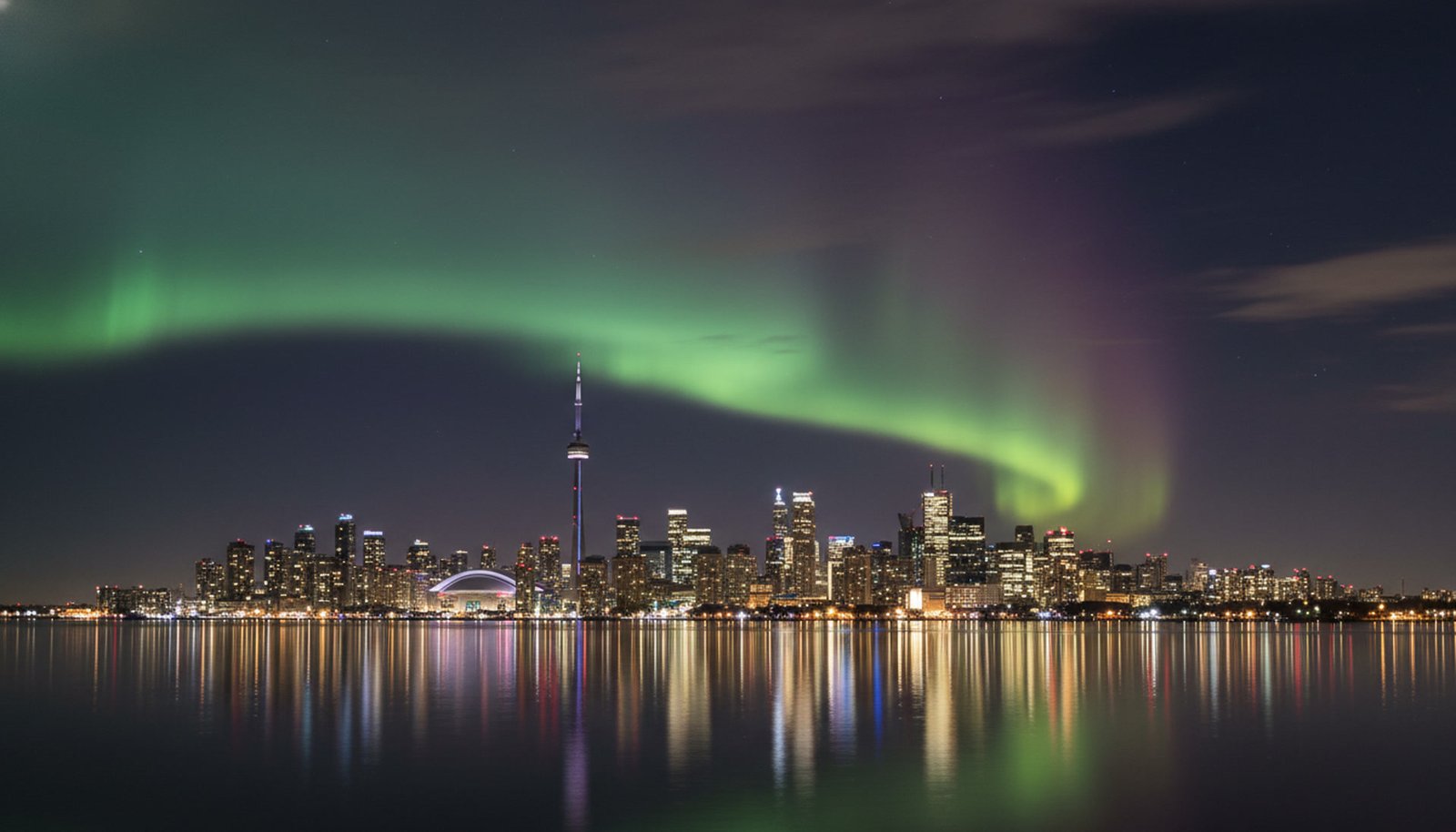
What are northern lights in Toronto?
Can You See the Northern Lights in Toronto?
Seeing the vibrant, dancing curtains of the Aurora Borealis is a bucket-list dream for many. While typically associated with Arctic locations like Iceland or Norway, the question often arises: can this celestial spectacle ever grace the skies of a southern Canadian city like Toronto? The answer is a hopeful, but conditional, yes.
Toronto lies far south of the Earth’s ‘auroral oval’, the region where auroras are a common sight. However, during periods of intense solar activity, this oval can expand dramatically, bringing the Northern Lights to lower latitudes. This guide explains the science behind why it’s so rare and provides practical tips for chasing this elusive sight in the Greater Toronto Area.
The Challenges: Why Toronto Isn't an Aurora Hotspot
Several major factors work against aurora sightings in Toronto. Understanding them is key to knowing what it takes for a successful viewing.
Geographic Latitude and the Auroral Oval
The Northern Lights occur within a ring around the Earth’s geomagnetic north pole known as the auroral oval. This oval typically covers northern Canada, Alaska, Scandinavia, and Siberia. Toronto’s geomagnetic latitude is simply too low for it to be under this oval on a normal night. For the aurora to be visible, a massive geomagnetic storm, fueled by a Coronal Mass Ejection (CME) from the sun, must hit Earth. This storm can energize and expand the auroral oval southward, sometimes stretching it down over southern Ontario and the northern United States, making a rare sighting possible.
The Battle Against Light Pollution
Even if a powerful storm pushes the aurora south, Toronto’s biggest challenge is light pollution. As one of North America’s largest metropolitan areas, the ambient light from buildings, streetlights, and cars creates a perpetual skyglow that washes out all but the brightest celestial objects. Auroras visible from this latitude are often faint and low on the northern horizon. This delicate light is easily obscured by the city’s glow. To see them, you must escape the city core. The brightness of the sky is often measured on the Bortle Scale, where Toronto’s core is a Class 8 or 9 (the brightest), making aurora viewing nearly impossible.
The Need for Extreme Space Weather
Regular solar wind causes the everyday aurora in the far north. For Toronto, we need an extraordinary event. The strength of a geomagnetic storm is measured on the Kp-index, a scale from 0 to 9. A typical night in the north might see auroras at Kp 2 or 3. For a faint glow to be visible on the horizon in Toronto, a storm of at least Kp 7 (‘Strong’) is required. For a truly impressive, overhead display (an exceptionally rare, once-in-a-decade event), a Kp 8 or 9 (‘Severe’ or ‘Extreme’) storm would be necessary. These powerful events are most common during the solar maximum, the peak of the Sun’s 11-year activity cycle.
How to Maximize Your Chances in Southern Ontario
If the conditions align, you can take steps to increase your odds of witnessing this rare spectacle.
Monitor Space Weather Forecasts
You can’t see the aurora if you don’t know it’s happening. Use resources like the NOAA Space Weather Prediction Center (SWPC) or apps like ‘My Aurora Forecast’. Look for alerts indicating a high Kp-index (7 or above). Other key indicators to watch for are a high solar wind speed (above 600 km/s) and a strongly negative Bz component (the direction of the interplanetary magnetic field). A southward Bz (negative value) is crucial as it allows solar particles to connect with Earth’s magnetic field more effectively, fueling a stronger storm and brighter aurora.
Escape the City and Look North
Your number one priority is to get away from city lights. Drive at least an hour or two north or east of the GTA. Look for locations with a clear, unobstructed view of the northern horizon. Provincial parks, conservation areas, or rural farmland are ideal. Places like the Torrance Barrens Dark-Sky Preserve near Gravenhurst are specifically designated for their dark skies and are excellent, though distant, options. Even getting to the north shore of Lake Simcoe can make a significant difference. The darker your location, the better your eyes can adapt and detect the faint auroral glow.
Manage Your Expectations and Use a Camera
When viewed from southern Ontario, the aurora might not look like the vibrant, dancing ribbons you see in photos. To the naked eye, a strong display might appear as a faint, greyish-white or greenish glow on the northern horizon, sometimes with subtle vertical pillars of light. Our eyes are not very sensitive to color in low light. However, a DSLR or mirrorless camera on a tripod can reveal the true colors. Use a long exposure setting (e.g., 10-20 seconds), a wide aperture (e.g., f/2.8), and a high ISO (e.g., 1600-3200) to capture the vivid greens and purples your eyes might miss.
Quick Facts
- Seeing the aurora in Toronto is possible but extremely rare, requiring a major geomagnetic storm.
- A Kp-index of 7 or higher is the minimum required for a potential sighting on the northern horizon.
- Severe light pollution from the city is the biggest obstacle; you must get to a dark location outside the GTA.
- Always look for a clear, unobstructed view to the north.
- To the naked eye, the aurora may appear as a faint, colorless glow, not the vibrant colors seen in photos.
- Use a camera with long exposure settings to capture the aurora’s true colors and structure.
- Sightings are more likely during the solar maximum, the peak of the Sun’s 11-year activity cycle.
Frequently Asked Questions (FAQ)
Q: How often can you see the Northern Lights in Toronto? A: Visible displays are very infrequent. A faint glow on the horizon might be possible a few times a year during the peak of the solar cycle, but a significant, memorable display might only happen once every 5-10 years.
Q: What is the best time of year to look for them? A: The aurora is caused by solar activity, which can happen any time. However, your chances are best during the months around the spring and fall equinoxes (March/April and September/October) due to favorable alignments of Earth’s magnetic field.
Q: Can I see the aurora from my apartment balcony in downtown Toronto? A: It is virtually impossible. The extreme light pollution in downtown Toronto will completely wash out any aurora except for perhaps a once-in-a-century superstorm. You must leave the city to have any realistic chance.
Other Books
- NOAA’s Space Weather Prediction Center – Aurora Forecast
- Dark Site Finder – Light Pollution Map
- Space.com: Auroras at lower latitudes


Auroral Whirlpools: The Hidden Electric Dance
Summary
By the end of this article, you will understand why auroras don’t just hang there as curtains, but can form stunning street-like patterns of whirlpools, and how this is driven by a complex electrical circuit connecting Earth to deep space.
Quick Facts
- Surprise: These beautiful auroral whirlpools can form in less than a minute.
- The aurora isn't just light; it's the visible part of a giant electrical circuit in the sky.
- Surprise: The swirling is caused by a tug-of-war between two different types of horizontal currents in the ionosphere.
- These vortices are often the first sign of an explosive release of energy called an auroral substorm.
The Discovery: Cracking the Auroral Code
Scientists have long observed that at the start of a powerful auroral display (a substorm), simple arcs of light can suddenly brighten, split, and twist into a row of swirling vortices. But what causes this rapid, beautiful chaos? To solve this, Dr. Yasutaka Hiraki didn’t use a telescope. He used a supercomputer. The Story of this discovery is one of digital recreation. He created a 3D simulation of the ionosphere, placed a simple auroral arc inside it, and then simulated a surge of energy from space—an enhanced electric field. The result was stunning: the simulated arc buckled and deformed into a perfect vortex street in just 30-40 seconds, matching real-world observations. By analyzing the flow of currents in his simulation, he pinpointed the exact electrical feedback loop responsible for the dance.
Ionospheric current system accompanied by auroral vortex streets – Hiraki, Y. (2016)
Our previous work reported that an initially placed arc intensifies, splits, and deforms into a vortex street during a couple of minutes, and the prime key is an enhancement of the convection electric field.
— Yasutaka Hiraki, Author
The Science Explained Simply
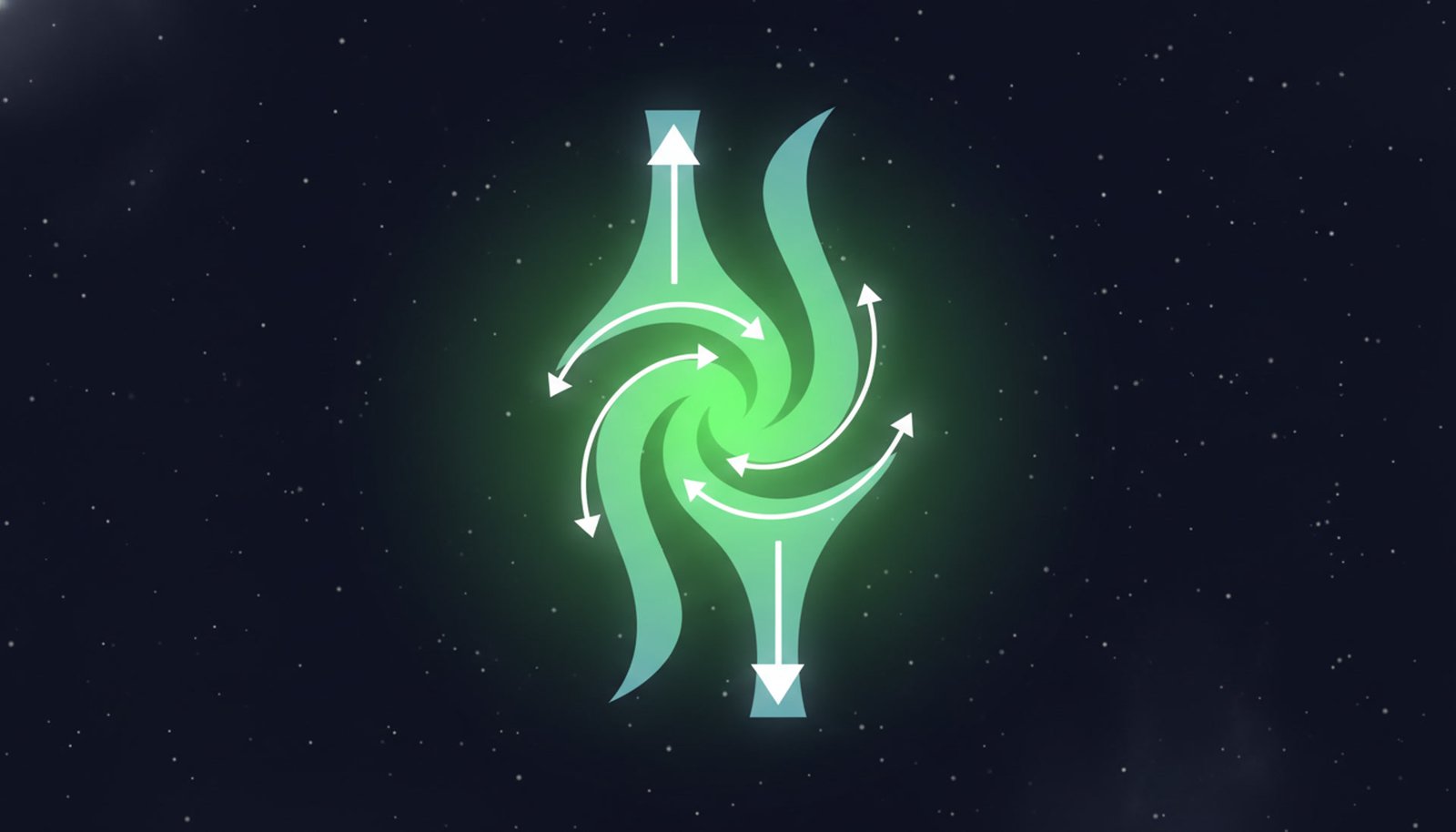
This swirling isn’t just a random pattern. It’s caused by a specific process called Cowling Polarization. To understand it, let’s build a fence around the concept: this is NOT like water swirling down a drain. It’s an electrical feedback loop. Imagine two types of currents flowing horizontally in the ionosphere: the Hall current and the Pedersen current. When a bright aurora forms, it acts like a roadblock for the main Hall current. This causes electrical charge to pile up on the edges of the aurora. This pile-up creates a *new* electric field. This new field then drives a Pedersen current, which flows in a different direction and helps complete the circuit. The interaction between the original current, the roadblock, and the new current is what kicks off the spinning motion that forms the vortex.
One component is due to the perturbed electric field by Alfvén waves, and the other is due to the perturbed electron density (or polarization) in the ionosphere.
— Yasutaka Hiraki, Author
The Aurora Connection
These vortex streets, while appearing as local phenomena, are deeply connected to the grand-scale behavior of Earth’s magnetic field. They are the ionospheric footprints of Alfvén waves—powerful magnetic waves that travel from the Earth’s distant magnetotail, a region where immense energy from the solar wind is stored. When this stored energy is suddenly released during a substorm, it sends these waves racing towards Earth. The waves deliver the extra energy and electric field that destabilize the calm auroral arcs. So, when you see a vortex, you’re witnessing the precise moment that energy from millions of miles away makes its dramatic entrance into our atmosphere, all guided by the invisible architecture of our planet’s magnetic shield.
A Peek Inside the Research
This research is a perfect example of how modern science uses Knowledge and Tools. The core of this work is a ‘three-dimensional magnetohydrodynamic (MHD) simulation’. This is a fancy way of saying they created a virtual box of plasma (the superheated gas that makes up the aurora) and programmed in the fundamental laws of physics that govern how electricity, magnetism, and fluids interact. They then set the initial conditions—a calm atmosphere with a simple auroral arc—and pressed ‘play’. By observing how this digital aurora evolved when ‘poked’ by an external electric field, they could dissect the complex, high-speed chain of events in a way that is impossible to do by just looking at the sky.
Key Takeaways
- Salient Idea: Auroral shapes are dictated by the delicate balance of invisible electrical currents.
- Magnetic waves, called Alfvén waves, act as messengers, carrying energy from deep space down to our atmosphere.
- A process called 'Cowling Polarization' creates a feedback loop where currents generate new electric fields, which in turn drive new currents, causing the swirls.
- Computer simulations are essential for untangling these fast, complex interactions that we can't fully see with cameras alone.
Sources & Further Reading
Frequently Asked Questions
Q: Why do the vortices form in a ‘street’ or a row?
A: This pattern, known as a von Kármán vortex street, is common in fluid dynamics when a flow is disturbed. The instability in the auroral arc naturally settles into this organized, repeating pattern of counter-rotating swirls, which is the most energy-stable configuration.
Q: Can we see these auroral whirlpools with the naked eye?
A: Yes, but it requires a very active and fast-moving aurora. They happen quickly, so they are often better captured by sensitive, high-speed cameras that can reveal the swirling structure that might look like a chaotic flicker to our eyes.
Q: What’s the difference between Pedersen and Hall currents?
A: In the ionosphere, an electric field pushes charged particles. The Pedersen current flows in the direction of this electric field. However, because of Earth’s magnetic field, electrons are deflected sideways, creating the Hall current, which flows perpendicular to both the electric and magnetic fields.