
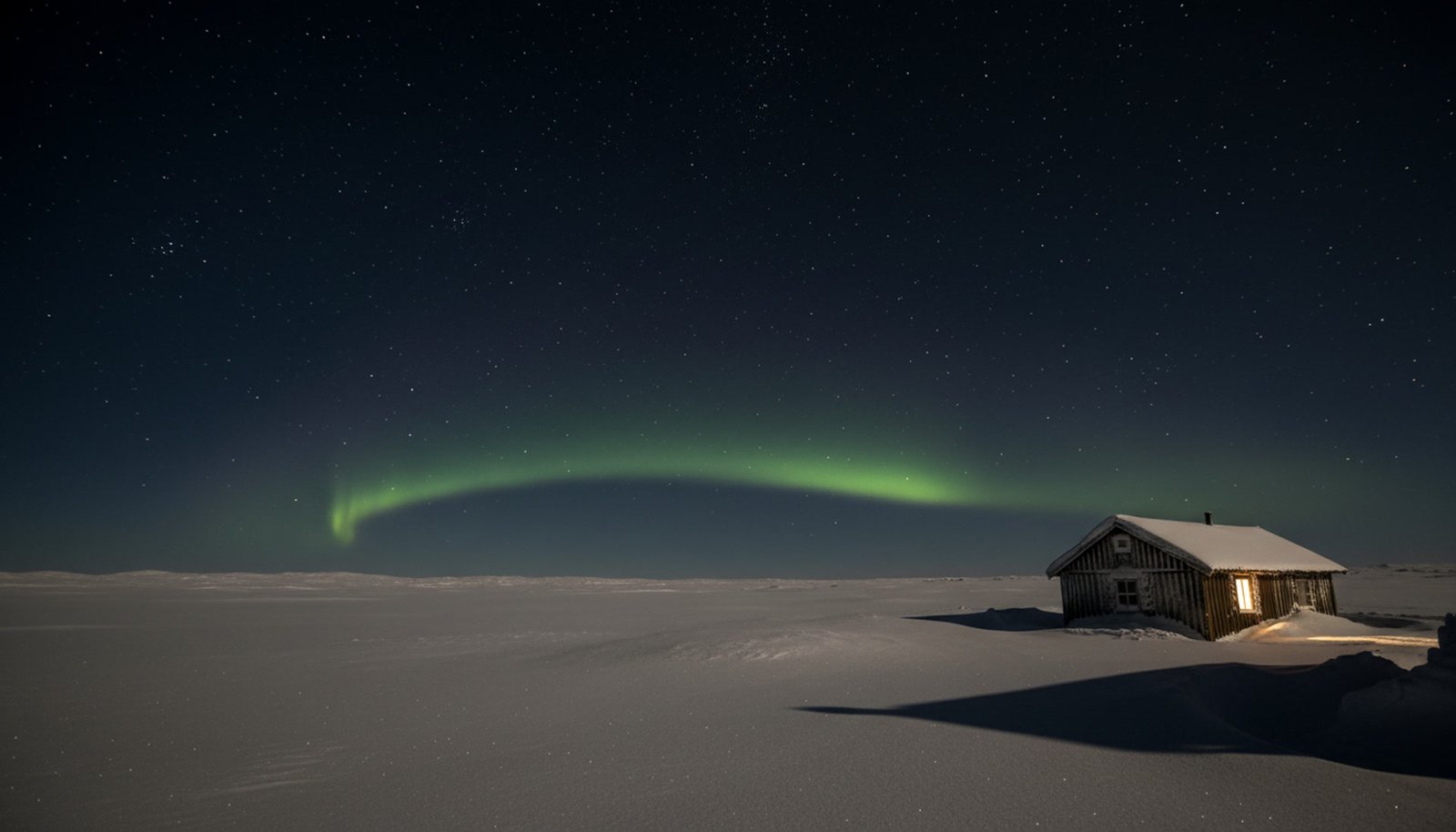
Can you see the northern lights every night?
Can You See the Northern Lights Every Night?
The dream of many travelers is to stand under a sky dancing with the ethereal green and purple hues of the Northern Lights. A common question is whether this spectacular display is a nightly event in the Arctic. While the aurora is a more frequent visitor to the polar skies than anywhere else, it is far from a guaranteed nightly show.
Seeing the aurora is like trying to catch a glimpse of a shy, wild animal; it requires patience, preparation, and a bit of luck. The appearance of the Northern Lights depends on a delicate interplay between the Sun’s activity, Earth’s magnetic field, and our local weather conditions. This guide breaks down the essential ingredients you need for a successful aurora hunt.
The Three Essential Ingredients for an Aurora Sighting
For the Northern Lights to be visible, three distinct conditions must be met simultaneously. If even one of these is missing, you won’t see the show, no matter how strong the solar storm.
Ingredient 1: Darkness (The Right Time & Place)
The aurora is a relatively faint phenomenon compared to the light from our sun or even a full moon. Therefore, the first requirement is complete darkness. This is why you cannot see the aurora during the day. In the high latitudes of the ‘auroral zone’, this also means you can’t see them during the summer months due to the Midnight Sun, when the sun never fully sets. The prime aurora viewing season runs from late August to early April. Additionally, you must get away from light pollution from cities and towns, which can easily wash out the aurora’s glow. Finding a remote spot with an unobstructed view of the northern horizon is critical.
Ingredient 2: Clear Skies (The Weather Factor)
This is often the most frustrating factor for aurora hunters. The Northern Lights occur very high in the atmosphere, between 60 to 200 miles (100-320 km) above the Earth’s surface. This is far above any weather or clouds. A strong aurora can be dancing brilliantly in the sky, but if there is a thick layer of cloud cover, you will not see a thing from the ground. Before heading out, it’s just as important to check the local weather forecast as it is to check the aurora forecast. A clear sky is non-negotiable. Sometimes, even a short drive of 20-30 minutes can be enough to escape a localized patch of clouds and find a clear viewing window.
Ingredient 3: Solar Activity (The Space Weather Factor)
The aurora is caused by charged particles from the sun—the solar wind—interacting with Earth’s magnetosphere. The strength and speed of this solar wind vary constantly. For a vibrant aurora to occur, there needs to be a significant stream of these particles hitting our atmosphere. This activity is measured on the Kp-index, a scale from 0 to 9. A Kp-index of 0-2 means very low activity, while a Kp of 4 or higher can produce a bright, active display visible across the auroral zone. This geomagnetic activity is unpredictable, driven by events on the sun like coronal mass ejections (CMEs). Following a space weather forecast is essential to know if the sun is providing the necessary fuel for the light show.
Maximizing Your Chances of a Sighting
While you can’t control the sun or the weather, you can control your preparation and strategy to significantly increase your odds of seeing the lights.
Choose the Right Location
Your geographical position is paramount. You need to be within the auroral oval, a ring-shaped zone centered on the magnetic north pole. Prime locations include northern Norway, Sweden, and Finland; Iceland; northern Canada (like Yukon and Northwest Territories); and Alaska. During periods of very high solar activity (a strong geomagnetic storm), this oval expands, and the lights can be seen from lower latitudes, but for the best and most consistent chances, you must travel north. The further you are inside this zone, the more likely you are to see the aurora even with lower Kp-index values.
Be Patient and Persistent
The aurora does not run on a schedule. It can appear for just a few minutes or dance for hours. The most common viewing window is between 10 PM and 2 AM local time, but it can happen at any time during the dark hours. The key is to be patient. Find a comfortable spot, dress in very warm layers, and be prepared to wait. Many successful sightings come after hours of waiting in the cold. Planning a trip with multiple nights dedicated to aurora hunting dramatically increases your chances, as it gives you more opportunities to get a night with clear skies and good solar activity.
Quick Facts
- You cannot see the Northern Lights every night; it’s a special event requiring specific conditions.
- Three things must align: darkness, clear skies, and sufficient solar activity.
- The best season for aurora viewing is from late August to early April when the nights are long and dark.
- Cloud cover is the number one obstacle; the aurora can be active above the clouds, but you won’t see it.
- Solar activity is measured by the Kp-index; a value of 4 or higher is considered a strong display.
- Location is critical: you must be within the ‘auroral oval’ in places like Iceland, northern Scandinavia, or Alaska.
- Patience is key. Plan for multiple nights and be prepared to wait, typically between 10 PM and 2 AM.
Frequently Asked Questions (FAQ)
Q: What time of night is best for seeing the aurora? A: While the aurora can appear at any time when it’s dark, the most active displays typically occur between 10 PM and 2 AM local time. This window is often referred to as ‘magnetic midnight’.
Q: Does a full moon prevent you from seeing the Northern Lights? A: A bright full moon can make the sky less dark, which can wash out faint auroras. However, a strong and vibrant aurora display will still be clearly visible, and the moonlight can beautifully illuminate the landscape for photography.
Q: Can the aurora be active even if I can’t see it? A: Yes, absolutely. The aurora is often active high in the atmosphere but may be too faint for the human eye to detect, especially if there’s light pollution. It could also be happening on the other side of the planet or be completely obscured by clouds.
Q: How far in advance can you forecast the Northern Lights? A: General long-term forecasts can predict active periods based on the sun’s rotation (27 days). However, reliable, short-term forecasts are typically only available 1 to 3 days in advance, after a solar event like a CME has occurred and is heading toward Earth.
Other Books
- NOAA Space Weather Prediction Center – Aurora Forecast
- Space.com – Where and When to See the Aurora
- Travel Alaska – Tips for Viewing the Northern Lights



Earth's Magnetic GPS: Mapping the Aurora
Summary
By the end of this article, you will understand why your compass doesn’t point to the geographic North Pole and how scientists use special ‘magnetic maps’ to track space weather and predict where the aurora will appear.
Quick Facts
- Earth's magnetic field is not perfectly aligned with its rotation axis; it's tilted.
- The magnetic poles are constantly moving, requiring scientists to update their maps every five years.
- By convention, we call the pole in the north the 'magnetic north pole', but the actual dipole axis of Earth's field points southward.
- The most precise magnetic 'grids' (like QD coordinates) are non-orthogonal, meaning their lines don't intersect at 90-degree angles, especially in the South Atlantic.
- Magnetic Local Time (MLT) is a system where 'noon' is defined by the Sun's position relative to the magnetic field, not geographic longitude.
The Discovery: Beyond the Bar Magnet
For centuries, we’ve known Earth acts like a giant bar magnet. Scientists first built coordinate systems based on this simple idea, called Centered Dipole (CD) coordinates. It was a good start, but observations of space phenomena didn’t quite line up. So, they created a more refined model where the ‘bar magnet’ was shifted from the Earth’s center—the Eccentric Dipole (ED) model. But even that wasn’t enough. The real magnetic field is complex and lumpy. The breakthrough came when scientists abandoned simple magnets and started using computers to trace the actual magnetic field lines from the full International Geomagnetic Reference Field (IGRF). This created incredibly accurate but mathematically tricky systems like Corrected Geomagnetic (CGM) and Quasi-Dipole (QD) coordinates, which are now essential for modern space science.
Original Paper: ‘Magnetic Coordinate Systems’ in Space Science Reviews
The improved accuracy comes at the expense of simplicity, as the result is a non-orthogonal coordinate system.
— K.M. Laundal & A.D. Richmond
The Science Explained Simply
Imagine a regular map grid where every line of latitude and longitude crosses at a perfect 90-degree angle. That’s an orthogonal system. Now, imagine stretching and warping that grid in some places. The lines would no longer be perpendicular. That’s a non-orthogonal system, and it’s exactly what the most accurate magnetic coordinates are like. This is NOT a mistake; it’s a true representation of Earth’s complex field. The key idea is that these coordinates are constant along a given magnetic field line. So if you travel up or down a field line, your Quasi-Dipole latitude and longitude don’t change. This makes them incredibly powerful for studying things like the aurora, which are guided by these very lines.
The deviation from orthogonality is particularly significant in the South Atlantic and in the southern parts of Africa.
— K.M. Laundal & A.D. Richmond
The Aurora Connection
The aurora is like a giant neon sign in the sky, lit up by charged particles from the solar wind that are guided by Earth’s magnetic field. If you plot auroral sightings on a regular geographic map, they appear in a scattered, messy pattern. But if you use a magnetic coordinate system like Corrected Geomagnetic (CGM) coordinates, the pattern snaps into focus: a perfect ring around the magnetic pole, known as the auroral oval. This is because the particles follow the magnetic field lines, not lines of geographic longitude. These coordinate systems are the ‘Rosetta Stone’ that allows us to understand the shape, location, and dynamics of the aurora, connecting what we see in the sky to the vast magnetic structures that protect our planet.
A Peek Inside the Research
Scientists can’t just ‘look’ at a magnetic field line. The work involves complex computation. They start with the International Geomagnetic Reference Field (IGRF), a global model built from satellite and ground-based magnetometer data. Using this model, they perform a process called field line tracing. A computer program starts at a specific point in the ionosphere (e.g., 110 km altitude) and calculates the direction of the magnetic field vector. It then takes a small step in that direction, recalculates, and repeats, stepping along the invisible magnetic line through space. By tracing this line to its highest point (the apex) or to where it crosses the equator, they can define accurate magnetic coordinates. This hard computational work is what makes modern, precise space weather forecasting possible.
Key Takeaways
- Geospace phenomena like the aurora are organized by the magnetic field, not geography.
- Scientists use different magnetic coordinate systems for different purposes, from simple dipole models for deep space to complex ones for the ionosphere.
- Simple models (like Centered Dipole) treat Earth like a perfect bar magnet, which is a good first approximation.
- Advanced models (like Quasi-Dipole) trace the real, messy magnetic field lines for high accuracy near Earth.
- Using vectors in advanced, non-orthogonal magnetic coordinates requires special mathematical handling to avoid errors.
Sources & Further Reading
Frequently Asked Questions
Q: Why are there so many different magnetic coordinate systems?
A: Different systems are tools for different jobs and different regions of space. Simple ‘dipole’ systems are good for high altitudes where the field is simple, while complex ‘field-line traced’ systems are needed for accuracy in the ionosphere where the aurora happens.
Q: What’s the difference between the magnetic pole and the geomagnetic pole?
A: The ‘magnetic pole’ (or dip pole) is where the field lines point straight down, which is what a compass would lead you to. The ‘geomagnetic pole’ is a theoretical concept based on the best simple dipole approximation of Earth’s field. They are in different locations and both move over time.
Q: Do I need to worry about this for my compass?
A: For basic navigation, your compass works fine by pointing to the magnetic dip pole. These advanced coordinate systems are specialized tools for scientists studying plasma physics and space weather on a global scale.