
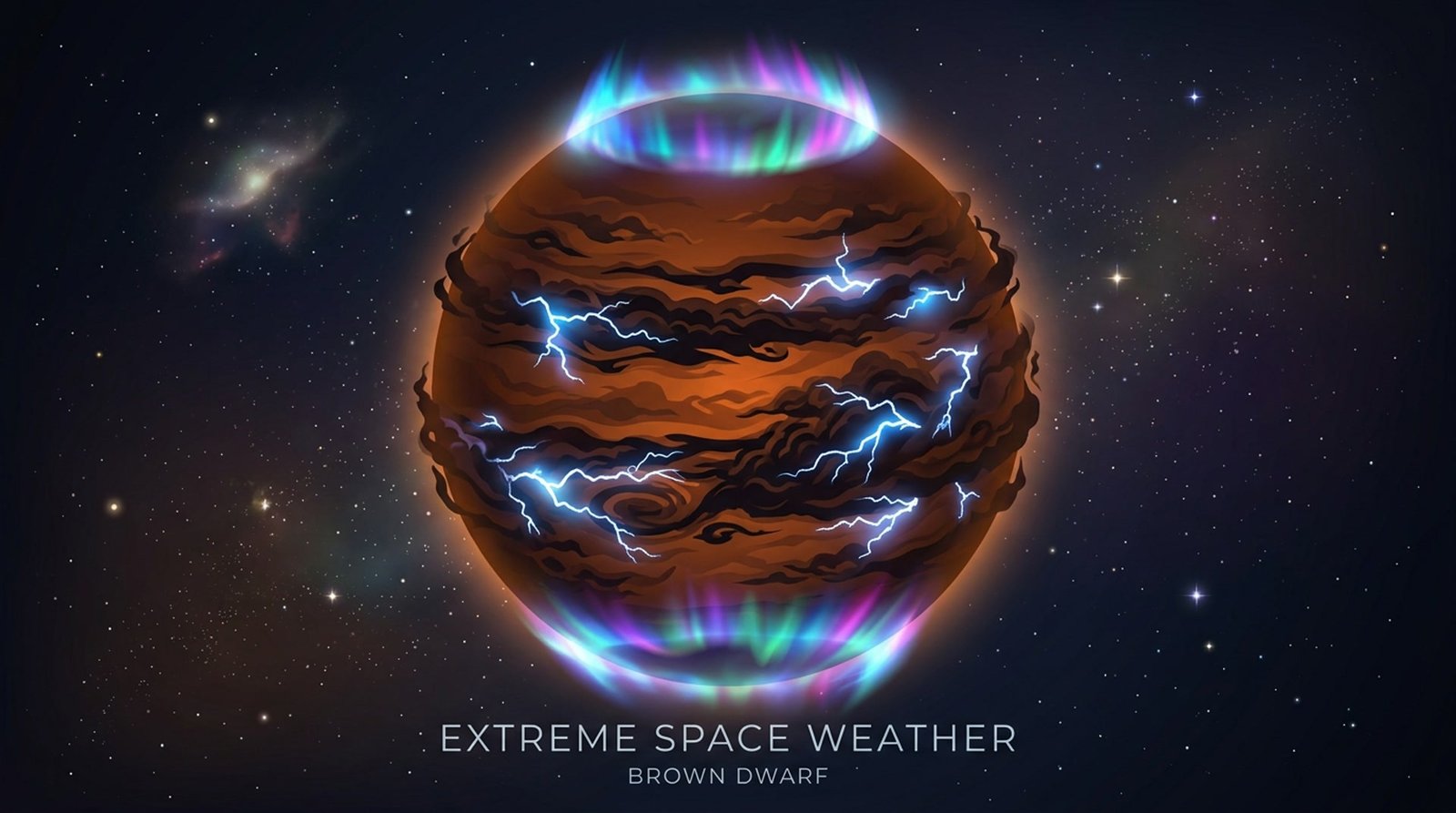
Alien Lightning: Electric Storms on Brown Dwarfs
Summary
By the end of this article, you will understand how extreme alien worlds create lightning in clouds of vaporized rock, and how super-powered auroras leave chemical clues we can detect from Earth.
Quick Facts
- Surprise: Clouds on these extreme worlds aren't made of water, but vaporized rocks and minerals like titanium dioxide.
- Salient Idea: Brown dwarfs feature auroras 10,000 times more powerful than the ones found on Jupiter.
- Surprise: The daysides of super-hot Jupiters are so hot that molecules break apart, meaning clouds only form on the nightside.
- Salient Idea: Alien lightning and auroras leave behind chemical fingerprints, like Hydronium, that scientists can track.
The Discovery: Hunting for Alien Storms
Astrophysicists wanted to know if the chaotic weather on giant alien planets could spark lightning. Because we cannot just fly a probe to a brown dwarf, scientists built 3D global circulation models to simulate extreme atmospheres. They found a Surprise: super-hot Jupiters have daysides so blisteringly hot that clouds cannot even form! But on the cooler nightside, mineral clouds swirl and crash together in the dark. This constant friction builds up static electricity, eventually unleashing massive lightning strikes. These strikes act like flash-furnaces, instantly altering the local gas to create tracer molecules like hydrogen cyanide (HCN). They discovered that tracing these leftover chemicals is our best shot at ‘seeing’ the storm.
Original Paper: ‘Lightning and charge processes in brown dwarf and exoplanet atmospheres’
Brown dwarfs enable us to study the role of electron beams for the emergence of an extrasolar, weather-system driven aurora-like chemistry.
— Dr. Christiane Helling
The Science Explained Simply
This is NOT like a thunderstorm on Earth. Earth clouds are made of water vapor. On these extreme worlds, temperatures are so high (over 1,000 degrees Celsius) that the clouds are actually made of vaporized rock and metals! When these heavy rock particles swirl in the wind and rub against each other, they steal electrons in a process called triboelectric charging. The Salient Idea here is that the alien sky acts like a massive battery. Once enough charge builds up, the sky rips open with an electric discharge. The lightning temporarily turns the atmosphere into a plasma channel hotter than the surface of the Sun.
The Aurora Connection
Earth’s auroras are caused by the solar wind slamming into our magnetic field. But brown dwarfs—massive objects floating alone in space, too big to be planets but too small to be stars—have auroras too! Even without a host star blasting them, their internal magnetic fields are incredibly strong. These fields act like particle accelerators, shooting powerful electron beams straight down into their own atmospheres. This creates auroras 10,000 times more intense than the ones on Jupiter. As these electron beams smash into hydrogen gas, they ionize the sky and create a glowing, charged upper atmosphere.
The fundamental mechanisms that generate aurorae on Jupiter and Saturn explain these 100,000 times more intense alien auroras.
— Research Team
A Peek Inside the Research
The researchers faced a major problem: finding direct proof of these auroras is incredibly hard. They originally wanted to detect a specific ionized molecule called H3+. However, their chemical kinetics models showed that H3+ reacts almost instantly with water and carbon monoxide in the atmosphere, vanishing before telescopes can see it. Using a massive mathematical simulation, they found a clever workaround. They discovered that H3+ reliably transforms into Hydronium (H3O+), a molecule that sticks around much longer. Finding Hydronium has now become the ultimate ‘smoking gun’ for astronomers hunting for alien auroras.
Key Takeaways
- Alien clouds charge up like giant batteries through friction, triggering massive lightning strikes.
- Auroras on brown dwarfs are powered by intense electron beams crashing into atmospheric gas.
- The H3+ ion is created by auroras, but it quickly transforms into Hydronium (H3O+).
- Finding Hydronium is the key to proving these massive electric storms exist across the galaxy.
Sources & Further Reading
Frequently Asked Questions
Q: Why can’t we just look at these planets through a telescope and see the lightning flashes?
A: These worlds are light-years away, so their entire massive body blends into a single tiny point of light. Instead of looking for quick flashes, scientists look for the long-lasting chemical ‘smoke’ (like Hydronium) that the lightning and auroras leave behind in the atmosphere.


The Solar Wind's X-ray Paintbrush
Summary
By the end of this article, you will understand the surprising reason why cold objects like comets and planetary atmospheres glow in high-energy X-rays, and how this reveals the invisible reach of the solar wind throughout our entire solar system.
Quick Facts
- Surprise: Cold objects like comets and the dark side of the Moon glow in X-rays.
- The X-ray glow from comets is brighter on the side facing the Sun.
- Jupiter has X-ray auroras at its poles, similar to Earth's Northern Lights but far more powerful.
- Even the 'empty' space of our solar system has a faint, background X-ray glow from this process.
- The discovery of X-rays from a comet in 1996 was a complete accident and revolutionized the field.
The Discovery: A Comet's Ghostly Glow
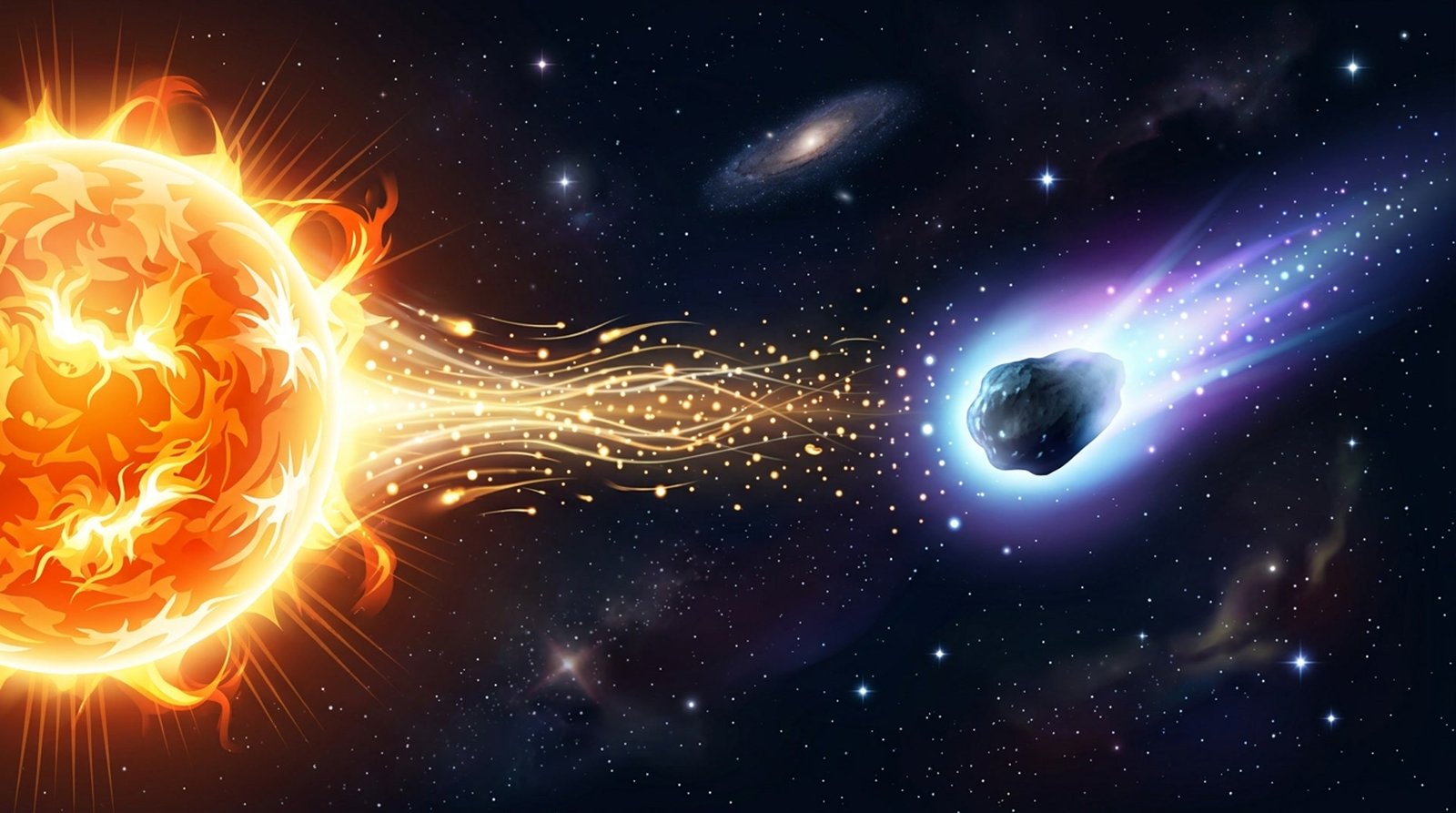
The Story of solar system X-rays began with a huge surprise. In 1996, astronomers using the ROSAT X-ray satellite observed Comet Hyakutake. They expected to see nothing. After all, comets are just icy bodies, far too cold to produce high-energy X-rays. Instead, they saw a bright, crescent-shaped glow. This single observation was a puzzle that couldn’t be explained by existing theories. It proved that our understanding was incomplete and kicked off a new field of study. Scientists realized the X-rays weren’t coming *from* the comet itself. The comet was just a canvas. The ‘paint’ was the solar wind, a constant stream of energetic particles from the Sun, interacting with the gas cloud around the comet.
Original Paper: ‘X-rays from Solar System Objects’ in Planetary and Space Science, vol.55 (2007)
This discovery revolutionized the field of solar system X-ray emission and demonstrated the importance of the solar wind charge exchange (SWCX) mechanism.
— Anil Bhardwaj et al.
The Science Explained Simply
The mechanism behind this glow is called Solar Wind Charge Exchange (SWCX). To understand it, we must build a fence around what it is *not*. This is NOT like a hot object glowing (like a stovetop). It’s also NOT just solar X-rays reflecting off a surface. Instead, imagine an energetic, highly charged ion (like an oxygen atom missing 7 electrons) flying from the Sun. This ion is ‘hungry’ for electrons. When it passes through the gas of a comet’s coma, it steals an electron from a neutral water molecule. The stolen electron is now in a high-energy state in its new atomic home. As it cascades down to a lower, more stable energy level, it releases that excess energy as a high-energy X-ray photon. It’s a microscopic flash of light caused by a cosmic theft.
X-rays are generated by ions left in excited states after charge transfer collisions with target neutrals.
— Anil Bhardwaj et al.
The Aurora Connection
The X-ray glow from comets has a cousin: the aurora. Both phenomena are caused by energetic particles from space colliding with atmospheric gases. On Earth, our magnetic field acts like a giant funnel, guiding charged particles from the solar wind and our magnetosphere toward the poles, creating the famous curtains of light. Jupiter has a similar, but much more powerful, X-ray aurora at its poles. Comets and Mars, however, lack strong global magnetic fields. For them, the interaction with the solar wind is less focused. This creates a more diffuse, halo-like glow around the entire object. So while the underlying physics is similar—particle collisions making gas glow—the presence of a magnetic field is the key difference between a focused aurora and a ghostly halo.
A Peek Inside the Research
Confirming the SWCX theory required powerful tools. The Chandra and XMM-Newton X-ray observatories were critical. They didn’t just take pictures; they performed spectroscopy, breaking the faint X-ray light into its constituent energies, like a prism creating a rainbow. This ‘spectrum’ contains sharp lines, or peaks, at very specific energies. These lines are fingerprints of specific elements. The Salient Idea is that the observed lines perfectly matched the energies expected from highly charged oxygen, carbon, and neon ions—the very elements found in the solar wind. This was the smoking gun. By reading the X-ray rainbow, scientists proved the glow came from solar wind ions stealing electrons, not from any process within the comet itself.
Key Takeaways
- Most solar system X-rays are not from heat, but from Solar Wind Charge Exchange (SWCX).
- The solar wind is a stream of highly charged, 'electron-hungry' ions from the Sun's corona.
- Comets and planetary atmospheres provide the neutral gas for these ions to interact with.
- X-ray telescopes like Chandra and XMM-Newton are crucial for seeing this faint, high-energy light.
- X-ray spectra act like 'fingerprints', telling us which elements are involved in the collisions.
Sources & Further Reading
Frequently Asked Questions
Q: Why can’t we see these X-rays from Earth with our eyes?
A: Our eyes can only detect a small range of light called the ‘visible spectrum’. X-rays are a form of light with much higher energy that is invisible to us. Additionally, Earth’s atmosphere absorbs most incoming X-rays, which is why we need space-based telescopes to study them.
Q: Does the Moon emit X-rays too?
A: Yes, but for a different reason! The Moon’s sunlit surface emits X-rays through fluorescence, where it absorbs solar X-rays and re-emits them at a slightly lower energy. The dark side, however, shows a faint X-ray glow from the same SWCX process, as the solar wind interacts with gas in Earth’s extended atmosphere (the geocorona).
Q: Are these X-rays dangerous to spacecraft or astronauts?
A: The X-ray emissions from these processes are extremely faint. While the solar wind particles that cause them can be a concern for long-term space missions (space weather), the resulting X-ray glow itself is not a significant source of radiation danger.