
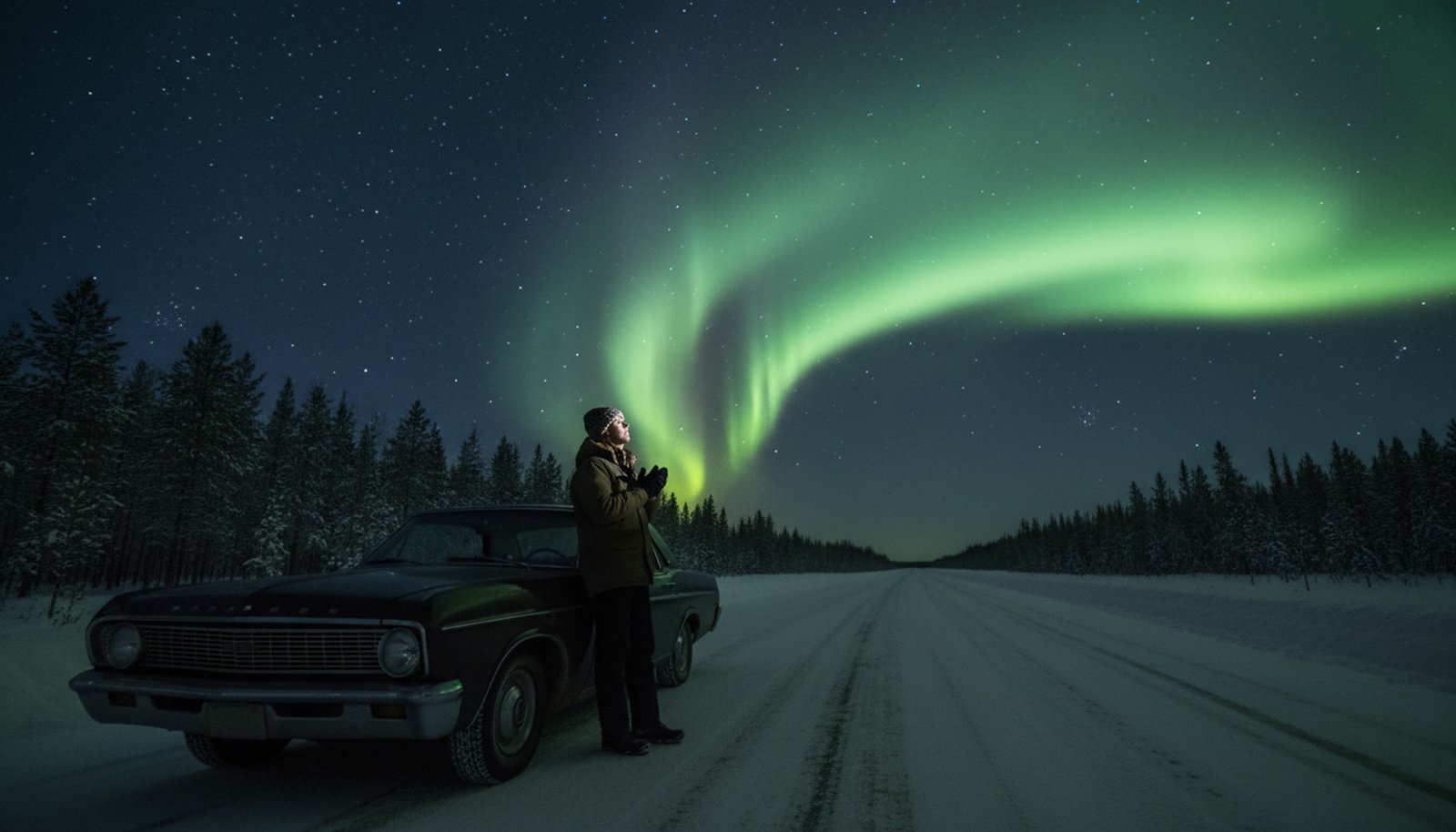
How to see northern lights tonight?
How Can I See the Northern Lights Tonight? A Step-by-Step Guide
The idea of seeing the Northern Lights ‘tonight’ is thrilling, turning a regular evening into a potential celestial adventure. While seeing the aurora always involves a bit of luck, you can dramatically increase your chances by being prepared. It’s not about just looking up; it’s about knowing when and where to look.
This guide provides a simple, actionable checklist to follow. By understanding the key factors—space weather, local weather, and location—you can transform from a hopeful sky-gazer into a strategic aurora hunter and give yourself the best possible shot at witnessing nature’s greatest light show.
Your 3-Step Checklist for Tonight's Aurora Hunt
Success in seeing the aurora tonight hinges on three critical checks. If any one of these fails, your chances drop to nearly zero. Follow these steps in order to know if it’s worth heading out.
Step 1: Check the Aurora Forecast
The aurora’s strength is driven by solar activity, which is measured on a scale called the Kp-index, from 0 (calm) to 9 (extreme geomagnetic storm). For most locations in the northern United States or southern Canada, you’ll need a Kp-index of at least 4 or 5 to see anything. For prime aurora-viewing regions like Alaska, Iceland, or northern Scandinavia, a Kp of 2 or 3 can be sufficient. Use a reliable source like the NOAA Space Weather Prediction Center or a dedicated aurora forecasting app. These services provide short-term forecasts (30-90 minutes) that are crucial for ‘tonight’ viewing. A high Kp forecast is your green light to proceed to the next step.
Step 2: Check the Local Weather Forecast
This step is just as important as the first. An amazing Kp-9 storm is happening, but if your sky is covered in a thick blanket of clouds, you won’t see a thing. The aurora occurs far above the clouds, at altitudes of 60 to 200 miles (100-320 km). You need clear or mostly clear skies to see it. Check your local weather forecast specifically for cloud cover percentage. Look for large patches of clear sky, especially on the northern horizon. Satellite imagery apps can be very helpful for visualizing where the cloud breaks might occur. If the sky is overcast, it’s better to wait for another night.
Step 3: Escape the City Lights
The aurora can be very faint, and the glow from cities, known as light pollution, will easily wash it out. You must get as far away from urban centers as possible. Use a light pollution map online to find ‘dark sky’ locations near you. These are often state or national parks, rural roads, or conservation areas. Your ideal spot has an unobstructed view to the north, as the aurora often begins as a low arc on the northern horizon. Even a small town can create enough light to obscure a faint display, so the darker your location, the better your chances of seeing the subtle colors and movements of the lights.
Essential Tips for a Successful Viewing
Once the forecasts look promising and you’ve chosen your spot, a few extra preparations can make the difference between a frustrating night and a magical one.
When and Where to Look
The most active period for auroras is typically during solar midnight, which is usually between 10 PM and 2 AM local time. While strong storms can produce auroras earlier or later, this window is your best bet. When you arrive at your dark location, face north. For viewers at lower latitudes, the aurora may just appear as a faint, greenish glow or pillars of light low on the horizon. Don’t expect the sky to erupt in color immediately. Be patient and scan the northern sky continuously. Sometimes what you think is a faint cloud is actually the beginning of an auroral arc.
Let Your Eyes Adjust to the Dark
Your eyes need time to become sensitive to low light. It can take 20 to 30 minutes for your pupils to fully dilate and for you to achieve ‘night vision’. During this time, you must avoid looking at bright lights, especially your phone screen. The white light from a screen will instantly reset your night vision. If you need a light, use a headlamp with a red-light mode, as red light has a minimal impact on your dark adaptation. This single tip is crucial, as a faint aurora can be completely invisible until your eyes are fully adjusted.
What to Bring for Comfort and Safety
Aurora hunting often involves standing still in the cold for long periods. Dress in warm layers, much warmer than you think you’ll need. Insulated boots, gloves, a hat, and a winter jacket are essential, even on a seemingly mild night. Bring a thermos with a hot drink to stay warm from the inside. A folding chair or blanket will make waiting more comfortable. If you plan to take pictures, a tripod is non-negotiable for the long exposures required. Finally, let someone know where you are going and when you expect to be back, especially if you are heading to a remote area.
Quick Facts
- You need three things to align: a good aurora forecast (Kp-index), clear skies, and a dark location.
- The Kp-index measures geomagnetic activity; a value of 4 or 5 is often needed for mid-latitudes.
- The aurora happens far above the clouds, so a clear weather forecast is mandatory.
- Use a light pollution map to find a viewing spot far from city lights with an open view to the north.
- The best time to watch is usually between 10 PM and 2 AM local time.
- Allow your eyes at least 20 minutes to fully adapt to the darkness; avoid looking at your phone.
- Dress in very warm layers, bring a hot drink, and use a red-light headlamp to preserve night vision.
Frequently Asked Questions (FAQ)
Q: What Kp-index do I need to see the aurora from my location? A: This depends entirely on your magnetic latitude. In places like Fairbanks, Alaska or Tromsø, Norway, a Kp of 1-2 is often visible. In the northern US (e.g., Minnesota, Montana), you’ll likely need a Kp of 4-6. For rare sightings further south, a major geomagnetic storm of Kp 7 or higher is required.
Q: Can I see the Northern Lights if there is a full moon? A: Yes, but a bright moon acts like a form of natural light pollution. It can wash out fainter auroras, making them harder to see and photograph. However, a very strong aurora will still be visible, and the moonlight can beautifully illuminate the landscape in your photos.
Q: Will my phone camera be able to capture the Northern Lights? A: Modern high-end smartphones with ‘Night Mode’ can often capture decent photos of the aurora. For best results, mount your phone on a small tripod to keep it perfectly still and use the longest exposure setting available. A dedicated DSLR or mirrorless camera with manual controls will still provide superior quality.
Other Books
- NOAA Space Weather Prediction Center – 30-Minute Aurora Forecast
- Light Pollution Map – Find Dark Skies Near You
- Space.com – How to Photograph the Aurora


Plasma Storms Found in the Northern Lights
Summary
By the end of this article, you will understand how scientists discovered the first direct evidence of ‘cavitating turbulence’—a process where intense plasma waves create dynamic, energy-filled bubbles inside the aurora.
Quick Facts
- This was the first direct proof of this violent plasma process happening naturally anywhere in space or astrophysics.
- The electron beams that create the beautiful aurora are also the power source for these plasma storms.
- The 'plasma bubbles,' known as cavitons, are only a few meters wide but occur hundreds of kilometers up in the atmosphere.
- Scientists used a powerful radar in Norway to listen for the specific 'echoes' these plasma waves produce.
- The key evidence was a unique signal—a 'central peak'—which is the smoking gun for cavitons.
The Discovery: Listening to a Plasma Storm
On a November night in 1999, scientists at the EISCAT radar in Norway were studying an intense aurora. They weren’t just watching the lights; they were probing the plasma high above. Their experiment was designed to detect two types of plasma waves: Langmuir and ion-acoustic. Suddenly, their screens lit up with a pattern that had been theorized but never seen in the wild. They detected strong signals from *both* types of waves at the same altitude and time. Even more telling was a Surprise feature in the ion-acoustic data: a strong, stationary central peak. This specific combination was the predicted ‘fingerprint’ of cavitating Langmuir turbulence. The data showed that the aurora’s electron beam was powerful enough to not just create waves, but to make those waves violently carve out bubbles in the plasma itself.
Original Paper: ‘Cavitating Langmuir Turbulence in the Terrestrial Aurora’
The data presented here are the first direct evidence of cavitating Langmuir turbulence occurring naturally in any space or astrophysical plasma.
— B. Isham et al.
The Science Explained Simply
This process is called ‘cavitating Langmuir turbulence.’ Imagine a powerful beam of auroral electrons shooting through the ionosphere’s plasma. This creates high-frequency energy waves, called Langmuir waves. Now, this is NOT like ripples in a pond. When these waves become incredibly intense, they act like a snowplow, physically pushing the surrounding charged particles out of the way. This creates a temporary, low-density ‘bubble’ or cavity—a caviton. The Langmuir waves then become trapped inside their own bubble, which makes them even stronger, until the whole structure collapses. This is the difference between gentle ‘weak’ turbulence and this violent, self-reinforcing ‘strong’ turbulence.
In its most developed form, this turbulence contains electron Langmuir modes trapped in dynamic density depressions known as cavitons.
— Research Paper Abstract
The Aurora Connection
The Northern Lights are more than just a beautiful display; they are the visible result of Earth’s magnetic field guiding high-energy electrons from the solar wind into our upper atmosphere. These same beams of electrons act as the engine for cavitating turbulence. The aurora provides the ‘pump’ of energy needed to drive plasma waves to their breaking point, where they begin to form cavitons. This discovery shows that the beautiful, dancing curtains of light are also sites of incredibly energetic and complex plasma physics. Understanding this process helps us model space weather and how energy from the sun is deposited into our atmosphere, which can affect satellites and radio communication.
A Peek Inside the Research
This discovery relied on the perfect combination of Tools and Knowledge. The tool was the EISCAT incoherent scatter radar, which can measure the faint echoes from different plasma waves. The knowledge came from the Zakharov equations, a set of theoretical physics equations from the 1970s that describe this exact behavior. The researchers ran computer simulations using these equations, feeding them the plasma conditions measured during the aurora (see Figure 4). The simulated radar signal was a near-perfect match for what they observed in reality (Figure 3), specifically the enhanced ‘shoulders’ and the critical ‘central peak’. This match between observation and simulation turned a strange radar signal into a landmark discovery.
Key Takeaways
- The aurora is a natural laboratory for extreme plasma physics.
- Strong Langmuir turbulence creates temporary, low-density cavities (cavitons) in plasma.
- These cavitons trap high-frequency plasma waves, causing them to intensify until they collapse.
- Simultaneous radar detection of Langmuir and ion-acoustic waves, plus a central peak, is the signature of this process.
- Computer simulations were essential to confirm that the observed radar data matched the theory of cavitation.
Sources & Further Reading
Frequently Asked Questions
Q: What is ‘Langmuir turbulence’?
A: It’s a type of disturbance that happens in plasma, which is a gas of charged particles. When a beam of electrons passes through it, it can create waves, much like a speedboat creates a wake in water. This paper is about a particularly strong, or ‘cavitating,’ form of this turbulence.
Q: Why is this discovery so important?
A: Scientists had created this effect in labs and predicted it happened in space, but this was the first time they found direct proof of it occurring naturally. It confirms a fundamental theory of plasma physics and shows it happens in places like the aurora, pulsars, and the sun’s corona.
Q: Can we see these ‘cavitons’ with our eyes?
A: No, they are far too small, only a few meters across, and occur in the very thin plasma of the ionosphere hundreds of kilometers up. We can only detect their effects using highly sensitive instruments like the EISCAT radar.