
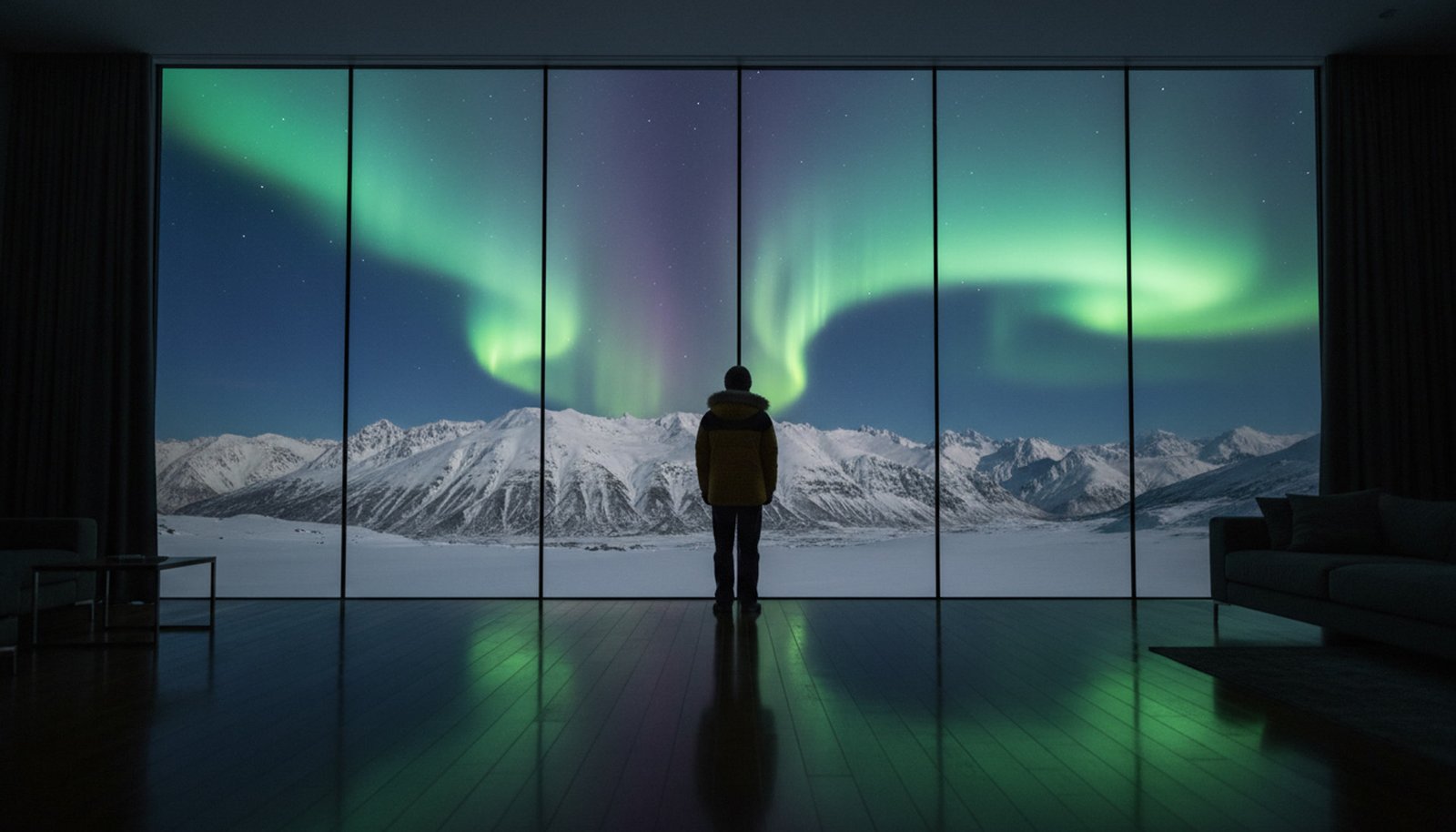
What is northern lights TV show about?
Northern Lights on TV: The Real Science Behind the Spectacle
You might have searched for information on a ‘Northern Lights TV show’ and found yourself here. It’s a popular title for dramas and thrillers, often using the aurora’s beauty and mystery as a backdrop. While those stories are captivating, the true story of the Northern Lights is a scientific epic that unfolds 93 million miles away and ends in a breathtaking light show in our planet’s sky.
This article explores how the aurora is portrayed in popular culture and then dives into the even more incredible science behind the real thing. We’ll separate the on-screen fiction from the astronomical facts to reveal what’s really happening during an auroral display.
The Aurora in Popular Culture
The Northern Lights have long captured the human imagination, making them a perfect element for storytelling in television and film. Their mysterious, ethereal quality provides a stunning backdrop for drama, romance, and suspense.
Common Themes in TV and Film
In media, the aurora is often used as a powerful symbolic device. It can represent magic, a connection to the spiritual world, a turning point in a character’s life, or an omen of things to come. For example, a TV show might use the appearance of the lights to coincide with a major plot twist or a moment of profound realization for a character. The setting is typically a remote, cold, and isolated location, which uses the aurora to amplify feelings of both beauty and isolation. Many fictional works, including recent TV series titled ‘Northern Lights’, leverage this dramatic potential, weaving the natural wonder into the fabric of their narrative to enhance the mood and atmosphere.
Separating On-Screen Fiction from Reality
While visually stunning, portrayals of the aurora on TV often take creative liberties. A common trope is characters ‘hearing’ the lights—a crackling or humming sound. In reality, the aurora occurs in the near-vacuum of the upper atmosphere, more than 60 miles (100 km) up, where it’s too thin for sound to travel to the ground. Another fictional element is attributing supernatural powers or direct influence over events to the aurora. While a strong geomagnetic storm (the cause of the aurora) can affect technology like satellites and power grids, the lights themselves are simply a beautiful result of physics and pose no direct danger or magical influence to people on the surface.
The Real 'Show': How the Aurora is Produced
The true story of the Northern Lights is a fascinating journey of energy and particles across the solar system. It’s a multi-stage process that turns invisible forces into the greatest light show on Earth.
Act 1: The Solar Wind
The show begins at our star, the Sun. The Sun constantly emits a stream of charged particles, mostly electrons and protons, known as the solar wind. This ‘wind’ travels through space at speeds of around one million miles per hour. Sometimes, the Sun has larger eruptions, called Coronal Mass Ejections (CMEs), which hurl vast clouds of these particles toward the planets. It is these powerful CMEs that are responsible for the most intense and widespread auroral displays, often visible much further south than usual. This journey from the Sun to Earth typically takes one to three days.
Act 2: Earth’s Magnetic Shield
When the solar wind reaches Earth, it first encounters our planet’s protective magnetic field, the magnetosphere. This invisible field, generated by the Earth’s molten outer core, deflects the majority of the harmful particles safely around the planet. However, the magnetosphere is weakest at the North and South Poles. Like a giant funnel, the magnetic field lines guide the solar wind particles down towards the polar regions, channeling them into the upper atmosphere where the final act of the light show takes place. This is why the aurora is concentrated in rings around the poles, known as the auroral ovals.
The Grand Finale: Atmospheric Collisions
As the trapped solar particles spiral down into the atmosphere, they collide with gas atoms and molecules, primarily oxygen and nitrogen. These collisions transfer energy to the atmospheric gases, ‘exciting’ them. To return to their normal state, the excited atoms must release this excess energy in the form of light particles called photons. The color of the light depends on which gas was hit and at what altitude. Green, the most common color, is from oxygen at 60-150 miles high. Red is from high-altitude oxygen (above 150 miles), while pinks and purples are often from nitrogen. Billions of these collisions create the shimmering curtains of light we see as the aurora.
Quick Facts
- The term ‘Northern Lights’ is used for various TV shows, but the real aurora is a natural light display.
- The aurora is caused by charged particles from the sun (solar wind) interacting with Earth’s magnetosphere.
- Fictional portrayals often include sounds or magical properties, which are not scientifically accurate.
- The different colors of the aurora are determined by which atmospheric gas (oxygen or nitrogen) is struck by solar particles and at what altitude.
- The lights are concentrated in ‘auroral ovals’ around the magnetic poles due to Earth’s magnetic field.
- Intense auroras are often caused by major solar events called Coronal Mass Ejections (CMEs).
- While the aurora itself is harmless, the underlying geomagnetic storms can impact satellites and power grids.
Frequently Asked Questions (FAQ)
Q: Are there any actual TV shows called ‘Northern Lights’? A: Yes, several TV shows, series, and movies have used the title ‘Northern Lights’. They are typically dramas or thrillers that use the aurora as a scenic or symbolic backdrop for a fictional story.
Q: Can the real aurora look as vibrant as it does on TV? A: Absolutely. During a strong geomagnetic storm, the aurora can be incredibly bright and fast-moving, looking just as spectacular as any special effect. However, what we see with the naked eye can sometimes be less colorful than what a camera captures in a long-exposure photograph.
Q: Are documentaries about the Northern Lights accurate? A: Generally, yes. Documentaries from reputable sources like PBS, BBC, National Geographic, or NASA provide scientifically accurate and fascinating insights into the physics behind the aurora and the efforts to study it.
Other Books
- NASA: What is an Aurora?
- IMDb: Example of a ‘Northern Lights’ TV Series
- NOAA Space Weather Prediction Center – Aurora Dashboard


Electron Showers Lower the Aurora's Ignition Point
Summary
By the end of this article, you will understand the hidden feedback loop that makes auroras suddenly explode in brightness, and why a ‘rain’ of electrons is the key to flipping the switch.
Quick Facts
- Auroras don't just 'turn on'; they need a strong enough 'push' from an electric field to intensify.
- Previous theories predicted this 'push' needed to be much stronger than what we actually observe in nature.
- The missing piece was a 'rain' of electrons that changes the electrical properties of the atmosphere.
- This electron shower makes the atmosphere more conductive, like adding salt to water.
- This increased conductivity lowers the 'ignition threshold' for an aurora by more than 50%.
The Discovery: Solving an Auroral Puzzle
For years, scientists were puzzled. Their models showed that for a quiet auroral arc to erupt into a dazzling display, it needed a very strong ‘push’ from a background electric field—about 25 to 45 millivolts per meter (mV/m). Yet, real-world radar observations showed these intensifications happening at much lower levels, around 10-20 mV/m. There was a disconnect between theory and reality. Dr. Yasutaka Hiraki’s research presents the Story of the solution. He introduced a crucial, previously under-appreciated effect: the ionization caused by precipitating electrons. These falling electrons energize the atmosphere, making it a better conductor. This single change in the model dramatically lowered the required energy threshold, perfectly aligning the theory with real-world observations.
It was found that the threshold of convection electric fields is significantly reduced by increasing the ionization rate.
— Yasutaka Hiraki, Researcher
The Science Explained Simply
Imagine Earth’s connection to space as a giant electrical circuit. The magnetosphere is the power source, and the ionosphere (our upper atmosphere) is like a resistor. Energy travels down this circuit via Alfvén waves. Now, this is NOT just about the waves delivering power. The key idea is that as these waves hit the atmosphere, they cause electrons to ‘precipitate’ or rain down. This rain of electrons ionizes the neutral air, which dramatically *lowers* the atmosphere’s electrical resistance. With lower resistance, the same amount of power from the magnetosphere can drive a much stronger current and amplify the Alfvén waves even more. This creates a runaway feedback loop, causing the aurora to suddenly and intensely brighten. It’s a self-fueling process.
The Aurora Connection
This research directly explains one of the most beautiful sights in the Arctic: the explosive onset of an auroral substorm. You might see a faint, quiet green arc hanging in the sky for minutes. Then, seemingly without warning, it erupts into swirling, dancing curtains of light that fill the sky. That sudden change is the moment the system crosses the now-lowered threshold. The positive feedback loop kicks in, the Alfvén wave instability grows exponentially, and the energy flowing down Earth’s magnetic field lines intensifies dramatically. The electron ‘rain’ didn’t just add to the light; it changed the rules of the game, allowing the main event to begin with less of a push.
The prime key is an enhancement of plasma convection, and the convection electric field has a threshold.
— Yasutaka Hiraki, Researcher
A Peek Inside the Research
This breakthrough didn’t come from a new telescope, but from powerful computer modeling and theoretical physics. Dr. Hiraki used a set of complex mathematical equations to simulate the magnetosphere-ionosphere (M-I) coupling system. This ‘digital twin’ of the auroral circuit allowed him to change one variable at a time. He modeled how Alfvén waves propagate and interact with the ionosphere. The crucial step was adding a term to his equations representing the ionization from precipitating electrons (the ‘q’ value). By running simulations with different ‘q’ values, he demonstrated precisely how this effect lowered the instability threshold, providing a clear, mathematical explanation for a long-standing mystery in space physics.
Key Takeaways
- Auroral intensification is driven by an instability of energy waves (Alfvén waves) traveling along Earth's magnetic field lines.
- Electron precipitation creates a positive feedback loop: the waves cause electrons to fall, which in turn makes it easier for the waves to grow stronger.
- The ionosphere isn't a static resistor in a cosmic circuit; its conductivity is dynamic and changes based on space weather.
- This model successfully explains why auroras can flare up suddenly even when the background energy conditions seem relatively calm.
Sources & Further Reading
Frequently Asked Questions
Q: What are Alfvén waves?
A: Alfvén waves are a type of electromagnetic wave that travels along magnetic field lines in a plasma. You can think of them like a vibration traveling down a guitar string, except the ‘string’ is one of Earth’s magnetic field lines, and the ‘vibration’ is carrying electrical current and energy that powers the aurora.
Q: So the falling electrons ARE the aurora?
A: Yes and no. The light of the aurora is produced when falling electrons strike atmospheric gases. But this research shows their *other* job is just as important: they change the conductivity of the atmosphere, which allows the *entire system* that accelerates them to become more powerful and unstable.
Q: Why is a ‘threshold’ so important?
A: A threshold explains why auroral displays aren’t constant. They can remain calm for a long time and then suddenly erupt. The system has to build up enough energy to cross that tipping point, and this research shows that electron precipitation effectively lowers the bar, making those eruptions happen more easily.