

The 1859 Solar Storm That Set the Sky on Fire
Summary
By the end of this article, you will understand how a massive solar storm in 1859 pushed auroras all the way to the tropics, and how scientists use 160-year-old ship logs to predict future space weather.
Quick Facts
- Surprise: Auroras were seen as far south as Panama and Hawaii, just 20 degrees from the equator.
- Surprise: The auroras were so intensely bright that people thought neighboring cities were engulfed in massive fires.
- Salient Idea: The storm was likely a 'double punch' where a first solar eruption cleared out space debris for the second one.
- Salient Idea: The light from the aurora was equivalent to a full moon, earning an extremely rare Class IV brightness rating.
The Discovery: Decoding the 1859 Skies
In September 1859, the largest geomagnetic storm in recorded history slammed into Earth. But to understand exactly how big the ‘Carrington Event’ was, modern scientists had to become historians. They didn’t just look at old magnetic observatory data; they dug through U.S. Navy ship logs, Mexican newspapers, and ancient Japanese diaries. They found a Surprise: accounts of brilliantly red skies from places near the equator, like Panama and the Caribbean. By piecing together these forgotten records, researchers reconstructed the exact size of the storm. They discovered the auroral oval didn’t just expand; it violently stretched down to latitudes where auroras are practically a myth. This wasn’t just a pretty light show; it was a massive disruption of Earth’s magnetic field.
Low-Latitude Aurorae during the Extreme Space Weather Events in 1859
During the watch to the N & E was seen an aurora borealis, brilliantly red.
— Logbook of the USS Saranac, off the coast of Panama, 1859
The Science Explained Simply
This is NOT your standard solar flare. A normal space weather event sends a cloud of plasma—a Coronal Mass Ejection (CME)—toward Earth, where it gets slowed down by the gases in interplanetary space. But the Carrington Event was different. The Salient Idea here is the ‘snowplow’ effect. The Sun released an initial CME that acted like a cosmic snowplow, sweeping all the resistance out of the way. When a second, highly-charged CME erupted days later, it had a perfectly clear highway to Earth. It hit our magnetic field with zero deceleration. This extreme impact compressed Earth’s magnetic shield, allowing highly energetic particles to dive deep into our atmosphere and trigger blood-red auroras in the tropics.
The Aurora Connection
While the 1859 auroras were a beautiful, terrifying spectacle, they reveal a critical vulnerability in our modern world. Auroras are the visible footprint of Earth’s magnetic field interacting with solar wind. When auroras are pushed to the equator, it means our magnetic shield is under severe stress. During the Carrington storm, this magnetic chaos caused telegraph wires to spark and catch fire. If a ‘snowplow’ CME of this magnitude hit us today, it wouldn’t just give us tropical Northern Lights; it could melt down the global electrical grid. Studying these historical auroras helps us measure the true limits of Earth’s magnetic shield.
Extreme worlds teach us about planetary survival, and extreme historical events teach us how to protect our future.
— NorthernLightsIceland.com Team
A Peek Inside the Research
How do researchers know exactly where the aurora was 160 years ago? It comes down to clever geometry. They didn’t just log where the observer was standing; they looked for clues about the aurora’s elevation angle—how high it appeared in the sky. If a sailor in the Caribbean reported the red light ‘rising to the zenith’ (straight overhead), scientists could use trigonometry to calculate the storm’s true equatorward boundary. By assuming the aurora topped out around 400 kilometers in altitude, they mapped the exact footprint of the event. It is a brilliant example of using historical storytelling to generate hard, quantifiable physics data.
fiery light shone in the heaven and fiery light was seen for whole night until the dawn.
— Chikusai Nikki (Historical Diary, Japan, 1859)
Key Takeaways
- Historical diaries and naval ship logs contain hidden, highly valuable data for modern astrophysics.
- Calculating the 'elevation angle' of historical sightings reveals exactly how far the aurora reached in the atmosphere.
- The 'snowplow' effect happens when an initial coronal mass ejection (CME) clears a frictionless path for a follow-up CME.
- Not all red night-sky glows are normal auroras; some are Stable Auroral Red (SAR) arcs caused by heated electrons in Earth's inner magnetic field.
Sources & Further Reading
Frequently Asked Questions
Q: Why were the 1859 auroras mostly red instead of the usual green?
A: Red auroras occur much higher in the atmosphere than green ones and require lower-energy electrons. However, some of these 1859 sightings might actually have been Stable Auroral Red (SAR) arcs, which happen when Earth’s inner magnetic ring current heats up dramatically.
Q: Could a Carrington Event happen again today?
A: Yes. The Sun operates on cycles, and extreme Coronal Mass Ejections happen periodically. In fact, a similar ‘snowplow’ solar storm narrowly missed Earth in 2012.



The 1872 Storm That Set the Sky on Fire
Summary
By the end of this article, you will understand how ancient diaries and historical records uncovered a massive solar storm that rivaled the famous Carrington Event, and why this poses a hidden threat to our modern technology.
Quick Facts
- Surprise: The aurora was so bright in Japan that people could count trees in the mountains at midnight.
- Surprise: Observers thought the bright red skies were massive city-wide fires in neighboring towns.
- Salient Idea: The aurora was seen incredibly close to the equator, including in Bombay, India and Shanghai, China.
- Surprise: A Chinese observer recorded a massive sunspot with their naked eye, describing it as a 'crow in the sun'.
The Discovery: Decoding Ancient Diaries
For decades, scientists believed the ‘Carrington Event’ of 1859 was the undisputed king of solar storms. But researchers recently dug into 48 historical documents from China, Japan, and Korea from February 1872. They weren’t just reading history; they were tracking space weather. They found a Surprise: accounts of intense, fiery red skies that sent people into a panic. In Japan, some people rumored that Kyoto and Nagoya were entirely in conflagration—meaning they thought the cities were burning down! By mapping these diary entries, scientists realized the aurora had stretched incredibly far south, meaning the solar storm that caused it was an absolute monster.
Original Paper: ‘The Great Space Weather Event during February 1872 Recorded in East Asia’
Three bands of red vapor appeared in the western sky. Some rumored Nagoya was in conflagration.
— Tanaka Nagane, 1911 (from 1872 historical interviews)
The Science Explained Simply
This is NOT just a story about a colorful sky. A geomagnetic storm happens when the Sun spits out a massive cloud of charged particles, called a Coronal Mass Ejection, which slams into Earth’s magnetic field. The Salient Idea here is magnetic displacement. When a storm is this strong, it warps our magnetic field so violently that high-intensity, low-energy electrons are dumped into our atmosphere much closer to the equator than normal. In 1872, the magnetic disturbance was measured at roughly -830 nT in Bombay. For context, that is a catastrophic level of magnetic interference that would melt modern power grids.
The Aurora Connection
Normally, Earth’s magnetic field funnels solar particles to the North and South poles, creating the standard auroras we know and love. But the 1872 storm was so violent it pushed the auroral oval down to 18.7 degrees magnetic latitude. That means auroras were visible directly overhead in places like Shanghai! When you see an aurora creeping toward the equator, it is a visual warning that our planet’s magnetic shield is being pushed to its absolute limits by the stellar wind.
The bright arc extended almost for 50 degrees very close to the Zenith.
— Italian Consulate in Shanghai, 1872
A Peek Inside the Research
How do we prove a storm from 150 years ago was real? It comes down to cross-referencing. The researchers didn’t just trust the diaries. They took the exact times recorded in the Asian texts and compared them to ground magnetic field recordings taken by an observatory in Colaba, Bombay, during the exact same hours in 1872. The sudden drop in the magnetic field in Bombay lined up perfectly with the intense red skies seen in Japan and China. It is a brilliant triumph of combining humanities (history) with hard physics.
The aurora recorded in China and Japan approximately corresponds to the initial phase, main phase, and the early recovery phase of the magnetic storm.
— Hayakawa et al.
Key Takeaways
- The 1872 storm rivals or even surpasses the famous 1859 Carrington Event in strength.
- Historical records like diaries and local treaties are crucial scientific data for space weather.
- Massive solar storms might happen more frequently than we previously thought.
- Understanding past extreme events helps us protect modern power grids and satellites.
Sources & Further Reading
Frequently Asked Questions
Q: Why do we care about a solar storm that happened in 1872?
A: Because it proves that Carrington-level extreme solar storms happen more frequently than we thought. If a storm of that magnitude hit today, it could destroy satellites, internet cables, and global power grids.
Q: Why did people think the aurora was a fire?
A: Auroras caused by extreme space weather are often deep red. Before people understood the science of the Northern Lights, a glowing red horizon looked exactly like the glow of a massive city-wide fire.
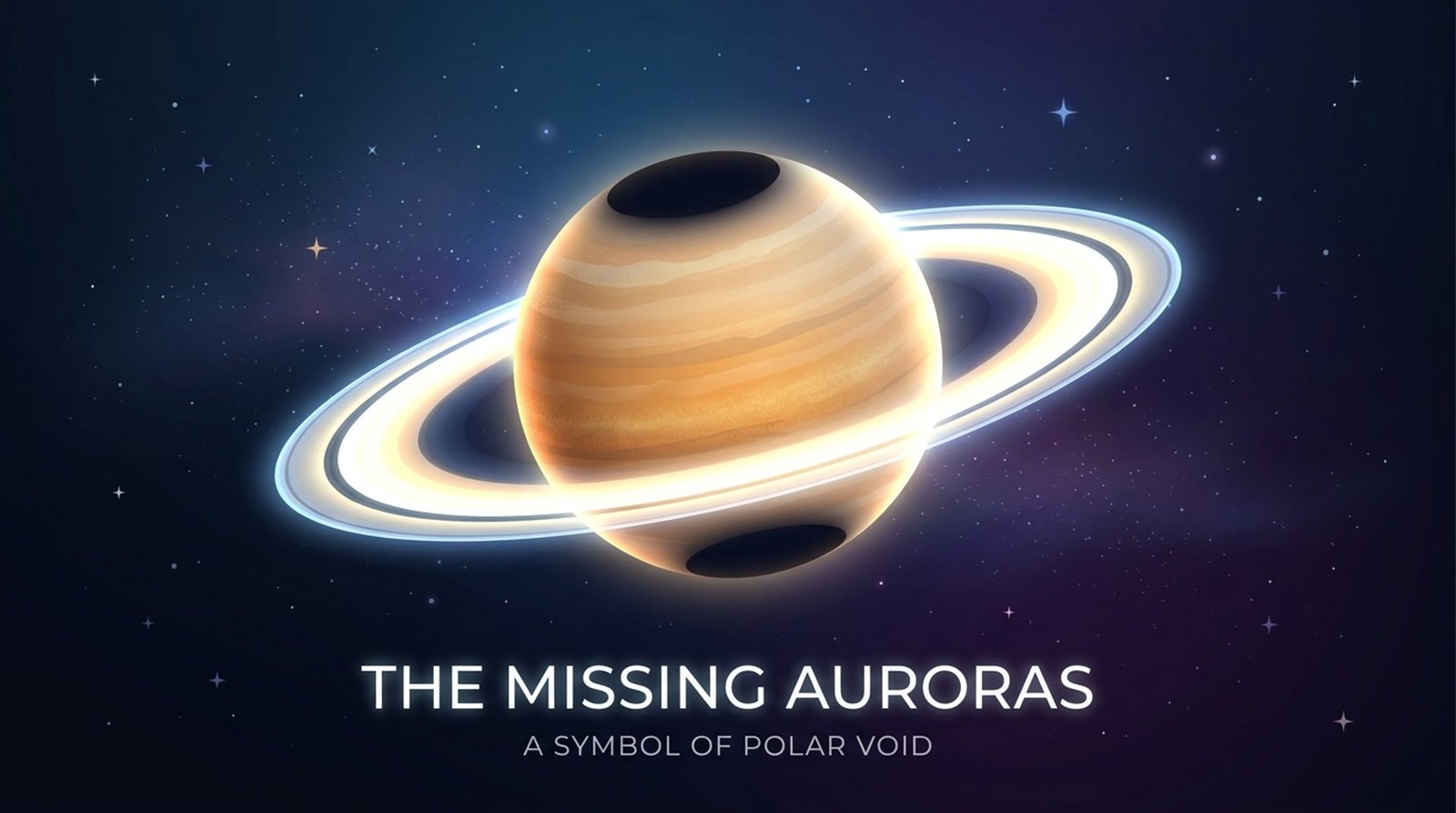
The Mystery of Saturn's Missing X-Ray Auroras
Summary
By the end of this article, you will understand why Saturn’s atmosphere acts as a giant mirror, why its rings glow, and why its auroras are completely invisible to our best X-ray telescopes.
Quick Facts
- Surprise: Saturn's atmosphere acts like a massive mirror, reflecting X-rays from the Sun
- Salient Idea: The brightness of Saturn's X-rays fades and brightens with the 11-year solar cycle
- Surprise: Saturn's icy rings glow with their own unique oxygen X-ray light, possibly triggered by massive lightning storms
- Surprise: Unlike Earth and Jupiter, Saturn has completely invisible X-ray auroras
The Discovery: The Missing Polar Lights
Between 2002 and 2005, scientists pointed two massive space telescopes, Chandra and XMM-Newton, at Saturn. They were looking for powerful X-ray auroras, much like the intense light storms we see on Jupiter and Earth. But they found a Surprise: the poles were completely dark. Instead, they discovered that Saturn’s main disk was glowing in X-rays, and its iconic rings were emitting a specific ‘oxygen line’ of X-ray energy. The Salient Idea here is that Saturn does not generate its own massive X-ray storms like Jupiter. Instead, its atmosphere acts as a giant mirror, simply scattering the X-rays that travel all the way from the Sun. As the Sun’s X-ray output dipped over the years, Saturn’s X-ray glow dimmed right along with it.
Original Paper: ‘X-rays from Saturn: A study with XMM-Newton and Chandra’
Unlike Jupiter and Earth, we do not find evidence for X-ray aurorae on Saturn.
— Dr. Graziella Branduardi-Raymont
The Science Explained Simply
This is NOT like the auroras on Earth, where our magnetic field actively crashes solar particles into our atmosphere to generate light. On Saturn, the planet is passively reflecting the Sun’s X-rays. Think of it like shining a flashlight at a disco ball. The ball doesn’t make the light; it just bounces it back. Because the brightness of Saturn’s disk perfectly matches the Sun’s 11-year activity cycle, scientists know the X-rays are just bouncing off the upper atmosphere. However, the rings are a different story. The X-rays coming from the icy rings don’t perfectly match the Sun’s cycle. Scientists suspect this ring glow might be caused by giant lightning storms shooting electron beams into the ice!
The Aurora Connection
So why doesn’t Saturn have X-ray auroras like Earth or Jupiter? It all comes down to the magnetic field and the solar wind. Jupiter has a monstrous magnetic field filled with dense volcanic gas from its moon Io. When energetic particles get trapped there, they create blinding X-ray auroras. Saturn, however, has a magnetic field 20 times weaker than Jupiter’s, and much less gas floating around its magnetosphere. The auroras likely *are* happening, but they are thousands of times too faint for our current telescopes to see. It teaches us that having a magnetic field isn’t enough; you need the right cosmic ingredients to ignite a visible space weather storm.
Saturnian X-ray aurorae are likely to have gone undetected because they are below the sensitivity threshold of current Earth-bound observatories.
— The Research Team
A Peek Inside the Research
How do astronomers know where X-rays come from when Saturn is almost a billion miles away? They use spectroscopy. By breaking down the invisible X-ray light into a spectrum, they found a distinct ‘oxygen’ signature coming specifically from the rings, and a ‘coronal’ signature matching the Sun coming from the planet’s disk. It requires incredible patience. They had to observe the planet over three years to track how the X-rays faded exactly when the Sun’s X-ray output dipped. It is a triumph of long-term observation, proving that the solar system is deeply connected by the invisible solar wind.
We approach the study of Saturn and its environment in a novel way using X-ray data.
— The Research Team
Key Takeaways
- Planets can emit X-rays in two ways: reflecting solar rays or generating their own through auroras
- A planet needs a highly dense magnetosphere to produce easily visible X-ray auroras
- Jupiter's magnetic field is 20 times stronger than Saturn's, explaining the difference in their light shows
- Current Earth-bound telescopes are not powerful enough to see Saturn's faint polar X-rays
Sources & Further Reading
Frequently Asked Questions
Q: Will we ever be able to see Saturn’s X-ray auroras?
A: Yes, but likely not from Earth! Scientists believe we will need to send a dedicated X-ray telescope on a spacecraft directly to the Saturnian system to finally see these incredibly faint light shows.
Q: Why do Saturn’s rings glow in X-rays?
A: Scientists think it might be ‘fluorescence’ caused by the Sun hitting the icy rings, or possibly giant lightning storms called ‘spokes’ shooting electron beams into the ice.
The Star with Auroras Sparked by a Hidden Planet
Summary
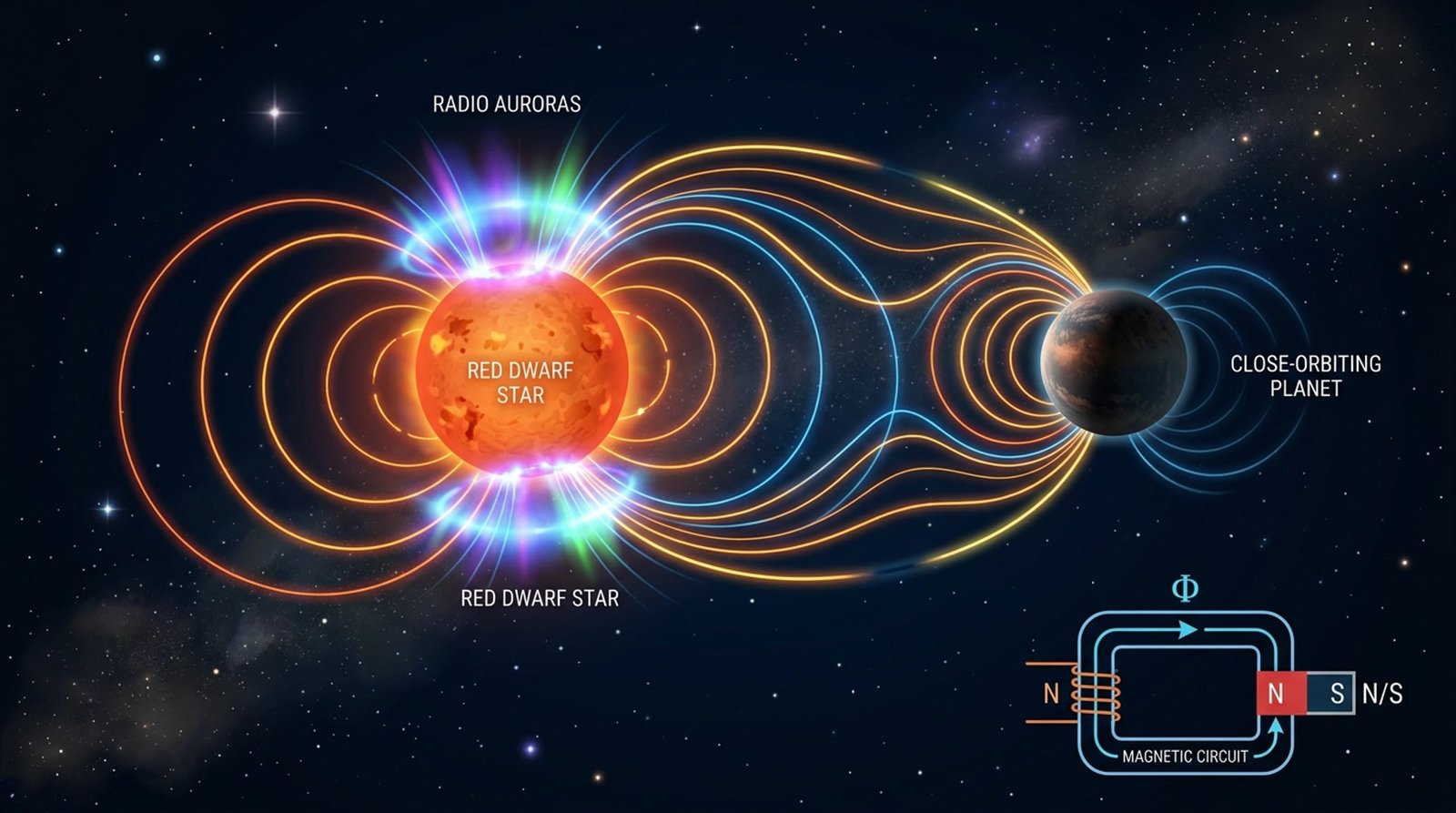
By the end of this article, you will understand how an invisible planet can act like a giant electric generator, sparking massive radio auroras on its host star.
Quick Facts
- Surprise: The star GJ 1151 is perfectly 'quiet' and inactive, yet it blasts out intense radio waves.
- Salient Idea: The radio waves are actually massive auroras happening on the star itself.
- Surprise: The auroras are powered by an invisible, Earth-sized planet orbiting the star in just 1 to 5 days.
- Surprise: We see this exact same phenomenon in our solar system between Jupiter and its volcanic moon, Io.
The Discovery: A Screaming Quiet Star
When astronomers look for radio waves in space, they usually point their telescopes at violent, active ‘flare stars.’ But when using the LOFAR radio telescope network, a team stumbled upon a Surprise: a perfectly quiet, inactive red dwarf star named GJ 1151 was blasting out a continuous, eight-hour-long radio signal. This made no sense. The star had no sunspots, no X-ray flares, and rotated incredibly slowly. It was a cosmic paradox. By analyzing the light, the team realized they were looking at an aurora, much like the Northern Lights. But a quiet star cannot generate auroras on its own. The Salient Idea emerged: the auroras were being sparked from the outside. An invisible, Earth-sized exoplanet orbiting extremely close to the star was acting as an electrical trigger.
Coherent radio emission from a quiescent red dwarf indicative of star-planet interaction
The characteristics of the emission are similar to those of planetary auroral emissions, suggesting a coronal structure dominated by a global magnetosphere.
— Dr. H. K. Vedantham
The Science Explained Simply
This is NOT a solar flare. Solar flares happen when a star’s magnetic fields get tangled and explode outward. This phenomenon, called a sub-Alfvénic interaction, is completely different. Imagine the star’s magnetic field as a web of invisible strings. As the Earth-sized planet orbits, it physically plows through these strings. Because the planet is moving so fast, it acts like the spinning rotor inside an electric generator. It creates millions of volts of electricity. This massive current of electrons gets funneled down the magnetic ‘strings’ straight into the star’s north and south poles. When the electrons crash into the star’s atmosphere, they release energy as radio waves. It is a permanent, one-way electrical circuit bridging millions of miles of empty space.
The Aurora Connection
To understand this alien solar system, we just have to look at our own. Jupiter has an incredibly powerful magnetic field, and its moon Io orbits right inside it. As Io moves, it generates an electrical current that travels down into Jupiter’s atmosphere, creating permanent, glowing auroras at Jupiter’s poles. The GJ 1151 system is doing the exact same thing, just scaled up to planetary and stellar sizes! Instead of a planet and a moon, it is a star and a planet. This teaches us that magnetic interactions are a universal rule of physics, operating across vast ranges of mass and scale, from terrestrial planets all the way up to main-sequence stars.
Our results show that large-scale currents that power radio aurorae operate over a vast range of mass and atmospheric composition.
— LOFAR Research Team
A Peek Inside the Research
How do we know it is an aurora and not just a hot burst of plasma? The secret is in circular polarization. When electrons spiral down a magnetic field line, they shoot out radio waves that twist in a specific corkscrew pattern. When the team looked at the LOFAR data, they saw the signal was 64% circularly polarized. Regular heat flares do not twist like that. Furthermore, the math proved that the star’s rotation was far too slow to generate this energy on its own. By eliminating the impossible, they proved the existence of the hidden planet. This marks a massive leap forward: scientists can now use low-frequency radio arrays to hunt for Earth-like planets around red dwarfs just by listening to the magnetic songs they sing.
Based on the positional co-incidence, transient nature, and high circularly polarised fraction, we conclusively associate the radio source with GJ 1151.
— Dr. J. R. Callingham
Key Takeaways
- Magnetic fields can physically link a star and a planet into a giant electrical circuit.
- Planets moving through strong magnetic fields generate massive currents of electrons.
- Highly polarized radio waves are the ultimate fingerprint for finding space auroras.
- Radio telescopes can now be used as a brand new tool to discover hidden exoplanets.
Sources & Further Reading
Frequently Asked Questions
Q: Why didn’t scientists just look at the planet through a telescope?
A: Exoplanets are incredibly small and faint compared to the blinding light of their host stars. We almost never see them directly; instead, we have to look for the gravitational or magnetic effects they have on their stars.
Q: Could this magnetic circuit happen to Earth?
A: No. Earth orbits too far away from the Sun, and the Sun’s stellar wind is too strong. This specific ‘sub-Alfvénic’ interaction requires a planet to be orbiting extremely close to a star with a specific type of magnetic field.
The Cosmic Pulse: How Giant Planets Control Earth's Climate
Summary
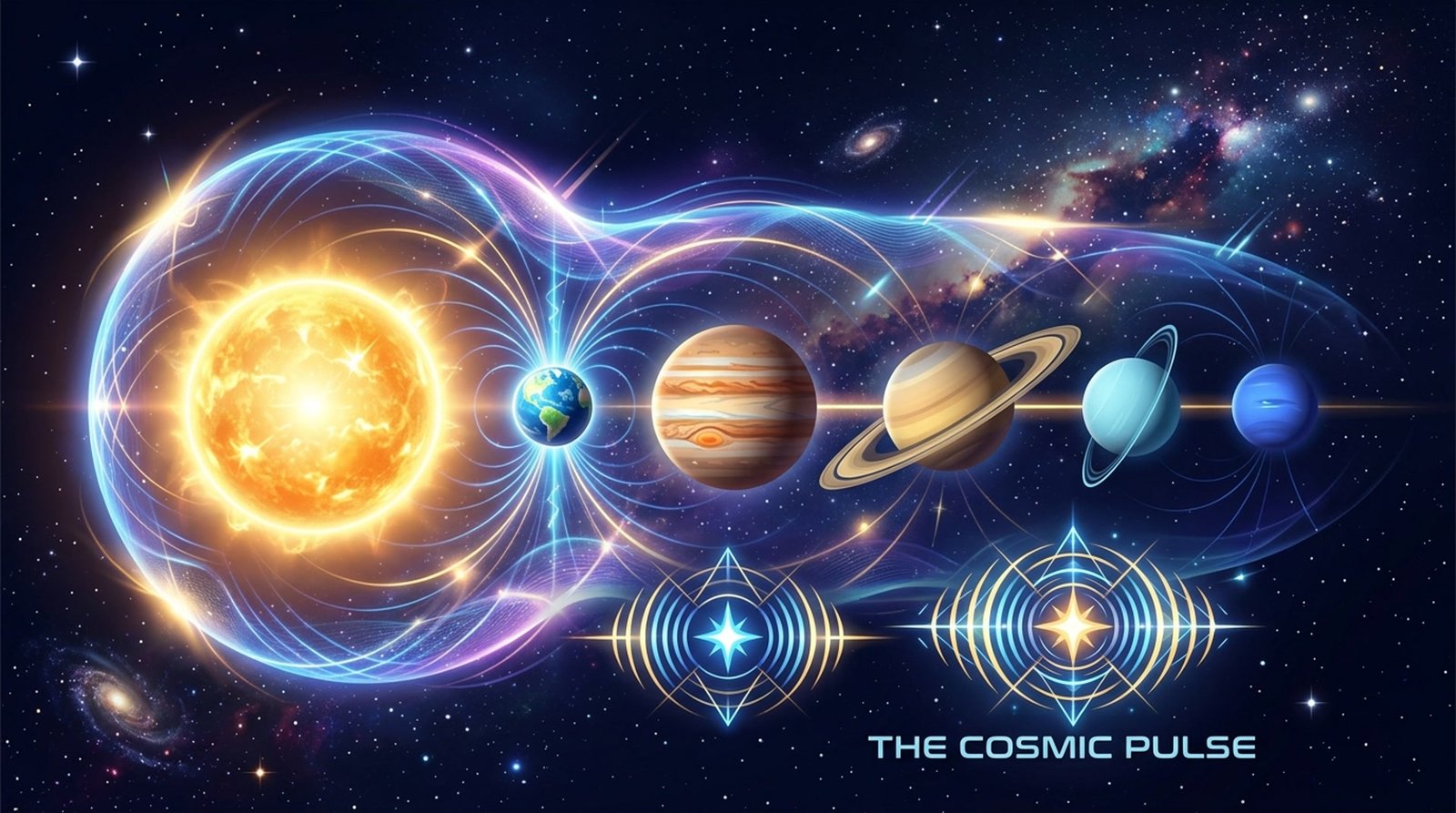
By the end of this article, you will understand how the slow, rhythmic dance of Jupiter, Saturn, Uranus, and Neptune acts as a giant magnetic pump, changing Earth’s climate and controlling the cosmic rays that hit our atmosphere.
Quick Facts
- Surprise: Cosmic rays from deep space constantly collide with our atmosphere to create radioactive Carbon-14
- Surprise: The entire solar system 'wobbles' and pulses based on the gravitational pull of Jupiter, Saturn, Uranus, and Neptune
- Salient Idea: These four giant planets sync up in a grand repeating pattern exactly every 2,318 years
- Surprise: This orbital dance physically expands and contracts the Sun's magnetic shield, ultimately altering Earth's weather
The Discovery: Solving an Ancient Climate Mystery
For decades, scientists studying ancient tree rings and ice cores noticed a mysterious pattern. Every 2,100 to 2,500 years, Earth experienced significant cooling periods, along with spikes in Carbon-14. They called this the Hallstatt cycle, but its origin remained unknown. Then, a team of researchers looked beyond Earth, out to the solar system’s center of mass. They discovered a Surprise: a mathematical resonance between the orbits of the four giant planets (Jupiter, Saturn, Uranus, and Neptune) creates a repeating gravitational pattern every 2,318 years. This massive planetary dance perfectly aligns with Earth’s ancient climate records, solving a multi-millennial puzzle.
The rhythmic contraction and expansion of the solar system… appear to work as a gravitational/electromagnetic pump.
— Dr. Nicola Scafetta and team
The Science Explained Simply
This is NOT astrology where planets magically influence your mood. This is pure orbital mechanics and astrophysics. As the giant planets orbit, their combined gravity pulls on the Sun, causing the entire solar system to ‘wobble’ around its center of mass. The Salient Idea here is the ‘breathing’ effect. When the planets align in a certain way, the solar system’s orbital footprint expands rapidly and contracts slowly. This physical motion changes the shape and strength of the heliosphere (our Sun’s protective magnetic bubble). Just like a pump, this breathing squishes and stretches the solar wind, deciding exactly how many high-energy cosmic rays are allowed to reach Earth to form clouds and alter our climate.
The Aurora Connection
The very same forces that create the Northern Lights in Iceland are at the heart of this 2,318-year cycle. Auroras occur when the solar wind interacts with Earth’s magnetic field. On a much grander scale, the Sun’s solar wind creates a massive magnetic shield called the heliosphere, which protects the entire solar system from deadly interstellar cosmic rays. When the giant planets alter the Sun’s movement, they change the intensity of this solar wind. Understanding this cycle helps us realize that our beautiful auroras are just the visible sparks of a massive, ancient magnetic defense system keeping our planet habitable.
The imploding-exploding dynamics revealed in our record could easily modulate the solar wind termination shock surface and, therefore, modulate the incoming cosmic ray flux.
— The Researchers
A Peek Inside the Research
How do we prove this planetary pulse exists? It comes down to incredible data and spectral analysis. The researchers didn’t just guess; they used NASA’s highly precise ephemeris data to track the exact gravitational pull of every planet going back 15,000 years. By calculating the Planetary Mass Center (the true balancing point of the solar system), they graphed its shifting eccentricity over millennia. The math revealed undeniable, sharp spikes at 159, 171, 185, and exactly 2,318 years. When they overlaid this gravitational graph with Earth’s Carbon-14 records, the peaks and valleys matched beautifully.
Since this resonance is perfectly coherent to the Hallstatt oscillation… this is unlikely a coincidence.
— The Research Team
Key Takeaways
- The 'Hallstatt cycle' is a 2,100 to 2,500-year climate pattern found in ancient ice cores and tree rings
- The orbital resonance of the gas giants acts like a massive pump for the solar wind
- When the solar system 'expands,' fewer cosmic rays hit Earth; when it 'contracts,' more cosmic rays get in
- Cosmic rays and space dust controlled by this cycle help form clouds, directly affecting Earth's long-term climate
Sources & Further Reading
Frequently Asked Questions
Q: How do cosmic rays actually change the weather?
A: When high-energy cosmic rays hit our atmosphere, they create tiny electrically charged particles. These particles act as ‘seeds’ that attract water vapor, helping to form dense clouds which reflect sunlight and cool the Earth.
Q: What is ‘orbital resonance’?
A: Orbital resonance happens when orbiting bodies exert a regular, periodic gravitational influence on each other because their orbital periods are related by a ratio of small integers. It is like a synchronized cosmic dance.
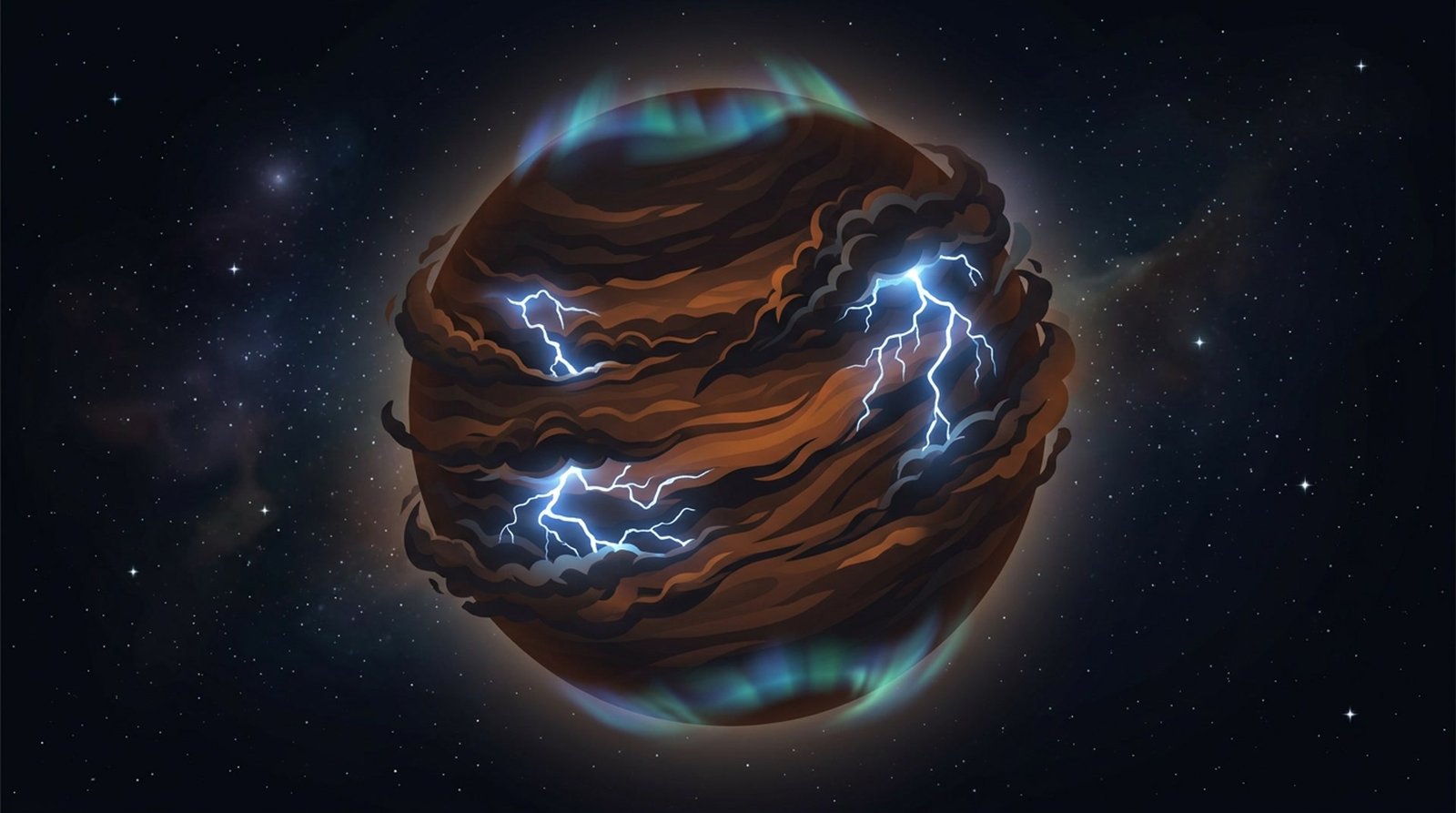
Sparking Clouds & Alien Auroras on Brown Dwarfs
Summary
By the end of this article, you will understand how alien planets grow clouds made of rock, and how cosmic rays trigger massive electrical storms and extraterrestrial auroras.
Quick Facts
- Surprise: Clouds on brown dwarfs are not made of water, they are made of vaporized rock and metal like iron and magnesium.
- Salient Idea: Cosmic rays from deep space crash into these alien atmospheres, creating massive 'air showers' of electricity.
- Surprise: If a rock cloud particle absorbs too many electrons, it violently explodes! Scientists call this a 'Coulomb explosion'.
- Surprise: Supersonic winds blowing through magnetic fields can act like giant generators, ripping electrons away from atoms.
The Discovery: Clouds of Sparking Rock
When we look at ultra-cool stars known as brown dwarfs and giant gas exoplanets, we see a Surprise: their clouds are not made of water. They are packed with vaporized minerals like iron and silicon. But the real discovery is how these alien clouds interact with electricity. Researchers wanted to know what happens when these mineral clouds are bombarded by cosmic rays or extreme winds. Using 3D computer simulations, they modeled how particles from deep space crash into the atmosphere, creating cascades of energy called air showers. They found that these alien clouds can build up massive amounts of static electricity. If a tiny dust grain gathers too many electrons, it will literally blow itself apart in a Coulomb explosion. It is an environment where the weather isn’t just stormy; it is electrically explosive.
Ionisation and discharge in cloud-forming atmospheres of brown dwarfs and extrasolar planets
Given a certain degree of thermal ionisation… cloud particles are destroyed electrostatically in regions with strong gas ionisation.
— Dr. Christiane Helling
The Science Explained Simply
Let’s be clear: this is NOT like a normal lightning storm on Earth. On our planet, ice and water rub together to create static electricity. On a brown dwarf, supersonic winds push rocky dust through strong magnetic fields, ripping electrons right off the gas in a process called Alfvén ionization. The Salient Idea here is the concept of a Coulomb explosion. Imagine a tiny grain of sand floating in this atmosphere. As it gets bombarded by free electrons, it gains a stronger and stronger negative charge. Eventually, the negative charges repel each other so violently that they overcome the physical strength of the rock itself. The particle shatters! This local destruction of cloud particles creates actual holes in the thick cloud cover.
The Aurora Connection
How does this connect to auroras? Just like Earth, brown dwarfs have magnetic fields. But a brown dwarf’s magnetic field can be thousands of times stronger! On Earth, the solar wind hits our magnetic shield and funnels down to the poles, lighting up the sky. On these alien worlds, the massive pool of free electrons created by cosmic rays and magnetic winds gets trapped. These trapped, spiraling electrons emit powerful radio waves and could generate spectacular extraterrestrial auroras. The same physics that paints the sky green over Iceland is responsible for generating brilliant, glowing displays across the galaxy on planets that do not even have a true sun to orbit!
Combined with a strong magnetic field… a chromosphere and aurorae might form as suggested by radio and X-ray observations.
— Helling et al. Research Team
A Peek Inside the Research
How do we study storms light-years away? We cannot send a weather balloon. Instead, the team relied on a 3D Monte Carlo radiative transfer code. They injected a simulated cosmic ray with a massive 10^20 electron-volts of energy into a virtual Jupiter-like atmosphere. The computer then tracked over a million secondary particles as they crashed and split, tracing their paths in three dimensions. By combining this with a specialized atmosphere model called DRIFT-PHOENIX, they could calculate exactly how many electrons would stick to a single piece of mineral dust. It is a masterful blend of quantum physics, fluid dynamics, and supercomputing.
Key Takeaways
- Alien clouds are formed by condensing minerals and they can hold massive electrical charges.
- Cosmic rays and stellar winds inject free electrons into the atmosphere, creating plasma.
- A 'Coulomb explosion' happens when electrostatic repulsion overcomes a particle's physical strength.
- Intense ionization can destroy patches of clouds, creating 'holes' that look like star spots from Earth.
Sources & Further Reading
Frequently Asked Questions
Q: What exactly is a brown dwarf?
A: It is often called a ‘failed star.’ It is an object larger than a giant planet like Jupiter, but not quite massive enough to ignite full nuclear fusion in its core like our Sun.
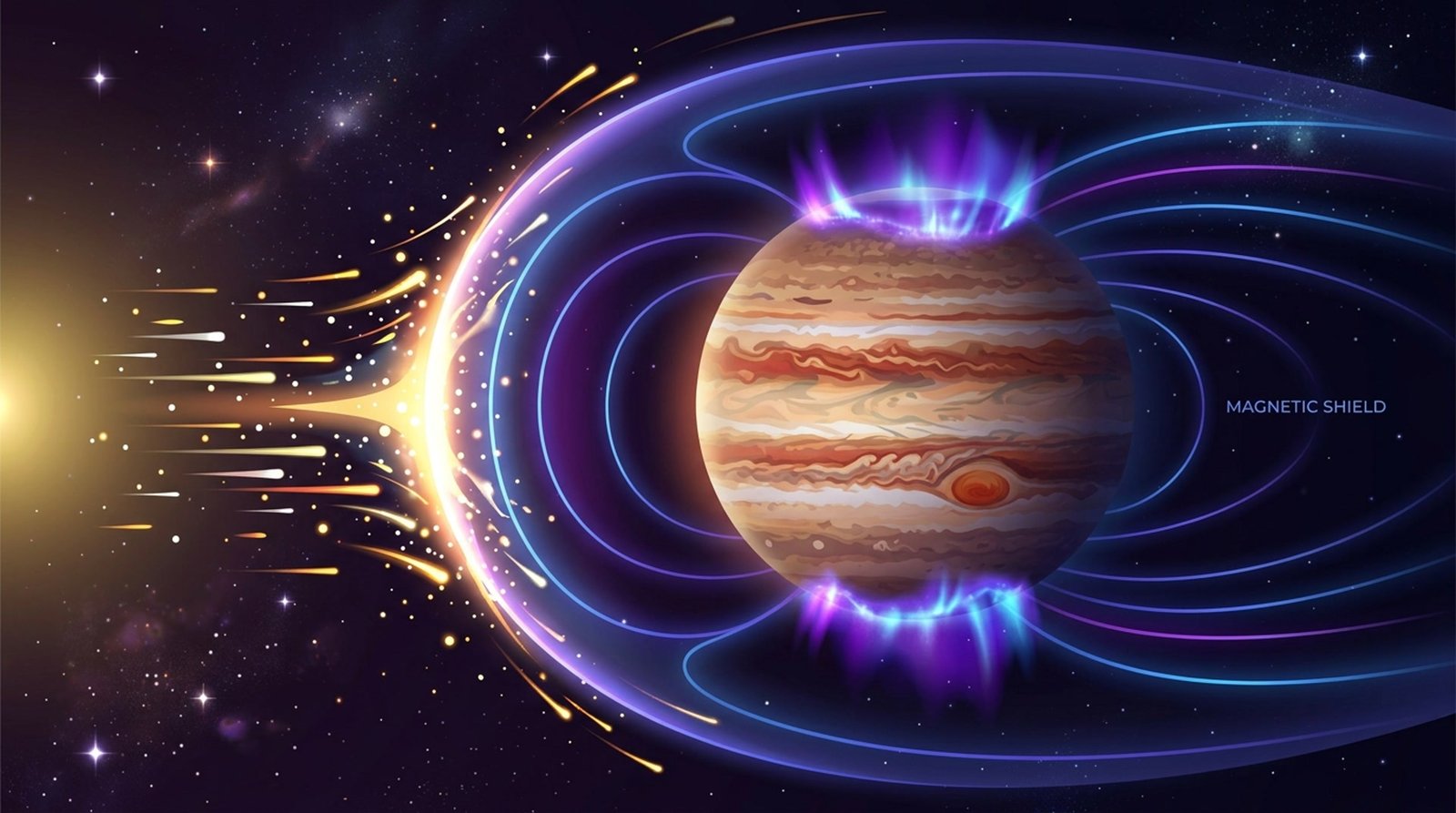
Jupiter's Auroral Engine: Supercharging the Giant
Summary
By the end of this article, you will understand how a sudden blast of solar wind can reverse Jupiter’s electrical currents, superheating its atmosphere and triggering the most powerful auroras in the solar system.
Quick Facts
- Surprise: A sudden solar wind shock can make Jupiter's auroras 4.5 times brighter in a matter of hours.
- Salient Idea: Unlike Earth, Jupiter's auroras are mostly powered by its own fast rotation, not just the Sun.
- Surprise: When compressed, the electrical currents between Jupiter's atmosphere and space actually run in reverse!
- Surprise: The solar storm dumps up to 2,000 Terawatts of power into Jupiter's upper atmosphere.
The Discovery: A 2,000 Terawatt Shock
In 2013, researchers modeled what happens when a violent burst of solar wind—like a Coronal Mass Ejection—slams into Jupiter. They didn’t just look at the magnetic field; they modeled the thermosphere, the upper layer of Jupiter’s atmosphere. They found a Surprise: when the solar wind compresses Jupiter’s massive magnetic shield, the electrical currents connecting space to the planet literally run in reverse. This injects a mind-bending 2,000 Terawatts of power into the atmosphere, triggering intense frictional heating and causing the planet’s auroras to flare up to 4.5 times their normal brightness.
Original Paper: ‘Response of the Jovian thermosphere to a transient pulse in solar wind pressure’
Transient compressions cause the reversal, with respect to steady state, of magnetosphere-ionosphere coupling currents…
— J. N. Yates et al.
The Science Explained Simply
This is NOT like wind blowing away smoke on Earth. Jupiter’s upper atmosphere acts like a massive, heavy flywheel. Because it is so massive, it has incredible inertia. When the solar wind suddenly crushes the magnetic field, the magnetic plasma spins up incredibly fast. But the heavy neutral atmosphere drags behind. This difference in speed creates massive friction, known as Joule heating. The Salient Idea is that this friction acts like a giant brake pad, transferring immense heat and energy from space directly into the planet’s sky, raising local temperatures by up to 175 degrees Kelvin.
The Aurora Connection
Earth’s auroras are directly powered by the solar wind hitting our magnetic field. Jupiter’s auroras, however, are mostly powered by the planet’s own insanely fast 10-hour rotation. But the solar wind still plays a crucial role. When a solar wind pulse hits, it acts as an amplifier. The sudden compression forces electrons down into the polar regions at terrifying speeds. This creates an ultraviolet light show 4.5 times brighter than normal. Studying this helps us understand how space weather interacts with magnetic shields, teaching us how atmospheres on Earth and other planets survive intense stellar radiation.
Extreme worlds teach us about planetary survival.
— NorthernLightsIceland.com Team
A Peek Inside the Research
How do you measure a storm on a planet 400 million miles away? You build a digital universe. The team used a Global Circulation Model (GCM) called ‘JASMIN’ to simulate Jupiter’s thermosphere. Instead of assuming the atmosphere instantly reacted to magnetic changes, they let the math simulate the delay. They mapped the flow of electrical currents, tracking how angular momentum transferred between the magnetosphere and the planet. It is a brilliant example of using complex fluid dynamics to predict phenomena we can eventually look for with space telescopes like Hubble.
We present the first study to investigate the response of the Jovian thermosphere to transient variations in solar wind dynamic pressure…
— The Research Team
Key Takeaways
- Solar wind compressions act like a giant switch, reversing energy flow into Jupiter's atmosphere.
- Jupiter's upper atmosphere acts like a massive flywheel, taking a long time to adjust to sudden magnetic changes.
- Joule heating (electrical friction) doubles during these solar storms, creating massive local temperature spikes.
- Understanding Jupiter's extreme space weather helps us model magnetic fields and atmospheric survival across the universe.
Sources & Further Reading
Frequently Asked Questions
Q: What happens when the solar wind expands instead of compresses?
A: The opposite happens! The atmosphere cools down slightly, and the auroral brightness drops, causing the planet to lose energy back into space as the system expands.

X-Ray Vision on Mars: How Rovers 'See' Underground
Summary
By the end of this article, you will understand how a Mars rover uses ground-penetrating radar to hunt for buried water, and how scientists use computer simulations to fix blurry data caused by a bumpy Martian ride.
Quick Facts
- Surprise: The ExoMars rover is designed to drill 2 meters underground to search for signs of life.
- Salient Idea: It uses a special radar called WISDOM that acts like an underground echo-locator.
- Surprise: If the rover drives over a bump and tilts even 13%, the radar signal gets badly distorted.
- Surprise: Scientists build virtual computer models of Martian dirt to test the radar before it even launches.
The Discovery: The Bumpy Ride Problem
To find traces of life on Mars, the European Space Agency’s ExoMars mission relies on the WISDOM radar. This instrument is designed to probe up to 2 meters beneath the Martian surface. However, researchers discovered a major Surprise: the data gets messy when the rover moves. As the rover drives over the uneven Martian topography, the angle of its radar antenna changes. The French research team realized that if the rover tilts by just 13 to 25 percent, the radar signal is thrown off by more than 2 decibels—enough to completely blur our picture of the underground. To solve this, they didn’t redesign the rover; they built a mathematical model to understand and correct the distortion.
Original Paper: ‘ETUDE DES SIGNAUX RECUEILLIS PAR UN RADAR EMBARQUE SUR UN VEHICULE EN DEPLACEMENT’
A correction of the incidence angle or a correction of the measurements could thus be considered.
— F. Demontoux and Team
The Science Explained Simply
This is NOT an optical camera that takes pictures of underground rocks. Ground-penetrating radar works more like a bat’s echolocation, but with light. The radar shoots high-frequency radio waves (between 500 MHz and 3 GHz) into the ground. When these waves hit different layers—like moving from dry dust to wet basalt—they bounce back. The Salient Idea here is that the echo depends entirely on the angle of the bounce. If the rover’s wheels are tilted on a rock, the ‘echo’ comes back crooked. By creating a parametric computer model using a software called HFSS, scientists can simulate exactly how the radio waves scatter when the terrain changes, allowing them to reverse-engineer a clear image from a crooked echo.
The Aurora Connection
Why are we looking underground in the first place? It all comes back to magnetic fields. Earth has a strong, active magnetic field that creates beautiful phenomena like auroras and protects our atmosphere from the harsh solar wind. Mars, however, lost its magnetic shield billions of years ago. Without it, the surface was bombarded by radiation, turning it into a sterile desert. If life—or liquid water—still exists on Mars, it had to hide deep underground. Understanding how to perfect subsurface radar allows us to explore the hidden safe havens on planets that lost their magnetic armor.
The subsurface of Mars remains unknown and seems the best place to harbor conditions favorable to life.
— F. Demontoux and Team
A Peek Inside the Research
Solving this problem required immense Knowledge and Tools. The researchers couldn’t test their theories on Mars yet, so they built a virtual one. Because calculating an entire Martian landscape at once would crash their computers, they used a clever workaround. They modeled just the radar antenna and the exact patch of ground beneath it, then mathematically shifted the properties (like rock size and soil ‘permittivity’) to simulate movement. By running thousands of ‘step-frequency’ simulations, they mapped exactly how a bump on the surface warps the data from below, creating a digital key to unlock real Martian mysteries.
Our problem therefore consisted of simulating this movement and thus that of the antenna above a geological structure whose properties vary.
— F. Demontoux and Team
Key Takeaways
- Searching for Martian life means looking underground, where it is safe from space radiation.
- Moving radars suffer from signal distortion when the ground is uneven or the soil composition changes.
- Computer simulations can predict how a rover's tilt affects radio waves, allowing us to correct the errors.
- Without a protective magnetic field, planetary surfaces are barren, making subsurface exploration critical.
Sources & Further Reading
Frequently Asked Questions
Q: Why can’t we just use cameras to look for life on Mars?
A: Cameras only see the surface! Because Mars has no magnetic field, the surface is blasted by harsh space radiation. Any surviving signs of life or liquid water would be hidden deep underground, requiring radar to ‘see’ them.
Q: What happens when the rover drives over a rock?
A: The tilt changes the angle of the radar antenna. This causes the radio echoes from underground to bounce back incorrectly, which makes the resulting data look blurry or distorted.
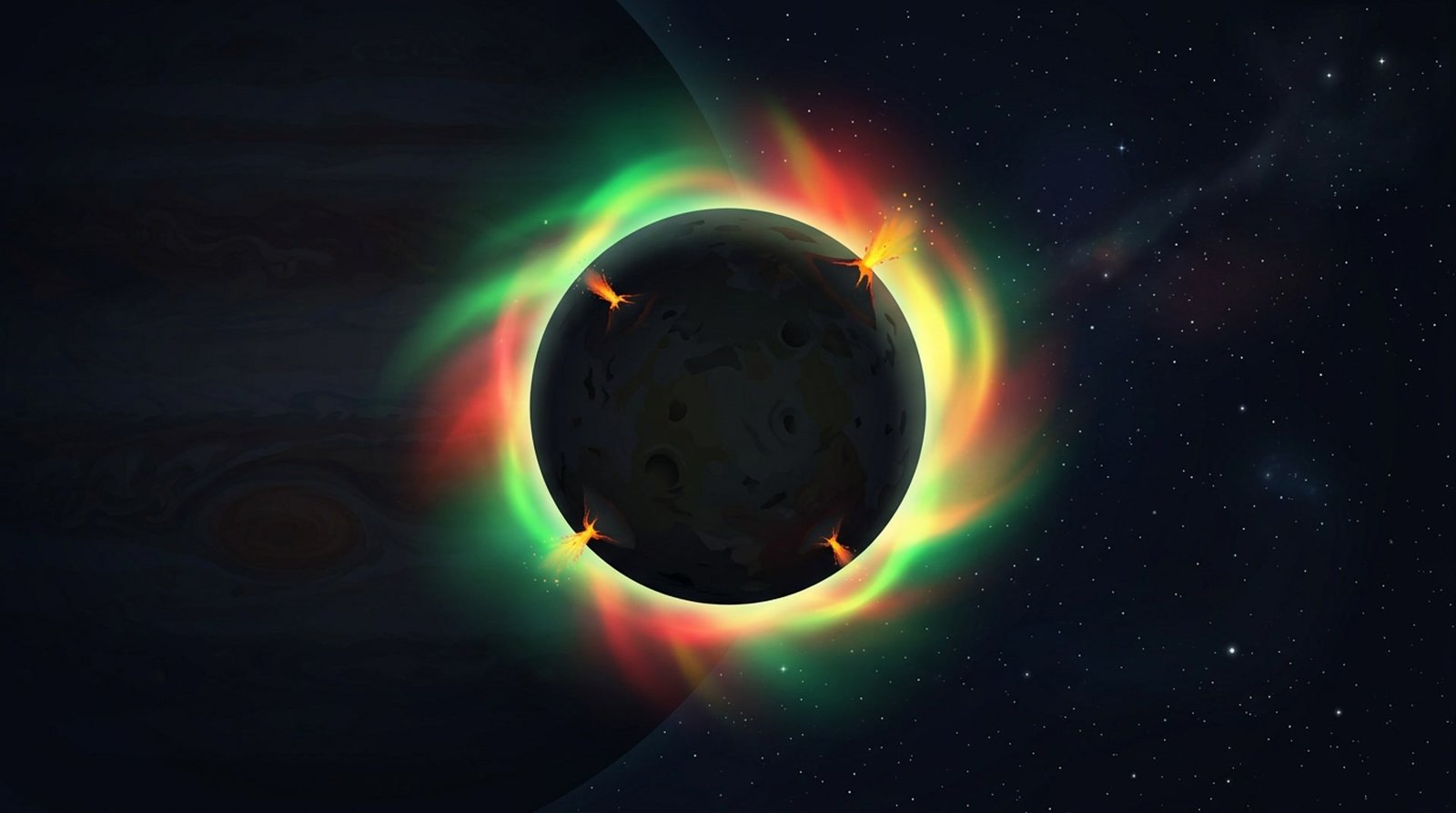
Volcanoes and Eclipses: Decoding the Hidden Auroras of Jupiter's Moon Io
Summary
By the end of this article, you will understand how scientists use Jupiter’s shadow to reveal invisible, glowing volcanic gases on its moon Io, and what that tells us about magnetic fields in space.
Quick Facts
- Surprise: Io is the most volcanically active world in our solar system, spewing out sulfur, salt, and potassium.
- Salient Idea: Astronomers have to wait until Io is completely hidden in Jupiter's shadow (an eclipse) to see its faint auroral glow.
- Surprise: Recent telescope observations discovered 13 brand new types of auroral light, tripling our previous knowledge of Io's visible auroras.
- Surprise: Io's auroras don't just happen at the poles like on Earth—they form glowing spots near the equator and light up the volcanic plumes themselves.
The Discovery: Tripling the Glow
In recent observations between 2022 and 2024, astronomers pointed the massive Keck telescope at Io right as it slipped into Jupiter’s dark shadow. They weren’t just taking pictures; they were using high-resolution spectroscopy to split the light into a rainbow. They found a Surprise: 13 brand new auroral emission lines that no one had ever seen before! This effectively tripled the number of known optical emissions for Io. By catching the moon in the dark, they could see the faint glow of oxygen, sodium, sulfur, and potassium atoms being excited by high-speed electrons. It is a brilliant example of how hiding from the sun can actually shed light on a planet’s deepest secrets.
Detection of New Auroral Emissions at Io and Implications for Its Interaction with the Plasma Torus
We observed Io’s optical aurora in eclipse… tripling the total number of optical emissions lines detected at Io.
— Zachariah Milby
The Science Explained Simply
This is NOT a normal atmosphere like Earth’s where gases stay gaseous. Because Io is so far from the sun, its sulfur dioxide atmosphere is incredibly fragile. The Salient Idea here is the concept of atmospheric collapse. When Io goes into an eclipse behind Jupiter, the temperature drops so fast that the volcanic gas literally freezes and falls back onto the surface as frost! But the auroras keep glowing. Why? Because the electrons slamming into the remaining high-altitude oxygen and sulfur atoms don’t care if the sun is shining. They are powered by Jupiter’s massive magnetic field, creating a constant, eerie glow even as the air below them freezes solid.
During eclipse SO2 can freeze back onto the surface, resulting in a thin exosphere.
— The Research Team
The Aurora Connection
Unlike Earth, where auroras are driven by the solar wind, Io is trapped deep inside Jupiter’s incredibly powerful magnetic field. Jupiter spins fast, sweeping a donut-shaped cloud of charged particles—called a plasma torus—right over Io. When these plasma electrons crash into the volcanic gases spewing from Io’s surface, they transfer their energy, causing the gas to glow. This isn’t just a pretty light show; these auroras map out the invisible magnetic web connecting Jupiter and its moons. Understanding how this giant magnetic engine works helps us understand space weather, radiation environments, and how magnetic fields protect or strip away planetary atmospheres.
We used high-resolution optical spectra… as a remote sensing window into the interaction between Io’s atmosphere and electrons within Jupiter’s magnetosphere.
— Study Authors
A Peek Inside the Research
How did scientists figure out exactly what gases were glowing? They didn’t just guess. They used a sophisticated tool called HIRES (High Resolution Echelle Spectrometer) on the Keck I telescope. It acts like a super-prism. Every chemical element emits a very specific wavelength of light—like a cosmic barcode. The team had to carefully subtract the scattered background light from Jupiter to isolate Io’s incredibly faint signals. They then compared these new barcodes to older images taken by the Cassini spacecraft in 2001. This brilliant detective work allowed them to prove that the glowing equatorial spots and limb glows were coming from distinct elements like sulfur and oxygen.
High-cadence observations leverage the large collecting areas of ground-based telescopes… to achieve high signal-to-noise.
— The Astronomers
Key Takeaways
- Io's fragile atmosphere is a mix of volcanic gas and frost that glows when hit by electrons from Jupiter's magnetic field.
- By analyzing different colors of light, scientists can identify exact atomic elements like Sodium and Sulfur in the alien air.
- The atmosphere actually 'collapses' and freezes back onto the surface when the sun goes down during an eclipse.
- Studying Io's auroras helps us measure the strength, energy, and density of Jupiter's massive plasma torus.
Sources & Further Reading
Frequently Asked Questions
Q: Why do astronomers have to wait for an eclipse to see Io’s auroras?
A: Sunlight completely washes out the faint glow of the auroras. By waiting until Io moves into the shadow of giant Jupiter, the background goes dark, allowing the sensitive telescopes to pick up the glowing gases.
Q: Are Io’s auroras the same colors as Earth’s?
A: Not exactly! Earth’s auroras are mostly green and red from oxygen. Io’s auroras include those, but also feature the bright yellow of sodium and the unique glows of volcanic sulfur and potassium.
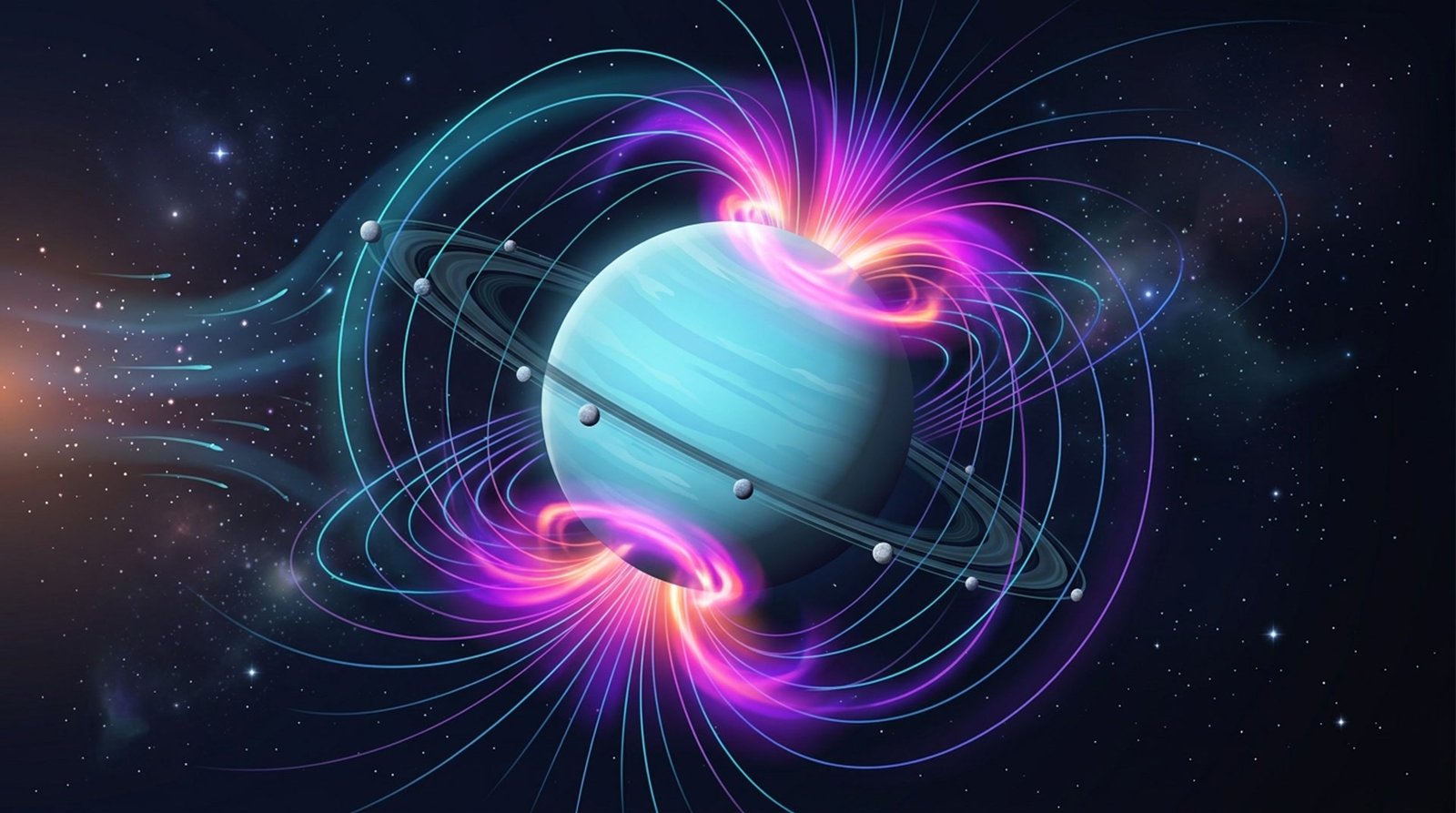
The Ice Giant's Hidden Space Heaters: Uncovering Uranus' Auroras
Summary
By the end of this article, you will understand why an ultra-cold planet is mysteriously cooling down, and how invisible magnetic auroras cause sudden, localized heat spikes in its upper atmosphere.
Quick Facts
- Surprise: Uranus' upper atmosphere is hundreds of degrees hotter than sunlight alone can explain, yet it has been steadily cooling since 1986.
- Salient Idea: The planet rolls on its side, and its magnetic poles are tilted entirely out of alignment with its spin.
- Surprise: In 2018, scientists saw the planet's temperature spike across two consecutive nights, matching the 8.7-hour gap between its two magnetic poles rotating into view.
- Surprise: Auroras on Uranus don't just glow; they physically heat the surrounding hydrogen gas.
The Discovery: A Cold Planet Gets Cooler
For decades, astronomers have been puzzled by Uranus. Despite being incredibly far from the Sun, its upper atmosphere is strangely hot—hundreds of degrees warmer than solar heating alone can explain. But here is the Surprise: since the Voyager 2 spacecraft flew by in 1986, the planet’s thermosphere has actually been steadily cooling down. To figure out why, scientists recently aimed a high-power spectrograph called IGRINS at the ice giant. In 2023, they confirmed the long-term cooling trend was still happening. But looking back at data from 2018, they noticed a massive, unexpected anomaly. Over two consecutive nights, the temperature of the planet’s hydrogen gas suddenly spiked by over 140 degrees. This was not a global climate shift; this was the signature of a localized space heater firing up as the planet rotated.
The consecutive-nights at elevated temperature… suggest that Uranus’ near-IR H2 aurora was detected over each of the northern and southern magnetic poles.
— L. M. Trafton & K. F. Kaplan
The Science Explained Simply
When we think of planetary heating, we usually think of sunlight. This is NOT solar heating. The sudden temperature spikes on Uranus are caused by auroral heating. On Earth, auroras (the Northern Lights) are beautiful ribbons of light. On Uranus, they are intense bursts of energy driven by charged particles slamming into the atmosphere. The Salient Idea here is that these particles transfer kinetic energy to the hydrogen gas, physically heating it up. Because Uranus is tilted 98 degrees on its side and its magnetic poles are wildly off-center, the planet’s rotation dragged first the northern aurora, and then the southern aurora, right across the telescope’s line of sight over a 26-hour period. The telescope wasn’t just seeing the atmosphere; it was looking directly down the barrel of an active magnetic storm.
The Aurora Connection
Auroras are the visible (or in this case, infrared) fingerprints of a planet’s magnetic field interacting with the solar wind. Earth’s magnetic field acts like a well-organized shield, funneling solar wind neatly to our north and south poles. Uranus’ magnetic field is a chaotic, tumbling mess. By measuring the exact temperature and location of these auroral heat spikes, scientists can map the invisible magnetic armor protecting the ice giant. Understanding how Uranus’ weird magnetic field catches and processes solar energy gives us vital clues about how magnetic shields operate on thousands of similar ‘ice giant’ exoplanets scattered across the galaxy. It reminds us that magnetic fields do not just protect atmospheres; they actively shape planetary weather.
The IR aurorae are thermalized by kinetic processes… so they persist according to the local heat capacity.
— Research Team
A Peek Inside the Research
How do you measure the exact temperature of a specific patch of gas 1.8 billion miles away? It comes down to high-resolution spectroscopy. The team used the IGRINS spectrograph, which splits incoming light into thousands of narrow bands. The challenge with observing Uranus is that Earth’s own atmosphere is full of glowing gases and water vapor that drown out the signal. IGRINS has such incredible resolution that it acts like a microscopic scalpel, separating the narrow emission lines of Uranus’ hydrogen from the noisy background of Earth’s sky. By comparing the strength of different light signatures from the hydrogen molecules, the team could calculate the exact rotational temperature of the gas, proving the existence of the auroral hot spots.
We report the first instance of high spectral resolution being used to observe Uranus… where the sky background is suppressed and narrow planetary emission lines stand out.
— The Authors
Key Takeaways
- High-resolution spectrometers act like cosmic thermometers, reading the exact temperature of gas molecules billions of miles away.
- Uranus is experiencing a decades-long cooling trend that defies simple seasonal explanations.
- Auroras create localized hot spots that can skew our measurements of a planet's overall climate.
- Tracking infrared auroras helps us map how the solar wind interacts with deeply weird magnetic fields.
Sources & Further Reading
Frequently Asked Questions
Q: Why is Uranus’ upper atmosphere cooling down?
A: Scientists aren’t entirely sure! It could be a delayed seasonal reaction to its 84-year orbit around the Sun, or it might be related to a long-term drop in the power of the solar wind since the 1980s.
Q: How are Uranus’ auroras different from Earth’s?
A: Earth’s auroras are aligned near our geographic poles. Uranus rolls on its side, and its magnetic poles are tilted 60 degrees away from its spin axis, meaning its auroras occur closer to its equator and wobble chaotically as it spins.

Decoding the Dust: How We Map Baby Planet Nurseries
Summary
By the end of this article, you will understand how astronomers combine chemistry and 3D computer modeling to figure out exactly what new planets are made of before they even form.
Quick Facts
- Surprise: The dust that builds planets makes up only 1% of a disk's mass, but it blocks almost all the starlight!
- Surprise: Astronomers found a hidden 'cavity' near the star MP Mus that telescopes couldn't even see directly.
- Salient Idea: The EaRTH model combines two different types of science (chemistry and 3D physics) that are usually kept totally separate.
- Salient Idea: The disk around the star MP Mus is filled with specific gemstones, like microscopic olivine and pyroxene.
The Discovery: The Cosmic Recipe Problem
For years, astronomers studying how planets form faced a frustrating bottleneck. They could study what the dust in a protoplanetary disk was made of (its mineralogy), OR they could study how the disk was shaped (its 3D structure). Because these features were usually studied separately, we were only getting half the story. Enter the EaRTH Disk Model. A team of scientists combined an empirical tool that reads chemical ‘fingerprints’ from starlight with a powerful 3D radiative transfer program called MCFOST. By feeding the exact chemical recipe of the dust directly into the 3D physics engine, they created a hybrid model. When they tested this on a young star system named MP Mus, it revealed a stunningly detailed map of where specific crystals were baking in the star’s heat.
Original Paper: ‘The Empirical and Radiative Transfer Hybrid (EaRTH) Disk Model’
The simultaneous insight into disk composition and structure provided by the EaRTH Disk methodology should be directly applicable to the James Webb Space Telescope.
— William Grimble et al.
The Science Explained Simply
This is NOT about taking a clear photograph through a telescope. Protoplanetary disks are often too far and too blurry to see perfectly. Instead, astronomers capture a spectrum—a barcode of infrared light. Every mineral, like olivine or pyroxene, absorbs and emits light at very specific wavelengths. The Salient Idea here is reverse-engineering: by looking at the missing and bright spots in the barcode, the EaRTH model figures out exactly what types of dust are floating in the disk, and how hot they are. It then uses physics to calculate exactly where that dust must be sitting in the disk to reach those temperatures.
The Aurora Connection
When the EaRTH model analyzed the star MP Mus, it predicted a completely empty ‘cavity’ very close to the star that our current images couldn’t even resolve. What causes these gaps? While baby planets can sweep up the dust, these inner cavities are also deeply connected to space weather. Young stars have violent, swirling magnetic fields that whip up intense stellar winds. These magnetic forces can clear out the inner dust completely. It is the exact same magnetic physics that drives the solar wind toward Earth, eventually crashing into our atmosphere to create the beautiful auroras we see today. Understanding these magnetic winds helps us understand how solar systems settle down.
Magnetic fields don’t just create auroras; they sculpt the nurseries where planets are born.
— NorthernLightsIceland.com Team
A Peek Inside the Research
To prove their model worked, the team had to recreate the MP Mus star system inside a computer. They used a program called MCFOST, which traces millions of virtual ‘photon packets’ as they shoot out of the virtual star and bounce off the virtual dust grains. This requires immense computing power. The team had to account for dust grain sizes, the ‘flaring’ angle of the disk, and even how turbulence mixes the dust. They kept tweaking the virtual solar system until the light it produced perfectly matched the real-world data captured by the Spitzer Space Telescope and ALMA radio dishes.
We fine-tune the MCFOST results to fit the Spitzer IRS spectrum and ALMA continuum mapping data.
— Research Team
Key Takeaways
- Protoplanetary disks are the dusty swirling rings where exoplanets are born.
- Looking at just the disk's shape or just its chemistry isn't enough; you need both to understand planet formation.
- Different temperatures in the disk create different 'zones' of minerals, acting like a cosmic sorting machine.
- This hybrid computer model prepares us to decode ultra-detailed data from the James Webb Space Telescope.
Sources & Further Reading
Frequently Asked Questions
Q: What is a protoplanetary disk?
A: It is a rotating circumstellar disk of dense gas and dust surrounding a young, newly formed star. Over millions of years, this dust clumps together to form planets.
Q: Why is the dust so important if it’s only 1% of the disk?
A: Even though gas makes up 99% of the disk, the dust is what blocks, absorbs, and scatters the star’s light. It’s also the raw material that rocky planets like Earth are made of!
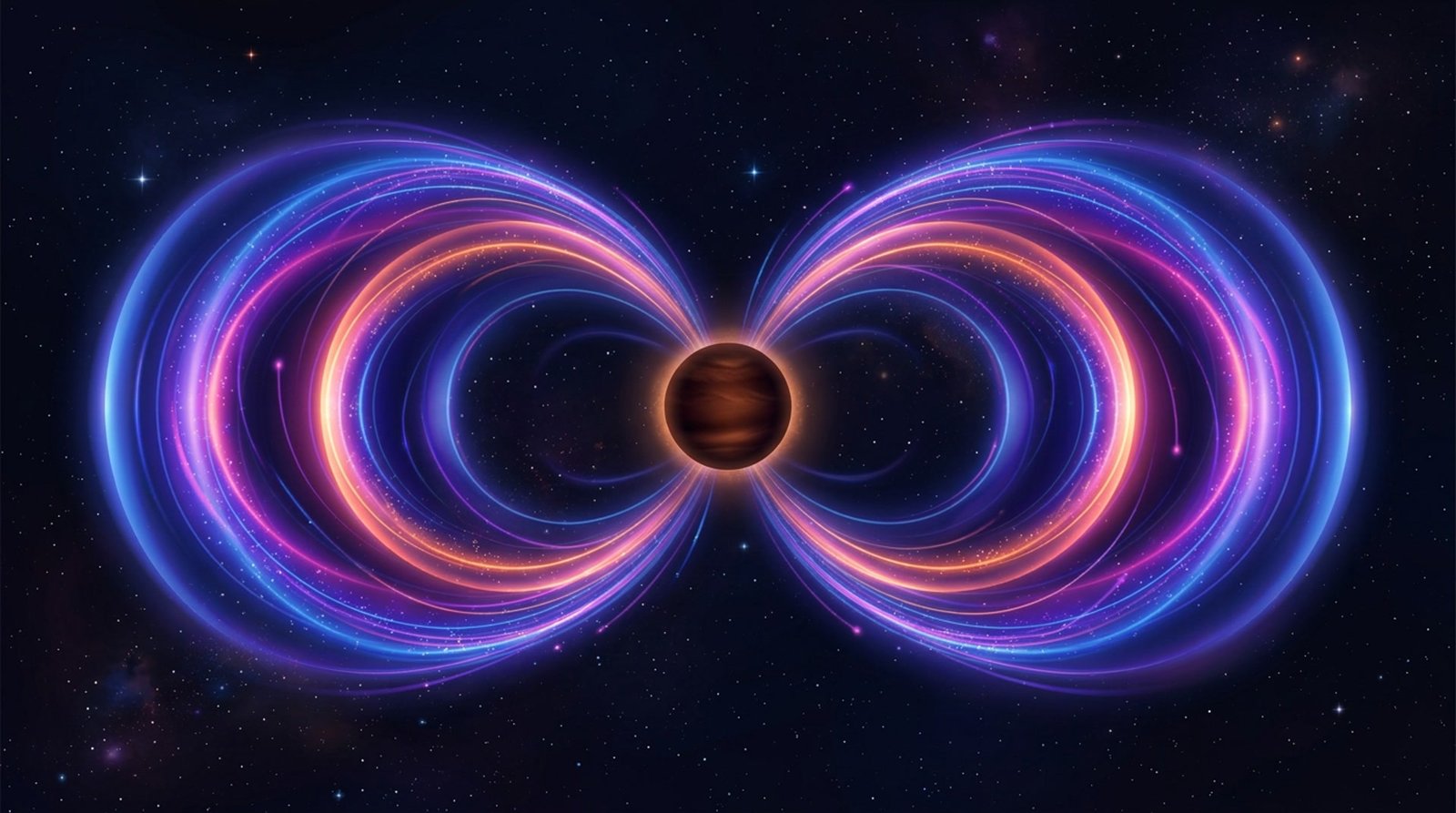
The First Alien Radiation Belt Ever Seen
Summary
By the end of this article, you will understand how scientists took the first picture of a giant magnetic radiation belt outside our solar system, and what it tells us about cosmic weather.
Quick Facts
- Surprise: The radiation belt is 18 times wider than the star itself
- Salient Idea: The object is a 'brown dwarf'—too massive to be a planet, but too small to be a normal star
- Surprise: The electrons trapped in this belt are moving near the speed of light
- Surprise: Scientists had to link 39 radio dishes from Hawaii to Germany to take the picture
The Discovery: Seeing the Invisible Field
In astronomy, seeing is believing. But how do you see a magnetic field? In 2023, scientists announced a major breakthrough: they resolved the first image of an extrasolar radiation belt. They focused on LSR J1835+3259, an ultracool dwarf about 18 light-years away. They found a Surprise: a massive, glowing, double-lobed structure of radio waves. This wasn’t a sudden burst or a glitch. Over three observations spanning a year, the twin lobes stayed perfectly stable. They had discovered a giant, persistent radiation belt. It is morphologically similar to the ones around Jupiter, but on an absolutely massive scale.
Original Paper: ‘Resolved imaging of an extrasolar radiation belt around an ultracool dwarf’
We present high resolution imaging of the ultracool dwarf… demonstrating that this radio emission is spatially resolved and traces a long-lived, double-lobed, and axisymmetric structure.
— Dr. Melodie M. Kao
The Science Explained Simply
This is NOT a belt of asteroids, ice, or dust. A radiation belt is a giant, invisible trap made of a strong magnetic field. The Salient Idea here is that the field catches extremely fast-moving, high-energy particles zooming through space. When these particles (like electrons) are caught, they spiral around the magnetic field lines at close to the speed of light. As they spin, they emit a steady hum of light called synchrotron radiation. That’s the steady radio wave glow the telescopes picked up. These belts sit completely outside the object itself. In fact, the two glowing lobes of this brown dwarf’s belt are separated by up to 18 times the radius of the dwarf!
The Aurora Connection
You might know that Earth’s magnetic field creates the beautiful Northern Lights while protecting us from deadly solar wind. Well, LSR J1835+3259 also has auroras, but they shine in invisible radio waves! Researchers found these bright auroral bursts happening right in the center, nestled between the two giant radiation lobes. The magnetic dipole acts as a massive shield and particle accelerator. Discovering this planet-like aurora and radiation belt combo on a star-like object tells us that the universe is incredibly efficient at creating cosmic weather systems. Understanding these giant magnetic shields helps us figure out how smaller ones, like Earth’s, behave and protect our own atmosphere.
A unified picture where radio emissions in ultracool dwarfs manifest from planet-like magnetospheric phenomena has emerged.
— Original Research Paper
A Peek Inside the Research
How do you take a picture of a faint radio hum light-years away? The team couldn’t just use one telescope. Instead, they relied on Very Long Baseline Interferometry (VLBI). By linking 39 radio dishes from the USA to Germany, they created a virtual telescope the size of the Earth! This gave them the intense resolving power needed to clearly see the empty space separating the two lobes. They had to carefully subtract the bright, flashing auroras from their data to reveal the much fainter, steady glow of the radiation belt underneath. It was a masterpiece of data processing.
Key Takeaways
- Radiation belts are persistent rings of high-energy plasma trapped by magnetic fields
- Unlike sudden solar flares, this alien radio emission is incredibly steady and long-lasting
- Radio aurorae flash at the center of the structure, proving a strong magnetic connection
- This discovery blurs the line between stars and planets, showing star-like objects have planet-like magnetic environments
Sources & Further Reading
Frequently Asked Questions
Q: What exactly is an ultracool dwarf?
A: An ultracool dwarf is a cosmic ‘in-between’ object. It’s too massive to be a regular planet like Jupiter, but not massive enough to fuse hydrogen and shine brightly like our Sun. They are often referred to as brown dwarfs.

Seeing the Invisible: How Scientists Photograph Magnetic Shields
Summary
By the end of this article, you will understand how scientists take pictures of invisible magnetic forcefields using ‘ghost’ atoms, and why this helps us predict space weather.
Quick Facts
- Surprise: Magnetic fields are completely invisible to regular cameras, but we can photograph them using fast-moving 'ghost' atoms.
- Salient Idea: When a fast, charged particle steals an electron from a slow gas atom, it becomes a neutral missile.
- Surprise: Because they are neutral, these atoms ignore magnetic fields and fly straight, acting just like light rays.
- Surprise: Mercury's magnetic field is so small that the solar wind actually slams into the ground, blasting rocks directly into space.
The Discovery: Photographing the Invisible
Before ENA imaging, scientists had to fly satellites blindly through space, measuring invisible magnetic fields one point at a time. It was like trying to understand a massive hurricane by walking through it with a single wind meter. They needed a Surprise global picture. They found their answer in Energetic Neutral Atoms (ENAs). When a fast, charged ion in space crashes into a slow, cold gas atom, it steals an electron. Suddenly, the ion becomes neutral. Because it has no charge, it no longer cares about the planet’s magnetic field. It shoots out in a perfectly straight line, just like a photon of light. By building special cameras to catch these straight-flying atoms, scientists realized they could finally take a real, 3D photograph of the massive, invisible magnetic storms swirling around our planet.
Original Thesis: ‘Energetic Neutral Atom Imaging of Planetary Environments’ by Alessandro Mura
Before the first ENA data, most of the knowledge about the Earth magnetospheric plasma came from in situ measurements… which could not represent any real instantaneous situation.
— Alessandro Mura
The Science Explained Simply
This is NOT a normal camera that catches light. An ENA camera catches actual matter. Think of a bumper car arena where the cars are trapped by magnetic tracks. The Salient Idea here is the ‘Charge Exchange.’ Imagine a fast-moving ion zooming along a magnetic track. It bumps into a slow, neutral gas atom and steals its electron. Instantly, the fast atom becomes neutral. It loses its connection to the magnetic track and flies off in a straight line, completely ignoring the magnetic field. Because they fly straight, we can trace them backward to see exactly where they came from. If we catch enough of these ‘ghost’ atoms, we can paint a brilliant picture of the massive, swirling plasma rings that surround planets like Earth, Mars, and Mercury.
The Aurora Connection
Earth’s magnetic field protects us from the solar wind, but during strong solar storms, particles get trapped in a giant donut-shaped cloud around Earth called the ring current. When this ring current gets supercharged, it funnels energy down into our atmosphere, sparking massive, glowing auroras. Before ENA imaging, we could only see the aurora, not the invisible storm in space powering it. By capturing these neutral atoms, we can monitor the health of our magnetic shield in real-time. We can watch space weather unfold globally. Studying these fields on Earth, as well as on planets with different shields like Mars and Mercury, helps us understand exactly how solar winds interact with planets to create beautiful auroras—or strip away atmospheres entirely.
ENA images are in principle able to depict such real conditions, and give the dynamical time profile that has led to the configuration photographed.
— Alessandro Mura
A Peek Inside the Research
How do you build a camera for invisible atoms? It requires intense Knowledge and Tools. Researchers develop instruments like the NAOMI and ELENA sensors. First, these cameras use high-voltage electric plates to deflect any charged particles, keeping the image clean. Then, the neutral atoms pass through a super-thin carbon foil or bounce off a special surface. This knocks an electron loose, allowing the camera to measure the atom’s exact speed and mass using a ‘Time-of-Flight’ detector. It takes millions of complex mathematical calculations, tracking particle paths backward through space, to turn these tiny physical impacts into a glowing, color-coded map of a planet’s magnetic shield. It is a triumph of engineering over the invisible universe.
Neutral atom imaging gives information not only about the energetic plasma, but also about the thermal neutral population.
— Alessandro Mura
Key Takeaways
- Energetic Neutral Atom (ENA) imaging lets us see whole magnetospheres in one snapshot.
- Charge-exchange is a cosmic game of tag where an ion grabs an electron to become neutral.
- Earth has a giant plasma ring current that we can now 'see' during solar storms.
- Studying ENA around Mars and Mercury teaches us how solar winds interact with planets to strip away atmospheres.
Sources & Further Reading
Frequently Asked Questions
Q: Can these energetic atoms hurt us on Earth?
A: No. Earth’s thick atmosphere acts like a physical brick wall, safely absorbing these atoms long before they reach the ground. They only exist high up in the vacuum of space.
Q: Why don’t we just use regular cameras to photograph space weather?
A: Regular cameras only catch light (photons). The plasma swirling around a planet is mostly invisible to regular light cameras, so we have to catch the actual atoms flying out of the storm to see its shape.
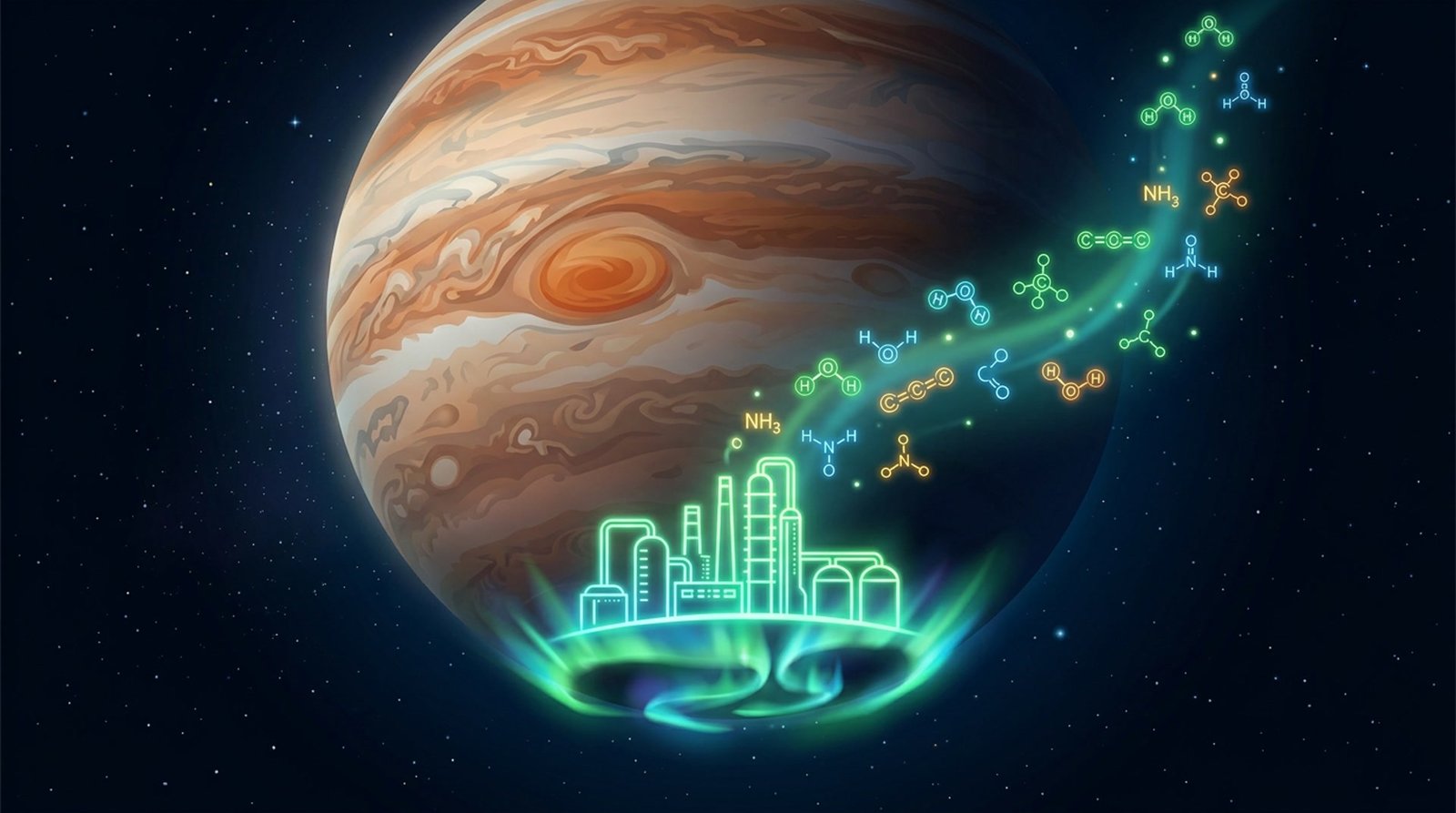
Jupiter's Auroras: A Giant Chemical Factory
Summary
By the end of this article, you will understand how Jupiter’s massive auroras act like a giant chemical factory, using space radiation to manufacture molecules in the dark polar atmosphere.
Quick Facts
- Surprise: Auroras don't just emit light; they act as catalysts to manufacture new chemicals.
- Salient Idea: Juno's polar orbit let scientists look directly down at Jupiter's south pole for the first time.
- Surprise: The region inside the southern auroral oval has 3 times more acetylene gas than the surrounding areas.
- Surprise: Normally, solar energy drives planetary chemistry, but at Jupiter's dark poles, charged particles take over.
The Discovery: The Southern Polar Mystery
In an unprecedented mission, the Juno spacecraft passed directly over Jupiter’s south pole. Scientists weren’t just looking at the stunning auroras; they were studying the invisible atmosphere beneath them. By looking at ultraviolet sunlight reflecting off the planet, they found a Surprise: a massive dark patch precisely matching the southern auroral oval. This wasn’t a cloud. It was a massive concentration of acetylene gas (C2H2). The auroras were actively changing the atmosphere’s chemistry. They had discovered that Jupiter’s light show is actually a giant, glowing chemical factory.
Enhanced C2H2 absorption within Jupiter’s southern auroral oval from Juno UVS observations
The C2H2 abundance poleward of the auroral oval is a factor of 3 higher than adjacent quiescent, non-auroral longitudes.
— Dr. Rohini S. Giles
The Science Explained Simply
This is NOT like normal planetary chemistry. Usually, the sun’s ultraviolet rays break down methane to create new chemicals like acetylene. Because the poles get very little sunlight, acetylene levels should naturally drop near the poles. But here is the Salient Idea: the auroras break the rules. Jupiter’s massive magnetic field funnels charged particles into the poles at incredible speeds. When these particles smash into the atmosphere, they trigger ion-neutral recombination reactions. Instead of solar energy, the kinetic energy of the auroral particles acts as the chemical catalyst, forcing molecules to combine into acetylene. It is a completely different way to build an atmosphere.
The Aurora Connection
Auroras on Earth are beautiful ribbons of light caused by solar wind hitting our magnetic field. Jupiter’s auroras are the most powerful in the Solar System. This study proves that auroras are not just a visual phenomenon—they are a powerful physical and chemical force. The magnetic field acts like a funnel, driving high-energy electrons and ions deep into the stratosphere. Without this magnetic funnel, the atmosphere at the poles would be chemically quiet and frozen. Studying this helps us understand how space weather shapes the very air of a planet, a process that could be happening on exoplanets across the galaxy.
The localized enhancement of C2H2 is likely caused by the influx of charged particles within Jupiter’s auroras.
— Research Team
A Peek Inside the Research
How do you measure invisible gas on a planet 500 million miles away? It comes down to Knowledge and Tools. The team used the Ultraviolet Spectrograph (UVS) on the Juno spacecraft. Instead of looking at the glowing aurora itself, they looked at reflected sunlight. Different gases absorb different colors of light. Acetylene acts like a sponge for specific ultraviolet wavelengths (around 172 nanometers). By measuring the missing light—the ultraviolet shadow—the scientists could map exactly where the acetylene was hiding. It is a triumph of using invisible light to trace invisible chemistry.
Unlike previous infrared observations, the UV spectra used in this study are not sensitive to the temperature of the atmosphere.
— Juno UVS Science Team
Key Takeaways
- Charged particles from space rewrite Jupiter's atmospheric chemistry.
- Ultraviolet light helps scientists 'see' invisible gases by looking at the shadows they cast.
- Ion-neutral chemical reactions dominate the polar stratosphere, completely overriding normal solar chemistry.
- Understanding this requires merging models of magnetic fields with neutral atmospheric chemistry.
Sources & Further Reading
Frequently Asked Questions
Q: Why is there usually less acetylene at the poles?
A: Acetylene is normally created when sunlight breaks down methane gas. Since the poles of a planet receive much less direct sunlight than the equator, the normal chemical reactions slow down significantly.
Q: How did the Juno spacecraft survive flying over the poles?
A: Juno passes through Jupiter’s intense radiation belts very quickly during its highly elliptical orbit. However, the radiation is so intense that the UVS instrument actually has to pause data collection at the closest approach to prevent degradation!
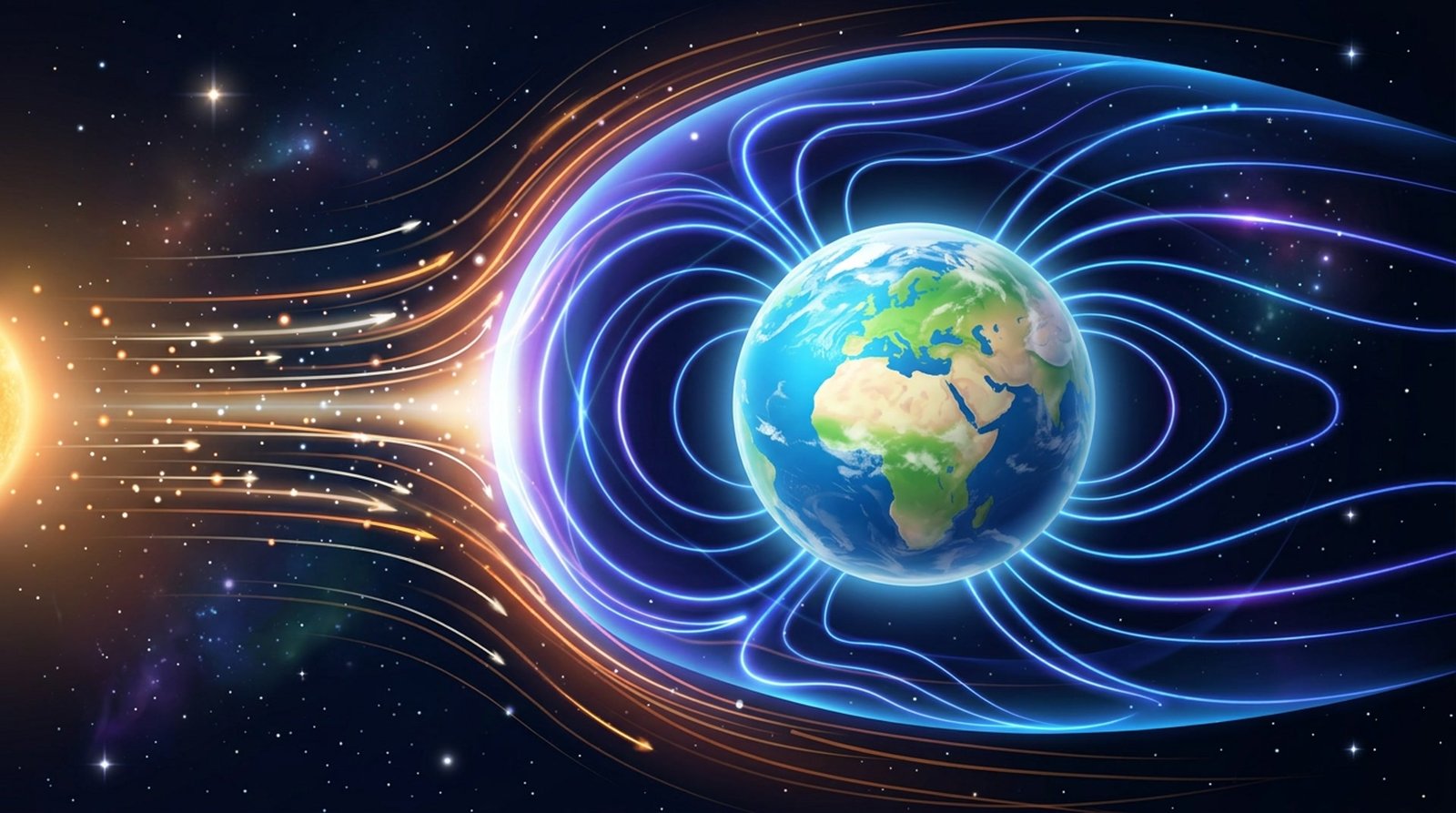
SMILE: X-Raying Earth's Invisible Magnetic Shield
Summary
By the end of this article, you will understand how a revolutionary satellite mission takes global X-ray pictures of our planet’s magnetic shield, and why seeing this invisible barrier is critical for surviving space weather.
Quick Facts
- Surprise: Earth's magnetic shield actually emits soft X-rays when blasted by solar wind
- Salient Idea: Past missions only measured space weather in tiny, local dots, but SMILE sees the entire panoramic view
- Surprise: The X-rays are created when charged solar particles 'steal' electrons from Earth's outer atmosphere
- Salient Idea: The mission orbits up to 20 Earth radii away to fit the whole magnetic bubble in a single frame
The Discovery: Seeing the Unseen Shield
For decades, scientists have studied the solar wind’s impact on Earth using satellites that measure local data—like trying to understand a global hurricane by looking through a tiny straw. They knew mass and energy entered our geospace, triggering auroras and geomagnetic storms, but they lacked a big-picture view. The Surprise came with a recent astronomical discovery: the Earth’s magnetosphere actually glows in soft X-rays! This happens through a process called Solar Wind Charge Exchange (SWCX). Instead of flying blindly through the storm, the ESA and CAS partnered to create the SMILE (Solar wind Magnetosphere Ionosphere Link Explorer) mission. By flying highly elliptical orbits over the North Pole, SMILE acts as a massive wide-angle lens, taking the first-ever continuous, uninterrupted X-ray movies of the solar wind crushing against our planet’s front door.
SMILE: A novel way to explore solar-terrestrial interactions
SMILE offers a new approach to global monitoring of geospace by imaging the magnetosheath and cusps in X-rays.
— G. Branduardi-Raymont
The Science Explained Simply
This is NOT like taking a regular photograph with visible light, and it is NOT an X-ray of solid bone. Earth’s magnetic shield is made of invisible plasma and forcefields. So how does SMILE ‘see’ it? The Salient Idea here is electron theft. The Sun blasts highly charged heavy ions (like Oxygen and Carbon) toward Earth. When these greedy ions smash into the neutral hydrogen gas surrounding our planet, they steal an electron. When that electron settles into its new home, it releases a burst of energy: a soft X-ray photon. SMILE’s Soft X-ray Imager catches these flashes. The thicker the solar wind, the brighter the X-ray glow. By mapping this glow, scientists can literally see the shape, size, and boundaries of our magnetic shield changing in real time.
The Aurora Connection
The Northern Lights are beautiful, but they are actually the exhaust footprints of a massive, violent interaction happening thousands of miles in space. When the solar wind breaks through Earth’s magnetic lines (a process called magnetic reconnection), it dumps explosive energy into our atmosphere. While SMILE’s X-ray camera watches the front of the magnetic shield take the hit, its Ultraviolet Imager (UVI) simultaneously watches the auroral oval at the North Pole. If the solar wind crushes the magnetic shield, the auroral oval expands and brightens. By watching both ends at once, scientists can finally link the cosmic weather hitting the shield directly to the auroral beads and substorms glowing in our skies.
The dimensions of the auroral oval indicate the open magnetic flux within the Earth’s magnetotail.
— SMILE Research Team
A Peek Inside the Research
You can’t just launch a billion-dollar satellite and hope the camera works. To prepare, researchers use Magneto-Hydro-Dynamic (MHD) simulations. The Salient Idea is that scientists build a digital replica of Earth’s magnetic field, hit it with virtual solar storms (like the massive St. Patrick’s Day storm of 2015), and calculate exactly what the X-ray glow should look like. They even run ‘boundary tracing algorithms’ to practice finding the exact edge of the magnetopause in pixelated images. This preparation ensures that the moment SMILE opens its mechanical eyes in space, researchers already have the tools to decode the X-rays and instantly warn us if a dangerous Coronal Mass Ejection is about to disrupt our global power grids.
Simulation and modelling of the data expected from SMILE… are advancing at a fast pace to extract the most accurate, best science.
— SMILE Definition Study
Key Takeaways
- Solar Wind Charge Exchange (SWCX) acts like an invisible flash, lighting up the magnetosphere
- SMILE combines X-ray imaging of the shield with UV imaging of the auroras to show cause and effect
- Understanding the global shape of the magnetosphere helps predict technology-destroying geomagnetic storms
- Advanced computer simulations (MHD models) are used to practice reading these X-ray images before launch
Sources & Further Reading
Frequently Asked Questions
Q: Why don’t we just use regular cameras to see the magnetic field?
A: Magnetic fields and space plasmas are completely invisible to the human eye and standard cameras. X-rays are the only way to ‘see’ the specific chemical reactions happening when solar wind hits our atmosphere.
Q: What is space weather and why should I care?
A: Space weather refers to storms of energy from the Sun. Severe space weather can fry satellites, disrupt GPS, and cause massive blackouts on Earth. Tracking it helps us protect our modern technology.
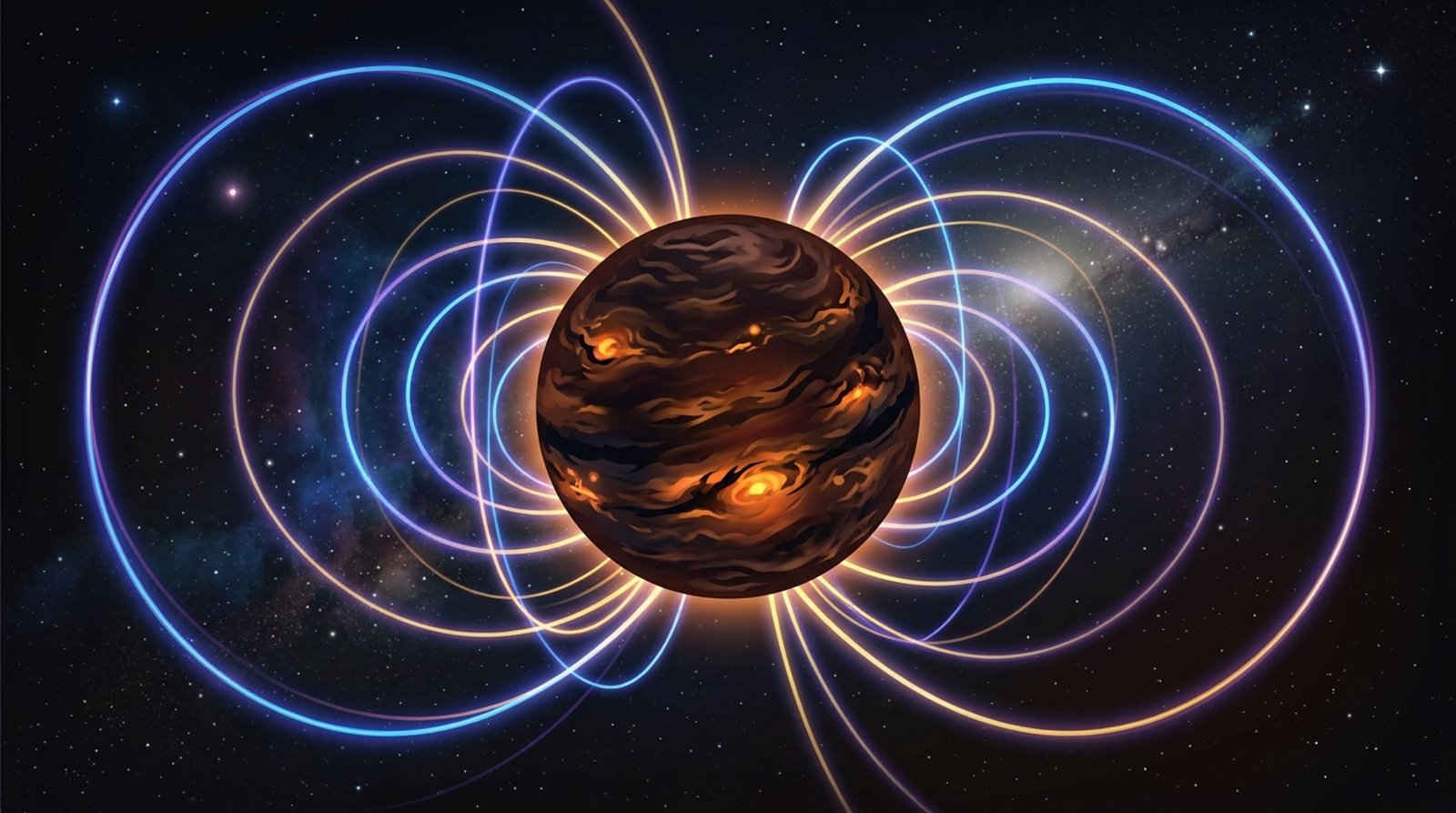
The Hunt for Invisible Alien Auroras
Summary
By the end of this article, you will understand how astronomers hunt for alien northern lights, and why failing to find them actually changes our understanding of the universe.
Quick Facts
- Surprise: Brown dwarfs—failed stars—can possess auroras up to 10,000 times more powerful than Jupiter's.
- Salient Idea: Scientists search for a specific glowing molecule, H3+, to find these alien northern lights.
- Surprise: Despite using the most powerful telescopes on Earth, researchers found zero H3+ glowing on these extreme targets.
- Salient Idea: The auroral energy might be so intense that particles crash too deep into the atmosphere, destroying the glowing molecules instantly.
The Discovery: The Search for Glowing Gas
Astronomers set out to find the ultimate cosmic light show. On Jupiter, intense auroras create a glowing molecular ion called H3+. Because brown dwarfs (objects too massive to be planets, but too small to be stars) have massive magnetic fields, scientists predicted they should have auroras thousands of times brighter. Using the powerful Keck Telescope in Hawaii, they hunted for the specific infrared ‘fingerprint’ of H3+ on five brown dwarfs and five giant exoplanets. But here is the Surprise: they found absolutely nothing. Not a single glowing molecule. Instead of a failure, this non-detection was a major clue. It proved that the physics of extreme alien auroras do not behave exactly like Jupiter’s. The energy involved is entirely different.
The limits we place on the emission of H3+ from brown dwarfs indicates that auroral generation likely does not linearly scale from the processes found on Jupiter.
— Aidan Gibbs and Michael P. Fitzgerald
The Science Explained Simply
This is NOT like looking up at the sky and seeing green ribbons of light. The auroras on brown dwarfs emit most of their energy in the invisible infrared spectrum. The Salient Idea here revolves around the glowing molecular ion H3+. It forms high in the atmosphere when radiation hits hydrogen gas. On Jupiter, it acts like a giant atmospheric thermostat, radiating heat away into space. But on a brown dwarf, if the auroral energy is too intense, the particles shoot completely past the upper atmosphere. They crash deep into the lower, thicker layers. Down there, the H3+ molecules are instantly destroyed by chemical reactions with water and hydrocarbons before they ever get a chance to glow. The lights are out because the storm is too violent.
The Aurora Connection
This entire study is fundamentally about magnetic fields and space weather. Auroras are the visible edge of an invisible battle between solar winds and magnetic shields. On Earth, our auroras are a beautiful reminder that our magnetic field is deflecting deadly radiation, keeping our atmosphere safe and breathable. Brown dwarfs are isolated wanderers, so their auroras are likely powered by fast rotation and internal magnetic dynamos, rather than a host star’s wind. By understanding why the magnetic storms on brown dwarfs swallow their own glowing evidence, scientists can better model how magnetic fields protect—or fail to protect—planets across the galaxy.
Understanding these extreme environments helps us map the protective magnetic shields of worlds light-years away.
— NorthernLightsIceland.com Team
A Peek Inside the Research
How do you measure something that isn’t there? It requires immense precision. The researchers used a technique called high-resolution spectroscopy. By filtering the light from these distant objects through the Keck Telescope’s NIRSPEC instrument, they created a rainbow of infrared light to look for missing chunks—the exact wavelengths where H3+ should be glowing. Because they knew the exact precision of their instrument, they could calculate an ‘upper limit’ of emission. This means they can definitively say, ‘If H3+ is there, it is glowing fainter than this exact mathematical limit.’ This precision sets the perfect stage for the James Webb Space Telescope (JWST), which lacks atmospheric interference from Earth and can peer an order of magnitude deeper into the dark.
JWST will be able to reach emission limits around an order-of-magnitude deeper than current ground-based instruments with equal exposure time.
— The Research Team
Key Takeaways
- Finding absolutely nothing is a scientific breakthrough that forces us to rethink our theoretical models.
- Extreme alien auroras do not behave like a scaled-up version of the auroras on Jupiter or Earth.
- High-energy particles in brown dwarf auroras likely penetrate deep into the atmosphere where chemical reactions destroy H3+.
- The James Webb Space Telescope (JWST) is the next vital tool for spotting these hidden light shows.
Sources & Further Reading
Frequently Asked Questions
Q: What exactly is a brown dwarf?
A: A brown dwarf is an object larger than a giant planet like Jupiter, but not quite massive enough to ignite nuclear fusion in its core and shine like a true star. They are often called ‘failed stars.’
Q: Why do scientists care about the H3+ molecule?
A: H3+ acts as a powerful tracer for ionospheres. Because it glows in the infrared, it tells scientists about the temperature, magnetic fields, and atmospheric chemistry of distant worlds.
Boiling Worlds: Finding Oxygen on the Hottest Planet
Summary
By the end of this article, you will understand how astronomers detect oxygen on a planet hundreds of light-years away, and why finding it means this alien world is literally boiling into space.
Quick Facts
- Surprise: KELT-9b is an 'ultra-hot Jupiter' with atmospheric temperatures reaching a mind-bending 10,000 Kelvin.
- Salient Idea: Scientists didn't use space telescopes—they found this oxygen from a telescope right here on Earth.
- Surprise: The planet is losing up to 1 billion kilograms of mass every single second.
- Surprise: The oxygen atoms are flying around in violent winds reaching speeds of over 13 kilometers per second.
The Discovery: A Boiling World's Oxygen
Astronomers recently made a Surprise discovery: they found oxygen in the atmosphere of KELT-9b, the hottest giant planet ever known. But this isn’t a lush, green world. It is a gas giant orbiting so close to its star that temperatures hit 10,000 degrees. The Salient Idea is that this intense heat actually causes the planet’s atmosphere to boil away into space. By pointing a telescope in Spain at the star, they watched the planet pass in front of it. The starlight filtered through KELT-9b’s atmosphere, and the oxygen absorbed a very specific color of red light. This marked the very first time neutral oxygen was definitively detected in an exoplanet’s atmosphere from a ground-based telescope!
Oxygen is a constituent of many of the most abundant molecules detected in exoplanetary atmospheres and a key ingredient for tracking how and where a planet formed.
— Francesco Borsa and Team
The Science Explained Simply
To understand this boiling planet, we must build a fence: This is NOT the breathable O2 gas you are used to on Earth. Because of the extreme heat, the oxygen molecules are ripped apart into single, violently moving atoms. Furthermore, scientists couldn’t just use standard physics to read the data. They had to use something called NLTE (Non-Local Thermodynamic Equilibrium). In simple terms, old models assumed heat was evenly balanced. NLTE models recognize that in extreme environments, intense radiation throws the atoms completely out of balance, making the upper atmosphere nearly 2,000 degrees hotter than previously thought! This accurate physics model was the only way they could perfectly match the giant, 13-kilometer-per-second winds whipping the oxygen around.
The Aurora Connection
The specific ‘fingerprint’ of light the scientists used to find this oxygen is called the OI 777.4 nm triplet. Why does that matter to us? Because it is the exact same light signature scientists use to probe airglow and auroras right here on Earth! When solar winds hit Earth’s magnetic field, oxygen in our upper atmosphere gets excited and glows, creating the stunning Northern Lights. On KELT-9b, there isn’t just a solar wind; there is a stellar hurricane. The planet’s atmosphere is being blasted away at 1 billion kilograms per second. By studying how oxygen behaves in the extreme magnetic and radioactive environment of KELT-9b, we learn more about how stellar winds interact with atmospheres and auroras across the universe.
The OI 777.4 nm triplet is used to probe airglow and aurora on the Earth… but has not been detected in an exoplanet atmosphere before.
— Research Team
A Peek Inside the Research
How do you see oxygen on a planet you can’t even take a picture of? The team used a high-resolution spectrograph called CARMENES on a 3.5-meter telescope in Spain. They employed a clever technique: they looked at the starlight when the planet was hiding behind the star, and compared it to the starlight when the planet was passing in front. By subtracting the two, the only light left over was the tiny fraction that passed *through* the planet’s atmosphere. They then used intense computer simulations to prove the missing light perfectly matched the fingerprint of fast-moving oxygen gas. It is a massive triumph of mathematics and optical observation.
Key Takeaways
- The oxygen found on KELT-9b is atomic (single atoms), not the breathable O2 gas we have on Earth.
- Intense stellar radiation throws the atmosphere out of balance, making it 2,000 degrees hotter than old models predicted.
- The exact light signature used to find this oxygen is the same one used to study auroras on Earth.
- This discovery proves we can study the exact chemical breakdown of evaporating worlds from the ground.
Sources & Further Reading
Frequently Asked Questions
Q: Could KELT-9b support life since it has oxygen?
A: Absolutely not. The oxygen found here isn’t the breathable O2 molecule, but single atoms of oxygen boiling away at 10,000 degrees. It is a completely hostile, melting gas giant!
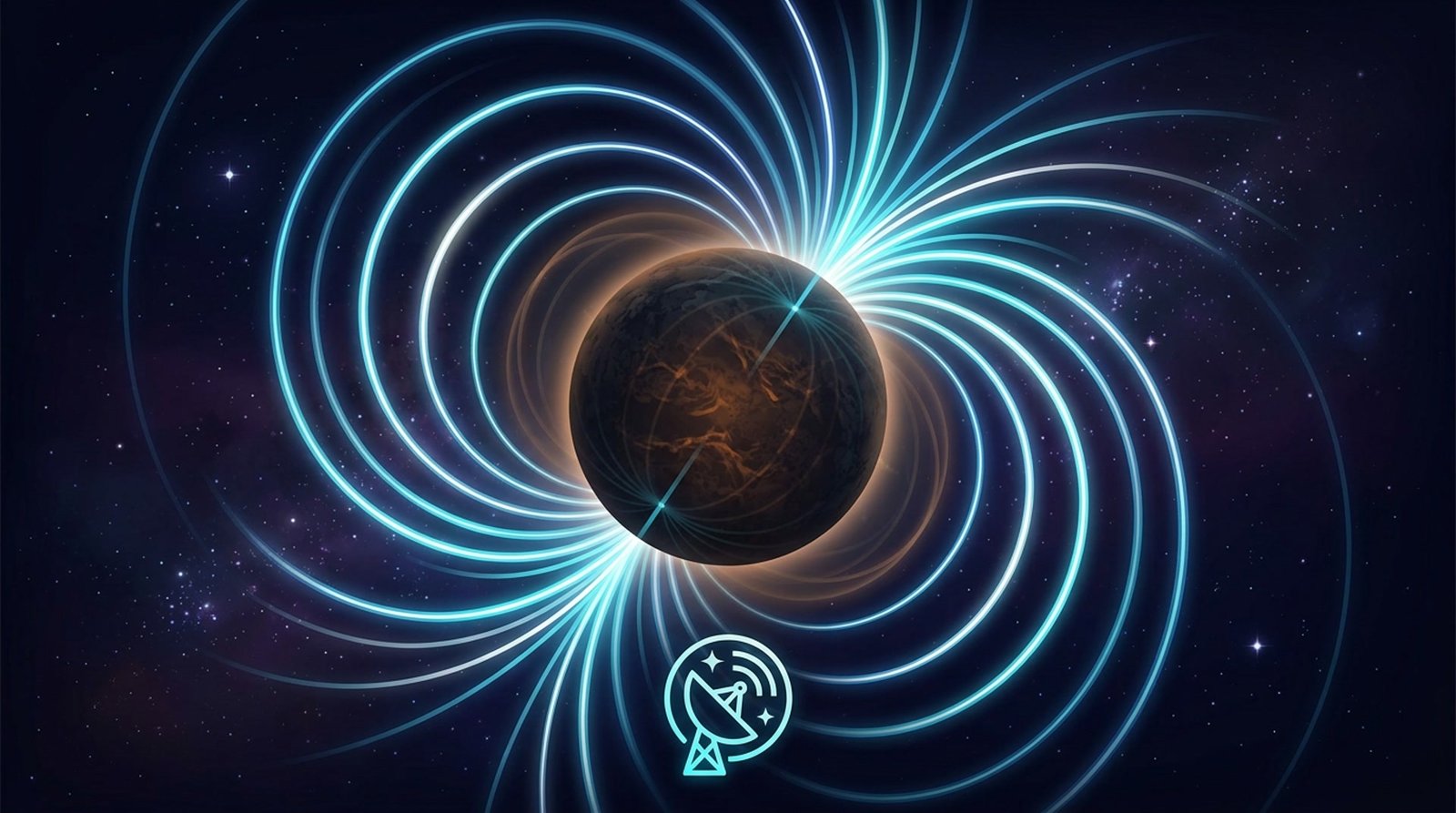
The Cold Star Discovered by Its Radio Auroras
Summary
By the end of this article, you will understand how astronomers use radio telescopes to find freezing, invisible ‘failed stars’ by hunting for their powerful magnetic auroras.
Quick Facts
- Surprise: This brown dwarf is so cold it has methane in its atmosphere, just like the giant planets in our solar system.
- Surprise: It was discovered using low-frequency radio waves instead of traditional infrared heat cameras.
- Salient Idea: The radio waves are generated by powerful magnetic auroras, just like the Northern Lights but massively scaled up.
- Surprise: Its radio beam is 100 times brighter than expected, possibly caused by a hidden moon interacting with its magnetic field.
The Discovery: Listening to the Dark
For decades, astronomers found brown dwarfs—objects too big to be planets but too small to be stars—by looking for their faint heat using infrared telescopes. But in 2020, a team tried something completely new. They used the LOFAR radio telescope to scan the sky for specific, spiraling radio waves. They found a Surprise: a strong radio signal from a completely blank, dark patch of sky. When they followed up with telescopes in Hawaii, they confirmed it was a freezing ‘failed star’ named BDR J1750+3809. They didn’t find it by seeing it; they found it by ‘listening’ to its massive magnetic field. This is the first time a sub-stellar object was discovered directly through radio waves!
Original Paper: ‘Direct radio discovery of a cold brown dwarf’
BDR J1750+3809 is the first radio-selected substellar object, which demonstrates that such objects can be directly discovered in sensitive wide-area radio surveys.
— H. K. Vedantham
The Science Explained Simply
To understand this discovery, we need to know what a brown dwarf actually is. This is NOT a normal star, because it lacks the mass to ignite hydrogen fusion in its core. But it is NOT a normal planet either, because it forms freely from collapsing gas clouds in space rather than growing inside a debris disk around a sun. The Salient Idea here is that these ‘failed stars’ are extremely cold. BDR J1750+3809 is so chilly it has methane in its atmosphere! Because it doesn’t shine with starlight, it is almost entirely invisible to regular optical telescopes. The only way it announces its presence is by shooting out intense, highly polarized radio beams from its poles.
The Aurora Connection
Here on Earth, the Northern Lights are beautiful visual displays caused by the solar wind hitting our magnetic field. But on gas giants like Jupiter, and on brown dwarfs, this same process creates invisible, incredibly powerful radio waves. This is called the Electron Cyclotron Maser Instability (ECMI). The radio waves we detected from BDR J1750+3809 are literally the sound of its auroras. Its magnetic field is about 25 Gauss—comparable to a giant planet’s. In fact, scientists think this brown dwarf’s auroras might be supercharged by an invisible moon orbiting close by, similar to how Jupiter’s moon Io powers Jupiter’s intense radio auroras!
Our discovery suggests that low-frequency radio surveys can be employed to discover sub-stellar objects that are too cold to be detected in infrared surveys.
— The Research Team
A Peek Inside the Research
How do you prove a random radio beep is a brown dwarf? It comes down to circular polarization. The LOFAR telescope didn’t just measure the brightness of the radio waves; it measured their ‘spin’. Normal stars and galaxies emit messy, unpolarized radio waves. But BDR J1750+3809 had a highly polarized radio fraction of almost 100%. This is the ‘fingerprint’ of an ECMI aurora. The team had to use massive supercomputers to sift through 8 hours of radio data, ruling out pulsars and normal stars, before turning massive infrared telescopes toward the exact coordinates to confirm the cold methane dwarf hidden in the dark.
Searching for circularly polarized radio sources has proved to be a powerful technique to identify coherent stellar radio emission.
— The Discovery Team
Key Takeaways
- Brown dwarfs are 'failed stars' that bridge the gap between giant planets and true stars.
- Low-frequency radio surveys can find cold objects in space that infrared telescopes completely miss.
- The electron cyclotron maser instability (ECMI) turns magnetic fields and particles into strong radio beams.
- Measuring these radio waves allows scientists to directly calculate the magnetic field strength of distant worlds.
Sources & Further Reading
Frequently Asked Questions
Q: If brown dwarfs are failed stars, could they have planets of their own?
A: Yes! Astronomers actually think the incredibly bright radio auroras on this brown dwarf might be caused by an undiscovered, orbiting planet or moon generating electrical currents, much like the Jupiter-Io system.
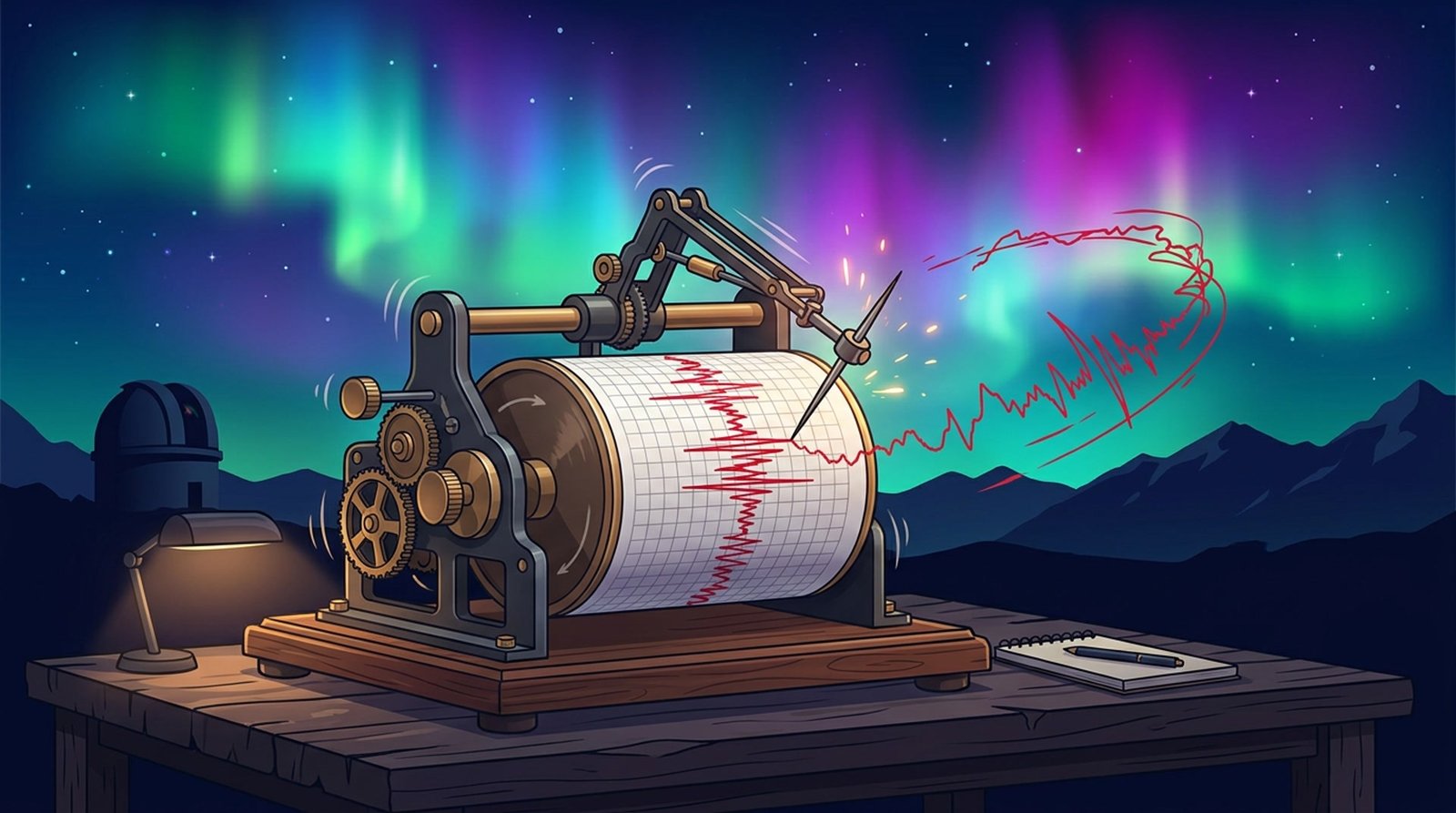
The 1941 Space Storm That Broke the Instruments
Summary
By the end of this article, you will understand how scientists reconstruct invisible magnetic storms from 80 years ago and why knowing this could save our modern internet and power grids.
Quick Facts
- Surprise: The solar storm traveled from the Sun to Earth at a blistering 2,260 kilometers per second.
- Salient Idea: The storm was so intense it physically pushed magnetic measurement needles off their paper tracks.
- Surprise: Auroras were seen as far south as Japan and Manchuria, far from their usual polar homes.
- Surprise: 1941 was a bizarrely active year, hosting three massive extreme space weather events while the world was at war.
The Discovery: The Storm That Went Off-Scale
In March 1941, a massive solar eruption slammed into Earth. The problem? It was so powerful that three out of four standard magnetic recording stations went completely off scale. The needles literally swung off the recording paper! Because of this, the storm’s true intensity was ‘lost’ to history. To solve this, researchers acted like detectives. They dug up alternative, forgotten magnetograms from mid-latitude places like Watheroo, Apia, and Tucson. By stitching these backup records together, they discovered a Surprise: the 1941 storm reached an incredible intensity of -464 nT, making it one of the top extreme space weather events in recorded history. It was the ultimate scientific cold case.
Extreme Space Weather Event in February/March 1941
Three of the four Dst station magnetograms went off scale… making the estimate of the intensity rather challenging.
— Hisashi Hayakawa et al.
The Science Explained Simply
This is NOT a regular storm. There is no rain, no wind you can feel, and no thunder. Instead, a geomagnetic storm is a blast of plasma and magnetic fields from the Sun, called a Coronal Mass Ejection. When this plasma hits Earth’s invisible magnetic shield, it compresses it. The Salient Idea here is the ‘Dst index’—a ruler scientists use to measure how much Earth’s magnetic field is disturbed. A normal day is near zero. A bad storm drops to -100 nT. The 1941 storm hit a massive -464 nT! It creates wild electrical currents in the upper atmosphere, which can fry power grids, disrupt compasses, and block radio communications down on the ground.
A blast of plasma that compresses our invisible shield, creating chaos in the atmosphere.
— NorthernLightsIceland.com Team
The Aurora Connection
You cannot see a magnetic field, but you can see its footprint: the aurora borealis. During a normal night, auroras stay near the North and South poles. But when a massive storm like 1941 hits, it acts like a cosmic hammer, pushing the auroral oval far towards the equator. During this event, people in Manchuria and northern Japan saw the sky glow with red-yellowish light and bluish-white stripes. By reading these historical eyewitness accounts, scientists can map exactly how far the magnetic shield was pushed back. It is a perfect connection between historical stargazing and modern astrophysics.
Diffuse reddish aurorae were visible… the aurora altitude reached almost up to the zenith.
— Historical Japanese Weather Records, 1941
A Peek Inside the Research
How do you measure a storm from 80 years ago? It comes down to patience and global cooperation. The researchers did not use a telescope; they used dusty archives. They digitized old, squiggly paper records from the UK, Japan, and the USA. They calculated the speed of the solar wind (2,260 km/s) by measuring the exact time gap between a solar flare’s X-ray burst and the storm hitting Earth 18.4 hours later. They applied math to correct the baselines and compensate for missing data. It is a triumph of data rescue, proving that old logbooks hold the key to predicting our solar system’s next big tantrum.
We reconstruct its time series and measure the storm intensity with an alternative Dst estimate.
— Hisashi Hayakawa et al.
Key Takeaways
- Coronal Mass Ejections (CMEs) from the Sun can temporarily crush Earth's magnetic shield.
- Historical records of auroras help scientists measure the exact size of past magnetic storms.
- When primary data is lost, researchers piece together 'backup' logs from smaller observatories around the world.
- Understanding these extreme historical events is critical to protecting modern power grids and satellites.
Sources & Further Reading
Frequently Asked Questions
Q: Could a space storm like the 1941 event happen today?
A: Yes. The Sun operates on cycles, and extreme storms are a natural part of space weather. If a -464 nT storm hit today, it could cause serious damage to satellites, GPS, and power grids if we are not prepared.
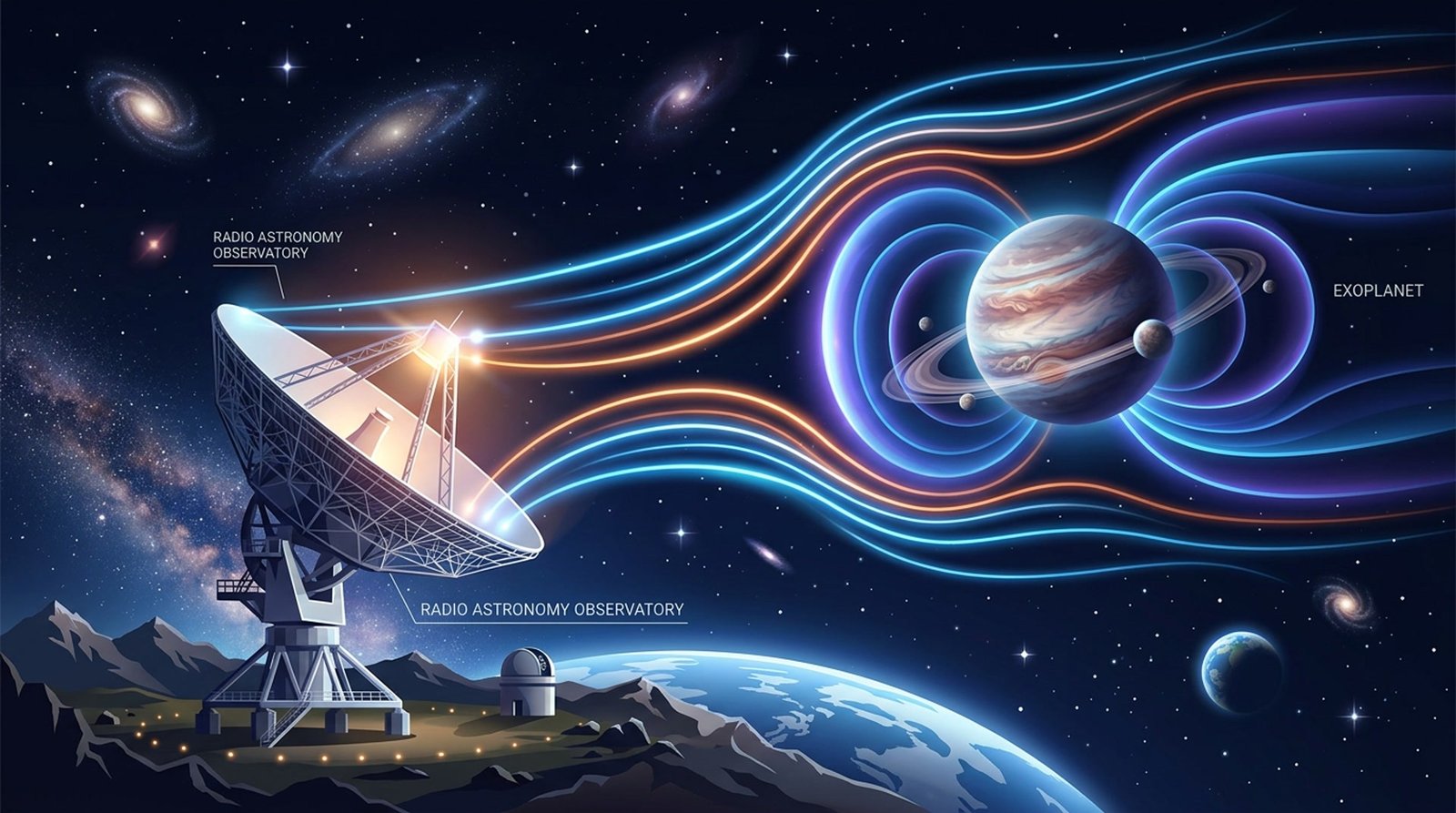
Detecting Invisible Alien Shields with Radio Twinkles
Summary
By the end of this article, you will understand how astronomers plan to use next-generation radio telescopes to ‘see’ the invisible magnetic shields protecting alien worlds.
Quick Facts
- Surprise: To a radio telescope, a star looks mostly dark, but its tiny magnetic spots are blindingly loud.
- Salient Idea: A planet's invisible magnetic field can act like a magnifying glass, bending the radio waves from its host star.
- Surprise: A tiny planet crossing a starspot can cause a massive 10% drop in radio light, making it easier to spot than in visible light.
- Salient Idea: Alien magnetospheres cause radio signals to 'twinkle' (scintillation), just like our atmosphere makes stars twinkle to the naked eye.
The Discovery: Looking Past the Visible
For two decades, astronomers have found exoplanets using optical telescopes, waiting for a planet to block a tiny fraction of its star’s visible light. But the Surprise is that visible light doesn’t tell us much about a planet’s magnetic field. Enter the next generation of radio telescopes, like the Square Kilometre Array (SKA). Researchers realized that if they look at stars in the radio spectrum, the rules change entirely. In radio frequencies, the bulk of a star is relatively quiet, but its active magnetic regions—starspots—are screaming loud. When a planet transits across one of these intense radio spots, it doesn’t just block a fraction of a percent of light; it can cause a massive 10% dip in the signal. This deep, brief radiometric transit gives astronomers a totally new, highly sensitive way to track planets and study the magnetic activity of their host stars.
Exoplanet Transits with Next-Generation Radio Telescopes (Pope et al., 2018)
This radio window on exoplanets and their host stars is therefore a valuable complement to existing optical tools.
— Dr. Benjamin J. S. Pope
The Science Explained Simply
This is NOT the same as a planet casting a simple physical shadow. When an exoplanet passes between us and a starspot, its solid body blocks some radio waves, but its extended magnetosphere—a giant bubble of charged plasma—interacts with the rest. The Salient Idea here is that this plasma acts like a funhouse mirror. It causes ‘refractive lensing,’ bending the star’s radio waves to focus or defocus them as they travel toward Earth. Furthermore, the uneven density of plasma in the alien shield causes ‘scintillation.’ Think of how the turbulent air in Earth’s atmosphere makes the stars twinkle at night. In the exact same way, the turbulent plasma in an alien magnetosphere makes the star’s radio signal twinkle. By measuring this twinkle, scientists can map the size and strength of an invisible magnetic shield light-years away.
The Aurora Connection
Why do we care so much about these invisible shields? Because they are the ultimate planetary bodyguards. Earth’s magnetic field catches the deadly, high-energy particles fired by the Sun. This collision creates the breathtaking Northern Lights (auroras) and, more importantly, prevents the solar wind from blowing away our breathable atmosphere. Many exoplanets face stellar winds thousands of times stronger than Earth does. Without a magnetic field, their atmospheres would be stripped away into space, rendering them barren rock. By using radio transits to detect magnetospheres, we are directly searching for planets capable of sustaining atmospheres. It is the cosmic equivalent of checking if a house has a roof before deciding if it is safe to live in.
These transits will probe planetary magnetospheres for the first time as they are back-lit by compact, bright stellar active regions.
— SKA Research Team
A Peek Inside the Research
To prove this concept, the research team didn’t just look up; they built complex mathematical models of ‘Hot Jupiters’—gas giants orbiting dangerously close to their stars. By simulating the plasma density and scale height of an exoplanet’s magnetosphere, they calculated exactly how radio waves from a starspot would propagate through it. They discovered that the intense plasma density causes strong refractive lensing and high ‘scintillation indexes.’ This means the twinkling effect isn’t just a theory; it is mathematically loud enough to be detected by the upcoming SKA2-Mid telescope. It is a triumph of physics, proving that by analyzing the chaotic fluttering of a radio signal, we can reverse-engineer the shape of an alien magnetic field.
We suggest that it will be important to model the strong-scintillation regime to explore what radio transit light curves can encode.
— Dr. Benjamin J. S. Pope
Key Takeaways
- Next-generation arrays like the Square Kilometre Array (SKA) will let us measure alien magnetic fields for the first time.
- Radio transits block localized, intense starspots rather than the whole glowing sphere of the star.
- The plasma inside a planet's magnetosphere causes radio waves to refract and scintillate.
- Detecting exoplanet magnetic fields is a massive step in finding truly habitable, protected worlds.
Sources & Further Reading
Frequently Asked Questions
Q: Can we see these radio transits with current telescopes?
A: Mostly no. Current radio telescopes aren’t quite sensitive enough to catch the rapid, small changes from typical stars. That is why astronomers are so excited for the upcoming Square Kilometre Array (SKA), which will be orders of magnitude more sensitive.
Q: Why do starspots emit so much radio energy?
A: Starspots are areas of intense, twisted magnetic fields on a star’s surface. These strong magnetic fields trap incredibly hot plasma, generating powerful thermal and non-thermal radio emissions that easily outshine the rest of the quiet star.
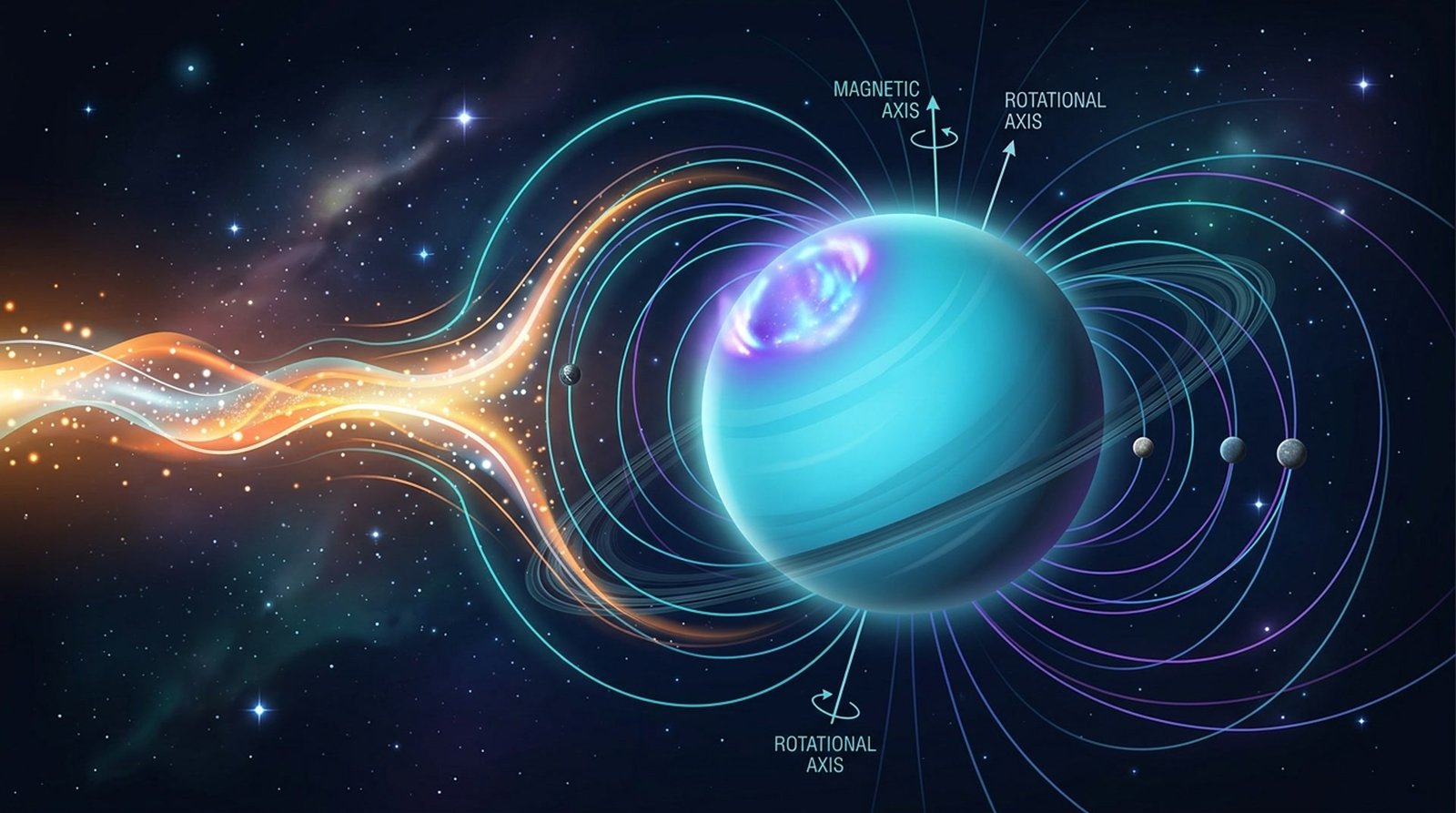
The Solar Storm That Lit Up Uranus
Summary
By the end of this article, you will understand how scientists predicted space weather billions of miles away to catch bizarre, off-center auroras on Uranus.
Quick Facts
- Surprise: A solar storm from Sept 2017 took over two full months to travel from the Sun to Uranus.
- Salient Idea: Uranus rotates on its side, making its magnetic field and auroras wildly tilted and off-center.
- Surprise: Scientists accurately predicted the exact week the space storm would hit the ice giant.
- Surprise: Uranian auroras flash in Far-Ultraviolet and Near-Infrared light, completely invisible to the human eye.
The Discovery: Tracking a Cosmic Storm
In September 2017, the Sun unleashed a massive coronal mass ejection. Scientists knew this solar storm was heading for Uranus, but it would take two months to cross the solar system. This gave them a rare chance to prepare. They pointed the ‘Hubble Space Telescope’, along with giant Earth-based telescopes like the ‘Very Large Telescope’ (VLT) and ‘Gemini North’, at the distant ice giant. When the storm finally hit in November, Hubble captured a Surprise: a bright, intense spot of Far-Ultraviolet light near the planet’s southern pole. They had successfully predicted and caught an alien aurora in action, triggered by the pressure wave of the solar wind!
Original Paper: ‘Analysis of HST, VLT and Gemini Coordinated Observations of Uranus Late 2017’
This event provided a unique opportunity to investigate the auroral response of the asymmetric Uranian magnetosphere.
— L. Lamy et al.
The Science Explained Simply
This is NOT like the auroras on Earth, which form neat, glowing rings around our North and South poles. Because Uranus rotates on its side, its magnetic field is wildly tilted and messy. The Salient Idea here is that Uranus’s auroras appear as patchy, transient spots rather than perfect halos. While looking for these spots, scientists also searched for near-infrared light from an ion called H3+. They expected to see concentrated glowing from the aurora. Instead, they found the H3+ glowing broadly across the entire southern hemisphere. This wide glow wasn’t an aurora; it was the planet’s upper atmosphere naturally heating up as it approached its summer season.
The Aurora Connection
Why does this matter to us? Auroras are the visible footprints of a planet’s magnetic shield interacting with the solar wind. Without Earth’s magnetic field, our atmosphere would be stripped away by these exact same solar storms. By studying Uranus’s highly tilted, asymmetrical magnetic field, we learn how magnetic shields work in extreme, twisted configurations. The auroras on Uranus act like glowing flare guns, showing us exactly where the invisible magnetic lines are bending and snapping. Understanding this twisted space weather helps us better appreciate the perfectly balanced magnetic bubble that protects life here on Earth.
Uranus’s auroras act like glowing flare guns, revealing the invisible physics of its magnetic shield.
— NorthernLightsIceland.com Team
A Peek Inside the Research
Coordinating this observation was no easy task. It required Knowledge and Tools spread across the globe and in orbit. Astronomers used computer models to calculate exactly when the solar wind would hit Uranus. Then, they had to secure highly coveted time on ‘Hubble’ in space, the ‘Chandra’ X-ray observatory, ‘VLT’ in Chile, and ‘Gemini North’ in Hawaii. By analyzing specific wavelengths of light—Far-Ultraviolet and Near-Infrared—they could literally peel back the layers of Uranus’s atmosphere. It was a triumph of international teamwork, proving we can forecast and observe space weather billions of miles away.
These new high resolution images reveal H3+ from the whole disc, but show no evidence of localized auroral emission in the infrared.
— Research Team
Key Takeaways
- Space weather affects planets across the entire solar system, not just Earth.
- Uranus's tilted magnetic field creates patchy, transient aurora spots rather than perfect rings.
- Near-Infrared telescopes revealed the planet's whole southern hemisphere is heating up as it approaches summer.
- Global coordination of space and ground telescopes is required to capture fast-changing planetary weather.
Sources & Further Reading
Frequently Asked Questions
Q: Could I see the auroras on Uranus if I flew a spaceship there?
A: Probably not with your bare eyes! The auroras observed in this study radiate in Far-Ultraviolet and Near-Infrared light, which are completely invisible to human vision. You would need special sensor goggles to see the light show.
Q: Why did it take two months for the solar storm to reach Uranus?
A: Uranus is located about 1.8 billion miles from the Sun. Even though the solar storm travels at over a million miles per hour, the sheer scale of the solar system means it takes months for that energy to cross the void.
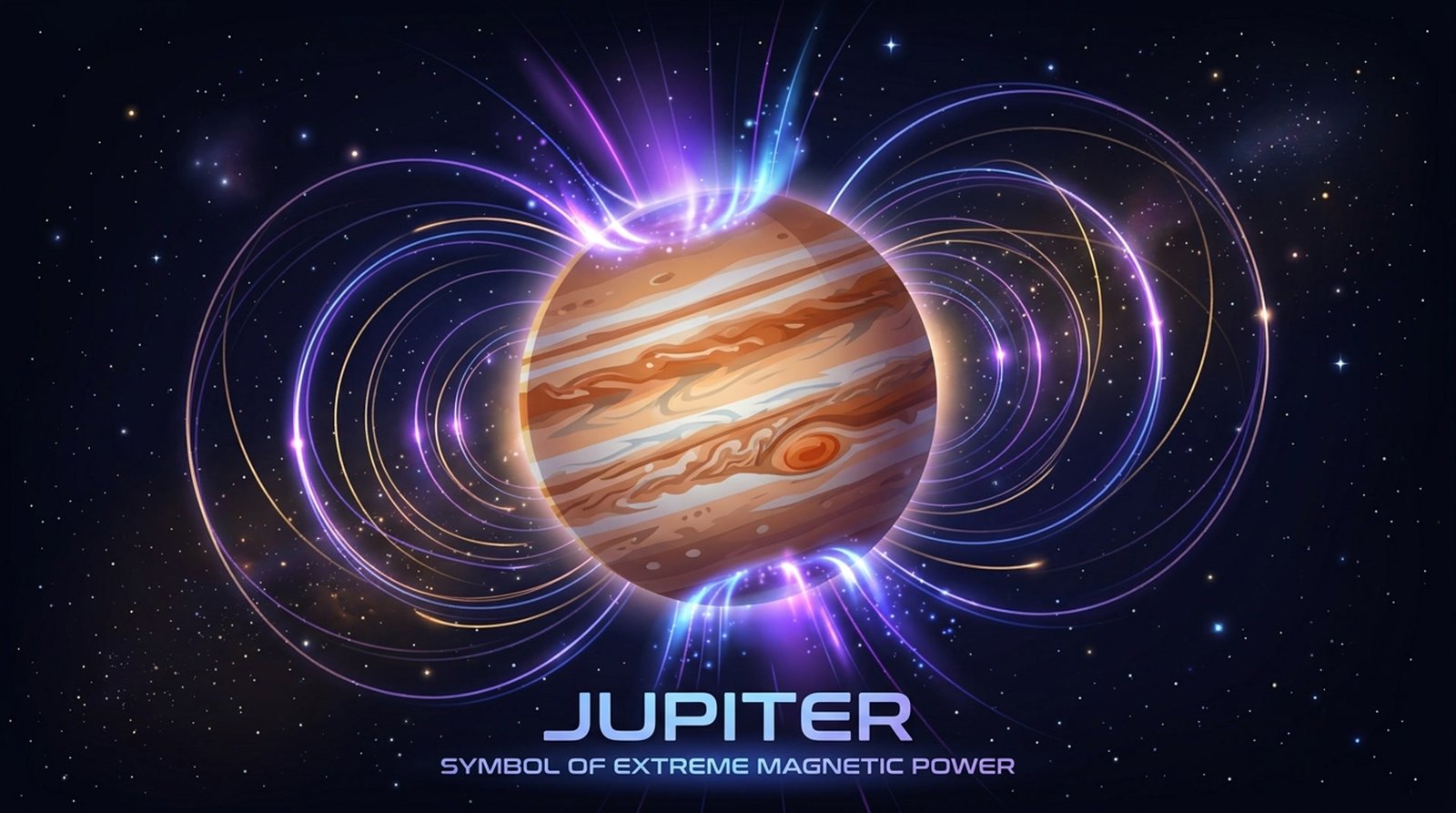
Jupiter's Invisible Light Show
Summary
By the end of this article, you will understand how a volcanic moon and a giant magnetic field create the most powerful, invisible X-ray auroras in the solar system.
Quick Facts
- Surprise: Jupiter's glowing auroras are fueled by a ton of sulfur and oxygen erupted every second from the volcanic moon Io.
- Salient Idea: The planet actually acts like a giant mirror, reflecting X-ray flares from the Sun off its equator.
- Surprise: The X-ray auroras aren't a steady glow; they pulse like a giant heartbeat every 9 to 45 minutes.
- Surprise: To create these X-rays, atoms are stripped of electrons and accelerated to millions of volts.
The Discovery: Solving a 40-Year Mystery
For decades, scientists knew Jupiter emitted X-rays, but they didn’t know exactly *why*. Using space telescopes like Chandra and XMM-Newton, they found a Surprise: the X-rays weren’t a steady glow, but pulsed like a clock every few tens of minutes. The breakthrough came when the Juno spacecraft actually flew through Jupiter’s magnetic field while telescopes watched from afar. They caught the culprit red-handed: giant compressional waves were vibrating Jupiter’s magnetic field lines, surfing heavy ions down into the atmosphere to crash and release X-rays. They had finally connected the remote light show to the invisible physics causing it.
X-ray Emissions from the Jovian System by W. R. Dunn
Perhaps Jupiter’s greatest attribute is the opportunity to connect observed X-ray emissions with in-situ plasma measurements.
— W. R. Dunn
The Science Explained Simply
This is NOT like the auroras on Earth, which are mostly driven by the solar wind. Instead, Jupiter’s X-ray auroras are powered from the inside out. The Salient Idea is a process called ‘charge exchange.’ Volcanoes on the moon Io blast out sulfur and oxygen. Jupiter’s spinning magnetic field strips these atoms of their electrons, turning them into high-energy ions. When these hungry ions are funneled down into Jupiter’s poles, they smash into neutral hydrogen gas. They violently steal electrons back, and in the process, ‘burp’ out high-energy X-ray photons. It is a massive, planet-sized particle accelerator.
The system is a rich natural laboratory for astronomical X-rays.
— W. R. Dunn
The Aurora Connection
Jupiter boasts the most powerful auroras in the solar system. While Earth’s auroras are beautiful ribbons of visible light driven by solar storms, Jupiter’s auroras are a multi-wavelength beast constantly fueled by its own volcanic moon. These X-ray emissions happen in the extreme polar regions, including mysterious ‘dawn storms’ and a highly active ‘hot spot.’ By studying how Jupiter’s massive, spinning magnetic field traps and accelerates these particles to millions of volts, scientists can better understand how magnetic fields protect planets—or turn them into radiation-blasted danger zones.
Jupiter’s magnetosphere is the largest coherent structure in the heliosphere.
— W. R. Dunn
A Peek Inside the Research
How do you map invisible light? It takes incredible Knowledge and Tools. Researchers don’t just look through a lens; they count individual X-ray photon hits on specialized detectors. By looking at the exact energy level of each photon, they can identify the specific element that created it—like a chemical fingerprint. This is called X-ray fluorescence. In the future, missions like ESA’s JUICE will use this technique to map the exact surface composition of Jupiter’s icy moons, potentially finding trace elements necessary for life hidden in the ice.
No other waveband is capable of providing these elemental constraints.
— W. R. Dunn
Key Takeaways
- Jupiter's most intense X-rays come from heavy ions undergoing 'charge exchange'—stealing electrons and releasing high-energy light.
- Magnetic waves act like cosmic surfers, accelerating particles down into Jupiter's poles.
- X-ray telescopes can read the elemental 'fingerprints' of Jupiter's icy moons to see what they are made of.
- Simultaneous data from orbiting telescopes and the in-situ Juno spacecraft finally solved the mystery of the pulsing flares.
Sources & Further Reading
Frequently Asked Questions
Q: Why can’t we see these auroras with our own eyes?
A: Human eyes only detect visible light. These auroras emit X-rays, which have much higher energy and shorter wavelengths, requiring specialized space telescopes like Chandra to ‘see’ them.
Q: Do Jupiter’s moons have auroras too?
A: The moons don’t have traditional auroras, but they do glow in X-rays! When Jupiter’s intense radiation hits moons like Europa, the ice emits X-rays that reveal exactly what the surface is made of.
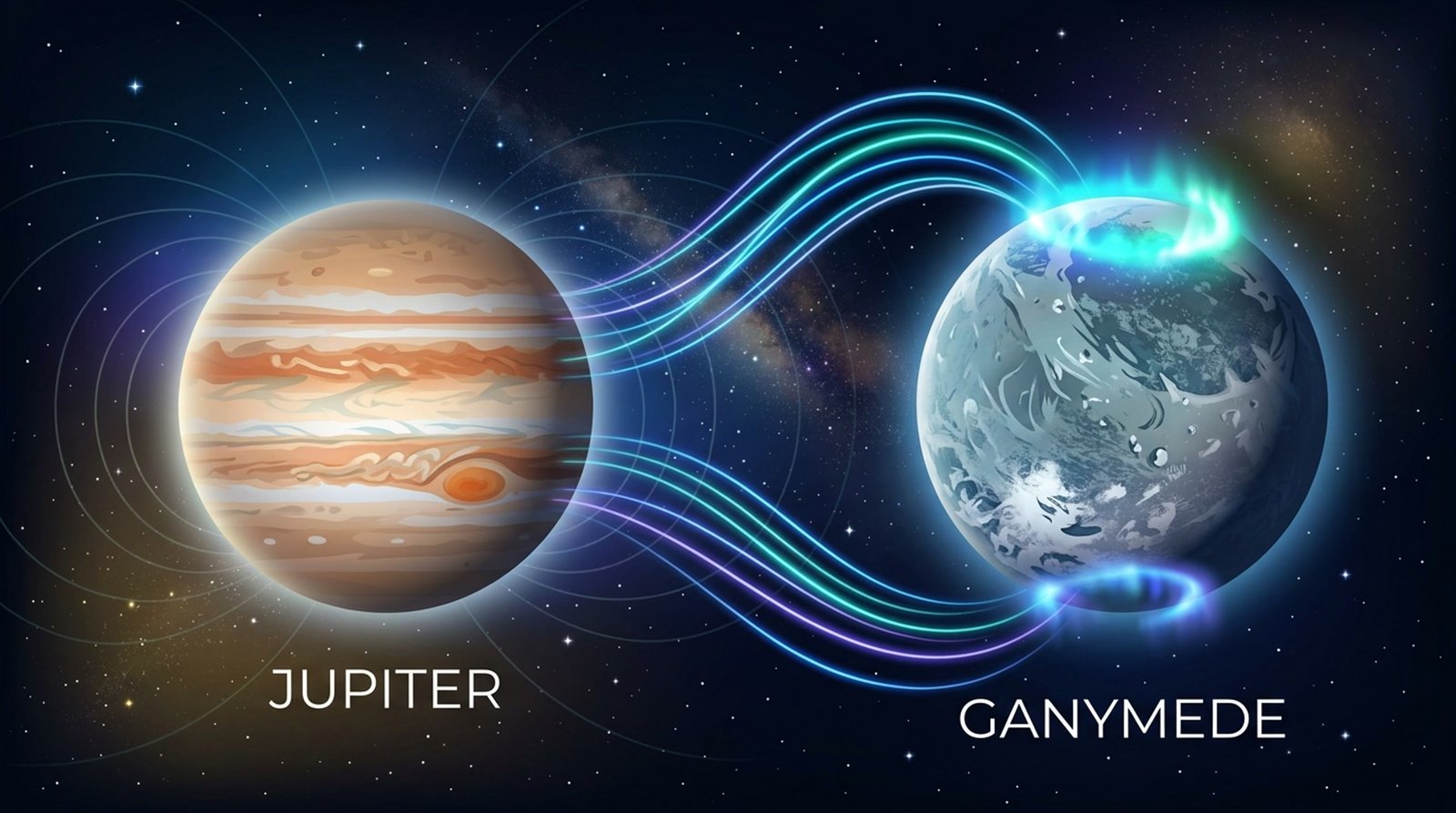
The See-Saw Auroras of Jupiter's Magnetic Moon
Summary
By the end of this article, you will understand how Jupiter’s magnetic field acts like a giant generator, causing the auroras on its moon Ganymede to alternate in brightness like a cosmic see-saw.
Quick Facts
- Surprise: Ganymede is the only moon in our solar system with its own magnetic field and auroras
- Salient Idea: The brightness of its north and south auroras alternates every 10 hours
- Surprise: These auroras aren't powered by the Sun, but by Jupiter's massive plasma sheet
- Surprise: Ganymede is actually a terrible 'lightbulb'—it takes massive amounts of energy to make its thin oxygen atmosphere glow
The Discovery: The Cosmic See-Saw
In June 2021, as NASA’s Juno spacecraft flew past Ganymede, astronomers pointed the Hubble Space Telescope at the moon to watch its auroras. What they saw was a Surprise: the northern and southern auroras were taking turns being the brightest. Over a 10-hour cycle, the glow shifted back and forth. The Salient Idea here is that this shifting perfectly matched Ganymede’s orbit through Jupiter’s massive, pancake-shaped magnetic plasma sheet. Whichever pole was facing the thickest part of the plasma sheet lit up the brightest. This observation gave scientists a visible heartbeat of the invisible magnetic forces wrapping around the moon.
Original Paper: Alternating north-south brightness ratio of Ganymede’s auroral ovals
The brightness ratio of northern and southern ovals oscillates such that the oval facing the Jovian plasma sheet is brighter.
— Joachim Saur, Lead Researcher
The Science Explained Simply
This is NOT like Earth’s auroras, which are driven by solar wind from the Sun. Instead, Ganymede is trapped inside Jupiter’s massive magnetic field. Jupiter spins incredibly fast, throwing out a disk of electrically charged gas called a plasma sheet. Think of it like a river of charged particles. As Ganymede bobs up and down through this river, the plasma hits it. The Salient Idea is plasma momentum. The side of Ganymede closest to the center of the ‘river’ gets hit harder by the dense plasma. This creates asymmetric magnetic stress—essentially squeezing the magnetic field harder on one side—which sends energy funneling down to that specific pole, lighting up the oxygen atmosphere.
The Aurora Connection
Understanding Ganymede’s auroras helps us understand magnetic shields everywhere. On Earth, our magnetic field creates auroras but also protects our atmosphere from being stripped away. Ganymede is a unique ‘mini-magnetosphere’ living inside a giant one. By studying how magnetic lines break, reconnect, and funnel particles to create these glowing ovals, we learn how magnetic fields protect and interact with atmospheres across the cosmos. It is a reminder that space isn’t empty; it is a web of invisible, powerful magnetic connections that dictate the survival of planetary atmospheres.
A better understanding of Ganymede’s auroral emission will provide important information for the science planning of ESA’s JUICE mission.
— Research Team
A Peek Inside the Research
How do you measure a moon’s aurora from Earth? The team didn’t just snap a regular photo; they used the Space Telescope Imaging Spectrograph on the Hubble Space Telescope. They were specifically looking for the ultraviolet glow of oxygen atoms. It is incredibly difficult work. They had to separate the faint auroral glow from sunlight reflecting off the moon’s icy surface. By analyzing exposures in 100-second chunks, they confirmed the ‘see-saw’ effect wasn’t just random static, but a steady, physically driven cycle tied directly to the moon’s position in space.
The total brightness is maximum when Ganymede is in the plasma sheet of Jupiter’s magnetosphere.
— Study Authors
Key Takeaways
- Ganymede's auroras act as a visual tracer for invisible magnetic forces in space
- The hemisphere facing the center of Jupiter's plasma sheet is always the brighter one
- Asymmetric magnetic stresses and electromagnetic fluxes are the true engines behind this moon's light show
- Hubble Space Telescope data helps scientists map environments that spacecraft like Juno fly through
Sources & Further Reading
Frequently Asked Questions
Q: Why does Ganymede have auroras but Earth’s Moon doesn’t?
A: Ganymede has a churning, liquid core that generates its own magnetic field, much like Earth. Our Moon’s core cooled down long ago, so it has no magnetic field to guide particles into auroral rings.

Forecasting the Sky's Electrical Surges
Summary
By the end of this article, you will understand how scientists map the electrical conductivity of the aurora to predict extreme space weather and protect Earth’s power grids.
Quick Facts
- Surprise: During a solar storm, the Northern Lights act as a giant electrical wire carrying massive currents.
- Salient Idea: Older prediction models had a 'ceiling' and completely missed the true intensity of the worst space weather.
- Surprise: Scientists fixed this by analyzing over 530,000 extreme weather maps from the chaotic year of 2003.
- Surprise: A changing magnetic field in space can literally blow out electrical transformers on the ground.
The Discovery: A Sky Full of Electricity
For years, space weather forecasts had a major blind spot. Models trained on ‘quiet’ solar data would consistently under-predict the intensity of extreme storms. The old system hit an invisible ceiling! Researchers tackled this by feeding a new model, called CMEE (Conductance Model for Extreme Events), over 530,000 maps from the chaotic year of 2003. They found a Surprise: by analyzing historical extreme solar storms, they could finally raise that artificial ceiling. Instead of breaking down when the sun threw a tantrum, the new model accurately predicted how Earth’s magnetic field would violently spike. They successfully decoded the extreme electrical patterns of the sky, giving us a way to foresee danger before it strikes the ground.
Conductance Model for Extreme Events: Impact of Auroral Conductance on Space Weather Forecasts
The inability to accurately estimate this quantity leads to underprediction of severe space weather events that can have adverse impacts on man-made technology.
— Agnit Mukhopadhyay
The Science Explained Simply
When we talk about the ionosphere during a solar storm, we must talk about ‘conductance’. This is NOT just how bright the auroras look in the sky to the human eye. Conductance is a specific measure of how easily electricity can flow through the atmosphere. The Salient Idea here is that during a storm, solar particles crash into our atmosphere, tearing apart atoms and freeing electrons. This physical process turns the sky into a giant conductive wire. If computer models guess this conductance wrong, they miscalculate the massive electrical currents closing through the poles, which means we cannot accurately predict when power grids on the ground might fail.
The Aurora Connection
The Northern Lights are the most visible sign of a massive electrical circuit in space. When you see an aurora, you are actually watching the exact locations where magnetospheric currents are crashing into Earth’s atmosphere. These currents flow down along magnetic field lines, light up the sky, and travel horizontally through the ionosphere. The new CMEE model specifically tracks this expanding auroral oval. By understanding exactly where and how intensely the aurora glows, scientists can map the invisible electrical grid high above our heads, proving that the beautiful Northern Lights are deeply tied to the magnetic shield protecting our modern technology.
Auroral currents are the dominant source of ground magnetic perturbations in high latitude regions.
— Space Weather Research Team
A Peek Inside the Research
How did the team build this? It comes down to incredible computing power, not guesswork. The researchers used the Space Weather Modeling Framework (SWMF) to simulate historical space weather events. By applying a non-linear mathematical algorithm to a massive dataset of field-aligned currents, they smoothed out the data to find the true patterns of electrical flow. The team had to dynamically track the boundaries of their digital maps to capture the expanding auroral oval during massive storms. It is a brilliant example of using historical extremes to calibrate the digital tools that will secure our future.
CMEE allows the auroral conductance to have an increased range of values, attaining a higher ceiling during extreme driving.
— Study Authors
Key Takeaways
- Ionospheric conductance measures how easily electricity flows through the Earth's upper atmosphere.
- The new CMEE model uses nonlinear math to accurately predict extreme events without capping out.
- Auroral adjustments help computer models simulate localized spikes in the sky's electric current.
- Accurate space weather forecasting requires blending massive historical datasets with physics.
Sources & Further Reading
Frequently Asked Questions
Q: Why does space weather affect our power grids?
A: When the Earth’s magnetic field changes rapidly during a solar storm, it creates electrical currents in the ground. These unexpected currents can surge into power lines and destroy transformers.
Q: How does the CMEE model help prevent blackouts?
A: By perfectly mapping the electrical conductivity of the aurora, the CMEE model predicts exact spikes in magnetic disturbances. This gives grid operators warning time to protect the system.
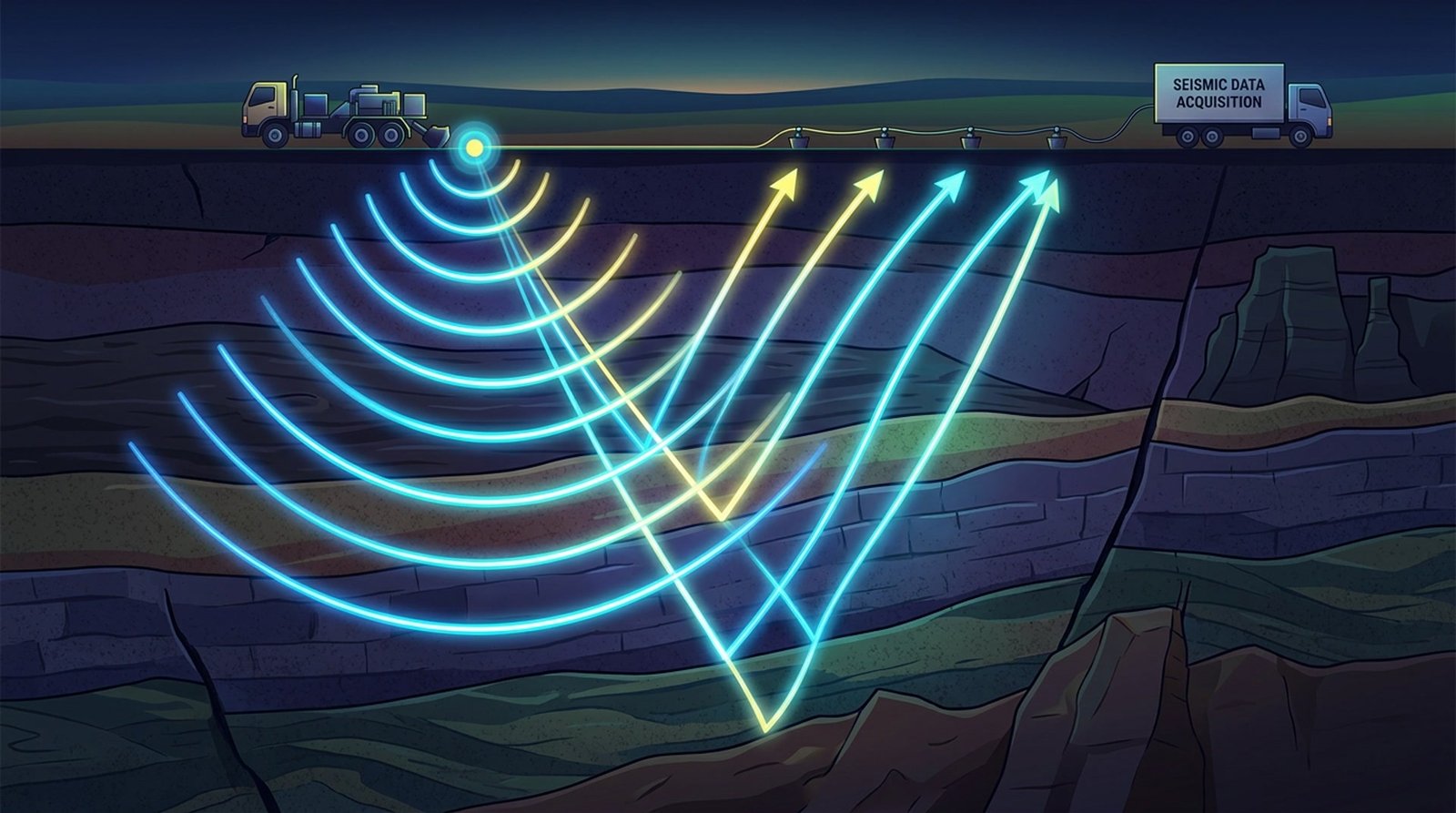
Rewinding Earth: How Supercomputers 'See' Underground
Summary
By the end of this article, you will understand how scientists use sound waves to see deep inside the Earth and how a clever math trick lets supercomputers ‘rewind’ time to save massive amounts of memory.
Quick Facts
- Surprise: Scientists use massive sound waves to map the Earth's crust, much like a bat uses echolocation
- Salient Idea: Storing a 3D simulation of these waves normally takes up hundreds of gigabytes of hard drive space
- Surprise: By scrambling the edges of the simulation, researchers can perfectly 'rewind' the wave without saving the whole video
- Surprise: The new math trick reduces data storage needs by over 500 times—from 132 gigabytes to less than half a gigabyte!
The Discovery: The Great Data Bottleneck
To see underground, scientists send sound waves down and record the echoes. This is called Reverse Time Migration (RTM). The problem? Computers have to record *every single frame* of this underground sound wave video to match it with the echoes coming back up. This creates massive data files that choke even the fastest hard drives. But recently, researchers found a brilliant workaround. Instead of saving the whole video, what if they could just save the final frame and calculate the physics backward? This Story is about how they achieved exactly that.
Original Paper: ‘Seismic Modeling and Migration with Random Boundaries on the NEC SX-Aurora TSUBASA’
Reverse Time Migration is a depth migration technique that provides a reliable high-resolution representation of the Earth subsurface…
— Barbosa & Coutinho
The Science Explained Simply
This is NOT just compressing a file like a ZIP folder. Instead, it is actual time travel via math. Imagine throwing a rock into a pool. If you know exactly where the ripples hit the edge, you can calculate backward to find where the rock landed. To do this perfectly, the researchers built Random Boundary Conditions (RBC). The edges of the simulation have randomized speeds that scramble the waves so they do not bounce back in a confusing way. The Salient Idea here is that by keeping all the wave’s energy inside this randomized box, the supercomputer can recreate the entire wave’s history from just the very last two moments.
The complete reconstruction of the wavefield can be achieved by keeping all energy in the system.
— The Research Team
The Aurora Connection
What does seeing underground have to do with the Northern Lights? It comes down to how we simulate complex 3D environments. The same massive supercomputers—like the NEC SX-Aurora TSUBASA vector processor used in this study—are essential for modeling space weather. Just as these researchers modeled sound waves crashing through rock layers, space physicists model the solar wind crashing into Earth’s magnetic field. Both require slicing a 3D space into millions of tiny grid points and solving extreme physics equations. By making these simulations run faster and use 500 times less memory, we pave the way for better models of both underground geology and our protective atmospheric shield.
Advances in wave propagation algorithms, wavefield storage, and hardware acceleration are some of the main challenges…
— The Research Team
A Peek Inside the Research
How do we know this works? The team ran their Reverse Time Migration on three different intense computing setups: regular multi-core CPUs, heavy-duty NVIDIA V100 graphics cards (GPUs), and a specialized ‘vector processor’. They found that for the biggest 3D grids, the vector processor completely dominated. It processed the huge blocks of math smoothly, running the reconstruction twice as fast as the traditional ‘save everything’ method. It proves that sometimes the best way to solve a computer problem is not just writing better code, but matching brilliant math to the perfect piece of hardware.
The vector processor implementation is the one that requires fewer code modifications… particularly for large 3D grids.
— The Research Team
Key Takeaways
- Reverse Time Migration (RTM) is a technique to build high-resolution images of the Earth's subsurface
- Random Boundary Conditions (RBC) scramble unwanted echoes, acting like frosted glass for sound waves
- Initial Value Reconstruction allows supercomputers to run simulations backward instead of storing massive files
- Vector Processors (like the NEC SX-Aurora TSUBASA) are incredibly powerful for simulating huge 3D grids
Sources & Further Reading
Frequently Asked Questions
Q: Why don’t scientists just buy bigger hard drives for all the data?
A: It’s not just about space; it’s about speed. Moving hundreds of gigabytes of data back and forth from a hard drive to a computer’s processor causes a massive traffic jam. Calculating the wave backward is actually faster than reading the massive file!

The Secret Heat Behind the Red Aurora
Summary
By the end of this article, you will understand how extreme heat in Earth’s upper atmosphere can create glowing red auroras, without needing direct strikes from solar particles.
Quick Facts
- Surprise: Earth's upper atmosphere can reach temperatures over 3,000 Kelvin (about 4,900 degrees Fahrenheit)
- Salient Idea: The background 'ambient' electrons get so hot they trigger the aurora themselves, acting like a cosmic oven
- Surprise: This 'thermal' glowing accounts for up to 50% of the red aurora light during certain intense space weather events
- Surprise: These super-heated auroras happen much higher up—around 350 to 400 kilometers—than normal auroras
The Discovery: The Aurora as a Cosmic Oven
For decades, scientists thought the stunning red auroras near the Earth’s poles were almost entirely caused by direct impact—like solar particles acting as cosmic bowling balls crashing into atmospheric oxygen. But a team of researchers looking at the sky over Svalbard, Norway, found a Surprise. During intense solar storms, the math wasn’t adding up. They used a giant radar system to scan the ionosphere and discovered massive heat spikes. We are talking about the background gas reaching over 3000 Kelvin. They realized that the ambient ‘cloud’ of electrons high up in our atmosphere was getting so insanely hot that it started exciting the oxygen atoms all by itself. This process, known as thermal excitation, wasn’t just a tiny background effect. It was responsible for up to half of the brilliant red light they were seeing in the sky. They had discovered that the aurora isn’t just a crash site—sometimes, it is a cosmic oven.
The ambient electrons are clearly heated by another physical process… exciting the atomic oxygen.
— Dr. Norah Kaggwa Kwagala
The Science Explained Simply
To understand this, we must build a fence around what this is NOT. This is NOT the standard auroral process where heavy, fast-moving particles from the sun slam directly into atmospheric gas to make it glow. Instead, imagine a crowded room where the air itself suddenly gets blistering hot. In the ionosphere, normally, when electrons get warm, they cool off by bumping into heavier ions. But when the density of electrons gets too high, this ‘cooling system’ fails. The Salient Idea here is thermal balance—or the lack of it. Because they cannot cool down, the background electrons get energized. The hottest ones at the ‘tail end’ of the temperature scale carry enough energy (about 1.96 electron volts) to literally bump into oxygen atoms and make them emit a specific red light. The heat itself acts like a battery powering the glow.
The Aurora Connection
The Earth’s magnetic field has weak spots near the poles called the ‘cusps.’ This is where the solar wind has a direct funnel into our atmosphere. Because of this direct connection, magnetic lines from the sun and Earth can cross and snap in a violent process called magnetic reconnection. This acts like a giant space heater. When we look up and see these specific, high-altitude red auroras, we are actually seeing the visual footprint of magnetic shields wrestling in space. Understanding this thermal red light helps us measure exactly how much energy our magnetic field is absorbing from the solar wind. Without this invisible shield absorbing and dispersing this massive energy as heat and light, our protective atmosphere would be constantly stripped away into deep space.
These emissions can occur both in the active and disturbed cusp… with the peak emission altitude above 350 km.
— The Research Team
A Peek Inside the Research
How do you measure the temperature of an invisible gas hundreds of kilometers above your head? It comes down to incredible tools. The scientists combined two massive instruments in Svalbard. First, the European Incoherent Scatter (EISCAT) radar acts like a giant thermometer and density scanner, shooting radio waves into space to measure the invisible electron gas. Second, the Meridian Scanning Photometer (MSP) acts like an ultra-sensitive light meter, scanning the sky to record the exact intensity of the red aurora. By combining the radar’s temperature data with the photometer’s light data, they could finally separate the ‘impact’ aurora from the ‘heat’ aurora. It is a brilliant example of using math and dual-sensor observation to solve a mystery hidden in plain sight.
This offered an excellent opportunity to investigate the role of thermally excited emissions… comparing radar measurements with optical data.
— Journal of Geophysical Research
Key Takeaways
- The red aurora (630.0 nm light) isn't just a sign of particle impacts; it acts as a giant thermometer for the sky
- Thermal excitation happens when the electron gas cooling system breaks down due to high density
- We can track invisible atmospheric heating using giant radar dishes and optical cameras
- Magnetic reconnection in the dayside cusp is a massive driver of this extreme heating
Sources & Further Reading
Frequently Asked Questions
Q: If the atmosphere is 3,000 degrees up there, why doesn’t a satellite melt?
A: Even though the individual electrons are moving incredibly fast (which is what temperature measures), the gas is so thin and spread out that it wouldn’t transfer enough heat to melt a solid object like a satellite. It is high temperature, but very low total heat energy.
How Solar Storms Shape Earth's Weather
Summary
By the end of this article, you will understand how invisible solar magnetic cycles leave physical fingerprints in tree rings, and how space weather drives long-term climate changes on Earth.
Quick Facts
- Surprise: A 200-year-old beech tree in Bulgaria contains an accurate historical record of space weather.
- Salient Idea: The Sun's magnetic poles flip every 11 years, directly affecting Earth's winter temperatures.
- Surprise: The solar cycles affecting Earth's climate originate in the Sun's outer atmosphere, not its blazing surface.
- Surprise: During a deep solar 'minimum' in the early 1800s, tree rings shrank dramatically as the climate cooled.
The Discovery: Decoding Trees and Sunspots
In this study, scientists wanted to see if the Sun’s mood swings leave permanent marks on Earth. They didn’t just look up; they looked down. By examining instrumental weather data from 1899 to 1994 across Bulgaria, and cross-referencing it with the tree rings of a 200-year-old beech tree, they found a massive Surprise. The tree’s growth rings pulsed in exact rhythm with the Sun’s magnetic cycles. When the Sun’s sunspot activity changed, the tree’s growth changed. They discovered that summer rains follow a strict 22-year cycle, while winter temperatures dance to an 11-year beat. This wasn’t a coincidence; it was a cosmic metronome dictating local climate.
The Climate of Bulgaria During 19th and 20th Centuries by Instrumental and Indirect Data
There are some evidences about evolution of the solar modulated climatic oscillations during the 20th century.
— Komitov et al.
The Science Explained Simply
To understand this, we must build a fence around a common misconception: This is NOT about the Sun simply getting ‘hotter’ or ‘colder’. It is about magnetism. The Sun undergoes a magnetic heartbeat called the Schwabe-Wolf cycle, where its magnetic activity peaks every 11 years. Every 22 years, its magnetic poles completely flip (the Hale cycle). The Salient Idea here is that these magnetic shifts alter the cosmic rays hitting Earth, which in turn influences cloud formation and weather patterns. Our climate is reacting to a massive, invisible magnetic pulse, creating distinct warm and dry summers during specific phases of this 22-year cycle.
The Aurora Connection
Here is where the magic happens. The researchers found even longer climate cycles hidden in the tree rings, lasting 54, 67, and 115 years. What causes these? The answer lies in the solar wind and the Sun’s corona (its outer atmosphere). These exact same 67-year and 115-year cycles perfectly match the historical records of middle latitude auroras. The very same gusts of solar wind that crash into Earth’s magnetic field to paint the sky with Northern Lights also fundamentally alter our global climate over decades. Auroras aren’t just pretty lights; they are the visible sparks of the engine driving our long-term weather.
A significant part of solar influence over Earth climate may be related to processes running in the outer parts of the Sun’s atmosphere.
— The Research Team
A Peek Inside the Research
How do you find a 22-year space weather cycle hidden inside a 200-year-old piece of wood? The researchers used a fascinating mathematical tool called a Two-Dimensional T-R Periodogram. Instead of looking at the whole 200 years at once, they used a ‘moving window’. They analyzed a 25-year slice of time, shifted it forward by one year, and analyzed it again. This is like isolating individual instruments in a chaotic symphony. By calculating the correlations, they proved that these solar-climate cycles aren’t static—they evolve, fade, and grow stronger depending on the Sun’s overarching grand magnetic cycles.
Key Takeaways
- Tree rings and weather station data confirm a 20-22 year cycle in summer rain and temperatures.
- These climate cycles perfectly match the 'Hale Cycle' of the Sun's changing magnetic field.
- Long-term weather variations are linked to the solar wind and cosmic magnetic forces.
- Mathematical 'time-slicing' tools let scientists separate overlapping climate cycles to see clear patterns.
Sources & Further Reading
Frequently Asked Questions
Q: What is the Dalton Minimum?
A: The Dalton Minimum was a period in the early 1800s when the Sun experienced extremely low magnetic activity. The tree rings in this study shrank dramatically during this time, proving it caused a significant cooling period on Earth.
Q: How do tree rings record space weather?
A: Trees grow wider rings during warm, wet years and narrower rings during cold, dry years. Because solar magnetic cycles dictate these weather patterns, the tree acts as a natural hard drive, recording the Sun’s behavior in its wood.
The Mystery Glowing Dot Inside a Baby Solar System
Summary
By the end of this article, you will understand how astronomers use artificial eclipses to hunt for newborn planets, and why one glowing red dot in a dusty disk is breaking the rules.
Quick Facts
- Surprise: Astronomers found a bright dot near a young star, but it completely vanishes when viewed in certain types of infrared light!
- Salient Idea: The star HD 169142 is surrounded by a 'transition disk'—a dust donut with wide gaps carved out by forming planets.
- Surprise: If it were a normal baby planet, it should be easily visible in near-infrared light, but it acts like a cosmic ghost.
- Surprise: The object is located about 16 Astronomical Units from its star—roughly halfway between Saturn and Uranus in our solar system.
The Discovery: A Dot in the Dust
In 2013, a team of astronomers pointed the Very Large Telescope (VLT) at HD 169142, a young star surrounded by a thick disk of gas and dust. They weren’t just taking a standard photo; they used a special mask called a Vortex Coronagraph to block the blinding light of the star. To their surprise, they found a faint, point-like feature glowing inside a cleared gap in the dust ring. At first, it looked exactly like a baby giant planet. But when they followed up a year later using the Magellan Telescope, the object was missing in other wavelengths of light! It was incredibly bright in ‘L-band’ infrared, but completely invisible in ‘H-band’. This wasn’t a mistake—it was a Surprise that meant they had found something much weirder than a normal planet.
Original Paper: ‘An Enigmatic Pointlike Feature within the HD 169142 Transitional Disk’
Given its lack of an H or KS counterpart despite its relative brightness, this candidate cannot be explained by purely photospheric emission.
— Beth A. Biller et al.
The Science Explained Simply
This is NOT just a picture of a planet’s surface. When you look at Jupiter, you see sunlight reflecting off its clouds. Young, massive planets also emit their own heat. If this object were just a big, hot baby planet (like a brown dwarf), it would shine brightly in near-infrared light. The Salient Idea here is that the missing light tells a story. Because the object only glows in longer, redder infrared wavelengths, it must be something else. It is NOT a background star, because a star would be visible in all wavelengths. Instead, astronomers believe it is a dense clump of dust, possibly being heated by an unseen planet forming inside it. The dust hides the planet but absorbs its energy, re-emitting it as a deep, mysterious red glow.
It is extraordinarily unlikely to be a background object.
— Research Team
The Aurora Connection
Why is it so hard to form a planet here? Young stars like HD 169142 are incredibly violent, blasting their surroundings with intense stellar winds and radiation. For a baby planet to survive and hold onto its gas, it needs a powerful magnetic field. On Earth, our magnetic field deflects the solar wind, creating beautiful auroras at the poles. In a young solar system, an invisible magnetic shield is the only thing stopping a newborn planet’s atmosphere from being blown into deep space. While we cannot see auroras on this mystery object yet, whatever is forming inside that dust clump relies on magnetic forces to gather material and survive the chaotic environment of a star’s nursery.
Magnetic fields are the invisible architects of planetary survival.
— NorthernLightsIceland.com Team
A Peek Inside the Research
How do you see a firefly sitting next to a searchlight? This is the core challenge of direct imaging in astronomy. The team didn’t just use big mirrors; they used Adaptive Optics and Coronagraphs. The VLT’s Vortex Coronagraph acts like an artificial eclipse, physically blocking the central star’s light. Then, the Magellan Telescope’s adaptive optics system physically reshaped its mirrors 1,000 times a second to cancel out the blur of Earth’s atmosphere. By comparing images taken at different wavelengths and rotating the camera, they mathematically subtracted the star’s leftover glare. It is a triumph of engineering that allows us to find a single, faint glowing dot across 145 parsecs of empty space.
The MagAO system is one of the highest sampled AO systems on a large telescope.
— Research Team
Key Takeaways
- Planet formation happens in the cleared gaps of dusty disks around young stars.
- Coronagraph masks are essential to block a star's glare and reveal faint objects nearby.
- Missing light in certain wavelengths proves this dot is not a normal planetary surface.
- The mystery dot might be a cloud of heated dust surrounding an invisible newborn planet.
Sources & Further Reading
Frequently Asked Questions
Q: Why can’t we just take a normal picture of the baby planet?
A: Stars are millions of times brighter than the planets orbiting them. To take a picture, astronomers must use special tools called coronagraphs to block the star’s glare, acting like an artificial eclipse.

The Secret Radio Stations Inside the Northern Lights
Summary
By the end of this article, you will understand how microscopic empty pockets in space called ‘electron holes’ trap, amplify, and broadcast the complex radio signals of the auroras.
Quick Facts
- Surprise: The aurora doesn't just create beautiful light; it blasts intense radio waves into space called Auroral Kilometric Radiation.
- Salient Idea: These radio waves are amplified inside 'electron holes'—tiny, fast-moving bubbles in space that are completely empty of electrons.
- Surprise: These microscopic bubbles act like natural microwave lasers (masers), trapping the radiation so it can grow stronger.
- Surprise: The bubbles travel upwards at thousands of kilometers per second before 'popping' and releasing the radio waves.
The Discovery: The Missing Radio Broadcaster
For years, scientists focused on the ‘upward’ electrical currents of the aurora to explain its massive radio broadcasts. But the radio signal had a fine structure—intricate, fast-changing details that the upward current couldn’t fully explain. Using data from the FAST satellite, researchers decided to look at the overlooked downward current region. They found a Surprise: the electron density here was much higher than expected, creating the perfect environment for tiny instabilities. They discovered that the downward current region wasn’t quiet at all; it was acting in tandem with the upward region to generate the complex fine structure of Auroral Kilometric Radiation.
Original Paper: ‘Electron-cylotron maser radiation from electron holes: Downward current region’
Since both regions always exist simultaneously they are acting in tandem in generating auroral kilometric radiation…
— Treumann, Baumjohann, and Pottelette
The Science Explained Simply
This is NOT a black hole, and it is NOT a hole in the ozone layer. An ‘electron hole’ is a microscopic, temporary bubble in plasma that is completely devoid of electrons. The Salient Idea here is that this empty bubble acts like a mirrored box. When an instability creates a radio wave inside this hole, the wave’s frequency is too low to pass through the dense walls of the bubble. So, the radiation is trapped. It bounces back and forth inside the hole, feeding off the surrounding energy and amplifying like a natural space laser (a maser). It is a permanent, moving trap for radio waves.
The Aurora Connection
When you watch the Northern Lights from Iceland, you are seeing the visible crash of solar particles into our atmosphere. But hundreds of kilometers above your head, Earth’s magnetic field is doing something just as incredible. It is funneling charged particles into streams that create these invisible radio masers. If Earth didn’t have a strong magnetic field, neither the beautiful visible auroras nor these fascinating microscopic radio amplifiers could exist. The electron holes actually travel along the magnetic field lines, moving from strong magnetic areas to weaker ones before finally releasing their trapped radio waves into the cosmos.
These holes move up along the magnetic field from regions of strong magnetic fields into regions of low magnetic fields.
— Research Team
A Peek Inside the Research
How do scientists measure something invisible that lasts less than a second? It comes down to intense mathematics and satellite data. The team analyzed the speed and angles of electrons measured by the FAST satellite. They faced a massive problem: their math showed the radio waves were amplifying TOO much, which was unrealistic. To solve this, they calculated that as the electron hole moves rapidly upward into weaker magnetic fields, the frequency of the radiation shifts. This shift causes the hole to slowly absorb some of its own radiation, acting like a natural brake to keep the radio waves at the exact intensity we observe from space.
Any excessive amplification must be reduced by some mechanism like self-absorption of the radiation inside the hole…
— Original Paper
Key Takeaways
- The aurora has 'upward' and 'downward' electrical currents, and both play unique roles in space weather.
- The fine, intricate details of auroral radio waves are born in the downward current region.
- Electron holes trap radio waves because the frequency of the wave prevents it from escaping the bubble's boundaries.
- Understanding Earth's natural radio emissions helps us decode the magnetic fields of other planets like Jupiter and Saturn.
Sources & Further Reading
Frequently Asked Questions
Q: Can I hear these radio waves with a normal radio on Earth?
A: No. The Earth’s ionosphere (a layer of our upper atmosphere) blocks these specific low-frequency radio waves from reaching the ground. However, satellites orbiting above the atmosphere can ‘hear’ them clearly!
Taking Photos of Jupiter Without Blinding Hubble
Summary
By the end of this article, you will understand how astronomers use Jupiter’s own chemical smog to safely photograph its spectacular auroras using a highly sensitive space telescope.
Quick Facts
- Surprise: Jupiter is actually too intensely bright for Hubble's most sensitive UV cameras to look at directly!
- Salient Idea: The planet's poles are covered in a chemical 'smog' made of heavy hydrocarbons like benzene.
- Surprise: This polar haze acts like natural sunglasses, absorbing bright UV light before it hits the telescope.
- Surprise: By aiming just slightly off-center, the light drops to 3.3 times below the telescope's danger limit.
The Discovery: A Blindingly Bright Giant
The Hubble Space Telescope has an incredibly sensitive camera called STIS, designed to look at faint cosmic objects. There was just one massive problem: Jupiter is too bright. Looking directly at the giant planet would overwhelm the detector, exceeding its strict safety limit of 200,000 light hits (counts) per second. The risk of blinding the telescope was simply too high. But astronomers Denis Grodent and his team had a Surprise theory: what if they didn’t look at the whole planet? They knew Jupiter’s poles were covered in a thick layer of haze. Using mathematical models and old images, they ran a simulation to see if this haze absorbed enough light to act as a natural shield. The results were thrilling: aiming just at the poles dropped the light levels to a safe 61,121 counts per second! This meant they could finally get a close look at the planet’s atmospheric secrets.
Observing Jupiter’s polar stratospheric haze with HST/STIS (White Paper)
These STIS images would provide unprecedented spatial and temporal resolution observations of small-scale stratospheric aerosol structures.
— Denis Grodent et al.
The Science Explained Simply
This is NOT just regular clouds blocking the sun. The haze on Jupiter is a specific layer of the stratosphere filled with complex chemicals called heavy hydrocarbons, such as benzene. The Salient Idea here is that these specific chemicals are exceptionally good at absorbing Middle Ultraviolet (MUV) light. Imagine trying to look at a blazing flashlight, but someone puts a dark, heavy purple filter over the bulb. That is exactly what the polar haze does to the sunlight bouncing off Jupiter. By shifting the telescope’s field of view so it mostly sees this dark, attenuated polar region—and completely misses the bright, blazing center of the planet—the camera can stay wide open without getting fried. It is a brilliant optical trick using the planet’s own atmosphere against itself. By understanding the chemistry of the haze, scientists turned an obstacle into a protective window.
The Aurora Connection
Why is this dark haze concentrated at the poles in the first place? The answer is extreme space weather. Just like Earth, Jupiter has massive magnetic fields that guide solar wind and volcanic particles into its poles, creating intense and beautiful auroras. But Jupiter’s auroras don’t just put on a light show; they actually alter the atmosphere itself. The sheer energy from this auroral precipitation triggers chemical reactions, cooking simple gases into the heavy, smog-like hydrocarbons that make up the haze. So, the very phenomenon scientists want to study—the aurora—is actually manufacturing the ‘sunglasses’ that allow the telescope to safely look at it! Understanding this cycle helps us decode how magnetic fields protect and shape planetary atmospheres across the universe. This magnetic connection highlights just how dynamic giant planets truly are.
The stratospheric haze structures… might be associated with auroral precipitation.
— Denis Grodent
A Peek Inside the Research
Scientists can’t just point a billion-dollar telescope and hope for the best. They had to prove it was safe before ever sending a command to space. To do this, they used Knowledge and Tools from past missions. They took an existing, older image of Jupiter from a different Hubble camera (WFPC2) and mathematically scaled it to match the super-sensitive STIS camera. They calculated the exact amount of sunlight scattering off Jupiter, factored in the absorption of the polar haze, and adjusted for the camera’s specific optics and emission spectrums. By digitally shifting Jupiter off-center in this computer simulation, focusing only on the darker pole, they proved the light levels would stay comfortably below the strict 200,000 counts per second screening limit. It was a rigorous mathematical rehearsal to prevent a catastrophic hardware failure in space. This careful preparation ensures that we can push our instruments to the absolute limit without risking the precious technology that connects us to the cosmos.
Key Takeaways
- Space telescopes have strict 'speed limits' for light to prevent their detectors from burning out.
- Jupiter's stratospheric haze is created by auroral activity and blocks massive amounts of UV light.
- Astronomers simulated old images to prove they could safely point the STIS instrument at Jupiter's poles.
- This clever positioning unlocks unprecedented, high-resolution views of Jupiter's auroras and aerosols.
Sources & Further Reading
Frequently Asked Questions
Q: Why can’t Hubble just use a physical dark filter over its lens?
A: While telescopes do have physical filters, using the specific one needed for this UV science still lets in too much total light if pointed directly at Jupiter’s bright center. The target itself had to be darker!