
Decoding the Birth of Giant Planets
Summary
By the end of this article, you will understand how scientists read the chemical fingerprints of distant planets to uncover exactly how and where they were born.
Quick Facts
- Surprise: The HR 8799 system has four massive planets, each 5 to 10 times heavier than Jupiter.
- Surprise: These planets are so young they are still glowing with the heat of their own creation at over 900 degrees Celsius.
- Salient Idea: By measuring sulfur, scientists can tell how much solid rock and ice a gas giant 'ate' while forming.
- Surprise: The outermost planet, HR 8799 b, has a massive amount of nitrogen, proving it formed in the deep freeze of the outer solar system.
The Discovery: The Chemical Recipe of Planets
Using the James Webb Space Telescope, astronomers looked at the HR 8799 system, a family of four giant planets. They weren’t just taking pictures; they were hunting for chemical fingerprints. By analyzing the light shining through the planets’ atmospheres, they found a Surprise: elevated levels of sulfur and carbon. This proved these gas giants didn’t just swallow gas; they consumed massive amounts of solid rocks and ice, known as pebbles, early in their lives. The outermost planet, planet ‘b’, also showed huge amounts of nitrogen from ammonia. This is the Salient Idea: the exact mix of chemicals in a planet’s sky acts like a recipe book, telling us the story of its birth.
The elemental abundance patterns we observe are consistent with a picture where planet b formed between the CO snowline and the more-distant N2 snowline.
— Dr. Jerry W. Xuan et al.
The Science Explained Simply
To understand how planets get their ingredients, we have to talk about snowlines. This is NOT a line of snow on a mountain. In a baby star system, a snowline is the exact distance from the star where a specific gas gets cold enough to freeze into solid ice. For example, the water snowline is close to the star, but the nitrogen snowline is very far away. When a planet forms, it sweeps up whatever is around it. The inner three HR 8799 planets formed inside the nitrogen snowline, meaning they missed out on freezing nitrogen. But the outermost planet formed so far away that it scooped up incredibly cold, nitrogen-rich gas and ice. By reading these chemical ‘barcodes’, we know exactly where they grew up.
The Aurora Connection
The HR 8799 planets are massive, hot gas giants with violent weather and likely intense magnetic fields. Just like Earth’s magnetic field catches the solar wind to create auroras, these giant planets’ magnetic fields interact with the intense stellar winds of their massive host star. Without these powerful magnetic shields, the heavy, enriched atmospheres that JWST just measured would be stripped away into space over millions of years. Understanding the complex chemistry of these gas giants helps us understand the extreme space weather and magnetic environments that govern whether a planet can hold onto its vital gases.
Extreme worlds teach us about planetary survival.
— NorthernLightsIceland.com Team
A Peek Inside the Research
How do you measure sulfur on a planet trillions of miles away? It requires incredible Knowledge and Tools. Researchers used a technique called spectroscopy with the JWST’s NIRSpec instrument. By spreading the infrared light from the planets into a rainbow, they looked for missing slices of light. Different molecules, like water, carbon monoxide, or hydrogen sulfide, block very specific colors of light. By carefully separating the blinding glare of the host star from the faint glow of the planets, they detected the distinct signatures of these molecules. It is a masterpiece of removing the noise to find the hidden signals of nature.
With four giant planets orbiting between 15-70 au, HR 8799 provides an unparalleled testbed for studying giant planet formation.
— JWST Research Team
Key Takeaways
- Planetary atmospheres are time capsules that record the ingredients available when they formed.
- 'Snowlines' in space dictate whether elements like carbon and nitrogen are solid ice or invisible gas.
- Pebble drift—tiny rocks migrating inward—plays a massive role in delivering heavy elements to growing planets.
- The JWST allows us to see these chemical signatures, like water, methane, and ammonia, with unprecedented clarity.
Sources & Further Reading
Frequently Asked Questions
Q: Why do scientists care about sulfur in a gas giant?
A: Sulfur is mostly found in solid rocks and dust in space, not gas. If a gas giant has a lot of sulfur, it proves the planet ‘ate’ a huge amount of solid material while forming, not just gas.
Q: What is ‘pebble drift’?
A: Pebble drift happens in young solar systems when tiny rocks and ice chunks slowly spiral inward toward the central star, often being swept up by growing planets along the way.


The Planet With 26,000 MPH Metal Winds
Summary
By the end of this article, you will understand how scientists measure wind on a planet 670 light-years away and why its atmosphere is a boiling storm of glowing metal.
Quick Facts
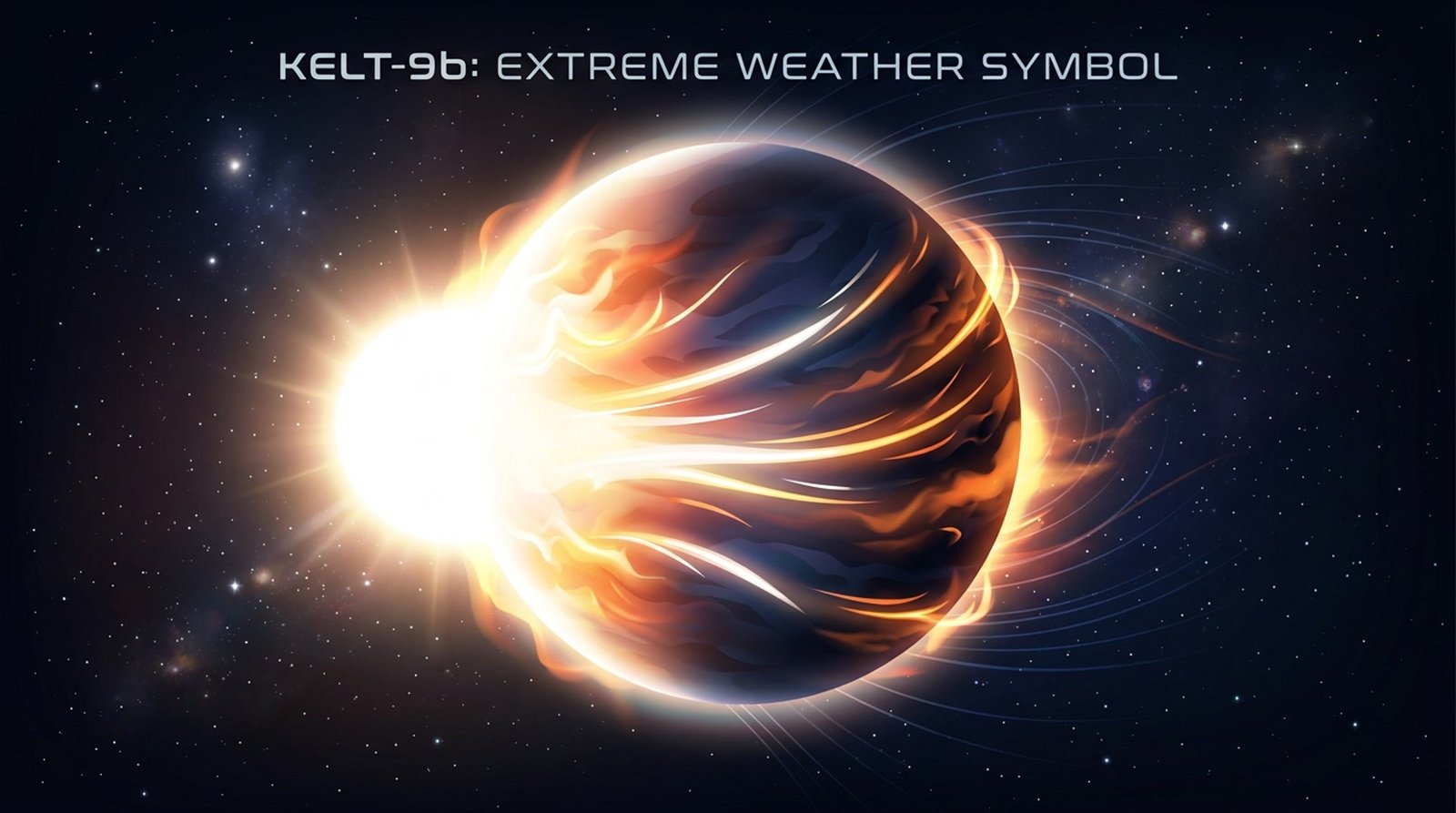
- Surprise: KELT-9b is hotter than most stars, with dayside temperatures reaching 4,000 degrees Celsius.
- Salient Idea: The planet is tidally locked, meaning one half is in permanent daylight and the other in permanent darkness.
- Surprise: Winds scream across the planet at roughly 11.7 kilometers per second (about 26,000 mph).
- Surprise: The atmosphere is so extreme that it contains vaporized heavy metals like iron, titanium, and calcium.
The Discovery: Catching a Supersonic Wind
In a recent study, astronomers pointed the Keck Planet Finder telescope at KELT-9b, the hottest exoplanet ever discovered. They weren’t just looking for its chemical makeup; they were hunting for motion. Using high-resolution spectroscopy, they tracked the light of vaporized metals. They found a Surprise: the light was shifting in a way that proved the glowing gas was moving incredibly fast. They had discovered a supersonic wind blowing at roughly 26,000 mph (11.7 km/s)! Because the planet is tidally locked, the blazing dayside acts like an engine, pushing heat toward the permanent nightside. This creates a relentless, global hurricane of vaporized iron and titanium.
Original Paper: ‘Extreme winds on the emerging dayside of an ultra-hot Jupiter’
This unambiguously suggests the presence of atmospheric winds… representing the most extreme atmospheric winds in hot Jupiters to date.
— Dr. Yapeng Zhang and team
The Science Explained Simply
This is NOT like wind on Earth, which is mostly driven by the sun heating our air and surface unevenly. On KELT-9b, the dayside temperature reaches a blistering 4,000 Kelvin (over 6,700 F). That is hotter than many stars! At this heat, molecules like water are completely ripped apart, and solid metals like iron turn into a glowing, electrically charged gas. The Salient Idea here is the extreme temperature difference between the day and night sides. Nature hates imbalance, so the atmosphere rushes to the dark side to cool off, creating a permanent, supersonic jet stream. It is a one-way conveyor belt of boiling metal.
The Aurora Connection
While KELT-9b does not have Northern Lights like Earth, it shares a deep connection with our planet: magnetic fields. On Earth, our magnetic field protects us from solar storms, causing auroras. On KELT-9b, the atmosphere is so hot that it becomes highly ionized, meaning it is full of electrically charged particles. When charged particles move through a planet’s magnetic field, they experience drag—a magnetic braking effect. Researchers expected a strong magnetic shield to severely slow these winds down. Instead, the 26,000 mph speeds suggest the atmospheric drag might be weaker or more complex than predicted. Studying this helps us understand the invisible magnetic forces that govern both extreme exoplanets and our own safe haven.
More realistic models are required in the extreme parameter regime of KELT-9 b to explore the full implications of the observations on atmospheric drag and magnetic fields.
— Astrophysics Research Team
A Peek Inside the Research
How do you measure wind speed on a planet trillions of miles away? It relies on a clever trick called the Doppler effect. Think of how a siren changes pitch as an ambulance speeds past you. Light does the exact same thing. As the vaporized metals in KELT-9b’s atmosphere blew toward the telescopes on Earth, the light waves squished together, shifting toward the blue end of the spectrum (a blueshift). The researchers used the Keck Planet Finder, an incredibly precise instrument, to measure this exact color shift. By separating the planet’s rotation from the wind, they pinpointed the exact speed of this supersonic metal storm.
High-resolution spectroscopy provides a unique opportunity to directly probe atmospheric dynamics by resolving Doppler shifts.
— Study Authors
Key Takeaways
- High-resolution spectroscopy allows astronomers to track the speed of glowing gas light-years away using the Doppler effect.
- Extreme heat rips molecules apart, creating a highly ionized (electrically charged) atmosphere.
- Magnetic fields interact with these charged winds, acting like a brake system for the planet's weather.
- Ultra-hot Jupiters act as natural laboratories to test how physics works under the universe's most extreme conditions.
Sources & Further Reading
Frequently Asked Questions
Q: What would it feel like to stand on KELT-9b?
A: You could not stand on it! It is a gas giant with no solid surface. Even if you could, the extreme heat would instantly vaporize you, and the 26,000 mph winds of charged metal plasma would blow your atoms into the permanent nightside.
The Exoplanet That Gets Flash-Heated Like a Comet
Summary
By the end of this article, you will understand how astronomers read the ‘weather’ on a gas giant that gets flash-heated from 400K to 1400K in a matter of hours, and what this extreme world teaches us about planetary atmospheres.
Quick Facts
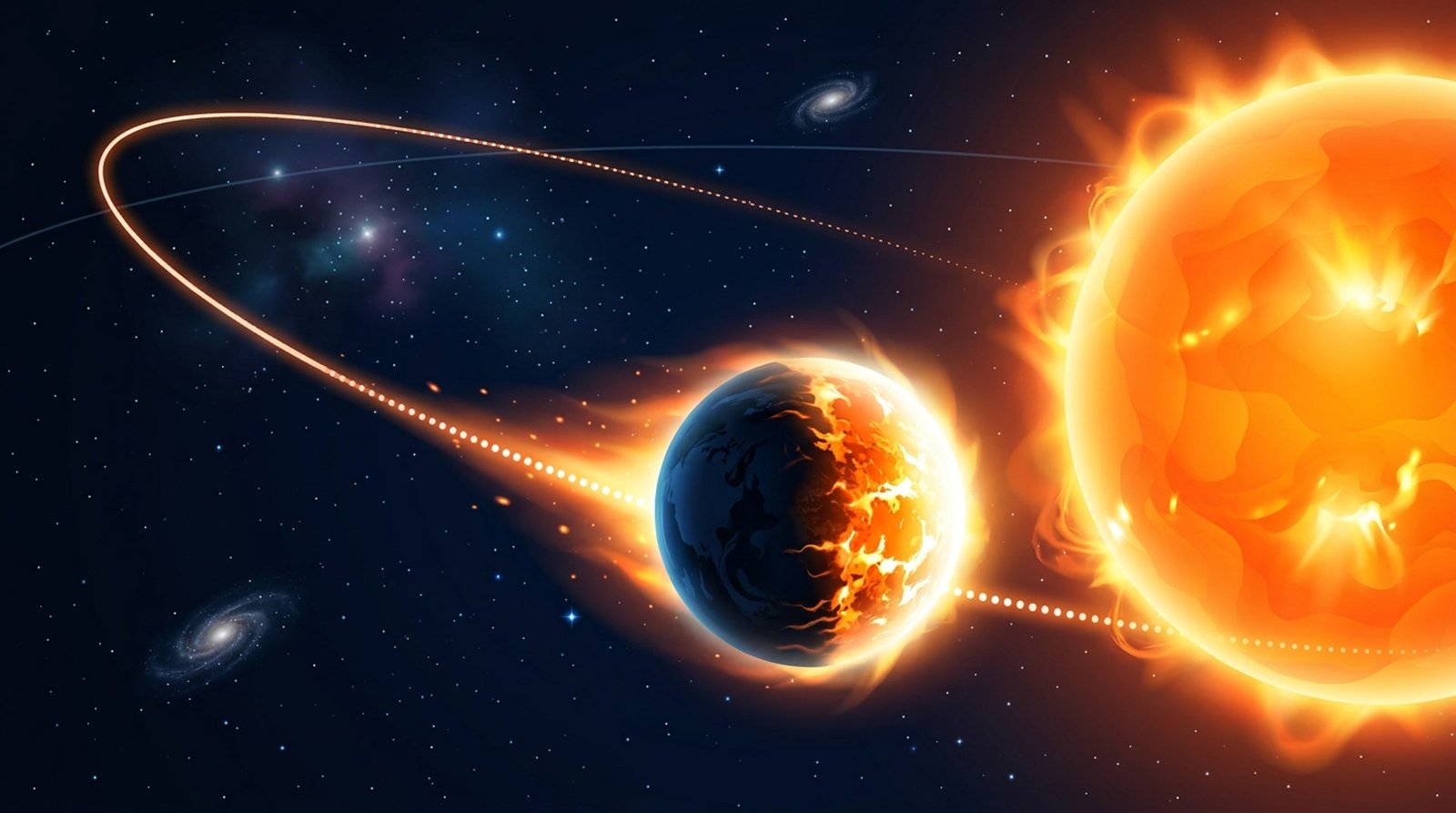
- Surprise: HD 80606 b has an orbit more like a comet than a normal planet, stretching far away and then swooping incredibly close to its star.
- Salient Idea: During its closest approach, the planet's temperature skyrockets from 400 Kelvin to 1400 Kelvin in just tens of hours.
- Surprise: Despite this intense 'flash heating', the planet's upper atmosphere actually stays cooler than the layers below it.
- Salient Idea: Atmospheric winds on this planet might be howling at thousands of miles per hour, driven by the sudden blast of stellar energy.
The Discovery: The Flash-Heated Gas Giant
Astronomers recently pointed the giant Keck II telescope in Hawaii at HD 80606 b right as it swooped within 0.03 AU of its host star. Because of its massive, stretched-out orbit, the planet experiences extreme ‘flash heating.’ The Surprise was that while older computer models predicted a super-hot upper atmosphere (a phenomenon called a thermal inversion), the new telescope data showed the exact opposite. Using high-resolution spectroscopy, the team caught a tentative glimpse of methane and carbon monoxide absorbing light. They proved that even during this violent heating event, the planet’s atmospheric chemistry is entirely different than expected.
The rapid heating of the atmosphere may lead to extreme chemical changes…
— Luke Finnerty, Lead Researcher
The Science Explained Simply
This is NOT just taking a zoomed-in picture of a planet. Exoplanets are way too far away for that. Instead, scientists look at the spectrum of light. The Salient Idea is that different chemicals in an atmosphere block specific colors of light. By looking at the starlight bouncing off the planet, researchers can find the ‘fingerprints’ of specific molecules. It is like analyzing the chemical makeup of a cloud from trillions of miles away simply by seeing which colors of light it eats up. In this case, the ‘missing’ light told them that methane and carbon monoxide were floating in the sky.
The Aurora Connection
When a planet gets this close to its star, it is absolutely bombarded by intense stellar radiation and solar winds. Here on Earth, our magnetic field interacts with solar winds to create beautiful auroras, while acting as an invisible shield that stops our atmosphere from being stripped into space. HD 80606 b gets blasted by radiation thousands of times stronger than Earth does during its close pass. Studying how its atmosphere survives this comet-like plunge helps us understand the limits of planetary protection and how magnetic fields might operate to save the skies of extreme, ultra-hot worlds.
Studying an atmosphere under an extreme external forcing function provides a unique opportunity.
— The Research Team
A Peek Inside the Research
Finding these chemicals requires serious Knowledge and Tools. The researchers used the NIRSPEC instrument on the giant Keck Telescope. They had to mathematically separate the planet’s incredibly faint signal from the blazing light of the host star and the interference of Earth’s own atmosphere. They used a technique called ‘cross-correlation’—matching the observed light to hundreds of thousands of computer-generated models—to find a tiny signal hidden in a mountain of noise. It is a painstaking, mathematical process that pushes the absolute limits of ground-based astronomy.
Future observations with higher spectral resolution are needed for a confident atmospheric detection.
— Finnerty et al.
Key Takeaways
- High-resolution spectroscopy acts like a cosmic barcode scanner, letting us detect gases like methane and carbon monoxide light-years away.
- Extreme eccentric orbits provide a natural laboratory to see how atmospheres react to sudden, massive bursts of radiation.
- The lack of a 'thermal inversion' on this planet changes how scientists model extreme weather on ultra-hot Jupiters.
- Planetary magnetic fields are crucial for protecting atmospheres from being entirely stripped away during these violent heating events.
Sources & Further Reading
Frequently Asked Questions
Q: What exactly is a ‘thermal inversion’?
A: Normally, an atmosphere gets colder as you go higher up. A thermal inversion is when a layer of the upper atmosphere actually gets hotter than the layers below it (like Earth’s stratosphere). Scientists thought this extreme planet would have one, but the data suggests it doesn’t!
Q: Why is the planet’s orbit shaped like a stretched-out oval?
A: HD 80606 b has an ‘eccentric’ orbit, meaning it swings far out into space and then dives incredibly close to its star. This bizarre path was likely caused by a gravitational tug-of-war with another star or planet billions of years ago.
Solving Mars' Glowing Aurora Mystery Using AI
Summary
By the end of this article, you will understand how solar winds create invisible glowing auroras on the daylight side of Mars, and how scientists used ‘explainable AI’ to uncover the planet’s atmospheric secrets.
Quick Facts
- Surprise: Mars has auroras that happen during the day, not just at night!
- Salient Idea: Earth's global magnetic field shields us, but Mars' weak field lets solar wind crash right into the atmosphere
- Surprise: The auroras emit ultraviolet light, meaning human eyes couldn't see them without special satellite instruments
- Surprise: Scientists used 'explainable AI' to force the computer to explain exactly how it solved the space weather puzzle
The Discovery: AI Meets Space Weather
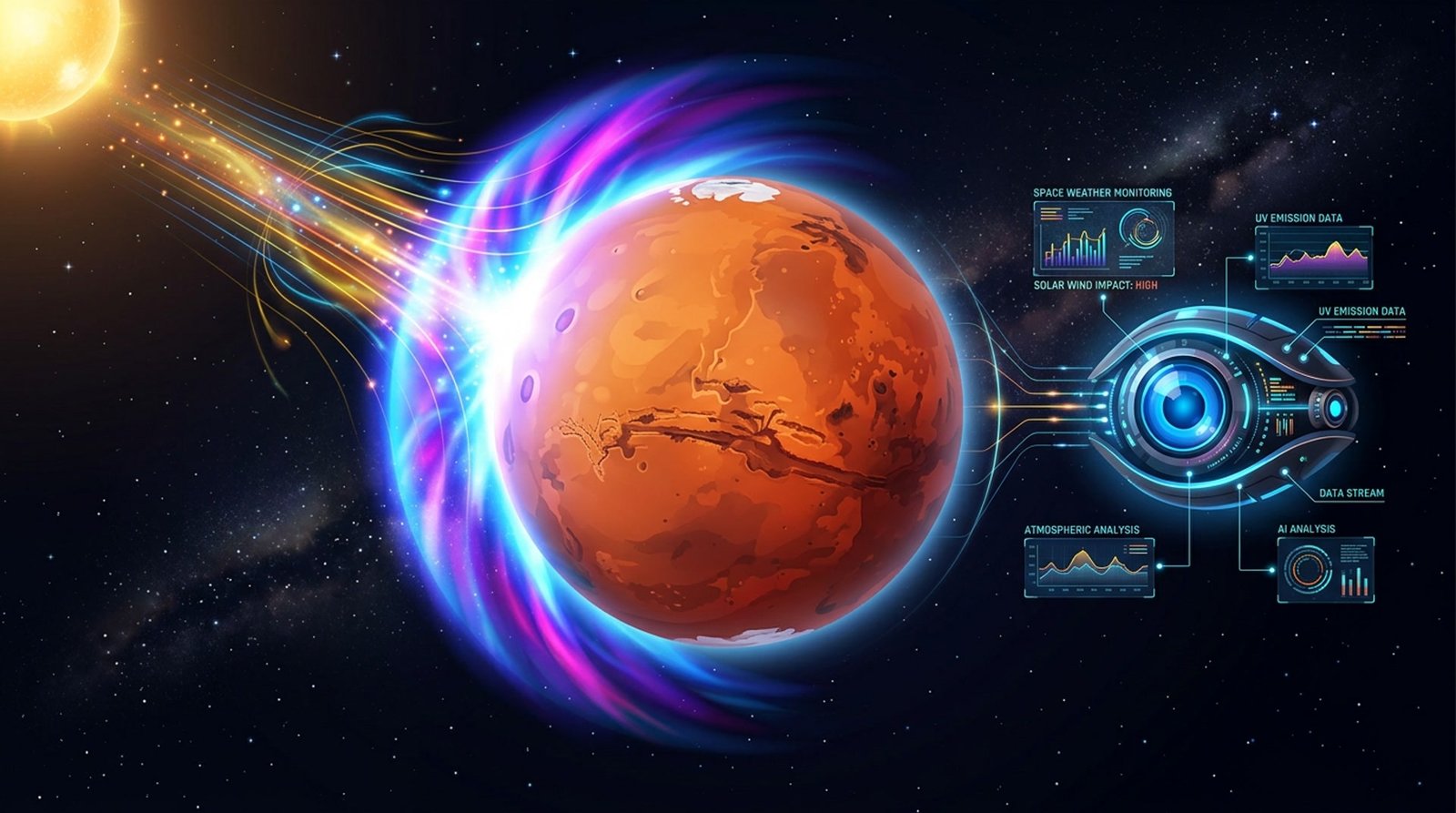
For years, scientists knew Mars had proton auroras—glowing patches of ultraviolet light on the daytime side of the planet. But figuring out exactly what triggers them across the chaotic Martian atmosphere was a massive puzzle. Using data from the MAVEN spacecraft gathered between 2014 and 2022, researchers decided to let a machine solve it. They built an Artificial Neural Network (ANN), feeding it thousands of measurements of solar wind, magnetic fields, and atmospheric density. The Surprise was how accurately the AI learned to predict these auroras. But AI is normally a ‘black box’—it gives an answer, but won’t tell you *how* it got there. To fix this, the team used a mathematical tool called SHAP to ‘interview’ the AI, forcing it to reveal that the Martian seasons and the angle of the sun were the biggest triggers for the glowing skies.
Original Paper: ‘An Explainable Deep-learning Model of Proton Auroras on Mars’
We develop a first purely data-driven model of proton auroras using MAVEN in-situ observations.
— Dr. Dattaraj B. Dhuri
The Science Explained Simply
This is NOT like the Northern Lights on Earth. On Earth, our strong global magnetic field catches solar wind electrons and funnels them to the poles, creating a nighttime light show. Mars lost its global magnetic field billions of years ago. The Salient Idea here is ‘charge exchange.’ When solar wind protons approach Mars, they steal an electron from a hydrogen atom floating in space. This turns them into energetic neutral atoms (ENAs). Because they are neutral, they completely ignore Mars’ weak magnetic defenses! They slam straight into the lower atmosphere on the *daylight* side, colliding with gas and emitting bursts of ultraviolet light. This creates a daytime aurora that is invisible to the naked eye but blazes brightly to UV cameras.
Solar wind protons penetrating as energetic neutral atoms into Mars’ thermosphere are primarily responsible for these auroras.
— Research Team
The Aurora Connection
Studying Martian proton auroras gives us a terrifying look at what happens when a planet loses its magnetic shield. On Earth, our heavy global magnetic field acts as an armor against space weather. Mars only has patchy, weak ‘crustal’ magnetic fields. When the solar wind hits, it strips away pieces of the Martian atmosphere over time—a historical loss that turned Mars from a wet, Earth-like world into a frozen desert. By understanding these daytime auroras, scientists can map exactly how the solar wind interacts with the remnants of Mars’ atmosphere today. It highlights just how vital Earth’s invisible magnetic shield is for protecting our skies and our lives.
Studying them can provide new insights into the complex interactions between the solar wind and weak crustal field of the planet.
— Study Authors
A Peek Inside the Research
How do you ask an AI for its reasoning? The team used SHAP (SHapley Additive exPlanations), a concept from cooperative game theory. Imagine a sports team winning a game; SHAP calculates exactly how much credit each player deserves. Here, the ‘players’ were data points like solar wind speed, temperature, and planetary alignment. The SHAP analysis revealed that the AI relied most heavily on the Solar Zenith Angle (where the sun is in the sky) and the Martian season (dusty summers cause more auroras). It proved the AI wasn’t just guessing—it was learning the actual physics of the Martian atmosphere from pure data.
Through SHAP analysis, we are able to identify possible biases and caveats in the data and modeling.
— Research Team
Key Takeaways
- Proton auroras are caused by solar wind transforming into 'neutral' atoms to sneak past magnetic defenses
- The Martian seasons, specifically its dusty southern summer, drastically change how these auroras behave
- Artificial Neural Networks (AI) can accurately predict space weather when fed massive amounts of satellite data
- SHAP analysis is a mathematical tool that opens up the AI 'black box' so humans can understand its logic
Sources & Further Reading
Frequently Asked Questions
Q: Can I see a proton aurora if I travel to Mars?
A: No, human eyes wouldn’t be able to see it. Proton auroras emit light in the extreme ultraviolet spectrum (specifically Lyman-alpha emissions), so you would need special UV goggles or cameras to see the sky glow.
Q: Why do these auroras happen during the day?
A: Because they are caused by a direct hit from the solar wind! The sun blasts these particles straight at the ‘day’ side of the planet, where they bypass Mars’ weak magnetic fields and crash directly into the atmosphere.
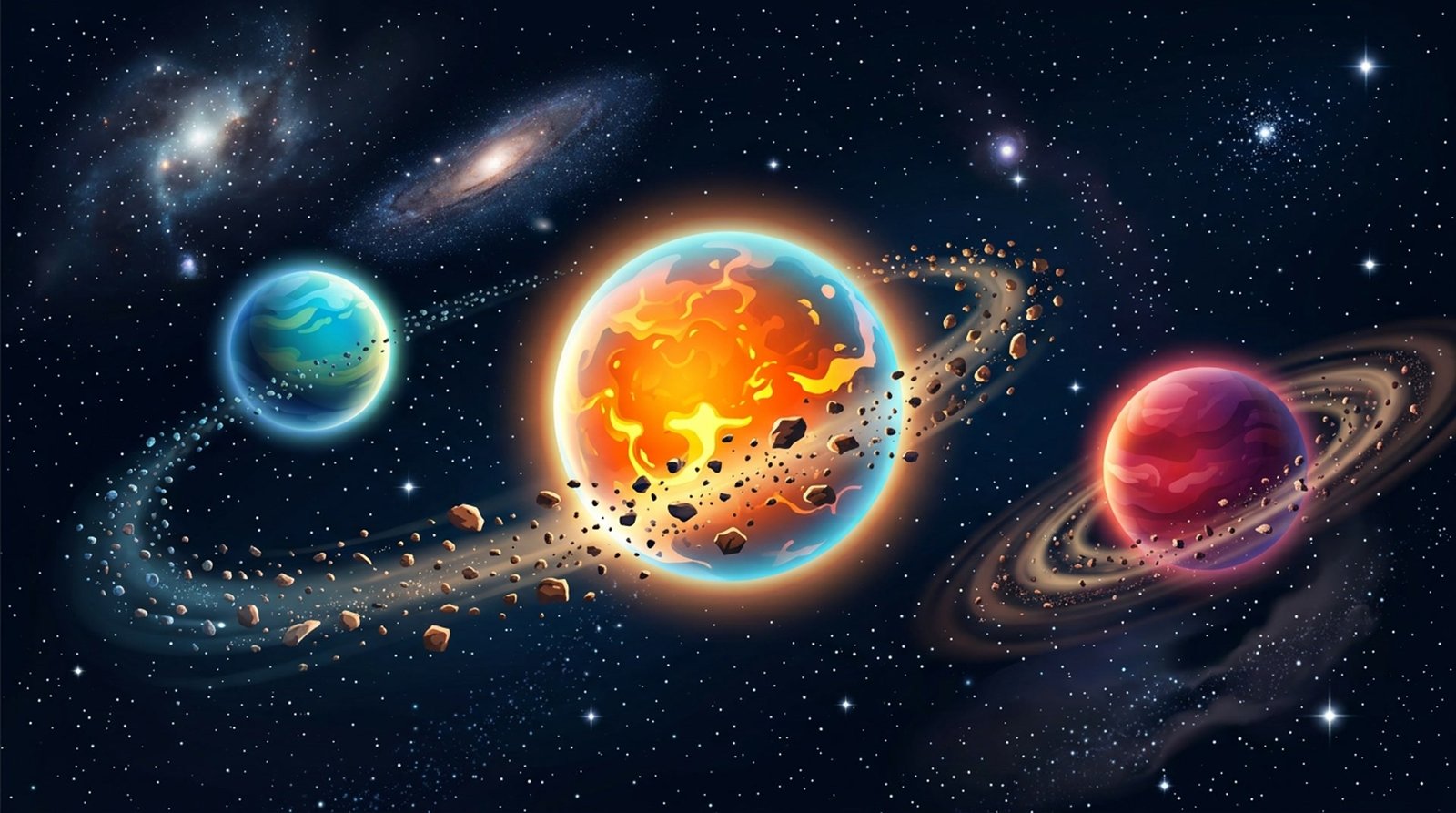
Giant Exoplanets Share Jupiter's Heavy Metal Secret
Summary
By the end of this article, you will understand how scientists read the chemical fingerprints of distant planets to reveal their violent, rocky origins.
Quick Facts
- Surprise: These planets are 15 to 70 times further from their star than Earth is from the Sun!
- Salient Idea: They contain chemical markers like water, methane, and even toxic hydrogen sulfide.
- Surprise: Despite being gas giants, they are packed with 'metals' (elements heavier than hydrogen and helium) just like Jupiter.
- Salient Idea: Scientists used the James Webb Space Telescope to block out a blinding star and photograph the faint planets directly.
The Discovery: The Heavy Metal Giants
Astronomers have long wondered if the gas giants in our solar system are unique. Using the James Webb Space Telescope (JWST), a team peered at HR 8799, a star system with four massive planets. They faced a huge challenge: the star is thousands of times brighter than the planets. By using special tools to subtract the blinding starlight, they found a Surprise: the atmospheres of three of these planets are loaded with heavy elements like carbon, oxygen, and sulfur. This wasn’t just a random mix. The chemical enrichment was uniform across all three worlds, perfectly mirroring the makeup of our very own Jupiter and Saturn. It tells a violent Story of massive planets sweeping up vast amounts of rocky and icy debris as they grew in the dark reaches of space.
Original Paper: ‘Jupiter-like uniform metal enrichment in a system of multiple giant exoplanets’
This composition closely resembles that of Jupiter and Saturn and demonstrates that this enrichment also occurs in systems of multiple gas giant planets orbiting stars beyond the Solar System.
— Jean-Baptiste Ruffio & Team
The Science Explained Simply
When astronomers say ‘metals’, they do NOT mean shiny steel or iron. In astronomy, a ‘metal’ is simply any element heavier than hydrogen or helium. The Salient Idea here is that we can measure these metals using spectroscopy. This is NOT simply taking a picture of a planet. Instead, it is capturing the light from the planet and breaking it into a rainbow. Different chemicals block specific colors of light. By looking at the missing colors, scientists can prove that molecules like water, methane, and hydrogen sulfide exist there. It’s like finding a chemical fingerprint. Because they found high levels of sulfur—which mostly exists as solid rock or ice in space—they know these gas giants must have eaten a lot of solid rocks during their formation.
The Aurora Connection
Just like Earth, giant planets have complex atmospheres shaped by intense cosmic forces. On Earth, our magnetic field interacts with the solar wind to create beautiful auroras while protecting our air. The planets of HR 8799 are exposed to intense ultraviolet radiation from their host star. To hold onto thick atmospheres rich with water and methane over millions of years, these giants likely have incredibly powerful magnetic fields of their own. Understanding the exact chemical mix of these distant atmospheres helps scientists model how planetary magnetic fields form and operate, reminding us of the delicate balance that keeps our own atmosphere—and our spectacular Northern Lights—intact.
The atmospheric compositions of exoplanets encode their accretion history and thereby provide constraints on planet formation models.
— Research Team
A Peek Inside the Research
Spotting these planets is incredibly difficult. Imagine trying to see a firefly hovering next to a searchlight from miles away. The researchers used the JWST’s Near-Infrared Spectrograph (NIRSpec). The hard work involved writing custom software to model and carefully erase the overwhelming glare of the star pixel by pixel. Once the starlight was subtracted, the faint, glowing embers of the planets’ light were left behind. By analyzing this isolated light, they achieved ‘5 to 28-sigma’ detections—meaning they are mathematically certain these molecules are there. It is a brilliant triumph of data processing and optical engineering.
It is a powerful way to disentangle a faint planet signal from the stellar halo especially with a space-based telescope like JWST.
— Jean-Baptiste Ruffio & Team
Key Takeaways
- Gas giants don't just form from gas; they swallow massive amounts of rocky and icy solids.
- Carbon, oxygen, and sulfur levels act like a forensic record of a planet's birth.
- Jupiter's unique chemical recipe isn't special to our solar system.
- Directly imaging planets allows us to read their atmospheres and uncover their formation history.
Sources & Further Reading
Frequently Asked Questions
Q: What does ‘metal enrichment’ mean for a gas giant?
A: In astronomy, a ‘metal’ means any element heavier than hydrogen and helium. Enrichment means the planet has a much higher concentration of elements like carbon, oxygen, and sulfur than the star it orbits, proving it absorbed solid rocky and icy debris.
Q: Why is it important that these planets are chemically like Jupiter?
A: It shows that the way Jupiter formed—by aggressively sweeping up solid materials in the early solar system—is a common process in the universe, even for planets orbiting much further from their stars than Jupiter does.
Catching the Weird, Pulsing Auroras of Uranus
Summary
By the end of this article, you will understand why Uranus has the strangest auroras in the solar system, and how scientists caught them flashing in deep space.
Quick Facts
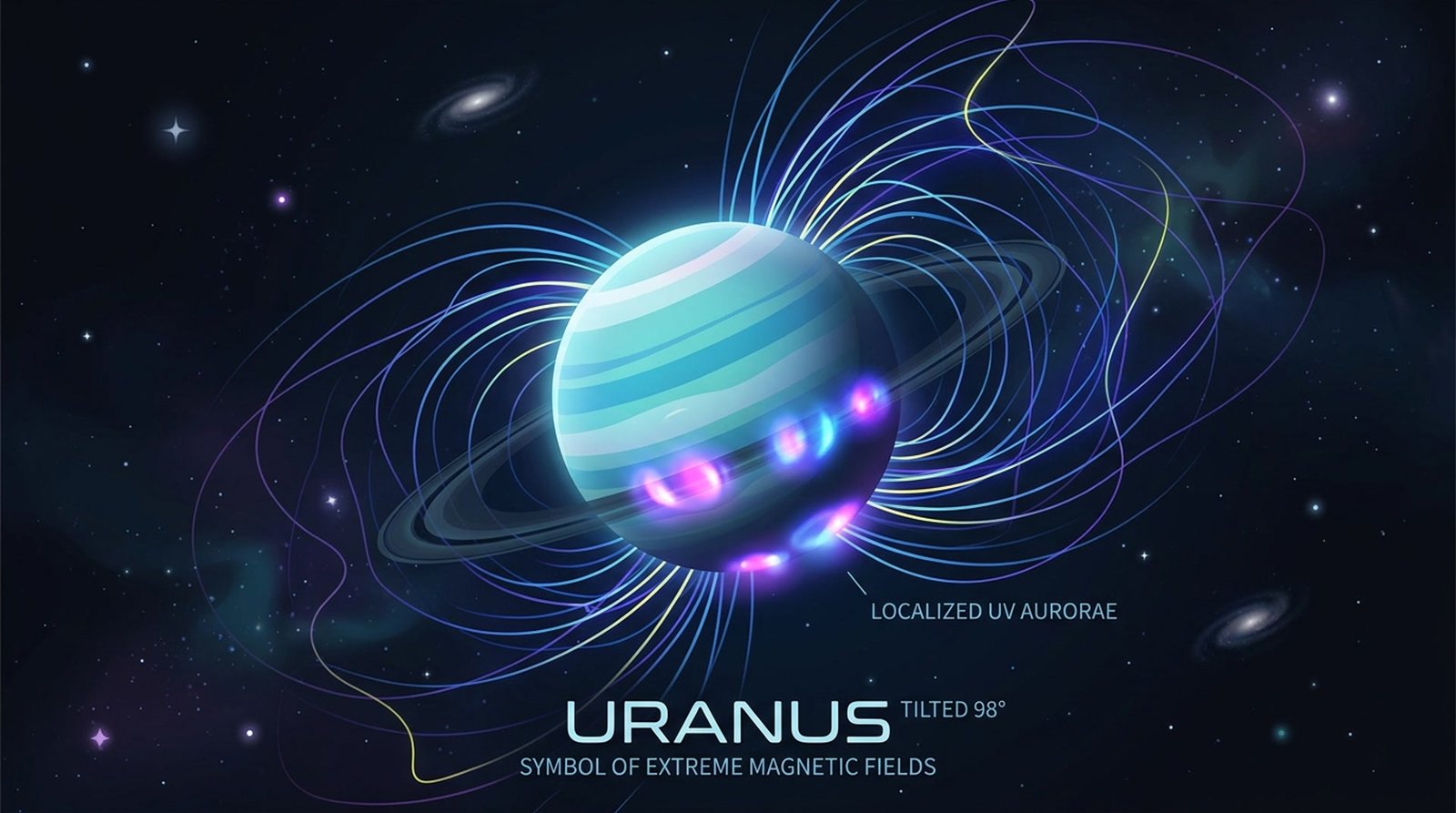
- Surprise: Uranus is knocked on its side, and its magnetic field is tilted 59 degrees away from its spin axis.
- Salient Idea: The planet's auroras are not continuous rings; they are brief spots that pulse for just a few seconds.
- Surprise: In 2014, the Hubble Space Telescope caught the brightest Uranus aurora ever seen, radiating 8.8 gigawatts of power.
- Surprise: Because one year on Uranus takes 84 Earth years, its auroral seasons take decades to change.
The Discovery: Flashes in the Dark
In 2012 and 2014, scientists pointed the Hubble Space Telescope at Uranus, waiting for solar wind shocks to hit the ice giant. They were hunting for something incredibly rare: Uranian auroras. Because Uranus is so far away, observing its space weather is a massive challenge. But when the data came back, the team found a Surprise: six new detections of ultraviolet auroras, including the most intense ones ever recorded. This wasn’t a steady glow. The images revealed localized, glowing spots rotating with the planet. The active regions lit up for a few tens of minutes, but the core emissions were made of brief, intense pulses lasting less than two seconds. They had successfully mapped the hidden magnetic footprint of a deeply alien world.
The detected emissions occur close to the expected arrival of interplanetary shocks.
— L. Lamy et al.
The Science Explained Simply
This is NOT like the auroras on Earth. On Earth, magnetic fields guide solar particles to the north and south poles, creating a continuous, glowing ring of light. Uranus is fundamentally different. The planet’s magnetic field is a mess. It is tilted 59 degrees away from the axis the planet spins on, and the magnetic center does not even line up with the center of the planet. The Salient Idea here is ‘pulsed cusp emissions.’ Because of this weird geometry, the solar wind hits the magnetic field at bizarre angles, causing localized, explosive reconnections. Instead of a steady halo, particles get dumped into the atmosphere in sudden, intense bursts, creating glowing spots that flash like a cosmic strobe light.
The Aurora Connection
Even two billion miles away, the sun dictates the weather. Just like on Earth, auroras on Uranus are driven by the solar wind—a stream of charged particles blasted out by our star. By tracking when massive bursts of solar wind were predicted to reach Uranus, scientists knew exactly when to look. When these high-pressure fronts slam into Uranus’ lopsided magnetic shield, the shield compresses. This sudden squeeze forces trapped plasma down into the planet’s hydrogen-rich atmosphere. It proves that no matter where you are in the solar system, if you have an atmosphere and a magnetic field, the sun’s invisible storms will find a way to light up your skies.
Possible Uranian cusp aurorae discussed above might thus be similarly triggered by solar wind compressions.
— The Research Team
A Peek Inside the Research
How do you see a flash of light that lasts one second, two billion miles away? It requires incredible Knowledge and Tools. The team used Hubble’s Space Telescope Imaging Spectrograph (STIS) in ‘time-tag mode.’ This instrument does not just take a long-exposure photograph; it records the exact arrival time of every single photon of ultraviolet light at a 125-microsecond resolution. By filtering out background noise and graphing the photon hits over time, they found clear spikes—auroral bursts well above the background level. They were literally counting individual packets of light to prove these alien auroras were flashing.
The time-tag mode enables us to process the data at the desired time resolution and to build time series of the counts.
— L. Lamy et al.
Key Takeaways
- Uranus' highly asymmetric magnetic field creates completely unique auroral behavior.
- Intense solar wind shocks trigger these rare, pulsing auroras.
- Scientists used Hubble's time-tag mode to measure individual ultraviolet photons.
- Tracking auroras is currently our best way to map Uranus' hidden magnetic poles.
Sources & Further Reading
Frequently Asked Questions
Q: Why didn’t Voyager 2 see these flashing spots when it flew by in 1986?
A: Uranus has extreme seasons that last decades. When Voyager 2 flew by, it was Solstice, and the magnetic geometry was totally different. By 2014, it was past Equinox, changing how the solar wind interacted with the planet.
Q: Are Uranus’ auroras visible to the naked eye?
A: No. Aside from being incredibly far away, these auroras radiate mostly in the far-ultraviolet spectrum, which is invisible to human eyes but perfectly visible to the Hubble Space Telescope.
Auroras on Planets Orbiting Dead Stars
Summary
By the end of this article, you will understand how dead, spinning stars can ignite massive auroras on alien planets, and how scientists plan to ‘hear’ them using giant radio telescopes on Earth.
Quick Facts
- Surprise: The very first planets discovered outside our solar system were orbiting a dead star, not a living one.
- Surprise: Pulsar planets do not even need their own magnetic fields to have auroras.
- Salient Idea: These alien auroras emit radio waves that are millions of times more powerful than Earth's.
- Surprise: Earth's own atmosphere (the ionosphere) actually blocks some of these alien radio signals from reaching our telescopes.
The Discovery: Listening for Alien Auroras
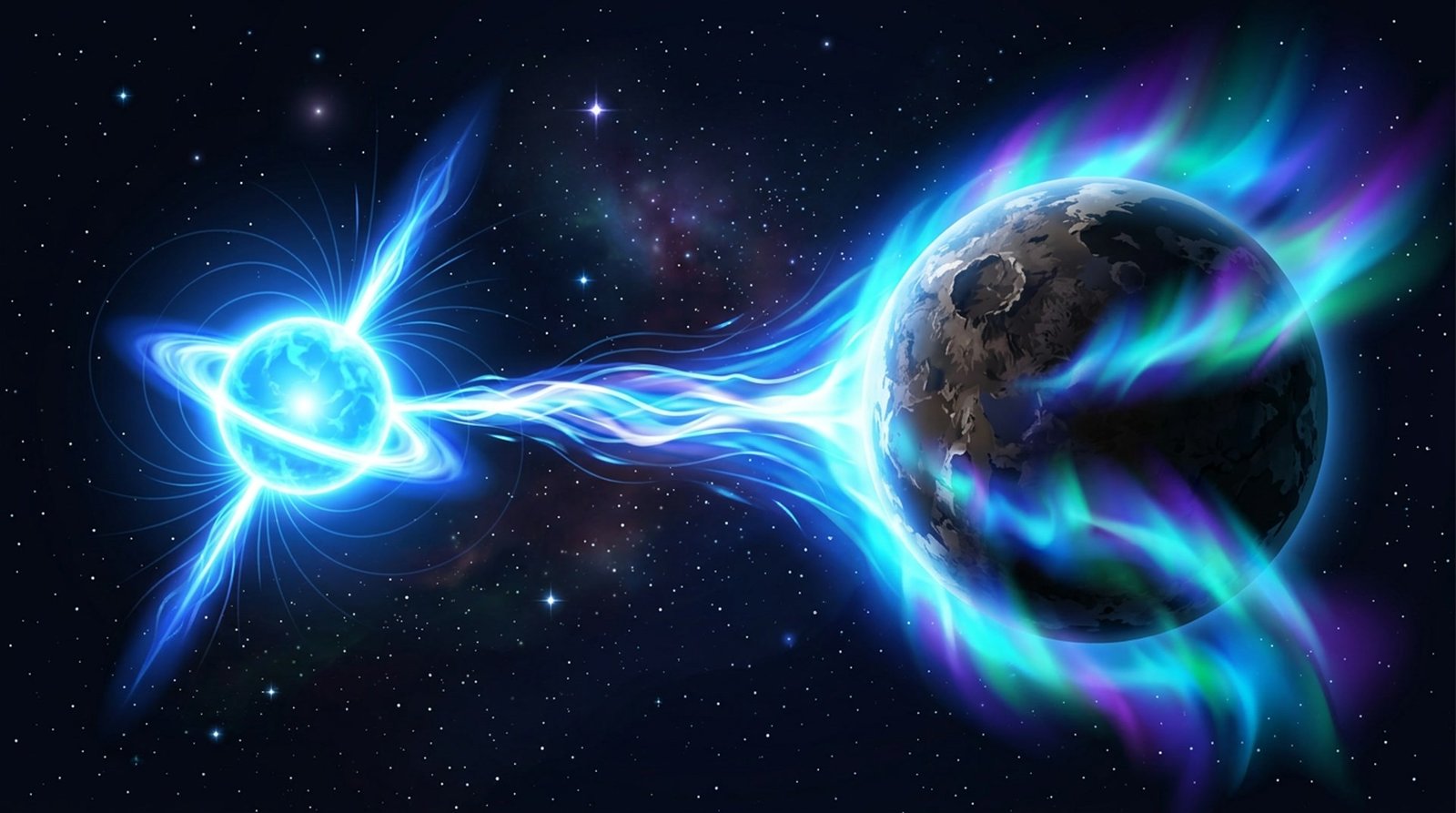
In 1992, astronomers found the first exoplanets orbiting a pulsar—a rapidly spinning, dead star. But how do we study worlds we cannot see? A team of researchers realized they could listen for them. Using supercomputers, they simulated what happens when a pulsar’s intense, magnetized wind slams into a rocky planet. They discovered a Surprise: the collision creates a massive, glowing aurora. But this isn’t visible light; it broadcasts as powerful radio waves. By calculating the strength of this radio signal, they found that current telescopes like LOFAR and the future Square Kilometre Array (SKA) might actually be able to detect these alien auroras from Earth, marking the first time we could ever ‘hear’ an exoplanet.
Original Paper: ‘Auroras on planets around pulsars’
We predict the existence of aurora on planets around millisecond pulsars… which would be the first radio detection of an extrasolar planet.
— Ruchi Mishra
The Science Explained Simply
This is NOT like the aurora on Earth. Earth has its own internal magnetic field that catches solar wind. The planets in this study are ‘dead’ rocks with zero magnetic fields. So how do they get auroras? The Salient Idea is that the pulsar’s wind is so overwhelmingly magnetic and fast that it wraps around the planet. The wind piles up and literally forces an ‘induced’ magnetic field onto the planet. Energetic electrons from the pulsar travel down these forced magnetic lines and crash into the planet, emitting low-frequency radio waves. It is a one-way blast of pure magnetic energy lighting up a barren rock.
Even without intrinsic planetary magnetic field, there can arise intense radio emission.
— Research Team
The Aurora Connection
On Earth, our Northern Lights are caused by the Sun’s mild stellar wind interacting with our protective magnetic shield. It is a gentle cosmic dance. Around a pulsar, space weather is a violent hurricane. The magnetic field of a millisecond pulsar is millions of times stronger than our Sun’s. By studying these extreme, alien auroras, scientists can better understand how stellar winds and magnetic fields behave everywhere in the universe. If we can understand how a planet survives the blast of a pulsar, we gain a deeper appreciation for Earth’s own invisible magnetic shield that keeps our atmosphere safe from the Sun.
Studying an aurora observed in the vicinity of non-magnetic planets could offer some insights for pulsar planets.
— Research Team
A Peek Inside the Research
How do scientists study something 2,000 light-years away? They use MHD (Magnetohydrodynamic) simulations. The researchers used a code called PLUTO to build a 3D digital model of a pulsar and a planet. They tested two scenarios: one where the planet’s surface was conductive, and one where it was ferromagnetic (like iron). They pushed the digital pulsar wind to near the speed of light and calculated the exact radio frequency the resulting aurora would emit. They faced a unique hurdle: Earth’s ionosphere blocks radio frequencies below 10 MHz. To hear these planets, scientists have to look for pulsars with winds just strong enough to push the aurora’s broadcast above that 10 MHz limit!
We perform the first magnetohydrodynamic simulations of magnetospheric pulsar-planet interaction.
— Ruchi Mishra
Key Takeaways
- A pulsar's intense stellar wind can induce a temporary magnetic field on a rocky planet.
- Radio telescopes could soon make the first-ever radio detection of an exoplanet by listening for its aurora.
- These alien auroras act as probes, helping us understand the mysterious, invisible winds of pulsars.
- Magnetohydrodynamic (MHD) computer simulations allow us to model extreme space weather we cannot test on Earth.
Sources & Further Reading
Frequently Asked Questions
Q: What exactly is a pulsar?
A: A pulsar is the crushed core of a dead star. It spins incredibly fast—sometimes hundreds of times a second—and shoots out powerful beams of radiation and highly magnetic winds.
Q: Why do we use radio telescopes to find these planets?
A: Planets are incredibly dim and hard to see with visible light. But the auroras created by pulsar winds blast out powerful radio waves, which our giant radio dish antennas on Earth can easily detect.
How the World Survived the 2024 Solar Maximum
Summary
By the end of this article, you will understand how massive solar storms affect Earth’s technology, and the surprising, low-cost ways operators actually protect our power grids, satellites, and flights.
Quick Facts
- Surprise: The May 2024 Gannon storm brought auroras as low as 35 degrees latitude!
- Surprise: Instead of shutting down during huge solar storms, most satellite companies keep running to avoid losing money.
- Salient Idea: Space weather creates invisible 'Geomagnetically Induced Currents' that can fry massive power transformers.
- Surprise: Operators favor cheap software modeling over buying expensive protective hardware.
The Discovery: The Great Gannon Storm
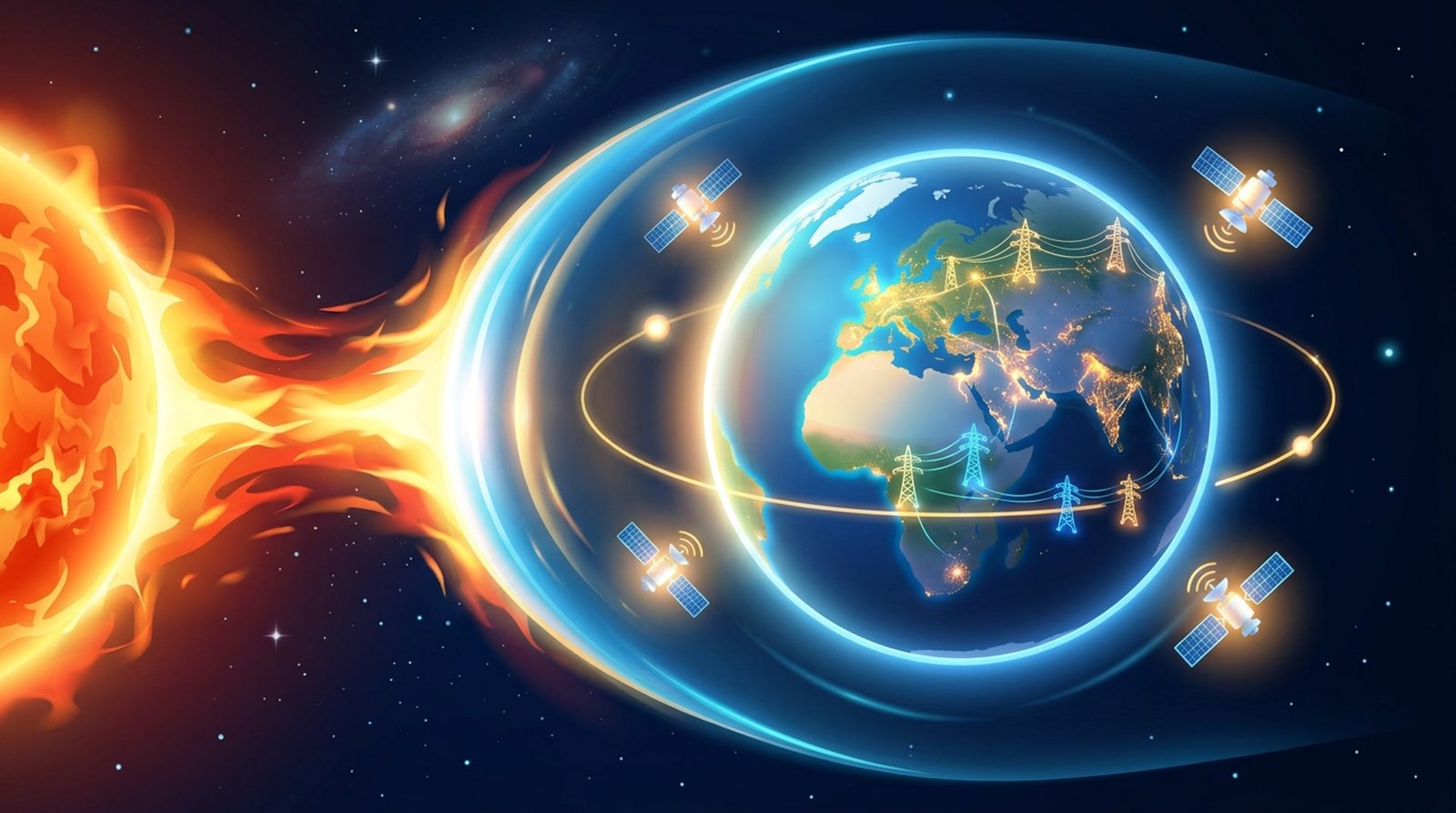
In May 2024, the Earth was hit by the Gannon Storm, an extreme G5 geomagnetic event. It was the largest space weather event in 20 years, lighting up skies with auroras far closer to the equator than normal. But while the sky was beautiful, critical infrastructure operators were sweating. A new study surveyed 55 operators across the power, satellite, and aviation industries to see how they handled the threat. The Surprise? While scientists often recommend expensive hardware upgrades or shutting systems down completely to avoid damage, most companies did the opposite. They kept operations running to protect their revenue, relying on careful monitoring and pre-planned strategies to dodge disaster.
Organizations prioritize mission continuity for revenue, often bypassing risk-averse advice.
— C. M. LaNeve et al.
The Science Explained Simply
When we talk about protecting infrastructure from space weather, this is NOT like putting a surge protector on your TV. A solar storm causes the Earth’s magnetic field to fluctuate, which creates Geomagnetically Induced Currents (GICs). These low-frequency currents sneak into massive power grid transformers and can literally melt them. The Salient Idea here is that operators protect these grids mostly with information, not just metal shields. They increase situational awareness, review computer models, and occasionally reroute power. Instead of buying million-dollar ‘GIC blockers,’ they train their teams to watch the network like hawks and balance the grid’s load before the solar particles even hit.
The Aurora Connection
The same solar energy that creates the breathtaking auroras we love is exactly what puts our technology at risk. When a Coronal Mass Ejection (CME) slams into Earth’s magnetic field, it dumps energy into the upper atmosphere. This heats the ionosphere, making it expand outward. For satellites in Low Earth Orbit, this expanding atmosphere acts like a sudden, thick fog, dragging them down and changing their orbits! So, while you might be staring up at a beautiful green aurora, satellite operators are scrambling to model new trajectories to keep their billion-dollar machines from falling out of the sky or getting fried by radiation.
When CMEs interact with Earth’s geospace environment they can deposit large quantities of energy… and the total density of the ionosphere increases.
— Research Team
A Peek Inside the Research
How do we know what these companies actually do? It isn’t just guesswork. Researchers painstakingly tracked down and contacted over 300 operators from the power, satellite, and aviation sectors. They used anonymous surveys and interviews to get the real, unvarnished truth about the 2024 solar maximum. They compared the ‘ideal’ solutions from academic literature against the real-world decisions made by stressed operators during a G5 storm. This perishable data is vital. It proved that while large companies have the cash to run predictive models, smaller ones are forced to just ‘weather the storm,’ highlighting a massive preparedness gap in our modern infrastructure.
This is one of the first exhaustive studies of space weather mitigation activities, and moves beyond the traditional focus on purely impacts.
— The Authors
Key Takeaways
- There is a huge gap between what scientists recommend and what companies actually do during solar storms.
- Situational awareness and communication are the primary defenses against space weather.
- Smaller companies often just 'weather the storm' because protective upgrades are too expensive.
- Satellites face threats like atmospheric drag, radiation, and single event upsets during solar maximums.
Sources & Further Reading
Frequently Asked Questions
Q: Why don’t satellite operators just turn everything off during a storm?
A: Turning off a satellite means dropping service for millions of paying customers. Most operators decide the financial loss of turning off is worse than the risk of damage, so they rely on the satellite’s physical shielding instead.
Q: Do solar storms affect airplanes?
A: Yes! High-altitude flights are exposed to more solar radiation, and space weather can scramble GPS and radio communications. Pilots train for this and will sometimes lower their altitude or reroute flights to stay safe.
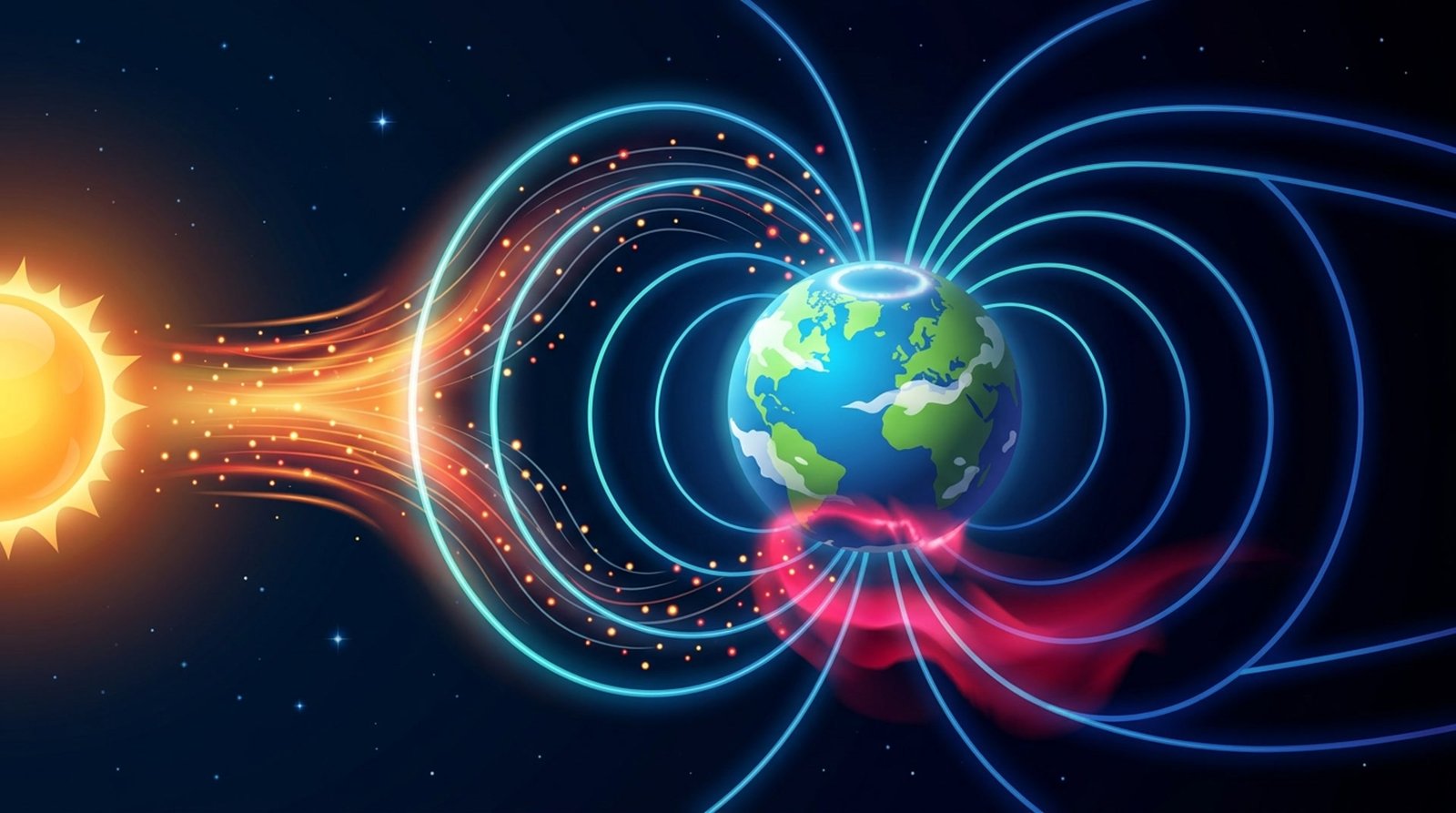
How Space Waves Paint the Sky Red
Summary
By the end of this article, you will understand how invisible space waves scatter low-energy electrons into Earth’s atmosphere to create rare, glowing red auroras.
Quick Facts
- Surprise: Red auroras happen much higher up (above 200 km) than typical green ones.
- Surprise: They are caused by 'low-energy' electrons (less than 1,000 volts), not massive energy spikes.
- Salient Idea: Instead of shooting straight down, these electrons are 'scattered' out of their magnetic traps by plasma waves.
- Surprise: The red glow takes so long to fade (about 110 seconds) that winds can blow the aurora across the sky.
The Discovery: Catching the Red Ghost
Scientists have long studied auroras, but streamer-like red-line auroras remained a mystery. In 2015, researchers used the THEMIS spacecraft and ground cameras in Canada to track them. They found a Surprise: a massive injection of plasma from deep space was shooting toward Earth. As this plasma hit Earth’s magnetic field and hit the cosmic brakes, it created intense ripples called Time Domain Structures (TDSs) and ECH waves. By perfectly syncing the satellite’s position in space with the red glowing patches on Earth, the team proved these exact waves were the culprit. The waves were literally shaking electrons out of the sky.
We establish a direct linkage between these red-line auroras and electron precipitation induced by TDSs and ECH waves.
— Yangyang Shen, Lead Author
The Science Explained Simply
This is NOT like the sharp, swirling green auroras you usually see. Typical green auroras are caused by high-energy electrons crashing down in straight lines, almost like lightning bolts. The Salient Idea here is scattering. The electrons causing these red auroras are ‘low-energy’ and are normally trapped safely in Earth’s magnetic field. But when TDS and ECH waves ripple through the area, they interact with the electrons—a process called pitch-angle scattering—knocking them off their safe path. They fall into the upper atmosphere like a gentle, diffuse cosmic rain, hitting oxygen atoms high up and making them glow red.
The Aurora Connection
The connection here to our daily lives is profound. These wave-driven electron showers play a massive role in space weather. When low-energy electrons heat up the highest parts of our atmosphere (the F-region ionosphere), the atmosphere actually expands outward. This changes chemical reactions and plasma density. Why does that matter? Because it creates drag on satellites, scrambles GPS navigation, and disrupts radio communications. By understanding the waves that paint the sky red, we aren’t just looking at pretty lights; we are tracking the invisible magnetic battle that protects Earth.
Understanding these processes helps us better predict space weather impacts on communication, navigation, and satellite operations.
— NorthernLightsIceland.com Team
A Peek Inside the Research
How do you prove a specific invisible wave in space caused a specific red light on Earth? The team used cross-correlation. They took data from the THEMIS satellite, which was measuring wave energy thousands of miles in space, and lined it up millisecond by millisecond with a specialized red-light camera (REGO) in Fort Smith, Canada. They didn’t just guess; they ran a supercomputer model called TREx-ATM to simulate what would happen if those exact satellite-measured waves hit the atmosphere. The model matched the real-life red lights almost perfectly, proving the connection.
Key Takeaways
- Plasma waves called TDSs and ECH waves act like cosmic brooms, sweeping trapped electrons into the atmosphere.
- Streamer-like red auroras represent a diffuse, wave-driven process, distinct from the sharp, direct-hit green auroras.
- Low-energy electron precipitation heats the upper atmosphere, which can physically expand it and alter satellite orbits.
- Connecting satellite data in space to camera footage on Earth is the key to proving how space weather works.
Sources & Further Reading
Frequently Asked Questions
Q: Why are these auroras red instead of green?
A: Red auroras occur much higher in the atmosphere (above 200 km). At this height, the scattered low-energy electrons hit oxygen atoms, which release red light. Because the air is thinner, the atoms don’t collide with other molecules as quickly, allowing the red glow to persist.
Q: What is pitch-angle scattering?
A: Imagine a marble rolling perfectly inside a groove. If you shake the groove, the marble falls out. Pitch-angle scattering is when space waves ‘shake’ the magnetic field, causing trapped electrons to fall out of orbit and plunge into Earth’s atmosphere.
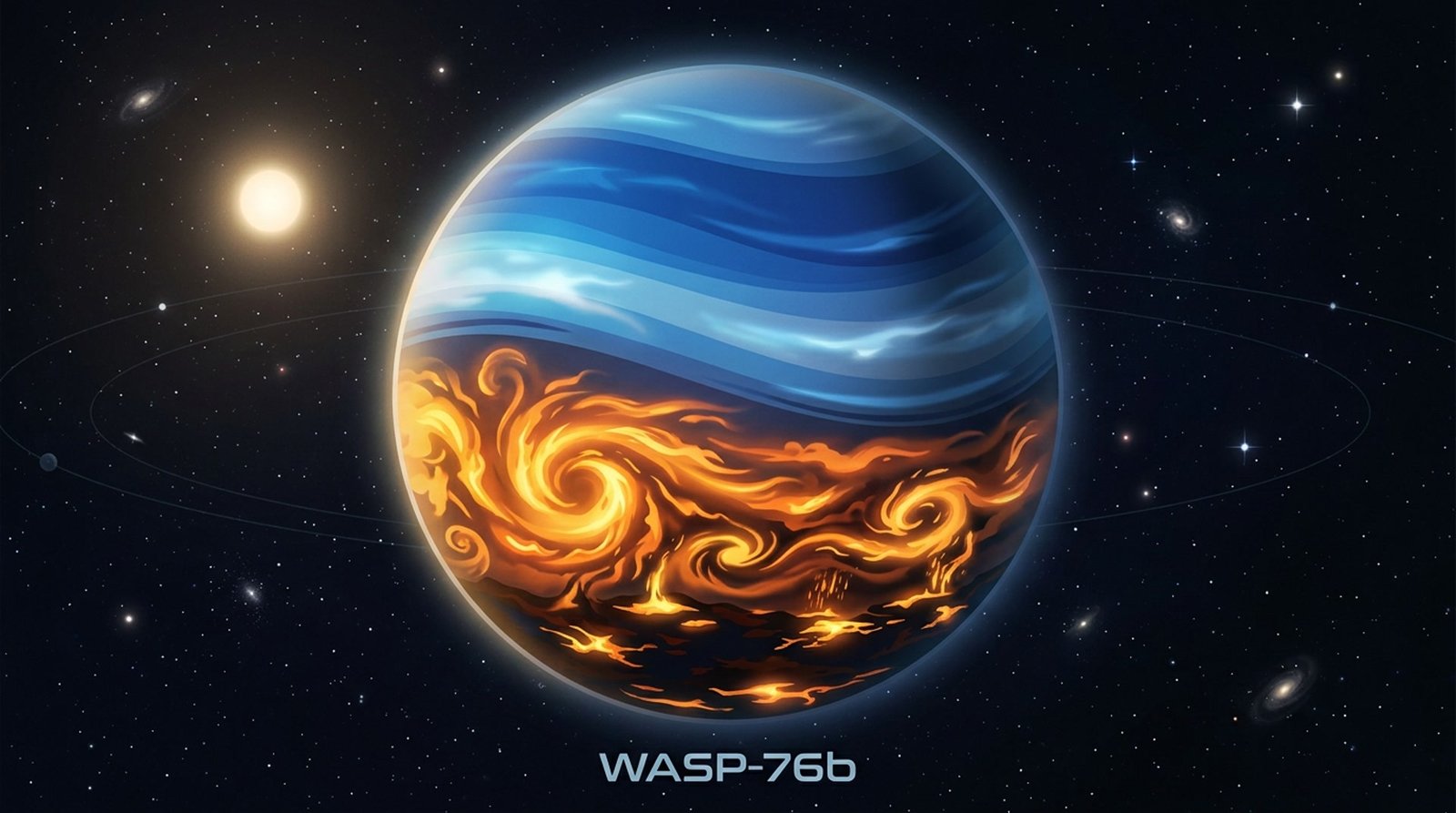
The Layer Cake Winds of an Iron-Raining Planet
Summary
By the end of this article, you will understand how astronomers map the winds on a planet 640 light-years away and discover its bizarre, multi-layered alien weather.
Quick Facts
- Surprise: Astronomers can measure wind speeds on a planet 640 light-years away just by looking at starlight.
- Salient Idea: WASP-76b has 'layer cake' weather—winds are raging fast deep down but much slower higher up.
- Surprise: Vaporized iron was detected blowing from the day side to the night side at over 11 kilometers per second.
- Surprise: The planet's shadow acts like a barcode, letting scientists see exactly what the alien air is made of.
The Discovery: Mapping an Alien Storm
In a massive leap for space weather forecasting, astronomers aimed the newly built Keck Planet Finder (KPF) at the famous ultra-hot Jupiter, WASP-76b. They knew this planet was a nightmare world where iron vaporizes on the day side and rains down on the night side. But they were looking for a Surprise. By analyzing the light filtering through the planet’s atmosphere during a transit, they discovered something completely unexpected: the weather changes drastically depending on how high up you go. Deep down in the atmosphere, heavy neutral iron is caught in a raging hurricane, blowing from the day side to the night side at over 11 kilometers per second. However, when the team looked at lighter elements like sodium and calcium, which float much higher up, the winds vanished. They had discovered a multi-layered atmosphere! This proved that WASP-76b isn’t just one giant, uniform storm. Instead, it has a complex, three-dimensional climate system with chaotic lower depths and surprisingly calm upper skies.
The KPF SURFS-UP Survey I: Transmission Spectroscopy of WASP-76 b
Neutral metals such as Fe I trace deeper regions with stronger asymmetries, while Na I and Ca II probe regions higher in the atmosphere where the ingress-egress asymmetries are weaker.
— The KPF SURFS-UP Survey Team
The Science Explained Simply
To understand this, we need to know how astronomers ‘see’ these winds. This is NOT a direct photograph of alien clouds moving. Instead, astronomers use a technique called transmission spectroscopy. When WASP-76b passes in front of its host star, the star’s light filters through the planet’s atmosphere. Different gases absorb different colors of light, creating a unique barcode or shadow. The Salient Idea here is the Doppler effect. When the iron winds blow toward our telescopes on Earth, the light they absorb gets squished, shifting slightly toward the blue end of the spectrum. The faster the wind, the bigger the blue-shift. But when scientists measured the barcodes for sodium and calcium, they didn’t see this blue-shift. The barcode stayed perfectly still. This means the gas at those higher altitudes isn’t moving toward us at breakneck speeds. The extreme day-to-night heat differences that drive the deep iron winds simply don’t have the same grip on the upper edges of the planet’s sky.
The Aurora Connection
Why do these upper layers matter? On Earth, the highest reaches of our atmosphere—where gases thin out and interact with space—are where the magic of auroras happens. High-altitude layers are constantly bombarded by stellar wind and protected by a planet’s magnetic field. On WASP-76b, the sodium and calcium sit in a similar high-altitude transition zone, where the atmosphere meets the terrifying radiation of its sun. By learning that the winds here are calm compared to the deeper iron storms, scientists can start to piece together how this alien world’s magnetic field might be operating. Understanding the physics of this high-altitude buffer zone on extreme exoplanets helps us appreciate the delicate magnetic shield protecting our own upper atmosphere, allowing us to safely witness the Northern Lights without having our air stripped away into the void.
Studying high-altitude dynamics on extreme worlds teaches us about the fragile boundaries where planetary atmospheres meet deep space.
— NorthernLightsIceland.com Team
A Peek Inside the Research
Extracting this data is an incredible feat of Knowledge and Tools. The signal of an alien atmosphere is incredibly faint and buried under massive amounts of noise. The research team had to write a custom software pipeline just to clean the data from the Keck Planet Finder. First, they had to remove the instrumental artifacts and normalize the light. But the biggest challenge was dealing with Earth’s own atmosphere! Our planet has water and oxygen that block starlight, creating ‘telluric’ interference. The team used complex line-by-line radiative transfer models to mathematically subtract Earth’s atmospheric signature, effectively peeling away our own sky so they could clearly see WASP-76b. Only after this rigorous mathematical cleaning could they isolate the tiny, shifting spectral lines of alien iron, calcium, and sodium. It is a masterpiece of separating the true planetary signal from cosmic noise.
Key Takeaways
- Different chemicals float at different heights, revealing a 3D picture of alien weather.
- Iron vapor gets pushed by extreme day-to-night winds, creating blue-shifted light signals.
- High-altitude gases like Sodium and Calcium show no wind shift, proving the upper skies are calmer.
- New tools like the Keck Planet Finder (KPF) give us unprecedented, crystal-clear views of exoplanet atmospheres.
Sources & Further Reading
Frequently Asked Questions
Q: How do we know the wind is blowing if we can’t see the planet clearly?
A: We use the Doppler effect! Just like a police siren changes pitch as it drives past you, light waves get squished (blue-shifted) when the wind blows the gas toward our telescopes. By measuring that shift, we calculate the wind speed.
Q: Why does iron rain down but sodium stays up high?
A: It comes down to atomic properties and pressure. Elements like sodium and calcium absorb light incredibly well even at very low pressures, meaning their ‘shadow’ shows up much higher in the atmosphere than heavier, neutral iron.
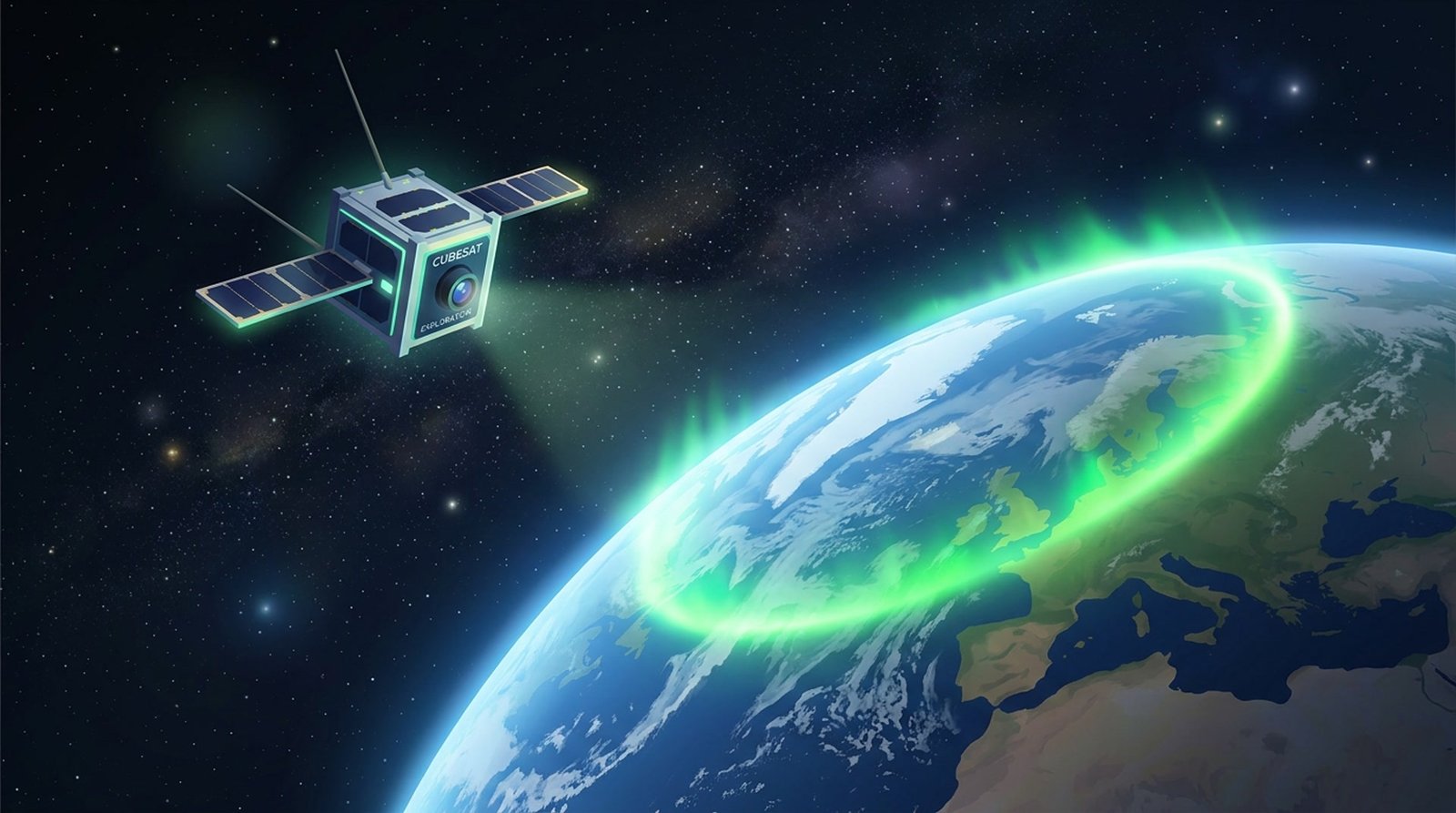
A Tiny CubeSat's First Aurora Photo from Space
Summary
By the end of this article, you will understand how a satellite the size of a milk carton captured the first nanosatellite image of the Northern Lights, and why viewing auroras from space sideways changes everything.
Quick Facts
- Surprise: The Suomi 100 satellite is a 1-Unit CubeSat, measuring just 10x10x10 cm (the size of a Rubik's cube)
- Salient Idea: The best way to photograph faint space weather is to look sideways at the Earth's horizon (the limb) against the blackness of space
- Surprise: The satellite spins constantly, meaning its camera rotated 7.2 degrees during the 2.4-second aurora exposure
- Surprise: Ground cameras entirely missed this aurora because of clouds and geography, proving the value of space-based imaging
The Discovery: A 10-Centimeter Photographer
In late 2018, a tiny box called Suomi 100 launched into orbit. It was a 1-Unit CubeSat, a low-cost satellite no bigger than a grapefruit, built mostly with commercial off-the-shelf parts. In January 2019, its simple 3-megapixel camera snapped a picture. Because the satellite’s data rate is incredibly low, researchers initially only saw a tiny, pixelated thumbnail. But upon closer inspection, they found a Surprise: the first-ever image of the Northern Lights taken by a nanosatellite. The image was slightly blurred because the satellite was tumbling, rotating constantly through the dark. To figure out what they were actually looking at, the team had to act like forensic detectives. They combined the satellite image with data from ground-based magnetometers across Scandinavia. Ground cameras saw nothing, proving exactly why this space-based view was so revolutionary. They had captured a ghost storm.
The analyzed image is, to the authors’ best knowledge, the first auroral image ever taken by a cubesat.
— Esa Kallio et al.
The Science Explained Simply
This is NOT like setting up a camera on a tripod in your snowy backyard. When you take a picture of an aurora from the ground, you are looking straight up through miles of thick, distorting atmosphere, and your view is easily blocked by clouds. The Salient Idea here is ‘limb-viewing geometry.’ Instead of pointing straight down at the ground (nadir), the Suomi 100 camera looked sideways, toward the edge (limb) of the Earth. Against the pitch-black background of empty space, even the faintest auroral emissions stand out brilliantly. To make sense of the photo, researchers built a 3D virtual model to trace where the red and green photons originated. They discovered the aurora was likely hovering high over the North Sea or Greenland, entirely out of sight from normal ground stations.
The Aurora Connection
Auroras are the ultimate visual evidence of Earth’s magnetic field battling the solar wind. When high-energy particles from space smash into oxygen and nitrogen in our upper atmosphere, they emit vibrant colors. But observing this from the ground only gives us a flat, bottom-up perspective. To truly understand these massive geomagnetic storms, scientists need tomographic (3D) imaging. Tiny nanosatellites like Suomi 100 are the missing puzzle piece. By flying right above the ionosphere, these CubeSats look at the vertical structure of auroral curtains from the side. This unique perspective helps us map the exact altitudes where different gases are energized, revealing the true power and shape of the invisible magnetic forces protecting our planet.
Synthetic images based on the intensity model showed that the location where the auroras were observed were ideal for auroral photography from space.
— Research Team
A Peek Inside the Research
How do you locate a glowing light in a photo taken from a spinning box traveling at 7 kilometers per second? It comes down to Knowledge and Tools—specifically, brilliant computational modeling. The team didn’t just guess; they built a Virtual Pin-Hole Camera simulation. They generated millions of fake ‘photon emission points’ in a 3D computer model, simulating green auroras at 110 km high and red auroras at 230 km high. By matching the stars in the background of the real photo (like the star Altair) and comparing the pixel intensities of their 3D model to the real image, they could mathematically triangulate the aurora’s true position. It is a triumph of using brilliant software engineering to enhance simple hardware.
The data analysis and modelling demonstrate how even a small 1-Unit CubeSat… can open new possibilities for auroral research.
— Esa Kallio et al.
Key Takeaways
- Space-based cameras bypass the biggest enemies of aurora hunters: clouds and thick atmospheric distortion
- A 3D computer simulation can be used to reverse-engineer the 3D location of an aurora from a single 2D photograph
- Nanosatellites prove that you don't need billion-dollar budgets to do real, valuable space weather science
- Combining ground-based magnetic sensors with space cameras gives a complete, multi-layered picture of an auroral storm
Sources & Further Reading
Frequently Asked Questions
Q: Why use a tiny satellite instead of a big, expensive space telescope?
A: Tiny CubeSats are incredibly cheap to build and launch using off-the-shelf parts. In the future, launching swarms of them could give us simultaneous 3D views of auroras from dozens of angles at once, something a single billion-dollar satellite cannot affordably do.
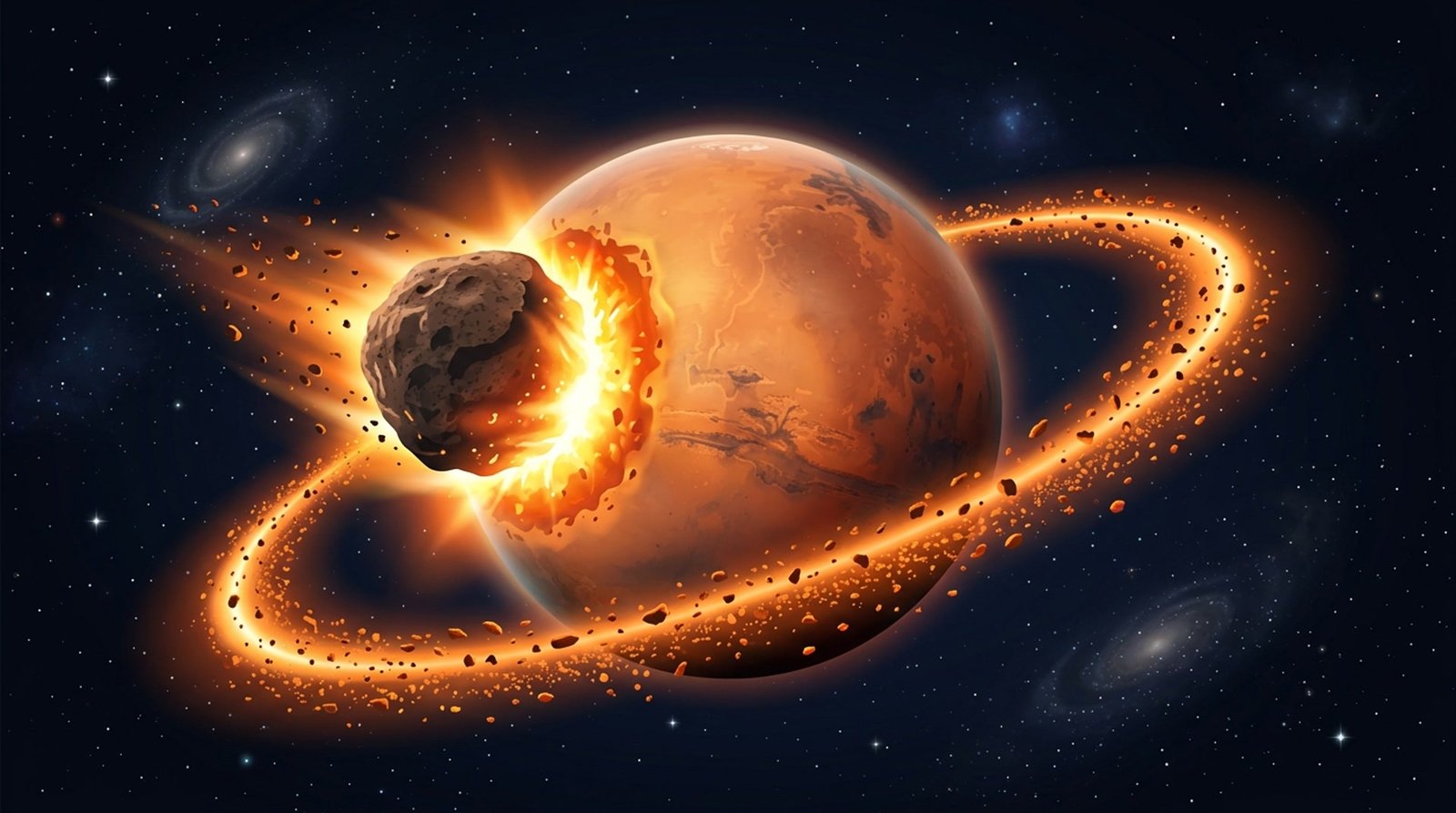
The Giant Impact That Birthed the Moons of Mars
Summary
By the end of this article, you will understand how a colossal asteroid collision smashed into Mars, creating a massive ring of debris that eventually clumped together to form its two moons, Phobos and Deimos.
Quick Facts
- Surprise: Phobos and Deimos were long thought to be captured asteroids, but their circular orbits prove otherwise.
- Surprise: Phobos is up to 35% empty space inside, like a giant, low-density cosmic sponge.
- Salient Idea: The Borealis-scale impact created a debris disk weighing 500 million trillion kilograms.
- Surprise: The crater left behind covers almost the entire northern hemisphere of Mars.
The Discovery: The Great Martian Crash
For decades, the prevailing theory was that Mars’ two moons, Phobos and Deimos, were simply roaming asteroids caught by martian gravity. But recent observations revealed a Surprise: their circular, equator-aligned orbits and highly porous compositions just didn’t match the ‘captured rock’ theory. Enter the giant impact hypothesis. Researchers realized that a massive collision—specifically one that created the 7,700-kilometer Borealis basin on Mars—could have blasted enough material into space to form a moon-birthing debris ring. By tracking the mass and angular momentum of the ejected rock, scientists proved that a Borealis-scale impact would create a disk massive enough to eventually clump together and birth both Phobos and Deimos.
Original Paper: ‘Formation of Phobos and Deimos via a Giant Impact’
A Borealis-scale impact is capable of producing a disk… sufficient to form at least one of the martian moons.
— Robert I. Citron
The Science Explained Simply
This is NOT a gentle gravitational capture of a passing rock. This is a violent, planetary-scale explosion. When an asteroid carrying 3% of Mars’ total mass slams into the planet, it vaporizes rock and shoots it into a ‘circum-Mars’ orbit. The Salient Idea here is the debris disk. Instead of flying off into deep space, 1% to 4% of the asteroid’s mass gets trapped in orbit, forming a dense ring around the planet’s equator. Over thousands of years, inside a zone called the strong tidal regime, these tiny fragments of molten rock and dust cool down and crash into one another. They slowly stitch themselves together into highly porous, sponge-like moons.
Moons that formed from the same impact that produced the martian spin would be expected to orbit near the equatorial plane.
— Rosenblatt and Charnoz
The Aurora Connection
While we study this impact to understand moons, these colossal collisions also shape a planet’s ability to host auroras and protect life. Early in its history, Mars had a global magnetic field, much like Earth’s, which shielded its atmosphere from the harsh solar wind. However, giant impacts like the Borealis crash can fundamentally alter the heat dynamics inside a planet’s core, potentially shutting down the internal dynamo that generates magnetic fields. Without that magnetic shield, Mars lost its atmosphere to space weather. Studying these violent impacts helps us understand not just how moons are made, but how delicate our own planetary magnetic shield truly is.
Giant impacts do more than make moons; they alter the magnetic destiny of entire worlds.
— NorthernLightsIceland.com Team
A Peek Inside the Research
How do we study a collision that happened billions of years ago? It comes down to incredible supercomputer modeling. The research team used a method called Smoothed Particle Hydrodynamics (SPH). They programmed up to 1,000,000 digital ‘particles’ to represent Mars and the incoming asteroid, assigning them real-world physics using the Tillotson equation of state. They then smashed them together at 6 kilometers per second. By analyzing the trajectory, energy, and gravity of every single particle post-impact, they calculated exactly how much rock would stay in orbit versus fall back to the surface. It is a brilliant triumph of simulated physics.
The collisionless particle representation can accurately simulate giant impacts onto Mars to determine the inserted mass.
— Research Team SPH Data
Key Takeaways
- Giant impacts were a common process in the late stages of planetary formation.
- A single impact created enough debris (1 to 4% of the asteroid's mass) to form both martian moons.
- Computer simulations using fluid dynamics can perfectly recreate planetary crashes from billions of years ago.
- Moons formed from a debris disk will orbit around a planet's equator, unlike randomly captured asteroids.
Sources & Further Reading
Frequently Asked Questions
Q: If Mars had a ring of debris, why doesn’t it have one now?
A: The debris ring was temporary. Over millions of years, the material either clumped together to form Phobos and Deimos, fell back onto the martian surface, or was blown away by solar radiation.
Q: Why is Phobos so porous and empty inside?
A: Because it wasn’t formed as a solid rock. It formed from thousands of smaller chunks of impact debris gently clumping together in orbit, leaving large voids and empty spaces between the rocks.
The Magnetic Funnels Feeding a Giant Exoplanet
Summary
By the end of this article, you will understand how a distant giant planet uses its magnetic field to ‘eat’ gas, and how scientists watch it happen in real-time.
Quick Facts
- Surprise: Delorme 1 (AB)b is up to 45 million years old, an age when most planets have long finished growing!
- Salient Idea: The planet is 13 times heavier than Jupiter, blurring the line between giant planet and brown dwarf.
- Surprise: Gas crashes into the planet so fast it creates a massive burst of ultraviolet light.
- Salient Idea: Scientists can track the 'weather' of this accretion changing over just a few hours.
The Discovery: Catching a Planet Eating
For a long time, scientists thought planets finished growing quickly. But when astronomers pointed the Very Large Telescope at Delorme 1 (AB)b, they found a Surprise: it is still actively eating gas at 30 to 45 million years old! They used a technique called spectroscopy to split the light from the planet and look at specific glowing signatures of hydrogen. They discovered a sudden burst of ultraviolet light and changing hydrogen line profiles over a few days. The Salient Idea here is that the light isn’t just glowing randomly—it changes shape and brightness based on how the gas is falling. This wasn’t just a static picture; they were watching the live action of a planet pulling in its surrounding material.
Original Paper: ‘ENTROPY II. Time series of Balmer line profiles of Delorme 1(AB)b’
This is typical of ongoing accretion on the target, confirming the accreting nature of Delorme 1 (AB)b despite its estimated old age.
— ENTROPY Survey Team
The Science Explained Simply
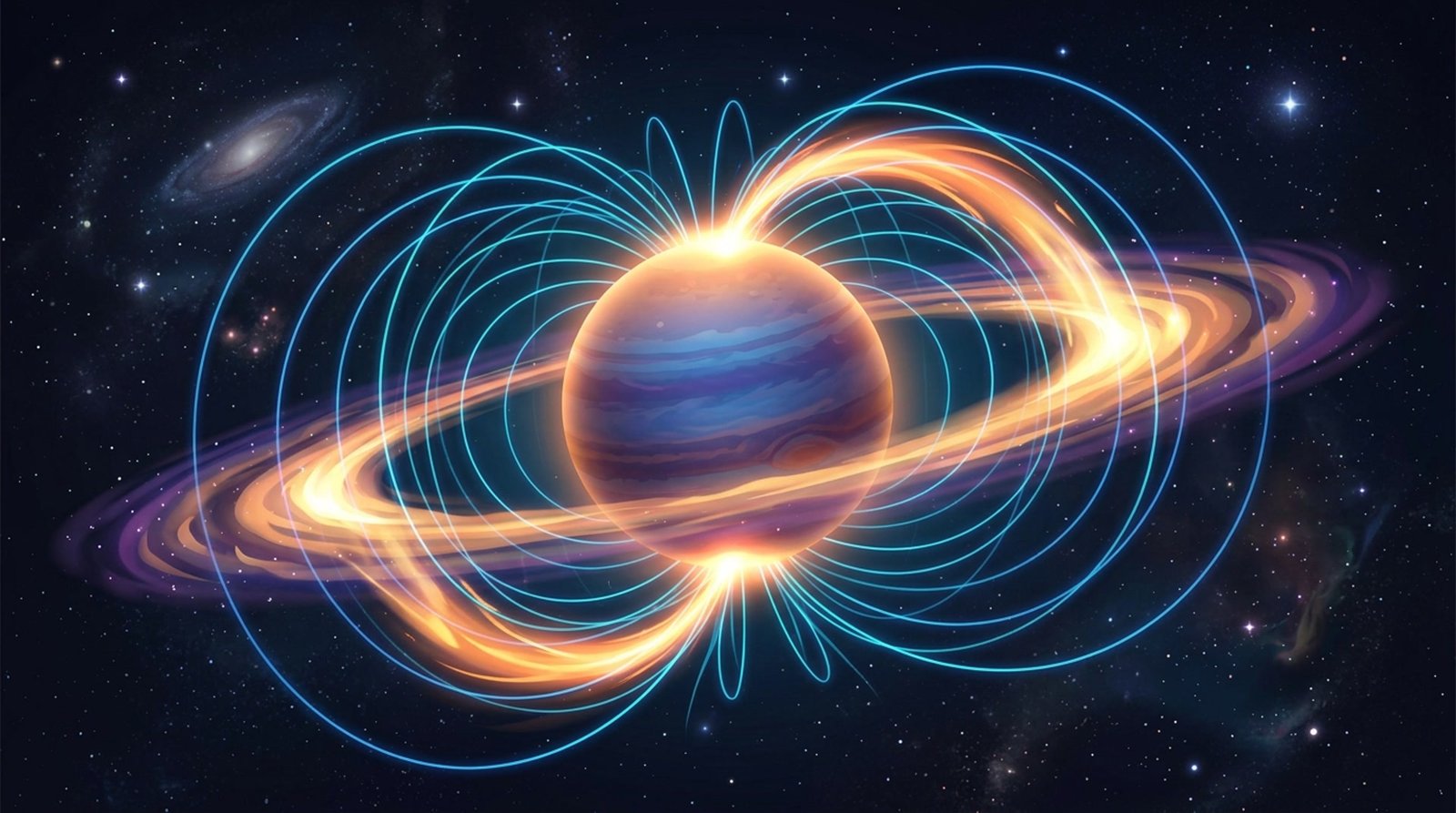
This is NOT just gas falling straight down like a rock dropped from a building. In space, falling gas gets caught by a planet’s magnetic field. This process is called magnetospheric accretion. The magnetic field lines act like giant, invisible slides. Gas from a surrounding disk is pulled onto these lines and gets funneled at extreme speeds toward the planet’s poles. When this gas hits the planet’s surface, it creates a massive shockwave that emits the ultraviolet light we see. By looking at the light, the scientists split the signal into two parts: the ‘wings’ (fast-moving gas on the slide) and the ‘core’ (the bright splash where it hits). This allows us to map a process we cannot physically see.
The properties of the broad component of the lines strongly support magnetospheric accretion.
— Dorian Demars
The Aurora Connection
While we love the Northern Lights on Earth, what is happening on Delorme 1 (AB)b is an aurora scaled up to extreme, violent levels. On Earth, our magnetic field catches a tiny bit of solar wind, funneling it to our poles to create beautiful, glowing lights. On this giant planet, the magnetic field is catching massive amounts of heavy, raw gas and slamming it into the planet. The physics are remarkably similar: magnetic field lines directing charged particles to the poles. Understanding how Delorme 1 (AB)b’s magnetic field controls this massive gas flow helps us understand the fundamental magnetic rules that protect our own atmosphere from being blown away.
Magnetic fields don’t just protect planets; sometimes they help build them.
— NorthernLightsIceland.com Team
A Peek Inside the Research
How do you see a magnetic field from 150 light-years away? The team used a powerful instrument called UVES to break the light into thousands of tiny slices, looking specifically at the ‘Balmer series’—the exact colors of light emitted by excited hydrogen. They built a custom algorithm to separate the light into two shapes: a ‘wings’ component and a ‘core’ component. They then matched these shapes against computer models of magnetic funnels and shockwaves. This is the Salient Idea of modern astronomy: we don’t look through telescopes with our eyes; we use code and math to decode the hidden physics inside a single beam of light.
We developed a novel method to decompose the lines into multiple components, making no assumption as to what shape they should have.
— ENTROPY Research Team
Key Takeaways
- Planets can continue to grow for tens of millions of years if they hold onto a disk of material.
- Magnetic fields act like funnels, directing falling gas straight into a planet's poles.
- By breaking light into its colors (spectroscopy), scientists map the speed and location of invisible falling gas.
- The UV light from this planet proves it is still actively feeding and creating massive shockwaves.
Sources & Further Reading
Frequently Asked Questions
Q: Why is it weird that this planet is still growing?
A: Most planets clear out their surrounding gas and dust within 3 to 10 million years. Delorme 1 (AB)b is up to 45 million years old, meaning it somehow kept a ‘Peter Pan’ disk of material that refused to grow up and disappear!
The Invisible Space Bubbles That Trigger Daytime Auroras
Summary
By the end of this article, you will understand how tiny, short-lived bubbles in the solar wind can physically squeeze Earth’s magnetic shield and create fast-moving daytime auroras.
Quick Facts
- Surprise: Auroras don't just happen at night; this event triggered auroras on the day side of Earth
- Salient Idea: Small 'bubbles' in the solar wind can act like mini solar storms, plucking our magnetic field like a guitar string
- Surprise: The auroras created by this event raced across the sky at over 100 kilometers per second
- It takes about 10 minutes for the signal from the space bubble to travel down to the atmosphere and light up the sky
The Discovery: Catching a Space Bubble
In 2008, a network of five THEMIS satellites detected a ‘foreshock transient’—a strange, localized cavity in the solar wind. A few minutes later, an All-Sky Imager (ASI) camera at the South Pole saw a Surprise: diffuse auroras began to brighten on the daytime side of Earth and race duskward across the sky. Shortly after, sharper discrete auroras lit up as well. By matching the satellite data with the camera footage, scientists realized this tiny space bubble had physically squeezed Earth’s magnetic shield. This proved that even small solar wind hiccups can create highly localized, fast-moving space weather.
The duskward propagation of aurora reflects the duskward propagation of the foreshock transient as it swept through the magnetosheath.
— Dr. Boyi Wang
The Science Explained Simply
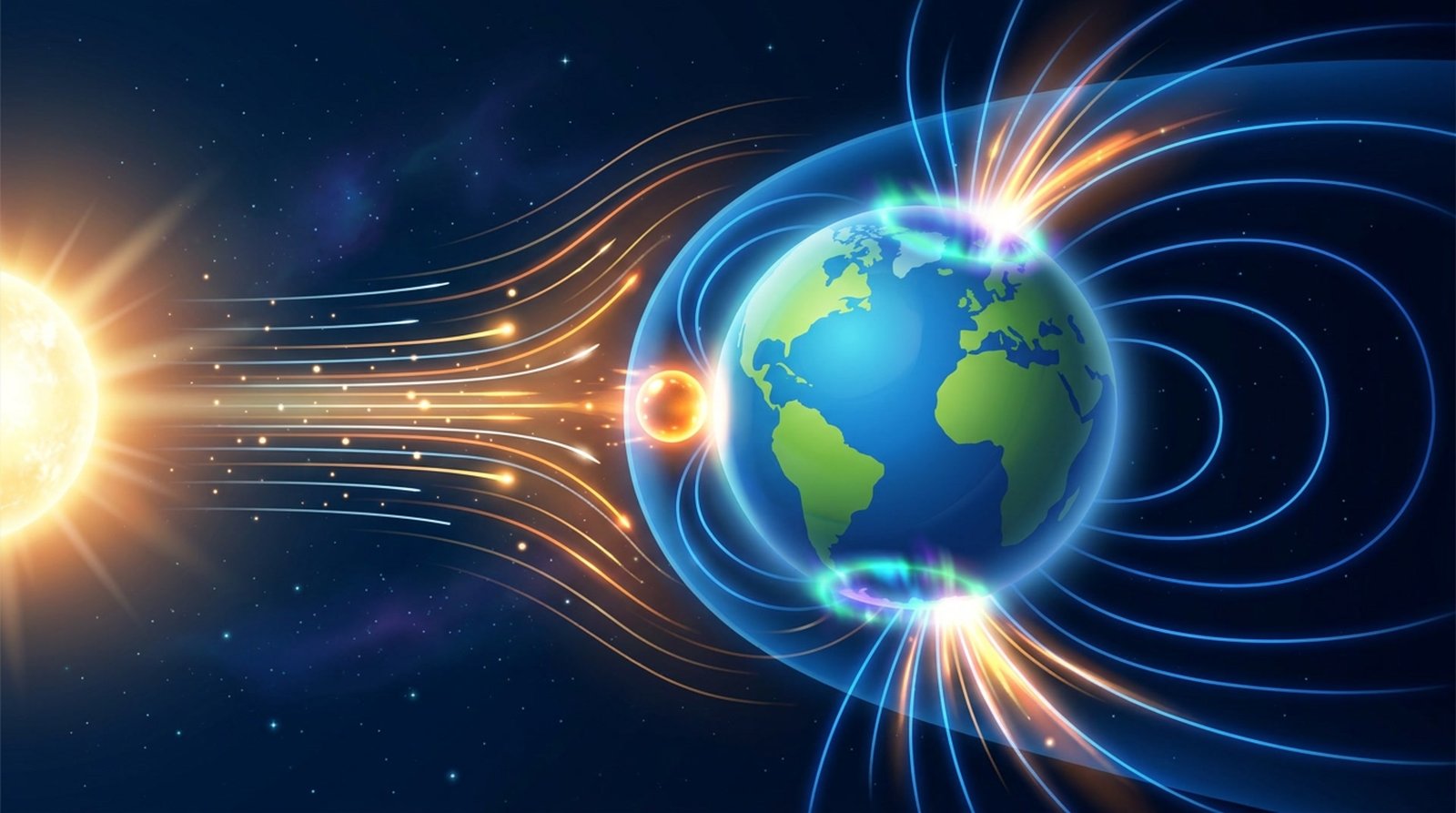
This is NOT a massive solar storm like a Coronal Mass Ejection (CME) that engulfs the whole planet. A foreshock transient is a small, short-lived ‘bubble’ formed when solar wind particles bounce off Earth’s bow shock and disrupt the incoming stream. Think of it like a rock in a river creating a temporary whirlpool. The Salient Idea here is the physical pinch: When this bubble hits the magnetopause (the edge of Earth’s magnetic field), it dents it. This compression sends vibrations down the magnetic field lines. These vibrations dump electrons into the atmosphere, lighting up the sky in a localized patch rather than a global storm.
The Aurora Connection
We usually think of auroras as a nighttime phenomenon, but this magnetic squeeze triggered daytime auroras. It caused ‘diffuse auroras’ (a faint, widespread glow from highly energetic particles) followed by ‘discrete auroras’ (the sharp, distinct ribbons we normally picture). Because magnetic field lines guide these particles with absolute precision, tracking the aurora’s movement on the ground is like watching a live shadow-puppet show. The glowing atmosphere acts as a giant projector screen, revealing the exact size, speed, and location of the invisible magnetic forces crashing into our shield tens of thousands of miles away in deep space.
Discrete aurora can be used to highlight upward field-aligned currents associated with dayside magnetopause disturbances.
— The Research Team
A Peek Inside the Research
How did they connect a space bubble to a glow in the sky? The team used coordinated multi-point observations. They took data from five THEMIS satellites positioned out in space to track the incoming solar wind bubble. Then, they matched the exact timings with a camera located at the South Pole. By doing complex math to map the pixels of the 2D camera image backwards along Earth’s curved magnetic field lines, they could measure the exact shape of the space bubble just by looking at the aurora it caused! It is a triumph of combining space-based sensors with ground-based optics.
Key Takeaways
- Foreshock transients are temporary anomalies formed right in front of Earth's bow shock
- When these transients hit our magnetic shield, they compress it and launch ultra-low frequency (ULF) waves
- These ULF waves travel down magnetic field lines, causing high-energy electrons to crash into the atmosphere
- Mapping 2D aurora images from the ground back into space allows us to measure invisible space weather
Sources & Further Reading
Frequently Asked Questions
Q: Can I see these daytime auroras with my naked eye?
A: Usually, no. The sun’s glare in the daytime sky is way too bright. Scientists use special cameras in places like the South Pole (where it can be completely dark during the day in winter) and filter for specific wavelengths of light to see them.
Q: How fast do these auroras move?
A: In this event, the mapped patterns of the aurora raced across the ionosphere at speeds averaging around 117 kilometers per second!
The Giant Impact That Flipped Mars
Summary
By the end of this article, you will understand how a massive collision not only tilted the entire planet of Mars but also created a crashing ring of debris that formed its two tiny moons.
Quick Facts
- Surprise: The massive impact that created Mars' moons also blasted a hole so big it forced the entire planet to physically tilt.
- Salient Idea: This tilting process is called 'True Polar Wander'—the crust doesn't slide, the whole planet just tips over.
- Surprise: The debris ring initially orbited at a wild, tilted angle before crashing into itself to form a flat, hula-hoop-like ring.
- Surprise: Phobos and Deimos are essentially the recycled leftovers of this chaotic cosmic collision.
The Discovery: A Tilted Mystery on Mars
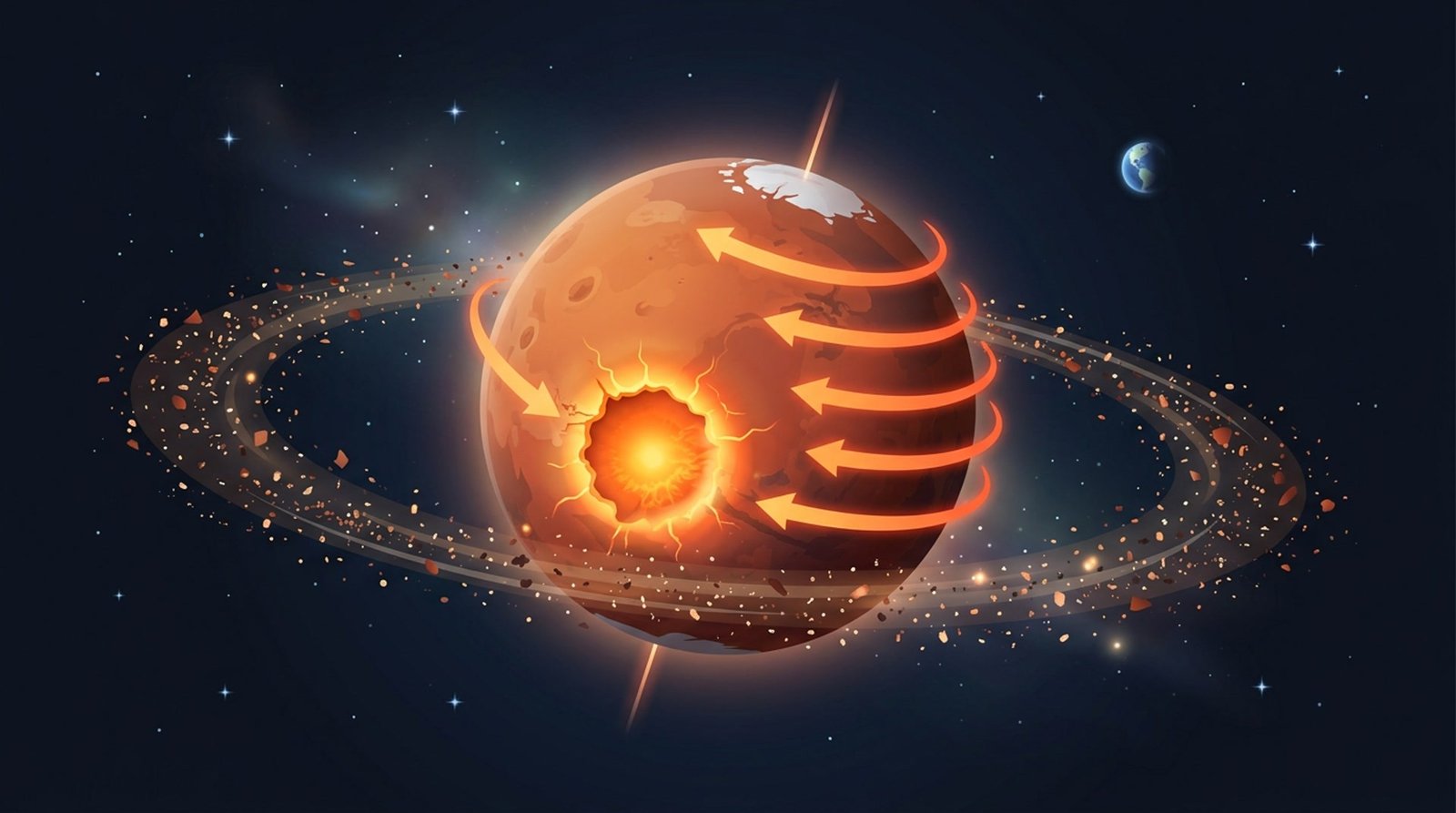
Astronomers have long debated where Mars’ tiny moons, Phobos and Deimos, came from. A leading theory is a giant impact that also created the Borealis basin—a massive crater currently sitting near Mars’ north pole. But there was a glaring problem. Physics dictates such an impact should have happened near the equator to spin up the planet and create an equatorial debris disk. So why is the crater at the north pole? Researchers realized that blasting away that much rock created a massive ‘dent’ or mass deficit. To balance its rotation, Mars actually tilted itself. The crater didn’t slide across the surface; the entire planet tipped over, moving the crater from the equator to the north pole. This phenomenon is known as True Polar Wander.
Original Paper: ‘ON THE IMPACT ORIGIN OF PHOBOS AND DEIMOS II’
The mass deficit created by the Borealis impact basin induces a global reorientation of the planet.
— Research Team
The Science Explained Simply
This is NOT like plate tectonics on Earth, where continents drift slowly over a liquid mantle. True Polar Wander is the entire solid body of a planet tipping over in space to realign its center of mass. Imagine a spinning top: if you stick a piece of clay to one side, the top will wobble and shift its spin axis. Mars did exactly this to compensate for the missing mass of the Borealis crater. Meanwhile, the debris blasted into space formed a chaotic, tilted ring. Through gravitational wobbles and thousands of tiny, energy-absorbing crashes (inelastic collisions), the debris calmed down and flattened into a neat, circular disk around the equator. It was from this calm, flat disk that the moons finally clumped together.
The Aurora Connection
Just as Earth’s magnetic field and auroras are driven by the spinning dynamo in our planet’s core, the rotation and internal mass distribution of a planet dictate its destiny. Mars once had a dynamic magnetic field, but as it cooled and experienced massive traumas—like the Borealis giant impact—its internal dynamics changed. True Polar Wander shows how deeply the surface is tied to the planetary rotation. Understanding how a planet responds to massive impacts helps us understand its core, its magnetic history, and ultimately, its ability to hold onto an atmosphere. The extreme forces that tilted Mars are a testament to the violent cosmic weather that shapes planetary environments.
Extreme worlds teach us about planetary survival.
— NorthernLightsIceland.com Team
A Peek Inside the Research
How do scientists look millions of years into the past? They use Knowledge and Tools, not magic. The team didn’t just guess; they used the ‘equilibrium theory’ of planetary rotation to calculate the exact physics of Mars’ mass deficit. They wrote complex N-body simulations, which track the gravity and collisions of thousands of virtual space rocks. By fast-forwarding these simulations, they watched how a messy, tilted cloud of rocks would naturally bump into each other, lose energy, and settle into a flat, predictable ring. It is a brilliant example of using the unbreakable laws of physics to rewind the clock on our solar system.
Our results strengthen the giant impact origin of Phobos and Deimos.
— Ryuki Hyodo et al.
Key Takeaways
- True Polar Wander happens when a planet reorients itself to balance a mass deficit or excess in its crust.
- A giant impact near the equator created the Borealis basin and spun up a massive debris disk.
- Inelastic collisions and gravitational precession forced the wild orbital debris into a flat, circular disk.
- Phobos and Deimos formed from this flattened equatorial disk, hiding their chaotic, tilted origins.
Sources & Further Reading
Frequently Asked Questions
Q: If the Borealis basin is a crater, why doesn’t it look like a typical round hole?
A: It covers almost the entire northern hemisphere of Mars! Over billions of years, lava flows, erosion, and smaller impacts have smoothed it out, but gravity maps still show the massive missing chunk of crust.
Q: Why didn’t the debris disk just fall back down to Mars?
A: Because of angular momentum. The rocks were moving sideways so fast that they kept missing the planet as they fell, entering a stable orbit until they clumped together into moons.
The Sky's Eraser: When Auroras Delete Themselves
Summary
By the end of this article, you will understand a bizarre space weather phenomenon where the Northern Lights suddenly brighten, completely wipe themselves out, and then slowly fade back into the night sky.
Quick Facts
- Surprise: The 'eraser' event actually begins with a rapid brightening of the aurora before it completely goes dark.
- Salient Idea: The entire erasing and recovering process takes an average of just 20 seconds.
- Surprise: This wasn't found in a massive magnetic storm, but during a very quiet night of magnetic activity.
- Surprise: It took old footage from 2002, reviewed years later, to officially identify 32 of these rare events.
The Discovery: Spotting the Sky's Eraser
In science, huge discoveries often hide in old data. While reviewing video captured in 2002 from Churchill, Canada, researchers noticed something bizarre. They weren’t looking at the famous, dancing curtains of light, but at the faint background glow called diffuse aurora. Suddenly, a stripe of light rapidly brightened, but what happened next was a Surprise. Instead of fading back to normal, the light dipped below its original brightness. It looked as if someone took a giant blackboard eraser to the night sky, wiping out the aurora completely. Over the next 20 seconds, the glow slowly refilled. By meticulously analyzing the footage, they identified 32 distinct events. They had discovered the ‘Diffuse Auroral Eraser.’ It is a story of how paying attention to the background can reveal completely new cosmic weather patterns.
Original Paper: ‘The Diffuse Auroral Eraser’ (Troyer et al., 2021)
It looks as if someone has taken an eraser to it.
— Dr. Riley Troyer & Team
The Science Explained Simply
To understand this, we must Build a Fence around what this is NOT. This is not a cloud passing by, and it is not a ‘pulsating aurora’ that blinks like a neon sign. Auroras are caused by electrons raining down from space and hitting our atmosphere. Think of a bucket with a hole in it, constantly being refilled. During an eraser event, a special type of energy wave in space—called a ‘chorus wave’—suddenly shakes the bucket, causing a massive splash (the brightening phase). But because so much water splashed out at once, the bucket temporarily empties, stopping the flow (the eraser phase). It takes about 20 seconds for the bucket to refill and the glow to return. The Salient Idea here is that the sky isn’t getting darker; it is physically running out of glowing particles for a brief moment.
The Aurora Connection
The secret behind the Auroral Eraser lies thousands of miles above us in Earth’s magnetic bubble, the magnetosphere. The diffuse glow of the aurora is normally fueled by ‘ECH waves’ gently scattering electrons into the atmosphere. But our magnetic field is also home to powerful, whistling electromagnetic waves called Chorus Waves. Scientists believe these chorus waves might sweep through the area, scattering a massive burst of electrons all at once. This interaction shows just how dynamic our planet’s magnetic shield really is. Even on a perfectly quiet night with low solar activity, invisible waves are clashing and interacting in space, turning off sections of the sky like giant cosmic light switches.
What process in the equatorial magnetosphere can turn off diffuse auroral emissions in localized regions?
— The Research Team
A Peek Inside the Research
How do you measure a disappearing act that lasts 20 seconds? The researchers used a clever tool called a keogram. Instead of watching hours of video, they took a single, vertical slice of pixels from each frame of the video and stacked them side-by-side chronologically. This turns a video into a single timeline image. By scanning this keogram, bright vertical stripes followed immediately by dark, empty gaps stuck out clearly. They then used a computer program to graph the pixel brightness over time—the superposed epoch analysis. This mathematical layering of 22 perfect events revealed the precise 20-second average recovery time. It proves that combining high-speed cameras with clever data visualization can reveal secrets invisible to the naked eye.
We found that the best way to identify an auroral eraser event was in a keogram.
— The Research Team
Key Takeaways
- An Auroral Eraser has four distinct phases: initial, brightening, eraser (dimming), and recovery.
- It is physically different from pulsating or 'black' auroras, which behave like blinking patches.
- Scientists use tools called 'keograms'—visual timelines of the sky—to spot these split-second events.
- The dark spot is likely caused by 'chorus waves' in space temporarily depleting the electrons that make the sky glow.
Sources & Further Reading
Frequently Asked Questions
Q: Can I see an auroral eraser with my naked eye?
A: It is very difficult! The diffuse aurora is already quite faint, and these events happen rapidly over just a few seconds. Researchers needed highly sensitive, 30-frames-per-second cameras to clearly document them.
Q: Do these events happen during massive solar storms?
A: Surprisingly, no. The 32 events analyzed in this study all occurred during a period of very quiet magnetic activity. This suggests they might be a common phenomenon that has simply been overlooked.
Jupiter's Rule-Breaking Auroras: Why We Were Wrong
Summary
By the end of this article, you will understand how NASA’s Juno spacecraft just busted a 20-year-old theory about what powers the brightest auroras in the solar system.
Quick Facts
- Surprise: Jupiter's auroras are the most powerful in the solar system, putting out 500 gigawatts of energy!
- Salient Idea: Scientists thought the auroras were created by Jupiter spinning its plasma, but new data says otherwise.
- Surprise: Instead of smooth curtains of light, Juno found fragmented, chaotic magnetic currents.
- Surprise: When the solar wind squishes Jupiter's magnetic field, the aurora actually gets brighter, not dimmer!
The Discovery: Busting the Spin Theory
For decades, scientists believed Jupiter’s brilliant main auroras were powered by the planet’s massive spin—a concept called the corotation enforcement theory. It made sense: Jupiter spins incredibly fast, dragging its magnetic field and plasma along with it. This was supposed to create a steady, smooth circuit of electricity raining down on the poles. But when NASA’s Juno spacecraft finally flew directly over Jupiter’s poles, it found a Surprise: the data completely contradicted the math. The currents weren’t smooth; they were fragmented. The auroras didn’t dim when they were supposed to, and the electrical structure was totally lopsided. This meant the reigning theory of the last two decades was fundamentally flawed. The discovery proved that nature is often much messier than our neatest equations.
If the particle acceleration process is stochastic, even regions of down-going currents would have a significant flux of down-going electrons creating auroral emissions.
— B. Bonfond et al.
The Science Explained Simply
This is NOT like a simple battery powering a lightbulb. The old theory pictured a steady, continuous loop of electricity. Imagine a spinning merry-go-round dragging the air around it in a perfect circle. But Juno found that Jupiter’s auroras act more like a stormy ocean. Instead of a one-way street of electrons causing the glow, the Salient Idea is that electrons are zooming in both directions at once! This bi-directional traffic is caused by chaotic magnetic waves, not a steady electric voltage. When the solar wind hits Jupiter, instead of dimming the lights as predicted, it acts like throwing gasoline on a fire. The magnetic field loads up with energy and snaps back, creating brilliant, chaotic bursts of ultraviolet light.
The Aurora Connection
Here on Earth, the Northern Lights are deeply connected to the solar wind crashing into our planet’s magnetic shield. Scientists used to think Jupiter was completely different—that it generated its own auroras entirely from within, using its rapid rotation and volcanic material from its moon, Io. But these six pieces of shattered evidence bring Jupiter a little closer to Earth. We now see that Jupiter’s auroras respond to magnetic loading and unloading, just like Earth’s do during a substorm. By studying how these colossal magnetic fields break down and reconfigure, we learn about the fundamental laws of space weather that protect our own atmosphere from the violent solar wind.
The aurora and the radio kilometric emissions increased during the magnetic unloading phases… similarly to what is observed on Earth.
— B. Bonfond et al.
A Peek Inside the Research
How do you dismantle a famous scientific theory? It takes Knowledge and Tools—specifically, the Hubble Space Telescope and the Juno spacecraft. The team compiled six specific observational anomalies. For example, they measured the ‘bend-back’ of the magnetic field on the dawn and dusk sides of the planet. The old math predicted the dawn side should be much brighter. Hubble’s images proved the exact opposite: the dusk side is three times brighter! By combining magnetic field readings with ultraviolet images, they didn’t just find one error; they found a pattern of six distinct contradictions. It’s a perfect example of the scientific method: when the observation disagrees with the theory, the theory has to change.
Key Takeaways
- The 'corotation enforcement' theory cannot explain Jupiter's main auroral emissions.
- Juno spacecraft data shows that particle acceleration is stochastic and chaotic, not smooth and steady.
- Magnetic unloading—like snapping a rubber band—powers the auroras, similar to Earth.
- Alfvén waves (ripples in magnetic fields) are likely the true spark for these massive light shows.
Sources & Further Reading
Frequently Asked Questions
Q: If the old theory is wrong, what actually causes Jupiter’s auroras?
A: Scientists now believe stochastic processes—specifically chaotic magnetic ripples called Alfvén waves—are accelerating electrons into the atmosphere, rather than a steady electrical current.
Why Some Auroras Dance Faster Than Others
Summary
By the end of this article, you will understand exactly why small auroras flicker rapidly while large auroral bands stay stable, and how scientists use video math to prove it.
Quick Facts
- Surprise: The Northern Lights are actually painted by invisible electric currents from space.
- Salient Idea: Large auroral shapes (10,000 square kilometers) stay stable for about a minute.
- Surprise: Small auroral shapes (1,000 square kilometers) change entirely in just 10 seconds!
- Surprise: Scientists matched the blinking lights of the aurora perfectly with invisible magnetic field currents.
The Discovery: The Rhythm of the Lights
For a long time, scientists have watched the Northern Lights and noticed some parts flicker quickly while others linger. But watching isn’t measuring. In 2011, researchers pointed an all-sky camera at the sky over Poker Flat, Alaska, and recorded 19 minutes of high-speed video. They didn’t just watch the video; they ran an innovative mathematical analysis to track how long different shapes lived. They found a Surprise: the lifespan of an aurora depends exactly on its size! Large auroral forms (around 10,000 square kilometers) stayed stable for up to a minute. Meanwhile, small auroral ripples (under 1,000 square kilometers) changed in just 10 seconds. They had finally proven the mathematical rhythm behind the dancing lights.
Original Paper: ‘Scale size-dependent characteristics of the nightside aurora’
We find a scale size-dependent variability where the largest scale sizes are stable on timescales of minutes while the small scale sizes are more variable.
— B. K. Humberset
The Science Explained Simply
How do you measure a dancing ghost? This is NOT just taking a photo and eyeballing the changes. To do this, researchers used a tool called a Fast Fourier Transform. Think of it like a musical equalizer, but for pictures. Instead of separating bass and treble, it separates large glowing blobs from tiny flickering dots. By comparing these separated sizes frame-by-frame, they could see exactly when a specific size started to change. The Salient Idea here is ‘scale size-dependent variability.’ Big shapes take a long time to shift. Small shapes are frantic and highly variable. The math strips away the visual confusion to reveal a highly organized pattern in the sky.
The Aurora Connection
The Northern Lights are beautiful, but they are actually the exhaust of a massive electrical machine. The Earth is surrounded by a magnetic shield, and when solar wind hits it, energy funnels down to the poles through Field-Aligned Currents. The researchers compared their video math to magnetic data collected by satellites. The result? A remarkable match. The stable big auroras and the frantic small auroras perfectly mirrored the behavior of the invisible magnetic currents driving them. The visible light is a glowing footprint of Earth’s magnetic shield reacting to the hostile environment of space.
The characteristics averaged over the event are in remarkable agreement with the spatiotemporal characteristics of the nightside field-aligned currents.
— Humberset et al.
A Peek Inside the Research
This wasn’t a simple time-lapse. The team had to analyze over 1.8 billion possible image combinations! To make it work, they narrowed it down to about 18 million calculations. But they faced a massive hurdle: the Earth rotates. If you look at the sky for 19 minutes, the stars and auroras seem to move simply because the Earth is spinning. The team had to write code to artificially ‘untwist’ the video, moving the pixels eastward by 2 kilometers every 10 seconds to lock the sky in place in an inertial frame. It is a triumph of careful data cleaning over raw observation.
We correct for the rotation of the all-sky imager with Earth.
— Research Team
Key Takeaways
- Auroral stability depends heavily on the 'scale size' of the shape.
- Different types of auroras (diffuse vs. active) have completely different lifespans.
- 2D mathematical algorithms can track the lifespan of light structures frame-by-frame.
- The visible light of the aurora is a direct mirror of the invisible electrical currents connecting Earth to space.
Sources & Further Reading
Frequently Asked Questions
Q: Why do some auroras look like they are rapidly pulsing or flickering?
A: Those are the small ‘scale sizes’ of the aurora. Because they are smaller in area, the electrical currents driving them can shift and change much faster, usually in under 10 seconds.
Q: Does the Earth’s rotation mess up the video analysis?
A: Yes! The scientists actually had to mathematically subtract the Earth’s 0.2 km/s eastward rotation from their data so they were only measuring the aurora’s true movement, not the Earth’s spin.
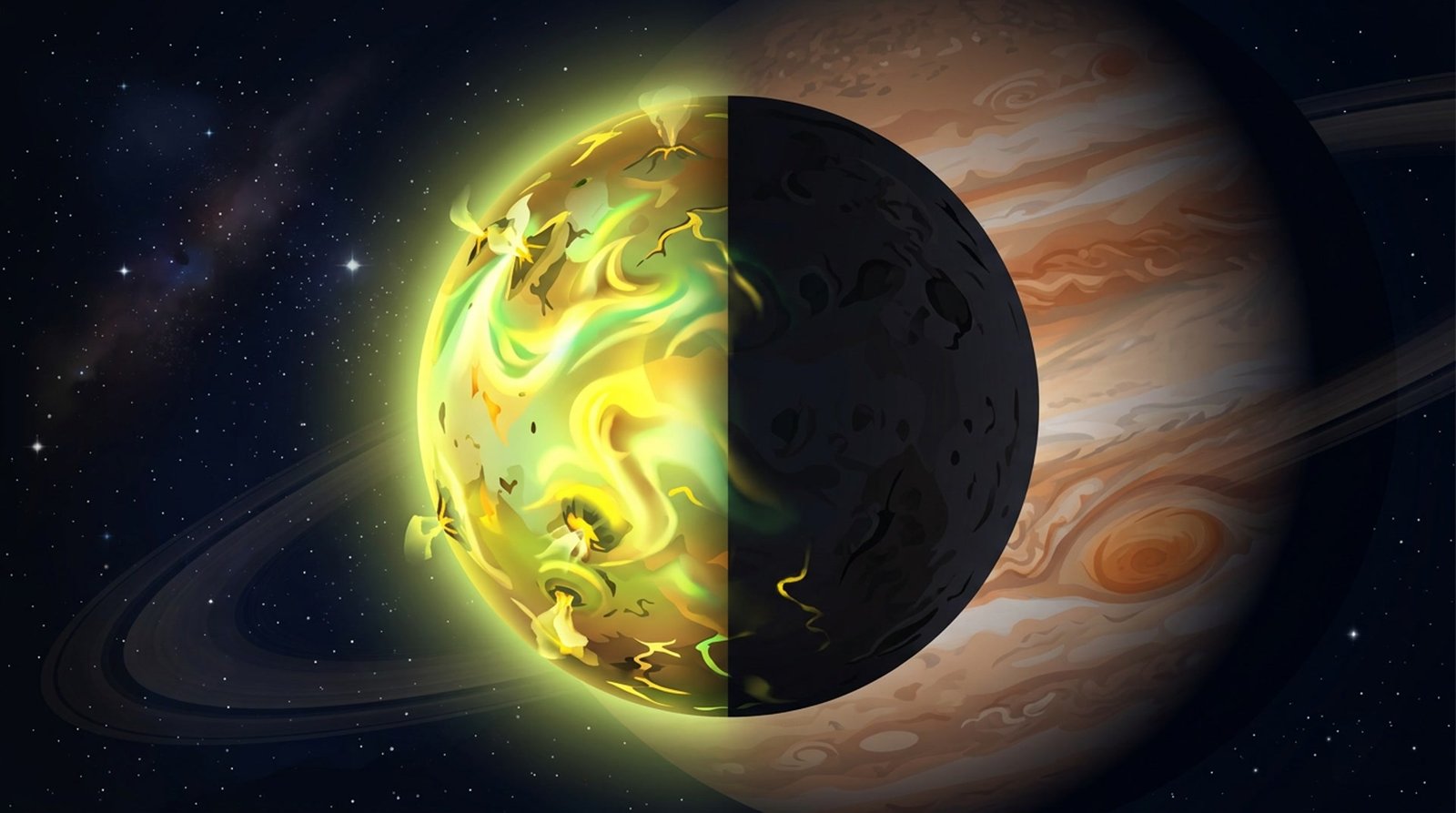
The Moon That Loses Its Glow in the Dark
Summary
By the end of this article, you will understand how Jupiter’s shadow literally turns off the glowing sodium aurora on its volcanic moon, Io, and why scientists were surprised by the chemistry behind it.
Quick Facts
- Surprise: Io's sodium aurora disappears in just 10 minutes when it enters Jupiter's shadow!
- Salient Idea: The glowing oxygen on Io doesn't care about the dark—it only reacts to Jupiter's magnetic plasma.
- Surprise: It takes nearly 2 hours for the sodium glow to fully recover once Io is back in the sunlight.
- Surprise: The aurora is made of vaporized table salt (NaCl) blasted from massive volcanoes.
The Discovery: The Vanishing Glow
Astronomers used powerful Earth-based telescopes to watch Io, Jupiter’s incredibly volcanic moon, pass into Jupiter’s massive shadow. They were looking at its optical aurorae—glowing gases in its atmosphere. They found a massive Surprise: The bright yellow glow of sodium gas plummeted, fading away in just 10 minutes. Yet, the green and red glow of oxygen stayed exactly the same! The oxygen simply tracked the invisible plasma of Jupiter’s magnetic field, entirely indifferent to the sudden darkness. But the sodium’s rapid disappearance meant something else was at play. The shadow wasn’t just cooling the moon down; it was physically turning off a light-powered chemical engine.
Original Paper: ‘Io’s Optical Aurorae in Jupiter’s Shadow’
Io’s sodium aurora mostly disappears in eclipse… e-folding timescales for decline and recovery differ sharply.
— Dr. Carl Schmidt
The Science Explained Simply
This is NOT a simple case of a gas freezing in the cold dark. That happens to Io’s sulfur dioxide, but sodium is different. The Salient Idea here is that sunlight acts as a trigger. In the sun, light breaks down volcanic salt into glowing sodium atoms. When Jupiter blocks the sun, this photochemistry halts. The sodium that is already there quickly escapes into space, and because the sun isn’t making more, the glow dies in minutes. When Io exits the shadow, it takes almost two hours to rebuild the sodium supply. It is a solar-powered chemical factory that gets its plug pulled every orbit.
The Aurora Connection
Earth’s auroras are created when solar wind hits our magnetic field. But Io’s auroras are driven by Jupiter’s rotating magnetic field, which sweeps past the moon, bombarding it with a plasma torus. This plasma directly excites the oxygen in Io’s atmosphere, making it glow red and green regardless of sunlight. But the sodium aurora needs *both*—the sunlight to create the sodium atoms, and the plasma electrons to make them glow. Studying this dual-requirement helps us understand the complex dance between massive magnetic fields, extreme volcanoes, and stellar light in creating planetary atmospheres.
Direct electron impact on atomic gas is sufficient to explain the brightness…
— Research Team
A Peek Inside the Research
How do you see a tiny glowing moon right next to the biggest, brightest planet in our solar system? The team used high-resolution optical spectrographs at observatories like Keck and Apache Point. They had to perfectly subtract Jupiter’s scattered light to isolate Io’s faint emission lines. Because Jupiter spins so fast, its light is actually Doppler-shifted, making this subtraction incredibly tricky! By separating the light like a prism, they tracked the precise brightness of sodium and oxygen minute-by-minute as Io plunged into darkness. It is a masterpiece of removing background noise to reveal a cosmic secret.
Even in ideal observing geometry, the optical spectra of Io in Jovian eclipse are strongly contaminated by Jupiter’s scattered light.
— The Researchers
Key Takeaways
- Jupiter's massive magnetic field bombards Io with plasma, creating permanent optical aurorae.
- Unlike Earth's aurora, Io's sodium aurora relies on a solar-powered chemical reaction.
- Planetary eclipses act as natural on/off switches, helping scientists time the exact speed of atmospheric chemistry.
- Observing this requires extreme precision to block out Jupiter's blinding glare and isolate Io's faint glow.
Sources & Further Reading
Frequently Asked Questions
Q: Why does oxygen stay glowing while sodium fades?
A: Oxygen’s glow is powered completely by Jupiter’s magnetic plasma bombarding the atmosphere, which doesn’t stop in the dark. Sodium needs sunlight to be created from salt molecules before the plasma can make it glow.
Q: Why does it take so long for the sodium glow to come back?
A: When Io leaves the shadow, it has to completely rebuild its sodium atmosphere from scratch. The sunlight has to break down salt molecules step-by-step, which takes nearly two hours to reach full strength.
The Hidden Auroras Dancing in Daylight
Summary
By the end of this article, you will understand how auroras can occur during the day, why they form strange stripes, and how they reveal invisible cracks in Earth’s magnetic shield.
Quick Facts
- Surprise: Auroras do not just happen at night; they happen around noon, too!
- Surprise: Scientists found a brand-new aurora shape and named it the 'Throat Aurora'.
- Salient Idea: Earth's own cold plasma leaks into space and acts like an invisible slide for hot electrons.
- Surprise: Afternoon daylight auroras are caused by heavy protons crashing into the atmosphere, not just electrons.
The Discovery: 7 Years in the Dark
Most people think auroras only happen at night. But researchers at the Yellow River Station in Svalbard, near the North Pole, used the endless darkness of Arctic winters to look at the dayside of Earth. Over 7 years, they captured millions of images. They found a Surprise: dayside diffuse auroras (DDAs) are everywhere. They categorized them into ‘unstructured’ glowing blankets and ‘structured’ patches and stripes. Most incredibly, they discovered a brand new phenomenon sprouting from these stripes. They called it the Throat Aurora—a rare, north-south aligned arc that points directly toward the equator.
A new auroral form, called throat aurora, is found to be developed from the stripy DDAs.
— De-Sheng Han and Research Team
The Science Explained Simply
This is NOT the sharp, bright curtain of light you see in typical nighttime aurora photos. Dayside diffuse auroras are faint, glowing patches and stripes. The Salient Idea here is how they form. High in space, ‘lumps’ and ‘wedges’ of cold plasma leak out of Earth’s atmosphere. These cold wedges act like invisible slides or ducts. When hot, energetic electrons from deep space hit these cold slides, they get dumped straight down into our atmosphere, creating the glowing stripes we see from the ground. It is a cosmic collision of hot and cold.
The Aurora Connection
Why does the ‘Throat Aurora’ matter? It acts as a giant, glowing ‘X marks the spot’ for space weather. Earth is protected by a massive magnetic shield. But sometimes, the solar wind forces this shield to crack open—a process called magnetic reconnection. The researchers realized that the Throat Aurora forms exactly where these new, open magnetic flux tubes are created. By simply looking at the sky, scientists can now map exactly where and when our planet’s invisible magnetic armor is opening up to the harsh environment of space.
The throat aurora is supposed to be a projection of a newly opened flux of reconnection.
— Research Team
A Peek Inside the Research
Discovering a new type of aurora does not happen overnight. It requires Knowledge and Tools, and a lot of patience. The team used a system of three all-sky imagers with special narrowband filters to capture the sky every 10 seconds. They collected data from 2003 to 2009. They had to manually process and visually inspect these images, looking for tiny, pulsating changes in faint green and red light. They then cross-referenced these visual shapes with satellite data and radar maps of high-altitude winds to prove their theory.
We visually inspected all of the images for many times focusing on examining the morphological and dynamical properties.
— Research Team
Key Takeaways
- Dayside diffuse auroras (DDAs) are split into two types: unstructured blankets and structured stripes.
- The structured stripes perfectly align with invisible ionospheric wind currents.
- Cold plasma from Earth's atmosphere is crucial for creating these structured daytime auroras.
- Throat auroras show the exact moment Earth's magnetic field connects with the Sun's.
Sources & Further Reading
Frequently Asked Questions
Q: How can scientists see auroras during the day if the sun is out?
A: They use research stations very close to the North Pole, like Svalbard. During the peak of winter, the sun never rises above the horizon, keeping the sky dark enough at ‘noon’ to see the faint daytime auroras.
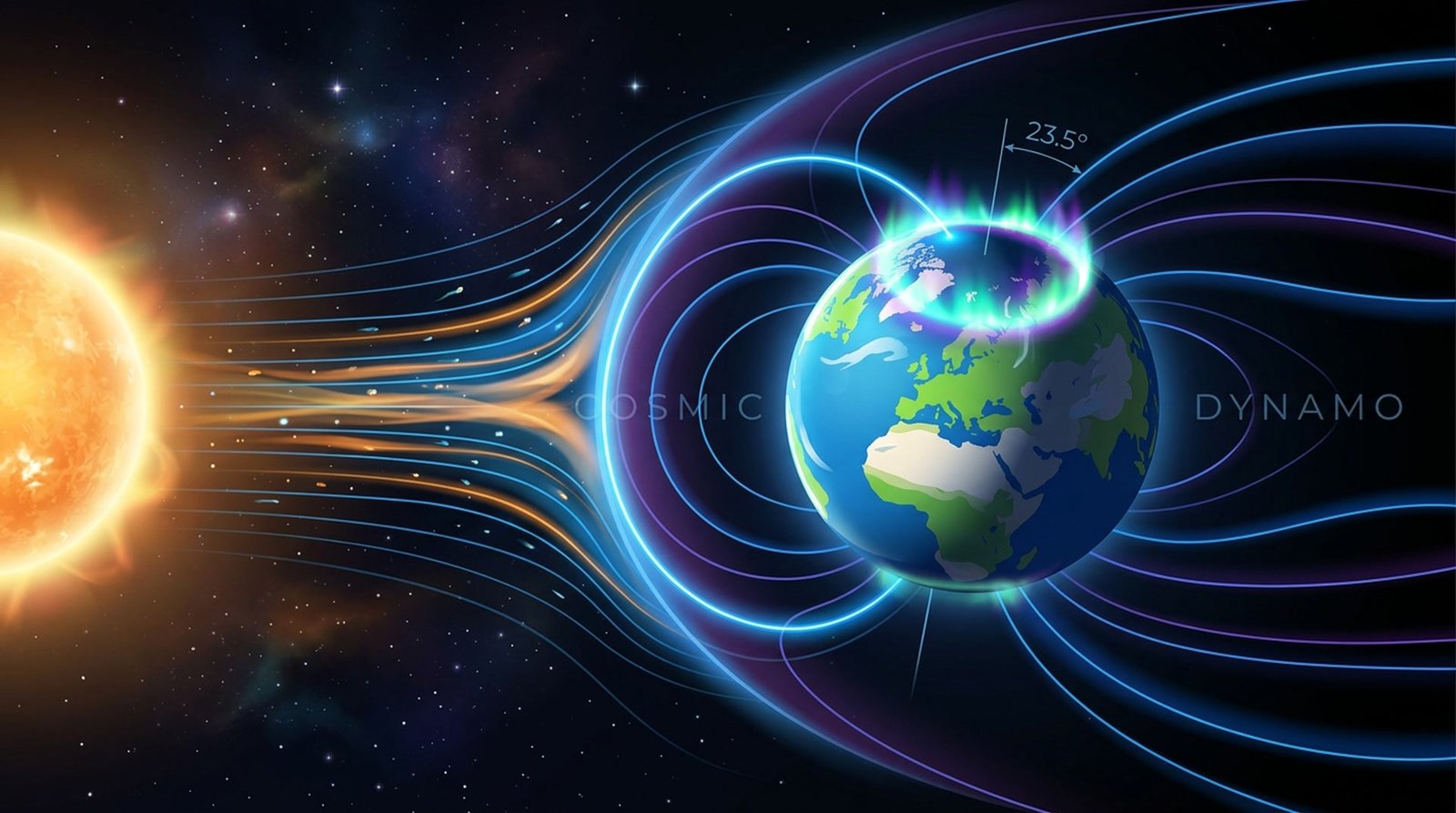
The Cosmic Dynamo: Why Auroras Prefer One Pole at a Time
Summary
By the end of this article, you will understand how a slight tilt in the Sun’s magnetic field acts like a cosmic generator, funneling more energy into one hemisphere and making its auroras glow significantly brighter.
Quick Facts
- Surprise: The Northern and Southern Lights are rarely perfect mirror images of each other.
- Salient Idea: The Interplanetary Magnetic Field (IMF) acts like a directional switch, sending more power to the North or South depending on its tilt.
- Surprise: A tiny magnetic shift of just 2 nanoTeslas in space can drastically change global weather patterns in the upper atmosphere.
- Surprise: This energy transfer is driven by a 'Solar Wind Dynamo'—a literal electrical generator in space.
The Discovery: A Tale of Two Hemispheres
For a long time, scientists assumed the auroras at the North and South poles were identical twins. But a team of researchers using the IMAGE satellite discovered a Surprise. By analyzing thousands of global ultraviolet images of the Earth’s poles, they noticed the auroral ovals were frequently lopsided. They isolated the data based on the Interplanetary Magnetic Field (IMF)—the magnetic field carried by the solar wind. They discovered that when the radial ‘X-component’ (Bx) of this field points away from Earth toward the Sun, the Northern Lights get a significant power boost in the dusk sector. When it points toward Earth, the Southern Lights get the boost. They had statistically proven that the Sun’s magnetic angle picks a favorite hemisphere.
This is the first statistical observational study indicating that IMF Bx can modify the energy conversion between the solar wind and the magnetosphere differently in the two hemispheres.
— J.P. Reistad et al.
The Science Explained Simply
This is NOT simply about the solar wind hitting one side of the Earth harder. The Earth is protected by its own magnetic bubble. The Salient Idea here is magnetic tension. Imagine the Earth’s magnetic field lines opening up and dragging behind the planet like long rubber bands in the solar wind. If the incoming solar magnetic field is tilted (the Bx component), it creates uneven tension. In one hemisphere, the rubber band is pulled tighter. This tension acts exactly like an electrical generator, known as the Solar Wind Dynamo. The tighter the magnetic tension, the more electrical current (Region 1 current) is pushed down into that specific hemisphere’s atmosphere.
The Aurora Connection
How does an invisible generator in space create the aurora we see? The Solar Wind Dynamo generates colossal electrical currents, funneling energetic electrons down along Earth’s magnetic field lines. When these electrons crash into the gases in our upper atmosphere, they transfer their energy, causing the oxygen and nitrogen to glow. Because the Bx tilt makes the dynamo more efficient in one hemisphere, it sends a denser stream of accelerated electrons (typically 1.5 to 2 keV) into that region. The result? A noticeably brighter auroral oval on the dusk side of the favored hemisphere. It is a perfect visualization of invisible space weather.
Hemispheric intensity asymmetries in the aurora… could be a signature of asymmetric Region 1 currents in the two hemispheres.
— Research Team
A Peek Inside the Research
Proving this wasn’t easy. The team needed a massive dataset, but daylight ruins auroral images. The researchers used a technique called dayglow subtraction, creating mathematical models to erase the sunlight from the pixels, leaving only the pure auroral ultraviolet emissions. They carefully selected periods during local winter, ensuring the Earth’s dipole tilt didn’t skew the results. Finally, they used rigorous statistical math (the Kolmogorov-Smirnov test) to prove with 95% confidence that the brightness difference wasn’t a random glitch, but a consistent physical law of our solar system.
We want to exclude, as good as possible, other mechanisms that can produce asymmetric aurora to avoid that the IMF Bx signatures drown in other stronger signals.
— J.P. Reistad et al.
Key Takeaways
- The radial component of the solar wind's magnetic field (Bx) controls auroral brightness.
- A negative Bx (pointing toward the Sun) makes the Northern Hemisphere's dusk auroras brighter.
- A positive Bx makes the Southern Hemisphere's dusk auroras brighter.
- This asymmetry is caused by different magnetic tension forces stretching Earth's field lines like rubber bands.
Sources & Further Reading
Frequently Asked Questions
Q: Does this mean one pole always has brighter auroras than the other?
A: No! The brightness flips depending on the orientation of the solar wind’s magnetic field. It acts like a cosmic toggle switch, shifting the power bias between the North and South as the solar wind changes.
Q: What is the Bx component?
A: Magnetic fields exist in 3D space. The Bx component is the part of the magnetic field that points radially—meaning directly toward or away from the Sun.
How Giant Planets Control Earth's Auroras and Climate
Summary
By the end of this article, you will understand how the orbits of Jupiter and Saturn create a 60-year cycle that controls both the Northern Lights and Earth’s global temperatures.
Quick Facts
- Surprise: Historical records of auroras from 1700 to 1966 perfectly match the ups and downs of Earth's climate
- Salient Idea: A massive 60-year cycle driven by Jupiter and Saturn acts like a cosmic metronome for our solar system
- Surprise: The planets' gravity might actually change the amount of clouds in our sky by altering the Earth's electric field
- Surprise: Based on this 60-year astronomical clock, global temperatures might naturally stabilize in the coming decades
The Discovery: The Cosmic 60-Year Clock
For centuries, people have suspected that the stars and planets affect our weather. In 2012, researchers found a Surprise: by analyzing centuries of historical mid-latitude aurora sightings from 1700 to 1966, they discovered a hidden rhythm. The auroras didn’t just appear randomly. They pulsed in distinct cycles of 10, 20, and exactly 60 years. Even more incredibly, when scientists looked at global temperature records, they found the exact same 60-year heartbeat. This wasn’t a coincidence. They had discovered a shared frequency linking the Northern Lights directly to Earth’s changing climate, acting like a giant cosmic clock.
The aurora records reveal a physical link between climate change and astronomical oscillations.
— Dr. Nicola Scafetta
The Science Explained Simply
This is NOT just the sun getting hotter and colder. It’s a complex chain reaction. The Salient Idea here is planetary gravity. Giant planets like Jupiter and Saturn exert a tidal pull on the sun, changing its magnetic activity. When the sun’s magnetic shield is weak, more cosmic rays from deep space hit Earth. These rays electrically charge our atmosphere. This electric charge actually helps form low-level clouds. More clouds mean more sunlight reflects back into space, cooling the Earth. So, Jupiter and Saturn move, the sun reacts, cosmic rays increase, clouds form, and the Earth cools. It is a brilliant, interconnected solar system machine!
The Aurora Connection
Why use auroras to study climate? Mid-latitude auroras (Northern Lights seen far south of the Arctic) are rare. They only happen when the Earth’s magnetic field is battered by intense solar winds and highly charged particles. Therefore, historical aurora records are actually perfect diaries of our solar system’s magnetic weather. By studying when these massive light shows happened over the last 300 years, scientists can track the exact level of atmospheric electrification. This same electrification drives the cloud cover that changes our temperatures. The auroras aren’t just beautiful; they are visible barometers of the forces steering our global climate.
When the ionosphere is highly ionized by cosmic rays, large auroras would more likely form at the mid-latitudes.
— Research Study
A Peek Inside the Research
How do we prove this 60-year cycle is real? It comes down to incredible data matching. The researcher didn’t just use modern thermometers. They looked at tree rings, ocean sediments, and even a historical diary of meteorite falls in China dating all the way back to 619 AD! By applying advanced mathematical tools like Maximum Entropy spectral analysis, they isolated the background ‘noise’ to find the exact beats of 10, 20, and 60 years in all these records. They then built a harmonic computer model, similar to how we predict ocean tides, to successfully forecast climate trends using only planetary motions.
A harmonic constituent model based on aurora cycles can efficiently both reconstruct and forecast climate oscillations.
— Research Study
Key Takeaways
- Mid-latitude auroras are a hidden proxy for measuring Earth's historical climate patterns
- Cosmic rays and solar winds directly impact how many clouds form in our atmosphere
- The combined tidal pull of Jupiter and Saturn creates rhythmic 10, 20, and 60-year solar cycles
- Climate change isn't just about greenhouse gases; our solar system's orbital dance plays a massive role
Sources & Further Reading
Frequently Asked Questions
Q: Does this mean humans aren’t causing climate change?
A: No, it doesn’t mean that. However, this research suggests that natural astronomical cycles (like the 60-year planetary rhythm) are responsible for a significant portion of warming and cooling, which must be factored into climate models.
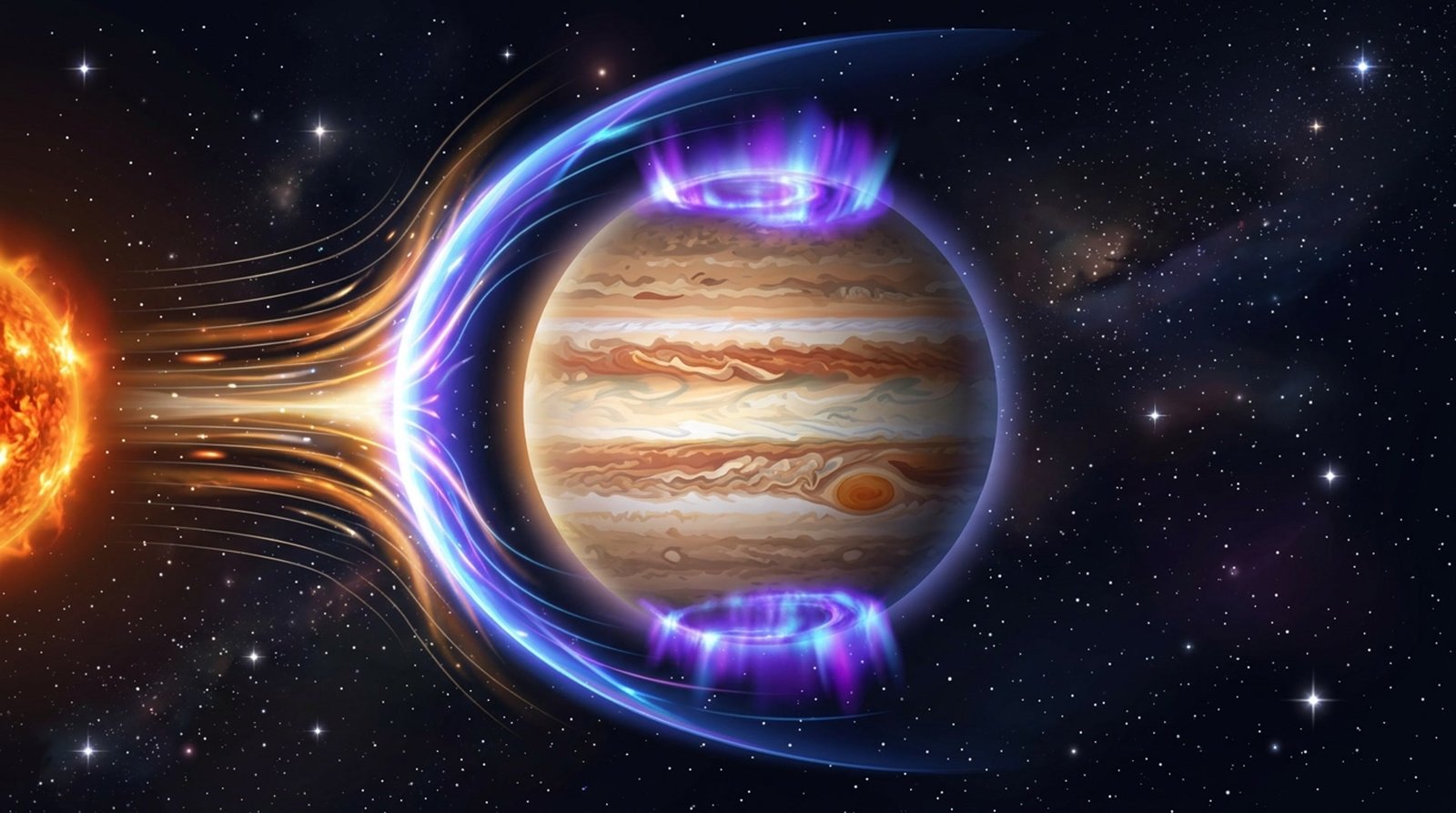
When the Solar Wind Crushed Jupiter: A 12-Terawatt Aurora
Summary
By the end of this article, you will understand how a violent solar storm crushed Jupiter’s magnetic shield, triggering a massive ultraviolet light show, and what this tells us about space weather.
Quick Facts
- Surprise: Jupiter's aurora spiked to 12 Terawatts—about the power of 12,000 large nuclear reactors on Earth
- Salient Idea: The Juno spacecraft actually crossed the boundary of Jupiter's magnetic shield right as it was being crushed
- Surprise: The solar storm compressed the planet's magnetic bubble so fast that the boundary 'overtook' the speeding spacecraft
- Surprise: It took about 4 hours after the peak magnetic crush for the aurora to reach its maximum brightness
The Discovery: A 12-Terawatt Light Show
In late 2022, NASA’s Juno spacecraft was orbiting Jupiter when a massive shockwave from the Sun arrived. This was a rare event. Juno’s instruments detected the outer edge of Jupiter’s magnetic shield—the magnetosphere—collapsing inward under the intense pressure of the solar wind. At the exact same time, Juno’s ultraviolet camera was watching the southern aurora. The Surprise: As the shield crushed inward, Jupiter’s ultraviolet auroras exploded in brightness, hitting a staggering 12 Terawatts of power. That is six times brighter than the baseline level! The timing proved that a powerful interplanetary shock literally squeezed the giant planet’s magnetic field, forcing a massive light show in the process.
Original Paper: ‘Jupiter’s UV auroral response to a magnetospheric compression event’
The auroral brightening was likely caused by a solar wind shock compressing the magnetosphere.
— Dr. R. S. Giles
The Science Explained Simply
To understand this, we have to Build a Fence: This is NOT like a simple light bulb turning on because a switch was flipped. Think of Jupiter’s magnetic field like a giant, invisible balloon. When the solar wind hits it hard, the balloon compresses. The Salient Idea here is that this compression dramatically changes the flow of plasma and electric currents thousands of miles above the planet. The energy from that ‘squeeze’ funnels down the magnetic field lines and crashes into Jupiter’s atmosphere, creating the brilliant ultraviolet light. Interestingly, the light show did not peak the very second the squeeze happened; it took about 4 hours for the energy to fully trigger the main aurora.
It is not a simple circuit; it is a delayed, massive magnetic squeeze.
— Science Team
The Aurora Connection
Here on Earth, our auroras (the Northern Lights) are intimately connected to the exact same process. When the Sun releases a burst of energy, it compresses Earth’s magnetic shield, sending charged particles raining down to create beautiful green and pink skies. Jupiter is doing the same thing, just on an unimaginably larger scale. However, Jupiter also creates its own auroras internally, driven by volcanic material from its moon Io. Cycling on the subject, this specific 2022 event proves that despite its internal power, Jupiter’s biggest, brightest ultraviolet auroras are still highly vulnerable to the whims of extreme space weather and solar wind shocks.
Extreme worlds teach us about the physics of planetary survival and magnetic protection.
— NorthernLightsIceland.com Team
A Peek Inside the Research
How do you measure a magnetic shield collapsing? The scientists used a brilliant combination of tools on the Juno spacecraft. They used the JADE instrument to count charged particles, which spiked when Juno crossed out of the magnetic shield and into the solar wind. They also used the UVS (Ultraviolet Spectrograph) to take wide pictures of the aurora. Because Juno’s orbit has shifted over the years, the spacecraft was perfectly positioned far to the south, giving it a continuous, unblocked view of the entire southern aurora without the planet’s rotation getting in the way. It is a masterpiece of orbital timing.
The Juno mission allows us to simultaneously compare the compression state of the magnetosphere with the total UV auroral power.
— Research Authors
Key Takeaways
- Solar wind shocks act as external triggers for massive energy releases on giant planets
- Juno's unique tilted orbit allows simultaneous measurement of magnetic size and auroral power
- Magnetospheric compression changes the flow of plasma, creating delayed but brilliant ultraviolet light shows
- Not all auroral activity comes from inside Jupiter; the Sun still plays a dominant role in extreme weather
Sources & Further Reading
Frequently Asked Questions
Q: What is a Terawatt, and how bright is Jupiter’s aurora?
A: A Terawatt is one trillion watts. Jupiter’s aurora reached 12 Terawatts during this event, which is thousands of times more powerful than the brightest auroras we see on Earth!
Q: Did the Sun cause this Jupiter aurora?
A: Yes! While Jupiter generates some of its own auroras using material from its moons, this specific extreme brightening was triggered by a massive shockwave of solar wind hitting the planet.
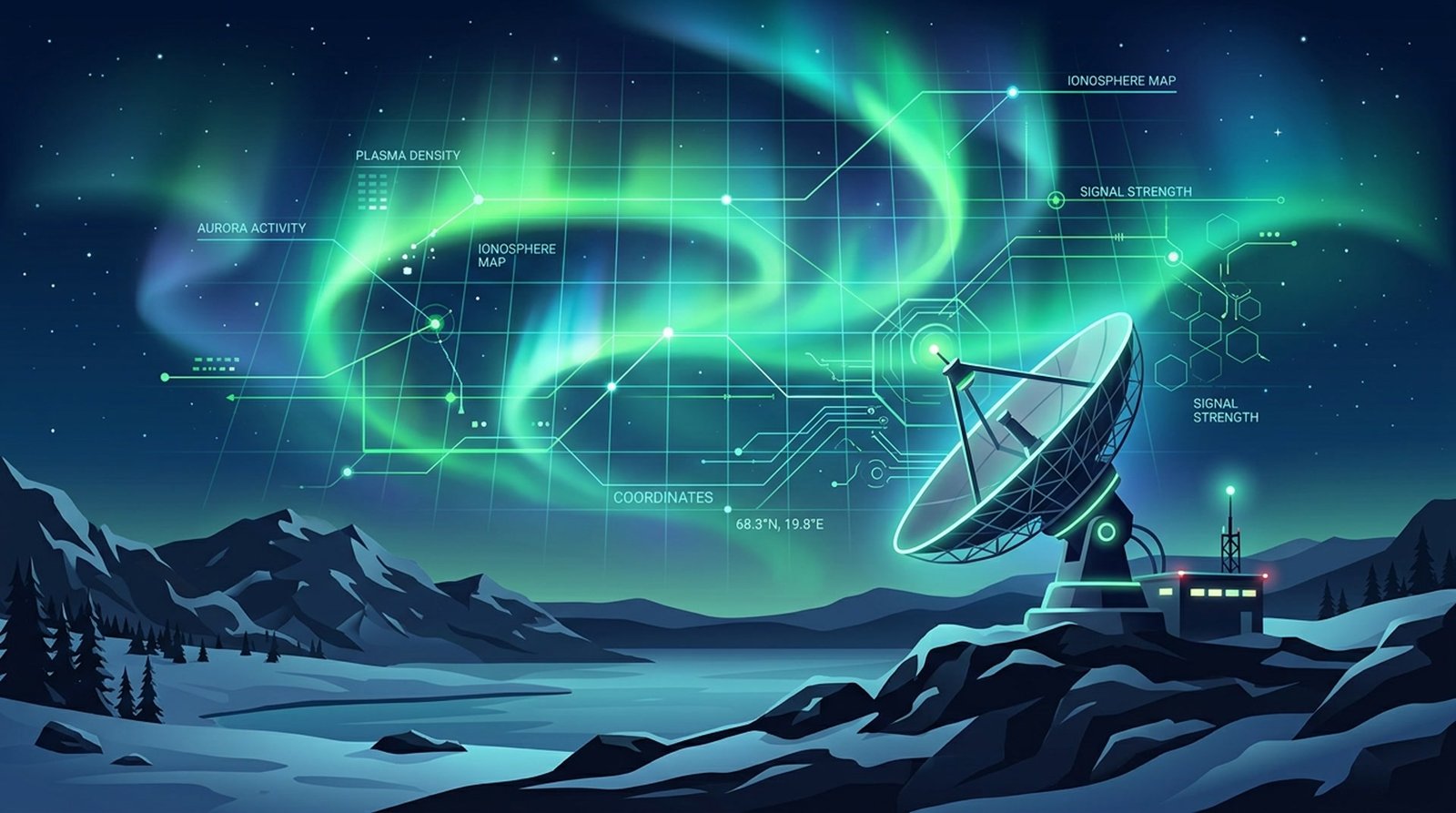
Using Self-Driving Car Tech to Track the Aurora
Summary
By the end of this article, you will understand how scientists are using self-driving car algorithms to track invisible radar echoes in the ionosphere, revealing the hidden electrical forces driving the Northern Lights.
Quick Facts
- Surprise: The ICEBEAR radar system processes an astonishing 200,000 images per second to track space weather.
- Salient Idea: Radars do not 'see' the aurora's light; they bounce signals off chaotic, 3-meter-wide waves in electrically charged plasma.
- Surprise: These invisible plasma storms can travel at mind-blowing speeds of up to 4,100 meters per second (over 9,000 mph!).
- Surprise: A really intense aurora acts like a giant space battery, creating its own electric field that can override the Earth's background magnetic drift.
The Discovery: Tracking the Invisible
The ionosphere, a layer of charged gas 90 kilometers above Earth, is highly chaotic. When the solar wind hits Earth’s magnetic field, it creates the beautiful Northern Lights. But it also creates intense, invisible plasma turbulence. The ICEBEAR radar in Canada was built to study this, recording over 10,000 radar echoes a minute! This created a huge problem: how do you track something so chaotic in a mountain of data? The researchers had a Surprise solution. They borrowed an unsupervised machine learning algorithm called DBSCAN—the exact same point-cloud technology used by self-driving cars to detect obstacles with lasers. By applying this math to the radar echoes, the algorithm automatically grouped the chaotic radar hits into distinct, trackable ‘clusters’. They were finally able to watch the invisible storm move in real-time.
Original Paper: ‘A Point-cloud Clustering & Tracking Algorithm for Radar Interferometry’
The radar aurora bulk motions exhibit key qualities of auroral electric field enhancements that has previously been observed with various instruments.
— Magnus F. Ivarsen
The Science Explained Simply
To understand this, we need to build a fence around the concept: This radar is NOT taking pictures of the aurora’s glowing light. Instead, the radar shoots radio waves into the sky. When those waves hit sharp density gradients in the plasma (specifically, 3-meter-wide ripples called Farley-Buneman waves), the signal bounces back. The Salient Idea here is that these radar echoes act like a tracer dye in a river. By grouping these echoes into a ‘point-cloud’ and tracking their bounding boxes from one second to the next, scientists aren’t just seeing where the plasma is—they are watching the invisible electric field push the plasma around.
The Aurora Connection
The motion of the aurora is governed by massive instability processes in the magnetosphere. When researchers matched their radar point-clouds with optical video of the aurora, they found a perfect match. The invisible radar blobs tracked the visible auroral forms almost perfectly. But the real Surprise happens during intense auroras. A strong aurora creates a localized electric field so powerful that it overrides the Earth’s ambient drift. The radar showed the plasma suddenly ripping parallel to the auroral arc at 4,100 meters per second. The aurora is not just a light show; it is an active, massive electrical generator in the sky.
The local electric field around these unusually intense precipitation regions is strong enough to completely override the ambient drift.
— Research Team
A Peek Inside the Research
How did the team actually track these clouds? It required incredibly clever data mining. The DBSCAN algorithm looks for the ‘nearest neighbors’ of a data point. If enough radar echoes are close together within a specific distance threshold (the noise limit), the AI groups them into a cluster. The team then wrote a script to look at the bounding box of that cluster. If a box in the next frame was roughly the same size and in roughly the same place, the computer knew it was looking at the exact same plasma cloud. This frame-by-frame tracking finally allowed scientists to calculate the actual bulk velocity of the radar aurora.
Our method, which is fully automatic, can be used to mine point-cloud data for irregular and dynamic clustering and flag this data for subsequent analyses.
— Original Paper
Key Takeaways
- An AI clustering tool called DBSCAN helps scientists automatically find and track moving 'blobs' of radar data.
- Plasma turbulence in the upper atmosphere directly follows the movement of visible auroral arcs.
- Intense auroras create extreme, localized winds of plasma that move parallel to the auroral curtains.
- Tracking these invisible structures helps us map the massive electrical currents connecting Earth to the solar wind.
Sources & Further Reading
Frequently Asked Questions
Q: If the aurora is made of light, how can a radar see it?
A: The radar does not see the light itself. Instead, it bounces radio waves off the chaotic, electrically charged gas (plasma) that is stirred up by the exact same energetic forces causing the Northern Lights.
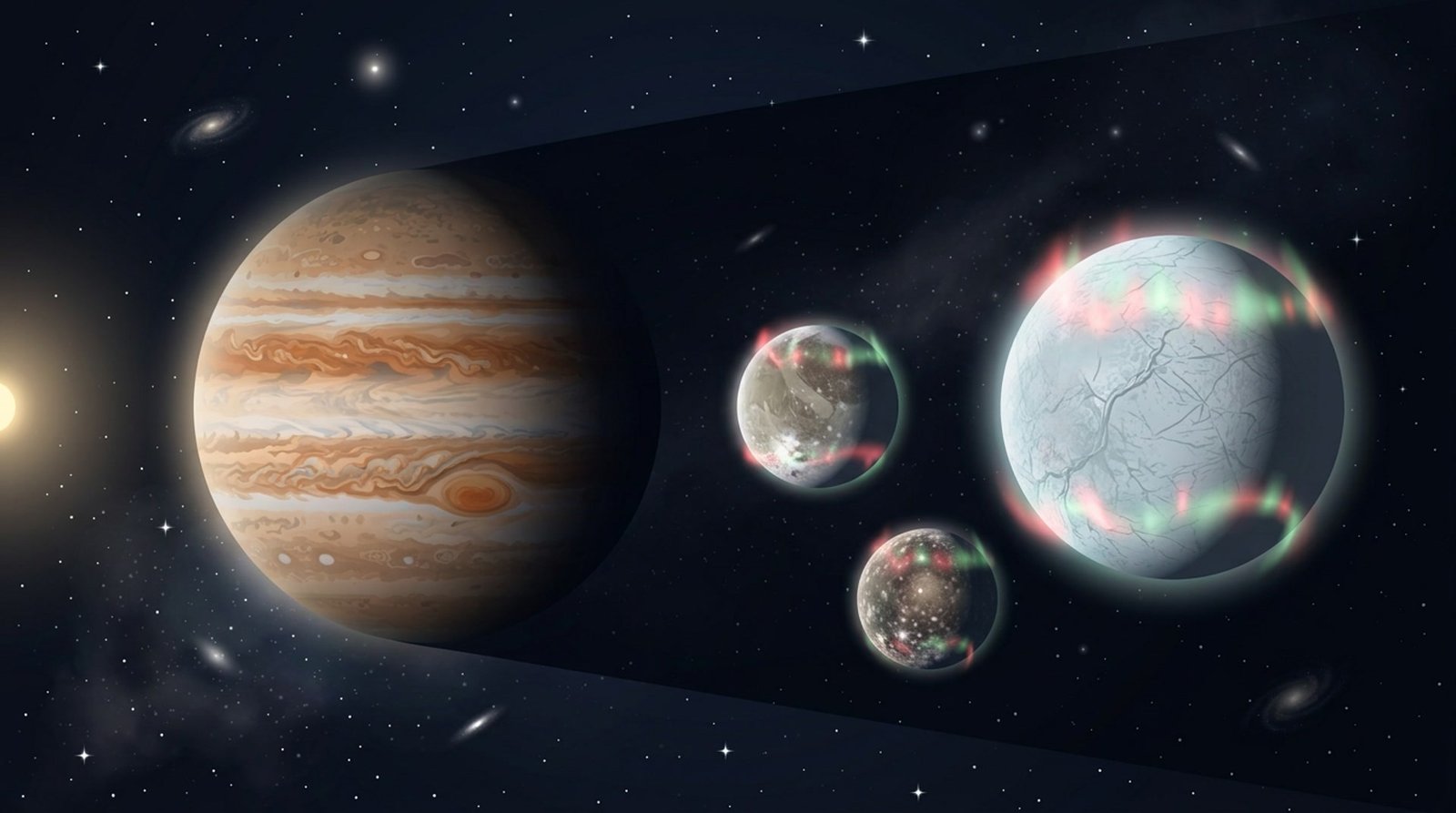
Glowing Moons: Decoding the Auroras of Jupiter's Ice Worlds
Summary
By the end of this article, you will understand how astronomers use giant eclipses to spot glowing auroras on Jupiter’s moons, and what these light shows reveal about alien atmospheres.
Quick Facts
- Surprise: Jupiter's moons have auroras, but you can only see them when the moons are hiding in Jupiter's shadow.
- Surprise: Astronomers detected the first 'optical' (visible to the human eye) auroras on Ganymede and Callisto.
- Salient Idea: The auroras act like chemical fingerprints—specific red and green glows prove the atmospheres are mostly oxygen gas.
- Surprise: Past UV studies thought these moons had wet, water-filled atmospheres, but this new visible-light data shows almost no water.
The Discovery: Glowing in the Dark
To see a faint glow next to a glaring star, you need to turn off the lights. Astronomers used the Keck telescope in Hawaii to stare at Jupiter’s moons—Europa, Ganymede, and Callisto—exactly when they passed into Jupiter’s giant shadow. Stripped of harsh, reflected sunlight, the moons revealed a Surprise: they were glowing. These were the first visible-light auroras ever detected on Ganymede and Callisto. By measuring the exact colors of this light, scientists discovered these atmospheres are dominated by oxygen gas. The Salient Idea here is that eclipses aren’t just cool visual events; they are nature’s way of dimming the background so we can see the faintest secrets of the solar system.
Original Paper: ‘The Optical Aurorae of Europa, Ganymede and Callisto’
We present the first detections of Ganymede’s and Callisto’s optical aurorae… and place upper limits on hydrogen.
— Dr. Katherine de Kleer and team
The Science Explained Simply
This is NOT like Earth’s thick atmosphere where rain and weather happen. The atmospheres on these icy moons are incredibly thin—almost a vacuum. But Jupiter’s powerful magnetic field acts like a particle accelerator, slamming electrons into the moons’ surfaces. When these electrons hit gas molecules, the molecules get ‘excited’ and release light. We call this an aurora. The Salient Idea is that different gases glow in different colors. Oxygen glows red and green. If there were a lot of water vapor, we would see a strong hydrogen glow (a specific red line called H-alpha). Because the scientists saw intense oxygen lines but almost no hydrogen lines, they proved these atmospheres are mostly oxygen, debunking recent theories of water-dominated skies.
The simultaneous measurement of multiple emission lines provides robust constraints on atmospheric composition.
— The Research Team
The Aurora Connection
On Earth, our magnetic field pulls solar wind to the poles, creating the Northern and Southern Lights. But Jupiter’s moons sit inside Jupiter’s massive, spinning magnetic field. This means their auroras aren’t driven by the Sun, but by Jupiter itself! As the moons orbit, they plow through a sheet of plasma (charged particles) trapped by the giant planet. In fact, Europa’s aurora gets brighter and dimmer depending on how deep it is inside this plasma sheet. Understanding these alien auroras helps us understand how magnetic fields interact with atmospheres across the universe, either protecting them or slowly stripping them away.
Europa’s auroral brightness correlates with magnetic latitude… and variations in the electron density.
— The Research Team
A Peek Inside the Research
How do you measure the exact gases on a moon hundreds of millions of miles away? The team used a tool called a spectrograph (the HIRES instrument on Keck). A spectrograph splits light into a rainbow barcode. Each chemical element has a specific set of lines on this barcode. The researchers looked for the exact wavelengths of oxygen (like 6300, 5577, and 7774 Angstroms) and hydrogen. It takes immense patience. The team observed just ten eclipses over 23 years (1998 to 2021) to gather enough light. This meticulous Knowledge and Tool combination allowed them to separate true auroral light from cosmic rays and background noise.
These constitute the first detections of emissions at 7774 and 8446 Angstroms at a planetary body other than Earth.
— The Research Team
Key Takeaways
- Observing moons during a Jupiter eclipse blocks out harsh sunlight, revealing faint atmospheric glows.
- Different molecules (like oxygen or water) emit specific colors of light when hit by high-energy electrons.
- Europa and Ganymede have extremely thin atmospheres made almost entirely of O2 (Oxygen).
- Callisto's first visible-light aurora detection proves it also has an oxygen-rich atmosphere.
Sources & Further Reading
Frequently Asked Questions
Q: Could we breathe the oxygen on these moons?
A: No. Even though the atmosphere is made of oxygen, it is incredibly thin—billions of times thinner than Earth’s atmosphere. It is practically a vacuum!
Q: Why did previous studies think there was water?
A: Previous studies looked at ultraviolet (UV) light on the sunlit sides of the moons. This optical (visible light) study looked at the dark sides during an eclipse, providing a different set of ‘chemical fingerprints’ that strongly point to pure oxygen.
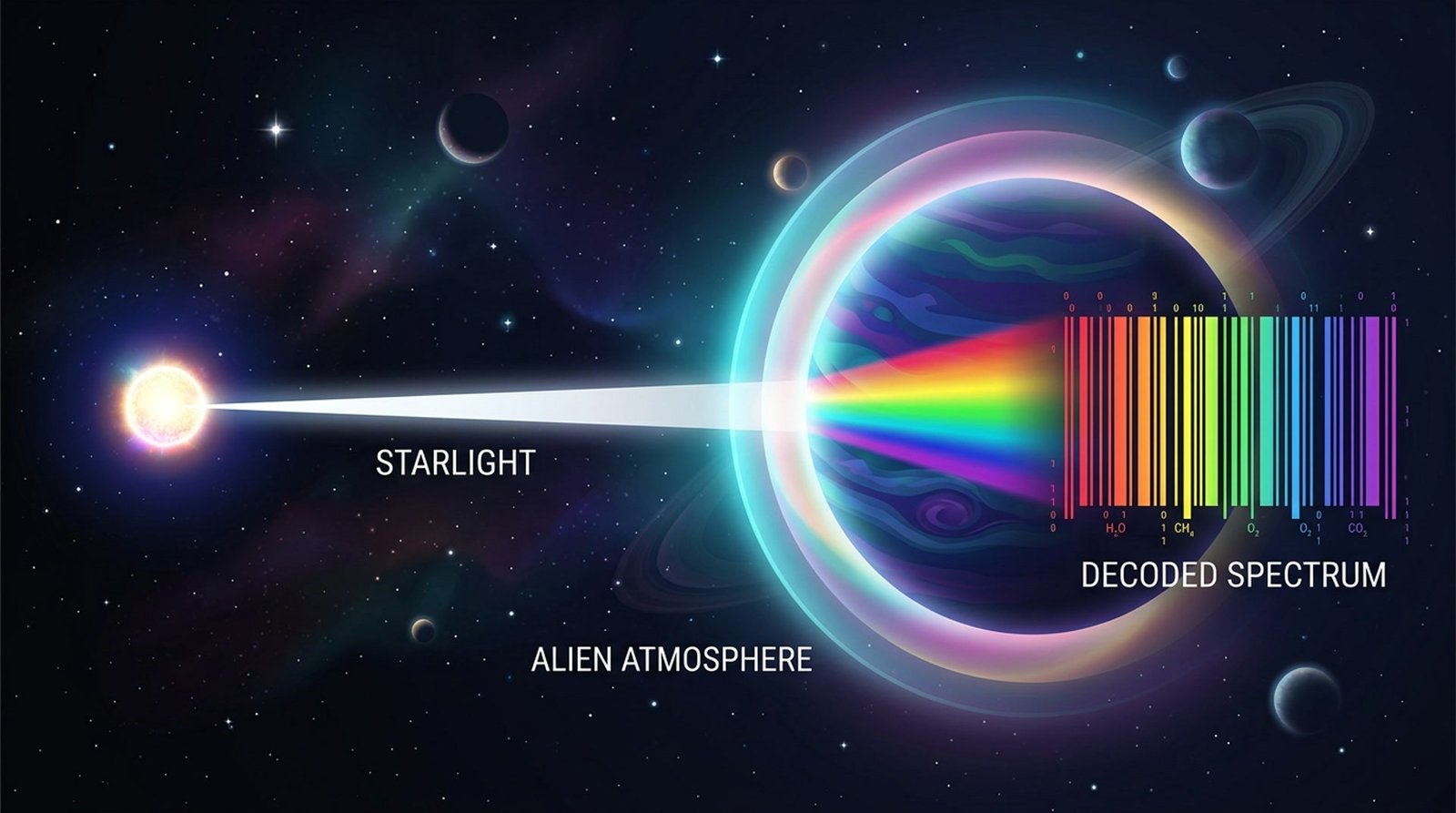
Decoding Alien Skies: How 'Aurora' Reads Exoplanet Air
Summary
By the end of this article, you will understand how astronomers can look at a tiny speck of light and figure out exactly what the air, clouds, and weather are like on alien worlds light-years away.
Quick Facts
- Surprise: We can figure out if an alien planet is cloudy just by looking at how it blocks starlight.
- Salient Idea: Astronomers use a trick called 'transmission spectroscopy' to see which colors of light are eaten by alien air.
- Surprise: The new 'Aurora' code does not just guess that every planet is a gas giant—it works for Earth-like rocky planets, too.
- Surprise: With just 10 observations using the new James Webb Space Telescope, Aurora could detect signs of ozone (a possible sign of life) on the exoplanet TRAPPIST-1 d.
The Discovery: Reading the Alien Barcode
For years, astronomers have studied giant, hydrogen-rich planets called ‘Hot Jupiters.’ But as we discover smaller, Earth-like planets, the old rules do not apply. Enter Aurora, a next-generation computer framework created by researchers Luis Welbanks and Nikku Madhusudhan. They needed a way to read the atmospheres of *any* planet—from gas giants to rocky worlds. The Story starts with starlight. When a planet crosses in front of its star, the planet’s atmosphere absorbs specific colors of light. It leaves a barcode of missing colors. By using Aurora to analyze this barcode, they successfully decoded the air of a mini-Neptune (K2-18b) and simulated how we will explore the rocky, Earth-sized TRAPPIST-1 d. They proved we can pinpoint water, carbon dioxide, and even clouds light-years away.
Original Paper: ‘Aurora: A Generalised Retrieval Framework for Exoplanetary Transmission Spectra’
Aurora can retrieve the bulk composition of any exoplanet atmosphere without the assumptions of a hydrogen-rich atmosphere.
— Luis Welbanks & Nikku Madhusudhan
The Science Explained Simply
This is NOT just taking a high-resolution photo of a planet. Telescopes cannot see the planet clearly; it just looks like a dip in the star’s brightness. But this is where the Salient Idea comes in: Transmission Spectroscopy. Imagine shining a flashlight through a glass of red fruit punch. The red liquid blocks blue and green light, but lets red through. Alien atmospheres do the exact same thing to starlight. Water vapor eats one color; carbon dioxide eats another. Aurora is the software that looks at the missing light and reverse-engineers exactly what molecules must be in the air to create that specific pattern. Build a fence: It is not a camera taking a picture of the sky, it is a chemical decoder ring reading the light.
The Aurora Connection
Speaking of atmospheres, how does a planet keep its air in the first place? Here on Earth, our magnetic field protects us from solar wind. Without it, our atmosphere would be stripped away into space. When solar storms hit our magnetic shield, they create the stunning Northern Lights—the real-world auroras! Interestingly, the ‘Aurora’ exoplanet software gets its name because it explores these exact atmospheric boundaries. If a rocky planet like TRAPPIST-1 d still has an atmosphere full of nitrogen and oxygen (which the Aurora software is built to look for), it strongly suggests that the planet might have a magnetic field protecting it, just like Earth. Finding a stable atmosphere is the very first step to finding alien auroras!
Finding an atmosphere is the first step to finding alien auroras.
— NorthernLightsIceland.com Team
A Peek Inside the Research
How did the researchers test this? It was not by looking through a glass lens. It was through intense mathematics. They used Bayesian inference—a type of advanced statistics that calculates the probability of different atmospheric models. The team ran simulations comparing different algorithms (like MultiNest and PolyChord) to see which could sort through millions of possible planet combinations the fastest. They even simulated fake data from the new James Webb Space Telescope (JWST) to prove that, if TRAPPIST-1 d has an ozone layer, Aurora will be able to detect it after watching just 10 transits. It is a massive triumph of software engineering preparing for the future of space exploration.
Our result of 10 JWST-NIRSpec transits could provide initial indications of O3 [ozone] in TRAPPIST-1 d.
— The Research Team
Key Takeaways
- Exoplanet atmospheres leave specific 'fingerprints' in the starlight that passes through them.
- Older tools assumed most planets had hydrogen-heavy air, but Aurora is built to be 'agnostic' and completely unbiased.
- Clouds and hazes can hide what is in the air, but Aurora maps them into four distinct zones to see through the fog.
- Advanced statistics (Bayesian inference) allow computers to test millions of atmospheric combinations to find the perfect match.
Sources & Further Reading
Frequently Asked Questions
Q: Why can’t we just take a picture of the exoplanet’s clouds?
A: Exoplanets are so incredibly far away and their host stars are so bright that the planet is completely washed out. We have to analyze the starlight filtering *through* the atmosphere instead.
Q: Why is it a big deal that Aurora doesn’t assume the planet is hydrogen-rich?
A: Gas giants like Jupiter are hydrogen-rich, but rocky planets like Earth are not. Older software struggled with rocky planets because it was built for giants. Aurora is flexible enough to handle Earth-like worlds.
How AI Reads the Aurora to Predict GPS Glitches
Summary
By the end of this article, you will understand how artificial intelligence decodes the shapes of the Northern Lights to detect invisible space weather that disrupts our satellite signals.
Quick Facts
- Surprise: The exact same solar energy that creates beautiful auroras can actually scramble satellite navigation signals.
- Salient Idea: AI can group auroras by their shapes without any human help using a technique called 'unsupervised learning'.
- Surprise: Specific aurora shapes, like sharp glowing 'arcs', are directly linked to much worse GPS signal disruptions.
- Surprise: The disruption in GPS signals is called 'scintillation', which causes the radio waves to lose their lock on your phone.
The Discovery: The Invisible GPS Storm
Humans have always looked at the Northern Lights in awe, but scientists noticed a problem: when the lights get wild, our GPS signals glitch out. This is called scintillation. A team of researchers decided to use artificial intelligence to see if the *shape* of the aurora could predict these glitches. They used a Residual Autoencoder, an AI that compresses thousands of images of the sky into simple patterns, without humans telling it what to look for. They found a Surprise: specific clusters of aurora shapes strongly correlated with massive spikes in GPS signal disruption. By analyzing the sky, the AI had discovered how to read the weather of space.
Correlation of Auroral Dynamics and GNSS Scintillation with an Autoencoder (NeurIPS 2019)
Our results suggest that specific dynamic structures of auroras are highly correlated with GNSS phase scintillations.
— Kara Lamb et al.
The Science Explained Simply
This is NOT humans labeling pictures of the sky. This is unsupervised learning. The AI looks at thousands of photos of the Northern Lights and groups them based on similarities, completely on its own. The Salient Idea here is that the AI found clusters of images—like specific ‘arcs’ or ‘discrete’ bright shapes—that matched perfectly with the exact times a nearby GPS receiver lost its signal. The AI learned to read the visual ‘fingerprint’ of the glowing atmosphere to detect invisible disruptions in the ionosphere. It isn’t just seeing pretty lights; it is doing math on the sky.
The Aurora Connection
Why do the lights and the GPS glitches happen at the same time? It all comes down to the solar wind. High-energy particles from the sun travel along Earth’s magnetic field and crash into the upper atmosphere. This crash creates the glowing visible light we call the aurora. But it also creates intense, localized fluctuations in electron density. These electrons act like a funhouse mirror for the radio waves coming from satellites in space, bending and breaking the signals before they reach your phone. The aurora is basically a giant neon sign pointing to magnetic chaos.
Variations in the visible aurora are manifestations of variations in the geophysical drivers.
— Research Team
A Peek Inside the Research
How did the researchers actually do this? They didn’t just guess. They took 35,277 images from cameras in Northern Canada and fed them into a deep learning model called a Res-AE. This model squeezed the massive image files down to a tiny 32×32 mathematical summary, filtering out the noise. Then, they used dimensional reduction techniques called t-SNE and UMAP to plot these summaries on a graph. This hard data proved that what we see in the sky mathematically lines up with the invisible scrambling of satellite signals. It is a brilliant mix of cameras and code.
Key Takeaways
- Solar particles hitting the Earth's magnetic field cause both visible auroras and invisible ionosphere disruptions.
- GNSS phase scintillations are tiny glitches in GPS signals caused by irregular electron density in the atmosphere.
- A Residual Autoencoder (an AI tool) compresses complex photos of the aurora into simple mathematical patterns.
- Unsupervised AI clustering reveals hidden connections between the visual type of aurora and radio interference.
Sources & Further Reading
Frequently Asked Questions
Q: What happens to my phone during one of these space weather events?
A: Your phone’s GPS might show you in the wrong location or lose its signal entirely for a few minutes. The radio waves from the satellites get distorted by the disturbed atmosphere above you.
Q: Why use AI instead of just having humans look at the aurora?
A: Human labeling can be biased and slow. By using ‘unsupervised’ AI, the computer finds hidden mathematical patterns in the aurora that a human eye might completely miss.
Speed Demons of the Sky: Fast-Moving Auroral Surges
Summary
By the end of this article, you will understand how scientists discovered a lightning-fast type of aurora, and how they use magnetic fingerprints to tell different space storms apart.
Quick Facts
- Surprise: These auroras travel at 3 to 4 kilometers per second, much faster than normal auroras!
- Salient Idea: They happen in 15-minute bursts right after a magnetic 'substorm' kicks off.
- Surprise: The electrical currents powering them actually spin backwards compared to similar auroras.
- Surprise: Scientists used a massive network of ground cameras and magnetometers across Europe to track them.
The Discovery: Catching a Cosmic Speedster
In 2013, researchers set up a massive network of all-sky cameras and magnetometers across northern Europe. They weren’t just taking pretty pictures; they were hunting for dynamic changes in the night sky. During a moderate space weather event, they observed a Surprise: a series of glowing green surges shooting eastward. These weren’t standard auroras. They were Eastward-Expanding Auroral Surges (EEAS). The team tracked these surges moving across the sky in 15-minute intervals, perfectly synced with invisible magnetic pulses detected on the ground. They had caught a completely unique, highly energetic phase of a space storm in action.
Original Paper: ‘Eastward-expanding auroral surges observed in the post-midnight sector’
The dynamic behavior of the EEAS is very similar for all three events, which occurred intermittently at intervals of about 15 min.
— Dr. Yoshimasa Tanaka
The Science Explained Simply
Here is the Salient Idea: This is NOT an ‘omega band’ aurora, even though it looks like one. Omega bands are large, glowing waves that drift slowly. The EEAS is entirely distinct because of its speed and timing. While omega bands stroll across the sky at about 1 kilometer per second during the end of a space storm, an EEAS rockets across at 3 to 4 kilometers per second right at the beginning. Even weirder, the electrical currents inside an EEAS spin counterclockwise—completely backwards compared to the smooth, clockwise spin of an omega band. This is a chaotic, high-speed surge, not a lazy glowing river.
The difference in the ionospheric current… may be attributed to a large temporal variation in the surge structure.
— Research Team
The Aurora Connection
Why do these speedsters exist? It all comes back to Earth’s magnetic field. When the solar wind stretches Earth’s magnetic tail too far, it snaps back, firing energy toward the poles. This creates a substorm. As the energy hits the atmosphere, it creates a massive electrical circuit called a substorm current wedge. The extreme speed of the EEAS is actually the visual footprint of this magnetic wedge rapidly expanding eastward. By studying these high-speed auroras, we are literally watching the physical boundaries of Earth’s protective magnetic shield stretch and snap in real time.
The fast eastward propagation speed… is consistent with the speed of eastward expansion fronts of the substorm current wedge.
— Research Team
A Peek Inside the Research
To prove these surges were unique, the scientists couldn’t just use cameras. They had to measure the invisible. They used magnetometers—highly sensitive electronic compasses that track fluctuations in magnetic fields. When an EEAS passed overhead, the magnetometers spiked, showing magnetic pulsations every 4 to 6 minutes. By combining the video of the glowing gas with the magnetic data of the invisible electrical currents, they could map out a 3D picture of the storm. It is a brilliant example of using multiple tools to uncover the hidden physics of the night sky.
It is necessary to analyze data from ground-based imager and magnetometer networks to study the spatiotemporal development…
— Dr. Yoshimasa Tanaka
Key Takeaways
- EEASs are distinct from common 'omega band' auroras due to their intense speed and timing.
- They are powered by an expanding 'substorm current wedge' deep in space.
- Magnetometers can detect the invisible electrical spinning of these auroras from the ground.
- Temporary, fast-changing magnetic forces create these dynamic surges rather than stable weather patterns.
Sources & Further Reading
Frequently Asked Questions
Q: Why do these fast auroras only happen after midnight?
A: The shape of Earth’s magnetic field gets stretched into a long tail on the night side by the solar wind. When that tail ‘snaps’ back, the explosive energy is directed straight toward the midnight and post-midnight sections of the globe.
The Weird Solar System Where Planets Defy the Rules
Summary
By the end of this article, you will understand how astronomers use extreme precision to find invisible planets, and why this ‘scrambled’ solar system is rewriting the rules of planetary formation.
Quick Facts
- Surprise: The star Rho Coronae Borealis is a subgiant that is almost as old as the Milky Way itself (over 10 billion years old).
- Surprise: It hosts an inner hot super-Earth, a warm Jupiter, and two outer Neptune-sized planets—a completely scrambled order compared to most systems.
- Salient Idea: Astronomers detect these planets not by seeing them, but by measuring how their gravity pulls and 'wobbles' the host star.
- Surprise: The newly discovered 'temperate Neptune' takes 281 days to orbit and used to be in the star's habitable zone.
The Discovery: Uncovering a Scrambled System
For decades, we knew the star Rho Coronae Borealis had two planets. But scientists suspected there was more to the story. Using a super-sensitive instrument called EXPRES, they stared at the star and looked for tiny gravitational wobbles. They found a Surprise: two entirely new planets hiding right under our noses! One is a hot super-Earth whipping around the star in just 13 days, and the other is a Neptune-sized planet taking 281 days. This system is bizarre. Instead of neat, orderly planets of the same size—what scientists call ‘peas in a pod’—this system is a random assortment of giants and rocky worlds. It proves that totally wild planetary architectures are out there, waiting to be found.
Original Paper: ‘EXPRES IV: Two Additional Planets Orbiting Rho Coronae Borealis’
This result shows that details of planetary system architectures have been hiding just below our previous detection limits.
— Dr. John M. Brewer
The Science Explained Simply
This is NOT a direct photograph of planets. Finding these worlds relies on the Doppler effect. As a planet orbits, its gravity tugs on the host star. When the star is pulled toward us, its light gets slightly squished (shifted blue). When pulled away, it stretches (shifted red). The Salient Idea here is extreme precision. Older instruments could only see massive Jupiters pulling hard on their stars. But the EXPRES spectrograph can measure a star wobbling at just 30 centimeters per second—slower than a typical walking pace! By carefully tracking these tiny color shifts over months, astronomers can map out exactly how heavy the invisible pulling planets are, and how long they take to orbit.
With every improvement in instrumental precision, our estimate of the ‘stellar noise floor’ has changed.
— Research Team
The Aurora Connection
Rho Coronae Borealis is an ancient star, and over its 10-billion-year lifespan, its stellar activity has evolved. Stars emit a constant flow of charged particles called the solar wind. For the newly discovered Neptune-like planet, which used to be in the habitable zone, surviving this wind requires a strong magnetic field. On Earth, our magnetic field catches these charged particles, creating beautiful auroras and protecting our atmosphere. If these distant exoplanets lack magnetic shields, the star’s expanding solar wind would strip away their atmospheres entirely over billions of years. Understanding a star’s ‘activity cycle’ helps us figure out if its planets could sustain the atmospheres needed for cosmic weather and auroras.
Stellar rotation and activity cycles can often masquerade as planetary signals, although high cadence observations mitigate this issue.
— EXPRES Team
A Peek Inside the Research
How do scientists separate a planet’s tug from a star’s natural bubbling surface? It comes down to incredible data filtering. The team took 163 highly detailed observations over several years. A major challenge is that stars have sunspots and magnetic activity that can fake a planet’s signal. The researchers had to look at the shape of the spectral lines to find the star’s actual rotation period—about 28 days. By Building a Fence around what was pure stellar activity and what was a gravitational pull, they proved the 13-day and 281-day signals were genuinely new planets, not just magnetic noise.
Combining high cadence with high instrumental precision can help us identify the small signals that may be lurking in our data.
— Research Paper
Key Takeaways
- Many undiscovered planets are hiding just below the detection limits of our current telescopes.
- Most known multi-planet systems look like 'peas-in-a-pod' with similar sizes, but this system is a wild, random mix.
- Extreme Precision Radial Velocity (EPRV) allows scientists to spot planets by measuring star movements as slow as a person walking.
- A planet's history and its star's evolution completely change its climate and potential to host life.
Sources & Further Reading
Frequently Asked Questions
Q: Could there be life on these newly discovered planets?
A: It is unlikely. The outer Neptune-mass planet used to be in the habitable zone billions of years ago, but the star is now expanding and getting hotter. Any water would likely boil away today!
Q: What does ‘peas in a pod’ mean in space?
A: It refers to star systems where planets are very similar in size and evenly spaced, much like peas in a pod. This new system breaks that rule entirely with its random mix of planet sizes.
Rogue Worlds: Hunting Free-Floating Planets with Euclid
Summary
By the end of this article, you will understand how the new Euclid space telescope detects ‘rogue’ planets wandering without stars, and what they tell us about the hidden mechanics of the universe.
Quick Facts
- Surprise: Some planets don't orbit stars; they float completely alone in deep space.
- The Euclid telescope can spot these tiny, faint objects across a massive field of view in a single shot.
- Astronomers found newborn planets just 3 million years old, weighing as little as 4 Jupiter masses.
- Salient Idea: To find them, scientists use 'benchmark' brown dwarfs to know exactly what heat signature to look for.
The Discovery: Finding Planets Without Stars
In 2023, the Euclid space telescope aimed its cameras at the sigma Orionis star cluster. The team wasn’t just looking at stars; they were hunting for the invisible. They found a Surprise: newly born planets, as small as four times the mass of Jupiter, wandering through space completely untethered to any star. By carefully analyzing the light, they discovered these ‘free-floating planets’ or rogue planets. The telescope’s incredible resolution allowed the team to filter out distant background galaxies and pinpoint the faint, reddish glow of these newborn nomadic worlds.
Free-floating planets appear to be ubiquitous and numerous…
— E.L. Martín et al.
The Science Explained Simply
Let’s be clear: this is NOT a normal exoplanet. Normal planets orbit a host star, like Earth orbits the Sun. A free-floating planet (FFP) has no star. The Salient Idea here is that these planets either formed on their own from collapsing gas clouds, or they were violently kicked out of their original solar systems. Because they don’t have a sun to warm them, they are incredibly cold and dark. Euclid spots them because they are still ‘newborns’—only 3 million years old—so they still glow with the leftover heat of their own creation.
The existence of FFPs challenges models of star and planet formation.
— Euclid ERO Team
The Aurora Connection
Could a planet without a star have auroras? Yes. Just like Earth, these massive gas giants likely generate powerful internal magnetic fields. While they don’t get blasted by regular solar wind from a host star, they do drift through interstellar gas and cosmic rays. If a rogue planet has a strong enough magnetic field, these interstellar particles could crash into its atmosphere, sparking alien auroras in the permanent night. Studying these lonely worlds helps us understand how magnetic fields form on planets outside our solar system, protecting atmospheres even in the darkest voids of space.
Even without a sun, magnetic fields act as planetary shields.
— NorthernLightsIceland.com Team
A Peek Inside the Research
How do you spot a tiny dark planet against a sky full of stars and galaxies? It requires incredibly precise tools. The team used a parameter called SPREAD_MODEL to distinguish true, pinpoint planets from fuzzy, distant background galaxies. They also relied on seven ‘benchmark’ objects—already known brown dwarfs in the area. By calibrating Euclid’s vision against these known benchmarks, they created a high-purity filter to safely identify brand-new rogue planet candidates without being fooled by deep-space noise.
We have developed a high-purity method to filter out the contamination.
— Euclid ERO Team
Key Takeaways
- Free-floating planets (FFPs) challenge our traditional models of how solar systems form.
- The Initial Mass Function (IMF) shows no lower limit, meaning space keeps making smaller and smaller rogue worlds.
- Euclid's broad filters and sharp vision separate true rogue planets from distant background galaxies.
- Magnetic fields on these solitary planets could create unique, star-less auroras powered by interstellar winds.
Sources & Further Reading
Frequently Asked Questions
Q: How can we see a planet if it has no star to light it up?
A: These rogue planets are very young—only about 3 million years old. They still radiate the leftover thermal heat from when they formed, which Euclid’s infrared cameras can detect as a faint glow.
A Perfectly Tilted Star and its Massive Brown Dwarf Companion
Summary
By the end of this article, you will understand how scientists measure the tilt of a star light-years away, and why a perfectly aligned orbit tells us the history of a rare ‘brown dwarf’ world.
Quick Facts
- Surprise: Brown dwarfs in close orbits are incredibly rare, sitting in a zone known as the 'brown dwarf desert'
- Salient Idea: Astronomers measure a star's 'obliquity' (tilt) to see if a planet's orbit matches the star's equator
- Surprise: GPX-1 b is almost 20 times more massive than Jupiter but orbits its star in just 1.74 Earth days
- Surprise: Extremely hot stars are terrible at using their gravity to 'fix' a misaligned planet's orbit
The Discovery: Catching the Cosmic Shadow
In 2023, astronomers used the Keck Planet Finder in Hawaii to observe a rare event: a massive brown dwarf passing in front of its host star, GPX-1. They were hunting for the system’s obliquity, which is how tilted the star’s spin is compared to the companion’s orbit. To do this, they tracked the Doppler shadow—a tiny shift in the star’s color as the brown dwarf blocked different parts of the spinning star’s surface. They found a Surprise: an incredibly low tilt of just 6.9 degrees. Unlike many chaotic ‘Hot Jupiter’ planets that orbit at wild, jagged angles, this brown dwarf is perfectly aligned with the star’s equator. This precise measurement is a huge clue in solving the mystery of the ‘brown dwarf desert’.
This suggests that GPX-1 b arrived at its short-period orbit in an already-aligned state.
— The OATMEAL Survey Team
The Science Explained Simply
This is NOT about ocean tides on Earth. In space, tidal realignment is how a star’s gravity slowly forces a tilted planet to flatten out and align with the star’s equator. The Salient Idea here is the ‘Kraft break’—a temperature dividing line for stars. Cooler stars like our Sun have boiling, convective outer layers that act like thick syrup, grabbing and realigning planets relatively quickly. But GPX-1 is a hot, early F-type star. Its outer layer is purely ‘radiative’—more like smooth glass. Because it’s so smooth, it is terrible at fixing tilted orbits. Since GPX-1 couldn’t have pulled the brown dwarf into alignment, the brown dwarf must have formed and traveled there in a perfectly flat, aligned path from the very beginning!
The Aurora Connection
Why do we care about a star’s boiling outer layers? Because those same convective layers on our Sun generate the magnetic fields that cause the solar wind and our beautiful Earthly auroras! GPX-1 is different. Because it is hotter than the Kraft break (above 6,250 Kelvin), it lacks that boiling convective envelope. This means its magnetic field setup is vastly different from our Sun’s. By understanding how the inside of a star works—whether it is radiative or convective—we learn not just about the orbits of giant planets, but also about the intense space weather and magnetic shields that dictate whether auroras can dance in the atmospheres of distant worlds.
The internal structure of a star dictates both its orbital mechanics and its magnetic space weather.
— NorthernLightsIceland.com Team
A Peek Inside the Research
How do you measure the spin of a star light-years away? It requires incredible Knowledge and Tools. The researchers used a technique relying on the Rossiter-McLaughlin effect. As a star spins, one side moves toward us (shifting its light slightly blue) and the other side moves away (shifting it slightly red). When the brown dwarf eclipses the star, it blocks the blue light, then the red light. By carefully tracking this ‘Doppler shadow’ with a high-resolution spectrograph over a 1.74-day orbit, the team mathematically mapped the angle. It is a triumph of using tiny color shifts to reconstruct a 3D orbital architecture in deep space.
By enlarging the number of such measurements… we will more clearly discern the differences between the mechanisms that dictate the formation and evolution of both classes of objects.
— Steven Giacalone, Lead Author
Key Takeaways
- Measuring a star's 'Doppler shadow' reveals its spin direction and tilt
- Many 'Hot Jupiters' have chaotic, highly tilted orbits, but this massive brown dwarf is perfectly aligned
- This perfect alignment means the brown dwarf likely glided inwards through a flat disk of gas, rather than being violently thrown
- The internal boiling structure of a star determines how quickly it can alter the orbits of its planets
Sources & Further Reading
Frequently Asked Questions
Q: What exactly is a ‘brown dwarf’?
A: It is an object heavier than a gas giant planet like Jupiter, but not quite heavy enough to fuse hydrogen and ignite into a true star. They are often called ‘failed stars’.
Photobombing Asteroids: Unlocking the Mystery of Psyche
Summary
By the end of this article, you will understand how astronomers use accidental ‘photobombs’ in old telescope data to figure out if an asteroid is a solid cannonball of metal or covered in dusty rock.
Quick Facts
- Surprise: There are hundreds of thousands of accidental asteroid photos hiding in public space archives
- Salient Idea: Thermal inertia tells us if an object is solid metal or covered in fluffy dust based on how it holds heat
- Surprise: Psyche was long thought to be pure bare metal, but new data proves its surface is highly insulating
- Salient Idea: The ESASky tool acts like a time machine, matching an asteroid's past orbit to exactly where old telescopes were looking
The Discovery: The Ultimate Cosmic Photobomb
In 2010, the Herschel Space Telescope was staring deep into a distant galactic region. Unbeknownst to scientists at the time, the famous asteroid (16) Psyche was drifting through the background. Decades later, astronomers used a new pipeline called the Solar System Object Search Service (SSOSS) to hunt for these accidental ‘photobombs.’ They found a Surprise: Psyche had been captured by Herschel in far-infrared light. By analyzing these serendipitous images, they measured how the asteroid held onto the Sun’s heat. Instead of acting like a solid cannonball of bare metal, it behaved like something covered in a powdery, rocky dust. This accidental picture totally changed our expectations for NASA’s upcoming mission to visit Psyche.
ESASky SSOSS: Solar System Object Search Service and the case of Psyche
This greatly simplifies the task of searching, identifying, and retrieving such data for scientific analysis.
— Dr. E. Racero
The Science Explained Simply
This is NOT just taking a picture to see what Psyche looks like. It is about measuring its thermal inertia—how quickly a surface heats up and cools down. Think of touching a metal playground slide versus a sandbox on a hot day. The metal transfers heat instantly, while the fluffy sand traps it. The Salient Idea here is that scientists expected Psyche to act like the metal slide, rapidly conducting heat. Instead, the Herschel infrared data showed it acts more like the sandbox. It holds onto heat in a way that suggests its metallic surface is covered in a highly insulating layer of regolith (crushed rocky dust).
The Aurora Connection
Why do we care about a metallic asteroid covered in dust? Psyche is widely believed to be the exposed iron core of a dead protoplanet that was shattered in the early solar system. Earth also has a molten iron core, which acts as a giant dynamo to generate our magnetic field. This magnetic shield protects our atmosphere from the solar wind and creates the beautiful auroras at the poles. By studying Psyche, we are essentially looking at the ‘engine’ that drives planetary magnetic fields, only frozen in time. Without metallic cores, worlds would have no auroras and no protection from space weather.
By examining Psyche, we are looking at the frozen heart of a planetary dynamo.
— NorthernLightsIceland.com Team
A Peek Inside the Research
How do you find a moving asteroid in an archive of millions of stationary images? It requires computational geometry, not just looking with your eyes. The team built the SSOSS pipeline to calculate the exact orbital paths of 800,000 asteroids over decades. They then mathematically overlaid these paths onto the exact ‘footprints’ (fields of view) of space telescopes like Hubble and Herschel. If the orbit and the footprint intersected at the exact right time, the computer flagged it as a detection. Through this brilliant matching game, they found over 30,000 accidental Hubble detections alone!
We performed a geometrical cross-match of the orbital path of each object with respect to the public high-level imaging footprints stored in the ESA archives.
— The Research Team
Key Takeaways
- Old astronomical data contains hidden discoveries that are completely free to uncover using computational geometry
- Serendipitous (accidental) detections are crucial for mapping an asteroid's true thermal properties
- Psyche's low thermal inertia matches silicate dust, proving it is not a highly conductive, bare metal world
- Studying exposed metallic cores like Psyche holds the key to understanding how planetary magnetic fields form
Sources & Further Reading
Frequently Asked Questions
Q: If Psyche is covered in dust, does that mean it isn’t a metallic asteroid?
A: Not necessarily! It likely still has a massive metallic core, but millions of years of meteor impacts have pulverized surface rocks and mixed them with the metal, creating a dusty, insulating outer shell.
Q: Why didn’t scientists notice Psyche in the Herschel images back in 2010?
A: Because they weren’t looking for it. The telescope was targeted at a specific galaxy or star, and Psyche was just a tiny, slow-moving speck of infrared light in the background of the image.

The Cosmic Sandbox: How NASA Tracks Thousands of Alien Worlds
Summary
By the end of this article, you will understand how scientists keep track of thousands of alien worlds, and how amateur astronomers actually help NASA confirm new planets.
Quick Facts
- Surprise: NASA has a public database tracking over 5,800 confirmed alien worlds.
- Salient Idea: A companion site called ExoFOP lets anyone, including amateur astronomers, upload telescope data.
- Surprise: The astronomy community has uploaded over one million files to help track and confirm planets.
- Surprise: New tools don't just track orbits, they track the actual chemical weather of alien atmospheres.
The Discovery: The Exoplanet Explosion
In the past few decades, astronomy experienced a massive boom. We went from knowing of zero planets outside our solar system to discovering thousands. But how do you keep track of them all? Enter the NASA Exoplanet Archive (NEA). Scientists realized they needed a master record. They built a system that scans new research papers every day using machine learning, grabbing the exact masses, orbits, and temperatures of new worlds. The Surprise is that keeping track of planets is just as hard as finding them in the first place. This archive has grown from tracking fewer than a thousand planets in 2013 to over 5,800 today, creating the ultimate map of our galactic neighborhood.
Original Paper: ‘The NASA Exoplanet Archive and Exoplanet Follow-up Observing Program’
The scale and complexity of exoplanet science have increased significantly.
— Jessie L. Christiansen et al.
The Science Explained Simply
To understand how NASA manages this, we must distinguish between two different tools. The NASA Exoplanet Archive is NOT a place for guesses; it is the highly curated, official list of confirmed planets. But before a planet gets confirmed, it needs a lot of testing. That is where ExoFOP comes in. ExoFOP is an open access sandbox. The Salient Idea here is collaboration: amateur astronomers, students, and professionals upload their own telescope pictures and light-curve graphs here. By keeping the messy, raw data in the ExoFOP sandbox, scientists can work together to prove a planet exists before it officially graduates to the Exoplanet Archive.
The Aurora Connection
We are no longer just counting planets; we are looking at their skies. With telescopes like JWST, the Exoplanet Archive now stores data on alien atmospheres. By reading the spectroscopy—the light passing through a planet’s air—scientists can find water, carbon, and iron. This is crucial for understanding space weather. If a planet has an atmosphere, it might have a magnetic field protecting it from harsh stellar winds. Just like Earth’s magnetic field creates the beautiful auroras while shielding us from radiation, finding atmospheres on exoplanets is the first step to finding alien auroras and worlds capable of supporting life.
We are in the era of increasingly detailed exoplanet characterization, from atmospheres to surfaces and even to interiors.
— NASA Exoplanet Archive Team
A Peek Inside the Research
How do you actually prove a dip in starlight is a planet? It takes heavy math. The archive provides public tools like EXOFAST, which uses powerful computer models to fit the data perfectly. Instead of researchers having to build these tools from scratch, the archive provides them right in the browser. They use complex algorithms to analyze the time a planet takes to cross its star and the tiny gravitational wobbles it causes. This Knowledge and Tools approach allows early-career scientists and students to make massive discoveries without needing a supercomputer in their bedroom.
Key Takeaways
- The NASA Exoplanet Archive acts as the official, highly curated master list of planets.
- ExoFOP is a collaborative space where the community shares raw data to confirm new worlds.
- Modern astronomy is shifting from just finding planets to analyzing their atmospheres and weather.
- Publicly shared data is essential for planning future missions to find habitable Earth-like planets.
Sources & Further Reading
Frequently Asked Questions
Q: Can anyone upload data to help find exoplanets?
A: Yes! While the main Exoplanet Archive is strictly curated, the ExoFOP platform is designed for the community. Registered users can upload their own telescope data to help confirm candidate planets.
The Moons That Breathe: Oxygen Bubbles in Alien Ice
Summary
By the end of this article, you will understand how Jupiter’s intense radiation creates hidden oxygen bubbles inside its icy moons, fueling alien auroras and possibly supporting underground oceans.
Quick Facts
- Surprise: The oxygen on these moons isn't from plants, it is created by deadly radiation smashing into solid water ice
- Salient Idea: The oxygen actually gets trapped in microscopic 'bubbles' or voids directly inside the solid ice grains
- Surprise: Europa recycles its oxygen so fast that it creates 'morning' and 'evening' weather patterns in its ultra-thin atmosphere
- Surprise: The trapped oxygen might eventually sink into underground oceans, potentially providing fuel for alien life
The Discovery: Finding Oxygen in the Ice
When spacecraft first looked at Jupiter’s moons Europa and Ganymede, they found something weird: signs of molecular oxygen (O2). But there are no plants out there. Scientists discovered a Surprise: the oxygen is created by Jupiter’s extreme radiation. High-energy particles smash into the moons’ icy surfaces, breaking the H2O apart. The hydrogen drifts away into space, but the heavier oxygen gets left behind. For years, scientists weren’t sure exactly how this oxygen was stored. Recently, through careful observation and modeling, they realized the radiation doesn’t just make the oxygen—it creates microscopic voids or bubbles in the ice to trap it! The radiation literally drills the storage tanks for the gas it creates.
Although the incident plasma produces these observables, processes within the surface are still not well understood.
— Apurva V. Oza et al.
The Science Explained Simply
This is NOT like oxygen in Earth’s atmosphere, floating freely in the sky. On Europa and Ganymede, the oxygen is tightly packed into tiny bubbles within solid ice grains. The Salient Idea here is a constant battle between destruction and healing. The radiation acts like a tiny hammer, smashing the ice to create bubbles and fill them with oxygen. But it can also smash those exact same bubbles apart! Meanwhile, the moon’s natural heat tries to ‘heal’ or anneal the ice, closing the voids. On Ganymede, where it is a bit warmer and the heavy radiation is deflected by its own magnetic field, larger bubbles can form. On freezing, heavily-blasted Europa, the bubbles are destroyed and recycled much faster.
The Aurora Connection
This trapped ice-oxygen doesn’t stay hidden forever. Because of the constant radiation from Jupiter’s massive magnetic field, some of these bubbles migrate to the surface and burst, releasing gas into a razor-thin atmosphere. This creates an incredible phenomenon: when Jupiter’s plasma hits this freshly released oxygen, it lights up, creating glowing auroras that are brighter at dusk and dawn! But the implications go deeper than a light show. As the ice shifts over millions of years, some of these oxygen-rich ice grains might sink downward into the moons’ hidden, subsurface oceans. This means Jupiter’s deadly surface radiation might be delivering the exact chemical energy needed to support alien life in the dark waters below.
Understanding the critical physical processes of O2 can help determine the evolution of other detected oxidants often suggested to be related to geologic activity.
— Research Team
A Peek Inside the Research
How do we study microscopic bubbles on moons hundreds of millions of miles away? It requires incredible Tools and Knowledge. Scientists look at the specific colors of light (spectra) bouncing off the moons. Oxygen trapped in cold ice absorbs light differently than free-floating oxygen gas. Researchers also try to recreate these conditions in Earth laboratories by blasting tiny, super-cold ice samples with particle accelerators. However, the paper notes a big challenge: lab ice is usually thin and highly porous, while the moons have thick, chunky ice grains that ‘heal’ differently. By combining telescope data, spacecraft flybys like Juno, and complex math models, researchers are finally bridging the gap between lab experiments and the wild universe.
Key Takeaways
- Jupiter's massive magnetic field acts like a particle accelerator, blasting its moons with radiation
- Radiation breaks H2O apart; the hydrogen escapes, but the oxygen gets trapped in the ice as bubbles
- The balance between radiation (which destroys bubbles) and heat (which heals ice) determines how much oxygen gets trapped
- This trapped oxygen slowly leaks out, feeding glowing auroras and creating a fragile atmosphere
Sources & Further Reading
Frequently Asked Questions
Q: Wait, if there’s oxygen on Europa, can humans breathe there?
A: No. The atmosphere is incredibly thin—billions of times thinner than Earth’s. The oxygen is mostly locked tightly inside microscopic ice bubbles, not floating in the air for us to breathe.
Q: Why does Europa have smaller oxygen bubbles than Ganymede?
A: Europa gets blasted with much more intense radiation from Jupiter, which destroys the bubbles almost as fast as it makes them. Ganymede has its own magnetic field that shields its equator, allowing the ice to heal and form larger bubbles.
The Hidden Volcanic Moon Revealed by a Cloud of Sodium
Summary
By the end of this article, you will understand how astronomers use the speed of light waves to detect invisible, volcanic moons spewing gas around distant planets.
Quick Facts
- Surprise: A giant cloud of neutral sodium gas was detected around the exoplanet WASP-49 Ab, but it only appears for 40 minutes of a 2-hour transit.
- Surprise: The gas is moving at speeds that completely mismatch the planet's own rotation and orbit.
- Salient Idea: The weird timing and speed suggest the gas comes from a separate, co-orbiting body—likely a volcanic 'exomoon'.
- Surprise: To find this, scientists had to measure starlight shifts as tiny as 60 meters per second using custom calibrations.
The Discovery: A Cloud That Breaks the Rules
In 2019, astronomers pointed the massive Keck Telescope at WASP-49 Ab, a hot Saturn-like planet. They were looking for the chemical makeup of its atmosphere. What they found was a Surprise: a massive cloud of neutral sodium that didn’t act right. The gas appeared as a sharp signal but only lasted for about 40 minutes of the planet’s 2-hour transit across its star. Even stranger, the Doppler shift showed the gas moving at speeds entirely detached from the planet’s natural rotation. It was shifting from a strong blue shift to a red shift, completely out of sync with the planetary rest frame. This meant the gas couldn’t be the planet’s normal atmosphere. It was a localized, fast-moving cloud, pointing to a shocking conclusion: a hidden, co-orbiting natural satellite—an exomoon—spewing volcanic gas into space!
Doppler Shifted Transient Sodium Detection by KECK/HIRES (Unni et al. 2023)
Considering the origin of the transient sodium gas is of unknown geometry, a co-orbiting natural satellite may be a likely source.
— Unni et al., Keck/HIRES Research Team
The Science Explained Simply
How do you know a gas cloud isn’t part of a planet? By using the Doppler Effect. This is NOT just looking at the color of the gas; it is measuring its precise speed. Just like a siren changes pitch as an ambulance drives past, light waves stretch and compress based on motion. As the gas moves toward us, its light shifts blue; as it moves away, it shifts red. The Salient Idea here is the speed limit. The sodium was moving way too fast—up to 10 kilometers per second—and in the wrong direction to simply be strapped to the planet’s atmospheric rotation. This mismatched speed is the smoking gun proving the gas orbits the planet as an independent, moving body.
The velocity residuals in time trace a blueshift… to redshift suggesting the origin of the observed sodium is unlikely from the atmosphere of the planet.
— Research Team Analysis
The Aurora Connection
What happens when a moon blasts volcanic gas into a planet’s magnetic field? Look at our own solar system. Jupiter’s volcanic moon, Io, spews tons of gas that gets trapped in Jupiter’s magnetic field, creating massive, glowing auroras. If WASP-49 Ab has a strong magnetic field, this exomoon’s transient sodium cloud is likely interacting with it, creating spectacular alien space weather events. Understanding these extreme magnetic interactions teaches us how planetary shields react to violent cosmic environments. Just as Earth’s magnetic field protects our atmosphere from the solar wind and creates the Northern Lights, these distant giant planets use their magnetic fields to wrangle the violent eruptions of their own moons.
Studying exoplanet environments helps us understand the magnetic interactions that power auroras across the universe.
— NorthernLightsIceland.com Team
A Peek Inside the Research
Finding this invisible moon wasn’t a lucky accident; it required intense Knowledge and Tools. The Keck/HIRES spectrograph is incredibly powerful, but minor temperature or pressure changes on Earth can slightly warp the instrument’s readings over a night of observation. The team couldn’t just use standard software. They had to manually realign the data using the host star’s own light lines to correct these microscopic distortions. By fixing these tiny errors order by order, they achieved a velocity precision of under 60 meters per second. This meticulous, custom calibration is what finally allowed them to isolate the faint, shifting signal of the hidden exomoon’s cloud.
This is an improvement in RV stability of roughly 240 m/s with respect to the instrument standard.
— Data Reduction Team
Key Takeaways
- High-resolution spectroscopy allows us to read the chemical and physical makeup of worlds trillions of miles away.
- Gas moving at the 'wrong' velocity is a critical clue that an unseen object is orbiting a planet.
- Transient signals mean the gas is localized in a clump or cloud, rather than a uniform planetary atmosphere.
- Volcanic moons, similar to Jupiter's moon Io, might be common around giant exoplanets.
Sources & Further Reading
Frequently Asked Questions
Q: Why can’t we just take a picture of this exomoon?
A: Exoplanets are so incredibly far away that they are drowned out by the blinding light of their host star. We can barely ‘see’ the planets themselves, let alone a tiny moon. We have to rely on reading the light spectrum (shadows and shifts) to find them.
Q: Could the sodium just be space dust?
A: No, because the signal only appears during a specific 40-minute window of the planet’s transit and has a very specific Doppler shift. Space dust would create a constant, unmoving signal. The shifting speed proves it is orbiting dynamically.
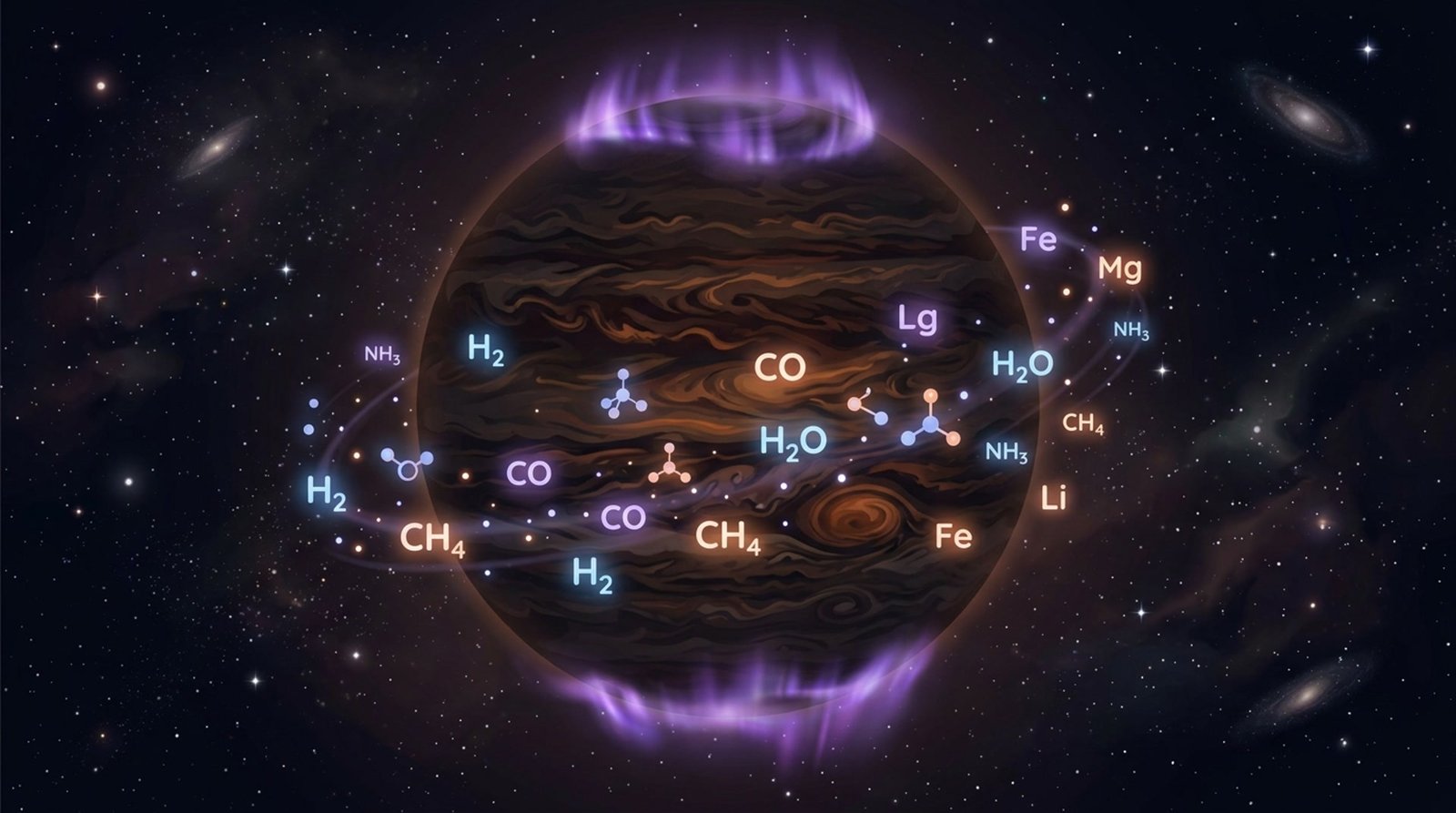
The Failed Star with Impossible Chemistry
Summary
By the end of this article, you will understand how the James Webb Space Telescope spotted impossible molecules on a dark ‘failed star’, and how invisible space auroras might be the culprit.
Quick Facts
- Surprise: The target, WISE-0458, is actually a binary system of two 'failed stars' orbiting each other.
- Salient Idea: JWST detected Hydrogen Cyanide (HCN) and Acetylene (C2H2) in its atmosphere.
- Surprise: Acetylene usually requires intense UV starlight to form, but this system is completely dark!
- Salient Idea: Scientists suspect that massive, hidden auroras or lightning storms are acting as a chemical spark plug.
The Discovery: A Chemical Mystery in the Dark
When astronomers pointed the James Webb Space Telescope (JWST) at WISE-0458, a cold T-type brown dwarf 30 light-years away, they expected to find water, methane, and ammonia. They did find those, but they also uncovered a massive Surprise: the distinct signatures of Hydrogen Cyanide (HCN) and Acetylene (C2H2). Finding these molecules here shouldn’t be possible. In our current understanding of space chemistry, Acetylene normally forms when strong ultraviolet starlight breaks apart other molecules. But WISE-0458 is an isolated system with no host star to light it up. The detection of these molecules forces us to rethink the violent, invisible forces churning inside these dark worlds.
Original Paper: ‘HCN and C2H2 in the atmosphere of a T8.5+T9 brown dwarf binary’
Our observed abundance of C2H2 in the WISE-0458 atmosphere cannot be explained within a ‘normal’ disequilibrium chemistry model.
— Matthews et al.
The Science Explained Simply
To understand this, we must Build a Fence: a brown dwarf is NOT a star, because it lacks the mass to ignite nuclear fusion, but it is NOT a planet, because it is much heavier and hotter than Jupiter. The first part of this chemical mystery is solved by ‘vertical mixing.’ Imagine a high-speed elevator inside the brown dwarf. Deep down, extreme heat and pressure forge complex molecules like Hydrogen Cyanide. If the atmospheric currents are violent enough, this elevator drags the gases to the cooler upper layers so fast that they ‘freeze’ into place before they have time to break apart. But while vertical mixing explains the Cyanide, it still doesn’t fully explain the Acetylene. Something else is providing a massive energy boost.
The Aurora Connection
If there is no starlight to create Acetylene, where does the ultraviolet light come from? The Salient Idea here is magnetic activity. Just like Earth, brown dwarfs can have incredibly powerful magnetic fields. When charged particles get caught in these fields, they crash into the poles, creating spectacular auroras. On Earth, auroras are beautiful light shows. On a brown dwarf, these magnetic storms could be so intense that they generate their own ultraviolet radiation, heating the upper atmosphere and acting like a cosmic spark plug. This localized energy could be exactly what is needed to cook up Acetylene in the pitch black of space.
Perhaps one or both brown dwarfs are magnetically active, driving aurorae and in turn generating UV photons and/or heating the upper atmosphere.
— Matthews et al.
A Peek Inside the Research
How do you detect a trace amount of gas on a dark object trillions of miles away? The team used JWST’s Mid-Infrared Instrument (MIRI). This tool doesn’t look at visible light; it reads thermal radiation. Every molecule in an atmosphere absorbs specific wavelengths of infrared light, leaving a ‘fingerprint’ or barcode in the spectrum. The researchers found sharp dips in the light exactly at 13.7 and 14 micrometers—the undeniable barcodes for Acetylene and Hydrogen Cyanide. It is a triumph of modern spectroscopy, proving that we can now decode the weather on worlds colder and darker than we ever imagined.
With JWST, we can finally explore this chemistry in detail, including for the coldest brown dwarfs that were not yet discovered in the Spitzer era.
— Matthews et al.
Key Takeaways
- Brown dwarfs act as cosmic laboratories for studying extreme weather and chemistry in isolation.
- Intense 'vertical mixing' acts like a high-speed elevator, dragging deep-core chemicals to the surface.
- The discovery of Acetylene (C2H2) breaks current atmospheric models for isolated, unlit objects.
- Magnetic fields and auroras can generate enough localized energy to drive complex chemistry in the dark.
Sources & Further Reading
Frequently Asked Questions
Q: What exactly is a brown dwarf?
A: A brown dwarf is often called a ‘failed star.’ It is a ball of gas heavier than a giant planet like Jupiter, but not quite heavy enough to crush its core into igniting stellar fusion.
Q: Why is finding Acetylene a big deal?
A: Acetylene usually needs external energy, like UV light from a sun, to form. Finding it on a dark, isolated object means there is a hidden, extreme energy source—like massive auroras—generating it from within.
The Super-Jupiter Spinning on its Side
Summary
By the end of this article, you will understand how astronomers read the shifting weather and extreme tilt of a giant planet light-years away using just a few pixels of light.
Quick Facts
- Surprise: AB Pictoris b is a 'Super-Jupiter' so massive it borders on being a failed star called a brown dwarf.
- Surprise: It likely spins completely on its side, rolling through space with a 90-degree tilt like Uranus.
- Salient Idea: Astronomers tracked its weather changing day by day just by analyzing the colors of light passing through its clouds.
- Surprise: The telescope can detect the difference between light carbon (12C) and heavy carbon (13C) on another world!
The Discovery: A Sideways-Spinning World
In 2022, astronomers pointed the Very Large Telescope (VLT) at AB Pictoris b for four straight nights. They weren’t looking to discover a new planet; they wanted to watch its weather change. By looking at the spectrum of light, they found a Surprise: the chemical signals of water and carbon monoxide shifted slightly each night. This was evidence of patchy clouds moving across the planet. But there was another Surprise: the planet’s rotation signature was incredibly slow. In the cosmos, young gas giants usually spin fast. This extreme slowness meant the planet was either a weirdly sluggish spinner, or its axis is tilted 90 degrees, pointing its pole straight at us like a bullseye. It might literally be rolling through space on its side.
A significant misalignment could mean AB Pic b is rolling in its orbit and has a Uranus-like orbit and obliquity.
— S. Gandhi et al.
The Science Explained Simply
This is NOT like clocking a car with a radar gun. We cannot actually see the planet spinning. Instead, we use the Doppler effect. When a planet spins, one side moves toward us (squishing the light waves to look bluer) and one side moves away (stretching them to look redder). The Salient Idea here is that if a planet is spinning fast, its chemical ‘fingerprints’ get smeared out across the spectrum. AB Pictoris b had very sharp, un-smeared lines. This means it has a very low ‘projected’ rotation. Imagine looking at a spinning top from exactly above—the edges aren’t moving toward or away from you, they are just spinning in a circle. That is why scientists think we are looking straight down the pole of a sideways-spinning world.
The Aurora Connection
A planet spinning on its side isn’t just an oddity—it completely changes its space weather! On Earth, our magnetic poles roughly line up with our spin, meaning the solar wind hits our magnetic shield from the side, funneling energy toward the poles to create beautiful auroras. But if a planet is spinning on its side, its magnetic field might be pointing directly at its star. This means the stellar wind slams into it completely differently, potentially funneling intense radiation straight into the sun-facing atmosphere. Understanding a planet’s tilt helps us understand its invisible magnetic shield, and what kind of extreme auroras might be dancing across its surface.
Planetary tilts dictate the geometry of their cosmic shields.
— NorthernLightsIceland.com Team
A Peek Inside the Research
How exactly did they spot shifting clouds? It comes down to incredible instruments, not just staring through an eyepiece. The team used the CRIRES+ spectrograph, which splits light into thousands of distinct colors with extreme precision. They were looking for specific isotopes—like heavy Carbon-13 versus normal Carbon-12. By watching these signals change over four nights, they realized the planet’s cloud deck was rising and falling. When the clouds dropped deeper, the telescope could ‘see’ deeper into the atmosphere, revealing more heavy carbon molecules. It is a triumph of patience and precision to map the 3D cloud structure of a world dozens of light-years away.
High-resolution spectroscopy is inherently more reliable in obtaining line ratios and features than the continuum.
— Research Team
Key Takeaways
- High-resolution spectroscopy lets us read specific chemical fingerprints hidden in starlight.
- Patchy, moving clouds on giant planets can hide or reveal deeper atmospheric layers day to day.
- A very low measured spin speed can mean we are looking straight down a planet's pole.
- A planet's tilt completely alters how its magnetic field interacts with stellar wind.
Sources & Further Reading
Frequently Asked Questions
Q: Why does a tilted planet look like it’s spinning slowly?
A: If a planet is tilted so its pole points right at us, the edges of the planet are just rotating in a circle from our point of view, not moving toward us or away from us. Because of this, the light doesn’t get stretched or squished by the Doppler effect, making the spin look incredibly slow.
Q: What is a ‘Super-Jupiter’?
A: A Super-Jupiter is a gas giant planet that is significantly more massive than our own Jupiter, often blurring the line between a giant planet and a ‘failed star’ known as a brown dwarf.
Jupiter's Polar Factory: The Aurora Engine
Summary
By the end of this article, you will understand how Jupiter’s extreme northern lights act as a massive chemical factory, manufacturing complex smog and driving supersonic winds.
Quick Facts
- Surprise: Jupiter's auroras drive supersonic winds that flow backward against the planet's rotation.
- Salient Idea: High-energy electrons from space smash into the atmosphere, cooking simple methane into complex fractal soot.
- Surprise: The moon Io powers this storm by shooting over a ton of volcanic gas into space every second.
- Surprise: Hydrogen cyanide gas completely vanishes over the poles because it gets trapped inside falling smog particles.
The Discovery: A Chemical Factory in the Sky
For decades, astronomers knew Jupiter had spectacular auroras. But when they looked closely using advanced telescopes like ALMA and the James Webb Space Telescope (JWST), they found a Surprise: the chemistry near the poles was completely twisted. They weren’t just seeing a light show; they were seeing a massive chemical factory. By measuring infrared and sub-millimeter wavelengths, researchers discovered that specific molecules like acetylene were unusually abundant near the auroras, while others like hydrogen cyanide mysteriously dropped by a factor of 100. This wasn’t a random anomaly. It was evidence of a massive, planet-sized engine. The auroras were physically cooking the atmosphere, breaking down basic gases and reforming them into heavy, sinking smog. Spectroscopy allowed scientists to map this in 3D, showing how these freshly minted chemicals slowly fall deeper into the stratosphere.
Original Paper: ‘The Polar Stratosphere of Jupiter’
The auroras are so energetic they fundamentally rewrite the chemistry of Jupiter’s stratosphere.
— Planetary Science Team
The Science Explained Simply
This is NOT like the auroras you see on Earth. On Earth, auroras are mostly a beautiful light show in the upper atmosphere. On Jupiter, the energy is so extreme it triggers continuous ion-neutral chemistry. When high-energy electrons smash into the planet’s upper atmosphere, they rip apart simple molecules like hydrogen and methane. The Salient Idea here is the assembly line: these broken pieces act as chemical building blocks. They smash into other neutral molecules, combining into heavier and heavier chains of carbon. Eventually, they form polycyclic aromatic hydrocarbons (PAHs)—essentially, dark, fractal-shaped soot. This soot clumps together and slowly falls into the lower stratosphere as a heavy haze. It is a permanent, one-way conveyor belt turning invisible gas into a sinking layer of alien smog, completely driven by the raw energy of the aurora.
The Aurora Connection
Jupiter takes the concept of space weather and turns the dial up to eleven. While Earth’s auroras are powered by the solar wind, Jupiter’s are largely powered by its own moon, Io. Io’s active volcanoes blast over a ton of sulfur and oxygen into space every single second. This plasma gets caught in Jupiter’s intensely powerful rotating magnetic field. This creates an electrical connection between the magnetosphere in deep space and the ionosphere in the planet’s upper atmosphere. The result? Massive forces exchange momentum, creating an auroral electrojet—a jet stream of charged particles flowing at supersonic speeds, sometimes moving backward against the planet’s natural rotation! Understanding this extreme magnetic connection helps us study how invisible shields protect, and sometimes radically alter, the atmospheres of giant planets.
Jupiter’s magnetic field acts like a giant blender, mixing deep space plasma with the planet’s own sky.
— NorthernLightsIceland.com Team
A Peek Inside the Research
How do we map invisible winds and gases millions of miles away? It comes down to reading light, not taking standard photos. Researchers use spectroscopy from instruments on spacecraft like Juno, alongside ground-based arrays like ALMA. Every molecule, from methane to hydrogen cyanide, emits or absorbs specific frequencies of light. By looking at the Doppler shift of these frequencies—how the light waves stretch or compress—they can actually measure the speed of the winds in the stratosphere! They essentially track the chemical ‘fingerprints’ as they get blown around the planet. It is an incredible triumph of using multi-wavelength astronomy—combining UV, infrared, and radio waves—to build a 3D model of an alien sky without ever sending a probe directly into the crushing clouds. It requires piecing together data from Voyager’s old flybys with JWST’s newest observations.
We track the Doppler shift of a single molecule’s glow to measure winds moving at supersonic speeds.
— Radio Astronomy Researchers
Key Takeaways
- Auroras on Jupiter act like a chemical refinery, physically altering the stratosphere.
- Powerful magnetic fields link the deep atmosphere to deep space, creating extreme 'electrojets'.
- Astronomers use invisible infrared and sub-millimeter light to map alien weather in 3D.
- Fractal aerosols grow larger as they fall, completely changing the planet's atmospheric chemistry.
Sources & Further Reading
Frequently Asked Questions
Q: Are Jupiter’s auroras visible to the naked eye?
A: If you were there, you would see a faint glow, but the majority of Jupiter’s incredible auroral energy is emitted in Ultraviolet and Infrared light, which is invisible to human eyes but blindingly bright to our space telescopes.
Q: Does it rain on Jupiter’s poles?
A: Not rain like water on Earth. Instead, the auroras create ‘hazes’ or ‘smog’—tiny fractal particles of complex carbon molecules that slowly drift and sink down into the deep atmosphere.
Volcanic Exomoon? A Strange Gas Cloud at WASP-49 b
Summary
By the end of this article, you will understand how astronomers use the speed of moving light to detect what might be the first ever volcanically active moon outside our solar system.
Quick Facts
- Surprise: The sodium gas cloud is moving in the 'wrong' direction for a normal planetary atmosphere.
- Salient Idea: The gas blocks out starlight completely out of sync with the planet's actual transit across its star.
- Surprise: The amount of sodium gas changes drastically from night to night, sometimes vanishing entirely.
- Surprise: The gas is orbiting higher up than the planet's atmosphere, right in the 'Hill sphere' where moons live.
The Discovery: A Cloud in the Wrong Place
When astronomers pointed massive telescopes at the exoplanet WASP-49 b—a hot, gas giant similar to Saturn—they expected to find a puffy atmosphere. Instead, they found a Surprise. There was a massive cloud of sodium gas, but it wasn’t acting like an atmosphere. The cloud was blocking starlight long before the planet even crossed in front of the star. Even weirder, the cloud was moving at an incredibly fast speed of +15.4 km/s. It was a massive, transient storm of metal gas that vanished on some nights and raged on others. This erratic, high-altitude gas strongly points to a hidden source orbiting the planet: a violently volcanic exomoon.
Original Research: Redshifted Sodium Transient near Exoplanet Transit
The transient sodium may be a putative indication of a natural satellite orbiting WASP-49 A b.
— Dr. Apurva V. Oza and Team
The Science Explained Simply
This is NOT just a planet losing its atmosphere to space. When a star heats up a planet’s gas, radiation pressure blows that gas away like a comet’s tail. Because this gas is pushed toward us, its light waves get squished, creating a blueshift. But the Salient Idea here is that the sodium at WASP-49 b is redshifted. It is moving away from us relative to the planet. The only physical way to get a massive, redshifted clump of sodium that orbits high above the planet is if the gas is being spewed out by a separate, fast-moving rocky body—a moon. Just like Earth’s moon orbits us, this invisible moon is racing around WASP-49 b, leaving a trail of volcanic exhaust.
The Aurora Connection
To understand this alien world, we look in our own cosmic backyard. Jupiter has a moon named Io, the most volcanic body in our solar system. Io’s volcanoes pump out tons of sodium gas. This gas gets trapped in Jupiter’s massive magnetic field, creating a glowing ‘plasma torus’ that fuels some of the most intense, permanent auroras in the solar system. If WASP-49 b has a volcanic moon spewing sodium, it almost certainly has a similar, supercharged magnetic interaction. The stellar winds from its sun-like star would clash with the planet’s magnetic shield and the moon’s metallic gas, likely creating blinding, planet-sized auroras that dwarf anything seen on Earth.
Io fuels Jupiter’s sodium exosphere out to a radius of ~500 planet radii.
— WASP-49 b Research Team
A Peek Inside the Research
How do you see a moon that is too small for any telescope to spot? You look for its shadow. The team used the ESPRESSO instrument on the Very Large Telescope (VLT) and the HARPS spectrograph. They didn’t take pictures; they broke the starlight down into a rainbow and looked for missing dark lines specifically where sodium absorbs light (the Na D-lines). By observing the system over multiple nights, they tracked how these dark lines shifted in wavelength over time. This technique, called time-resolved high-resolution spectroscopy, allowed them to realize the gas was moving independently of the planet. It is a brilliant example of using the speed of light to weigh and track invisible objects.
By examining the time-evolution of sodium, we are able to pinpoint when in time the observed redshift occurred.
— WASP-49 b Research Team
Key Takeaways
- Not all gas around a planet belongs to the planet itself; moons can create their own extreme atmospheres.
- Radiation pressure from stars usually blows gas away like a comet tail, but this gas is fighting the current.
- Volcanic moons are powered by tidal heating—gravity stretching and squishing the moon until its rocky inside melts.
- Finding exomoons directly is incredibly hard, but we can hunt them by looking for the chemical clouds they leave behind.
Sources & Further Reading
Frequently Asked Questions
Q: Why can’t we just take a picture of the moon?
A: The WASP-49 system is incredibly far away. Even our best telescopes can’t resolve an image of the planet, let alone a tiny moon orbiting it. We have to look at the chemical ‘shadows’ they cast in the starlight.
Q: Could the sodium just be coming from the star itself?
A: No. The researchers carefully checked the star’s activity. The star is a very calm, sun-like star without massive solar flares. The sodium signal is also moving at a speed that matches an orbit around the planet, not the star.
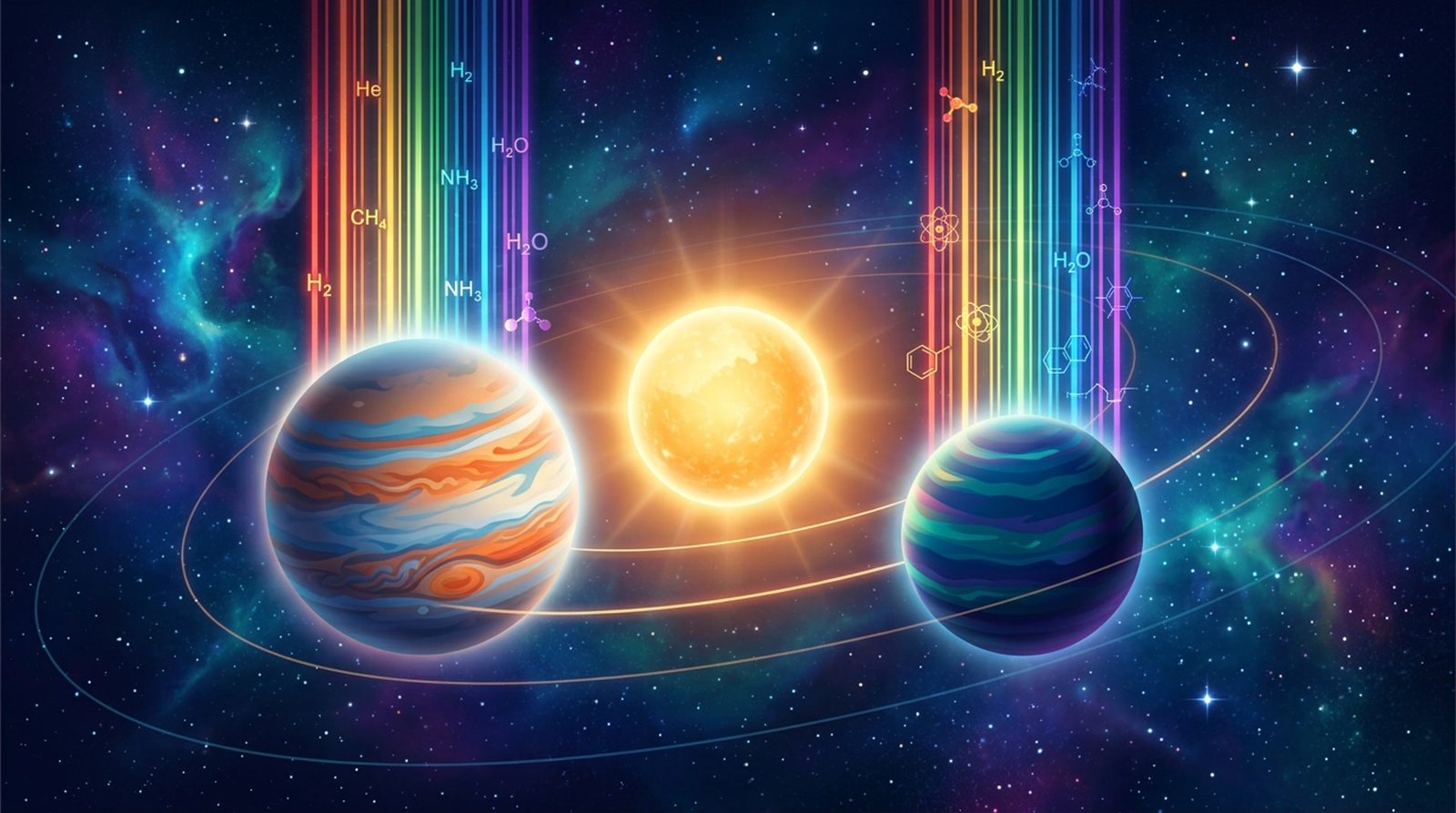
Decoding the Atmospheres of Two Super-Jupiters
Summary
By the end of this article, you will understand how astronomers use light to read the chemical fingerprints of giant planets, and what those chemicals reveal about how planets are born.
Quick Facts
- Surprise: The planet YSES 1 b is 14 to 22 times more massive than Jupiter!
- Surprise: Astronomers detected a rare type of heavy carbon (Carbon-13) floating in the planet's atmosphere.
- Salient Idea: The inner planet spins twice as slow as the outer planet, possibly slowed down by a magnetic field.
- Surprise: These huge planets orbit their star at 160 and 320 times the distance Earth is from the Sun.
The Discovery: Reading Planetary Barcodes
In 2024, scientists used the powerful VLT telescope in Chile to look at a star system called YSES 1. This system has two massive planets, called super-Jupiters, orbiting incredibly far from their star. But scientists did not just take a picture—they used an upgraded instrument called CRIRES+ to break the planets’ light down into a spectrum, like a rainbow. They found a Surprise: by reading the missing colors in the light, they detected the exact chemical fingerprints of water, carbon monoxide, and a heavy isotope of carbon (Carbon-13). It is the first time water and carbon monoxide have been detected on the smaller, outer planet, YSES 1 c. This discovery proves we can read the weather of alien worlds with incredible precision.
High-resolution spectroscopic characterization of young super-Jovian planets enables precise constraints on elemental and isotopic abundances of their atmospheres.
— Yapeng Zhang et al.
The Science Explained Simply
This is NOT a story about planets forming like Earth, slowly gathering rocks over billions of years. Super-Jupiters pose a major problem for astronomers: they are too huge and too far from their star to form the ‘normal’ way. The Salient Idea here is using chemistry as a time machine. By measuring the ratio of carbon to oxygen (C/O) in the planets’ atmospheres, scientists can figure out where they were born. The inner planet has a C/O ratio matching its host star, suggesting it formed very quickly when a massive cloud of gas collapsed under its own gravity. It is a top-down formation, completely different from how rocky, terrestrial planets are made.
Comparing chemical abundances in the atmospheres of both companions and the system’s dynamical properties provides unprecedented details for tracing its formation history.
— The Research Team
The Aurora Connection
What determines how fast a planet spins? The inner planet, YSES 1 b, spins much slower than the outer planet. Why? The secret might be magnetic fields. When a giant planet forms, it is surrounded by a spinning disk of gas and dust. If the planet has a strong magnetic field—much like the one that causes the auroras on Earth—that field interacts with the disk. Over millions of years, this magnetic connection acts like a giant, invisible brake, slowing the planet’s rotation. Our own magnetic field protects our atmosphere from the solar wind and creates the Northern Lights, but on young super-Jupiters, magnetic fields literally shape the physical spin of the world.
Massive companions can effectively ionize the CPDs [circumplanetary disks] and spin down through interactions between magnetic fields.
— Astrophysics Theory
A Peek Inside the Research
How do you see a dim planet next to a blindingly bright star? It requires intense data processing. The team had to physically block the star’s light, but some still leaked into their instruments. To fix this, they used advanced math—specifically, polynomial equations—to model the exact brightness of the leaking starlight and subtract it from the data pixel by pixel. Only then could they extract the faint, pure light of the super-Jupiters. This Story of problem-solving shows that modern astronomy is just as much about writing brilliant software as it is about building giant telescopes.
To remove the stellar contamination, we carried out additional corrections on the 2D data before spectrum extraction.
— Yapeng Zhang
Key Takeaways
- High-resolution spectroscopy allows scientists to find specific molecules like water and carbon monoxide light-years away.
- A planet's ratio of carbon to oxygen acts as a chemical fingerprint to tell us exactly where and how it formed.
- Comparing multiple giant planets in the exact same system helps astronomers test and rule out different formation theories.
- Magnetic braking from a planetary disk can drastically slow down a gas giant's rotation speed.
Sources & Further Reading
Frequently Asked Questions
Q: What exactly is a super-Jupiter?
A: A super-Jupiter is a gas giant planet that is significantly more massive than our own Jupiter. The planets in this study, YSES 1 b and YSES 1 c, are estimated to be roughly 14 and 6 times heavier than Jupiter, respectively.
Q: How do astronomers know what chemicals are in an exoplanet’s atmosphere?
A: They use a technique called spectroscopy. Different chemicals absorb specific colors of light. By looking at a planet’s light, scientists see dark ‘lines’ where colors are missing, which act like a chemical barcode.
Alien Auroras: Listening to Exoplanet Magnetic Shields
Summary
By the end of this article, you will understand how astronomers use giant radio telescopes to ‘hear’ the auroras of distant planets, and why finding these magnetic shields is crucial in the hunt for habitable alien life.
Quick Facts
- Surprise: Astronomers don't just look at exoplanets, they 'listen' to them using giant arrays of radio antennas.
- Salient Idea: Earth and Jupiter create radio waves when charged particles hit their magnetic fields, causing auroras.
- Surprise: A moon can power a planet's aurora! Jupiter's moon Io acts like an electric generator, creating the brightest radio signal in our solar system.
- Salient Idea: Finding a radio signal from an exoplanet proves it has a magnetic shield, which could protect alien life from deadly stellar winds.
The Discovery: Listening for Alien Worlds
For decades, astronomers have been finding thousands of exoplanets using optical telescopes. But there is a huge problem: we cannot see their magnetic fields. A magnetic field is an invisible shield that protects a planet’s atmosphere from being blown away by violent stellar winds. Without it, life as we know it is impossible. So, how do you detect an invisible shield? The answer is a Surprise: you do not look for it, you *listen* for it. Researchers use giant arrays of radio antennas to search for intense bursts of radio waves. In our own solar system, Jupiter is a massive radio transmitter. When particles from the Sun, or volcanic gas from its moon Io, slam into Jupiter’s magnetic field, they spiral toward the poles and create brilliant auroras. These auroras blast highly structured radio waves into space. By pointing our radio telescopes at distant stars, scientists are hunting for these exact same alien radio broadcasts.
Radio detections provide a window onto stellar magnetic activity and the space weather conditions of extrasolar planets.
— Dr. J. R. Callingham et al.
The Science Explained Simply
This is NOT about listening to alien civilizations broadcasting music or speech. These radio waves are a natural physical phenomenon caused by the Electron Cyclotron Maser (ECM) instability. When high-speed electrons are accelerated by a planet’s magnetic field, they spiral tightly around the magnetic field lines near the poles. As they reflect back, they act in unison to beam out incredibly bright, highly polarized radio waves in a hollow cone shape. The Salient Idea here is the ‘radio-magnetic scaling law.’ The maximum frequency of this radio broadcast is directly tied to the strength of the planet’s magnetic field. If we catch the signal, we instantly know exactly how strong the planet’s magnetic shield is. However, the radio beam is directional like a lighthouse. If Earth isn’t inside that specific cone of radio light, the planet remains completely radio-silent to us.
ECM emission is a direct probe of the magnetic field strength of the emitting body.
— Research Team
The Aurora Connection
Auroras are the ultimate indicator of space weather. When a star unleashes a Coronal Mass Ejection (CME)—a massive explosion of hot, dense plasma—it slams into planetary magnetic fields. On Earth, this interaction creates the breathtaking Northern Lights. But for planets orbiting highly active, volatile ‘M-dwarf’ stars, these constant plasma barrages can entirely erode a planet’s atmosphere if it lacks a strong magnetic shield. Interestingly, some exoplanets orbit so close to their stars that they orbit *inside* the star’s own outer magnetic field. This creates Star-Planet Interactions (SPI), acting like a scaled-up version of Jupiter and its moon Io. The planet essentially forces an aurora to spark on the *star itself*, creating a massive radio beacon that alerts us to the planet’s magnetic presence.
The persistent impact of CMEs on a terrestrial planet has the potential to erode its atmosphere.
— Study Authors
A Peek Inside the Research
How do we actually tune in to these distant planets? The research relies on Knowledge and Tools like LOFAR (the Low-Frequency Array), an enormous network of radio antennas spread across Europe. Finding these signals is incredibly difficult because the emission is faint, highly variable, and often blocked by our own Earth’s ionosphere. In fact, to find Earth-like exoplanets, researchers note that we will eventually need to build radio interferometers on the far side of the Moon, completely shielded from Earth’s noisy radio interference. By carefully separating the chaotic, broadband radio noise of stellar flares from the highly structured, circularly polarized ‘pings’ of auroral ECM emission, astrophysicists are inching closer to the very first confirmed direct radio detection of an exoplanet.
In the long-term, low-frequency exoplanet science will require radio interferometers on the far side of the Moon.
— Research Team
Key Takeaways
- Auroras emit powerful radio waves through a process called the Electron Cyclotron Maser instability.
- Coronal Mass Ejections (CMEs) from stars hurl dangerous plasma that can strip away a planet's atmosphere.
- Star-planet interactions occur when a close-in planet physically tangles with its host star's magnetic field.
- Future telescopes on the far side of the Moon might be the only way to detect Earth-like exoplanets without Earth's own radio interference.
Sources & Further Reading
Frequently Asked Questions
Q: Can you hear these radio waves with your ears?
A: No, these are electromagnetic radio waves, not sound waves. However, scientists can convert the electromagnetic frequencies into audio files so we can listen to the ‘chirps’ and ‘whistles’ of the auroras.
Q: Why haven’t we definitively found an exoplanet radio signal yet?
A: The signals are very faint, highly beamed (so they might miss Earth entirely), and can be easily confused with massive radio bursts coming from the host star’s own solar flares.

The Cosmic Tug-of-War Over Mars
Summary
By the end of this article, you will understand exactly how extreme solar storms from space and massive dust storms from the surface battle for control of the Martian atmosphere.
Quick Facts
- Surprise: Solar flares can penetrate all the way down to 80 km above the Martian surface.
- Salient Idea: Dust storms heat the lower atmosphere, causing the entire upper atmosphere to literally swell and 'loft' upwards into space.
- Surprise: Extreme solar wind acts like a giant hand, physically suppressing and crushing the rising atmosphere back down.
- Surprise: The collision of these dust and solar storms triggers glowing proton auroras across the Martian day side.
The Discovery: Attacked from Above and Below
In 2021 and 2022, scientists using the MAVEN spacecraft set out to observe the Martian ionosphere—the electrified edge of space. They analyzed data from two distinct, extreme periods. First, an intense solar storm hit Mars in April 2021. Then, in June 2022, a massive, overlapping A-class and B-class dust storm choked the planet just as another wave of solar storms arrived. They found a Surprise: the dust storms were heating the planet, causing the atmosphere to expand and ‘loft’ upwards by up to 20 kilometers as a single unit. But simultaneously, the immense dynamic pressure from the solar wind was slamming into that expanded atmosphere, suppressing the loft and violently stripping away its particles. Mars was caught in a planetary-scale vise grip.
The thermosphere, on average, lofts as a unit… demonstrating the widespread and multifaceted impact of dust activity and extreme solar activity.
— Marianna Felici et al.
The Science Explained Simply
This is NOT the breathable layer of air where weather happens on Earth. The ionosphere is a high-altitude layer of gas that has been cooked by the sun’s ultraviolet light and X-rays until the electrons are ripped away from their atoms, creating a sea of charged particles called plasma. The Salient Idea here is the concept of ‘Total Electron Content’ (TEC). When a solar storm (like a Coronal Mass Ejection) hits Mars, it injects extreme energy into this plasma layer, spiking the TEC by up to 200%. But unlike Earth, Mars has no thick atmospheric cushion. The high-energy solar particles can penetrate incredibly deep—down to 80 km above the surface—forcing the ionosphere to dramatically reshape itself in real-time.
The Aurora Connection
Earth’s strong magnetic field deflects the solar wind, funneling it to the poles to create our beautiful Northern Lights. Mars lost its global magnetic shield billions of years ago. When the expanding, dust-choked Martian atmosphere collides with an aggressive solar storm, the solar wind plows directly into the planet’s swollen halo of hydrogen gas. This direct impact creates highly active proton auroras that can span the entire day side of the planet. Studying how these auroras flare up during dust storms gives us a terrifyingly clear picture of how unprotected planets bleed their atmospheres out into the cold void of space.
Numerous proton aurora events observed during this time period correspond with increases in the ROSE TEC… demonstrating widespread impact.
— MAVEN Research Team
A Peek Inside the Research
How do you measure a completely invisible layer of plasma from orbit? The researchers didn’t use cameras; they used Radio Occultation. By transmitting a radio signal from the MAVEN spacecraft straight through the Martian atmosphere to receivers on Earth, scientists measured exactly how much the radio waves bent and delayed. This delay reveals the exact density of electrons at every altitude. To prove the solar and dust storms were changing the planet, the team first had to build a meticulous mathematical model of a ‘quiet’, undisturbed Mars. By subtracting this baseline from their storm data, the invisible effects of the cosmic tug-of-war suddenly became crystal clear.
To quantify the effects that space weather events and dust storm induce, we need to isolate and subtract the baseline photochemically produced ionosphere first.
— Marianna Felici et al.
Key Takeaways
- The ionosphere of Mars is highly dynamic and controlled by both space weather and surface weather.
- MAVEN uses radio waves passing through the atmosphere to measure the exact thickness and electron density of Mars.
- Solar energetic particles strip electrons from molecules, creating dense layers of plasma deep in the atmosphere.
- A planet's lack of a global magnetic field leaves its atmosphere entirely at the mercy of the Sun.
Sources & Further Reading
Frequently Asked Questions
Q: Does Mars have a magnetic field like Earth?
A: No. Mars lost its global magnetic field billions of years ago. It only has weak, localized magnetic ‘umbrellas’ in its crust, leaving the majority of the planet’s atmosphere exposed to the direct blast of the solar wind.
Q: What happens to the atmosphere when it ‘lofts’?
A: When a dust storm heats the lower atmosphere, the gas expands and rises to higher altitudes. This pushes the upper atmosphere further out into space, where it is easier for solar winds to strip it away.
Q: Can we see Martian auroras with our naked eyes?
A: Unlike Earth’s vibrant green and pink auroras, Martian proton auroras happen in the ultraviolet spectrum, meaning they are completely invisible to human eyes but shine brightly to specialized instruments like MAVEN’s imaging spectrograph.
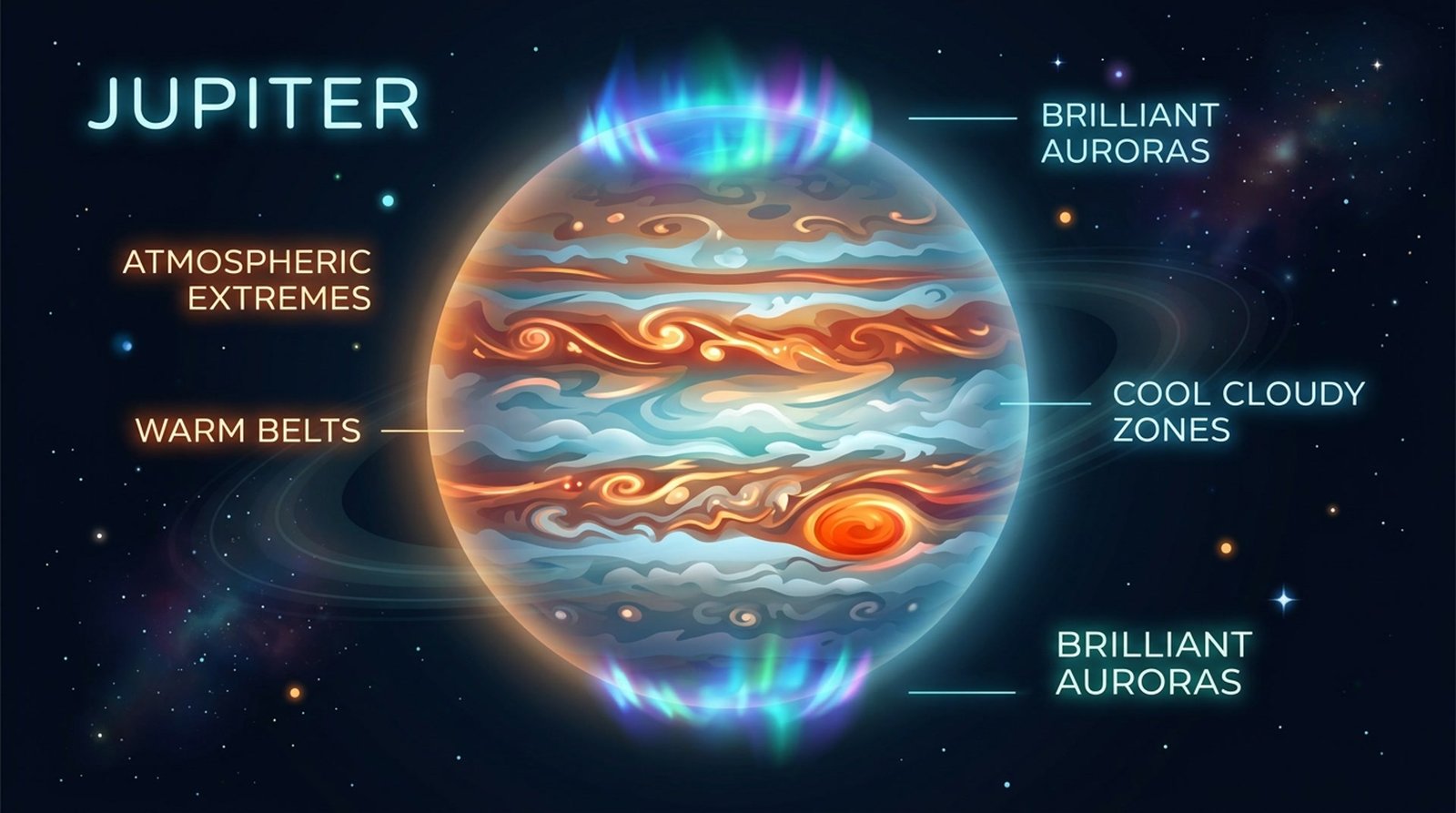
Jupiter's Hidden Heat: Decoding the Giant's Polar Auroras
Summary
By the end of this article, you will understand how scientists map Jupiter’s temperatures from Earth, and how solar storms power extreme auroras that heat the giant planet’s stratosphere.
Quick Facts
- Surprise: Jupiter's famous colorful stripes do not stop at the equator; they extend almost all the way to the poles.
- Surprise: The planet's northern and southern auroras act like massive heaters, raising the stratospheric temperature by 20 degrees.
- Salient Idea: The cold polar vortices act like massive fences, trapping heat and special chemicals created by the auroras.
- Surprise: Scientists observed Jupiter's auroras rapidly cooling down just days after being hit by a massive solar wind storm.
The Discovery: A Thermal Map of a Giant
In May 2018, astronomers aimed the massive Very Large Telescope (VLT) in Chile at Jupiter. They were not looking at visible light; they were using an instrument called VISIR to measure mid-infrared heat. They found a Surprise: Jupiter’s famous pattern of alternating stripes (warm, cloud-free belts and cool, cloudy zones) does not just exist near the equator—it reaches almost to the planet’s extreme poles. Even more fascinating, the team mapped a massive, cold polar vortex at each pole. But the real breakthrough happened in the south. They watched in real-time as an intense ‘hotspot’—created by Jupiter’s southern aurora—rapidly cooled over four nights immediately following a violent solar wind storm.
We captured the subsequent cooling of the southern auroral region… evidence of an interaction between the magnetosphere and stratosphere.
— Research Team
The Science Explained Simply
This is NOT like a typical storm on Earth that blows over in a few days. Jupiter’s polar vortices are colossal, permanent cyclones of cold air sitting at the very top and bottom of the planet. The Salient Idea here is containment. These vortices act like gigantic atmospheric fences. Inside these boundaries, thick reflective aerosols (space clouds) cause extreme radiative cooling. Meanwhile, right next to these cold traps, the planet’s auroras are blasting the upper atmosphere with heat and creating complex chemicals like ethane and acetylene. The vortex barrier prevents this aurora-heated, chemically-rich air from easily mixing with the rest of the planet.
The cold polar vortices coincide with reflective aerosols, suggesting dynamic entrainment by the jet streams.
— Research Team
The Aurora Connection
On Earth, our magnetic field catches solar wind to create beautiful auroras. Jupiter does this too, but on a monstrous scale. Jupiter’s magnetic field is 20,000 times stronger than Earth’s. When a solar wind compression event (a dense wave of solar particles) slams into Jupiter, it drives highly energetic electrons deep into the atmosphere. This does not just create light; it creates intense heat—raising temperatures by up to 20 Kelvin deep in the stratosphere. Studying how Jupiter’s auroras heat its atmosphere and change its chemistry helps scientists understand space weather, proving that auroras are powerful engines that can drive global planetary climates.
Auroral regions are prone to injections of high-energy ions and electrons… resulting in a magnetosphere-to-stratosphere warming.
— Research Team
A Peek Inside the Research
How do you measure the temperature of a planet 400 million miles away? It requires incredibly precise Tools and Knowledge. The team used the VLT to capture light in the ‘mid-infrared’ spectrum—light that is essentially invisible heat. Because Earth’s own atmosphere gets in the way, they used a technique called ‘chopping and nodding’ to subtract the background noise of our sky. Then, they fed this data into a complex computer model called NEMESIS. This model works backwards, adjusting temperature and chemical profiles until they perfectly match the telescope’s observations. It is a triumph of mathematical deduction over unimaginable distances.
This provides an unprecedented view of Jupiter’s poles in the mid-infrared.
— Research Team
Key Takeaways
- Mid-infrared telescopes on Earth can see heat patterns that even spacecraft orbiting Jupiter cannot easily detect.
- Auroras are not just light shows; they fundamentally alter the chemistry and temperature of a planet's atmosphere.
- High-energy solar winds act like a switch, compressing Jupiter's magnetic field and triggering rapid temperature changes.
- Jupiter's dark, cloud-free belts are actually warmer and have less gas condensation than the bright, cloudy zones.
Sources & Further Reading
Frequently Asked Questions
Q: Why did they use a telescope on Earth when the Juno spacecraft is orbiting Jupiter?
A: Juno is amazing, but it lacks instruments sensitive to mid-infrared light. Earth-based telescopes like the VLT provide the crucial thermal data needed to see the heat of the lower stratosphere.
Q: What makes Jupiter’s stripes different colors?
A: The light zones are colder and covered in thick ammonia ice clouds. The dark belts are warmer, cloud-free regions where we are looking deeper into the planet’s atmosphere.
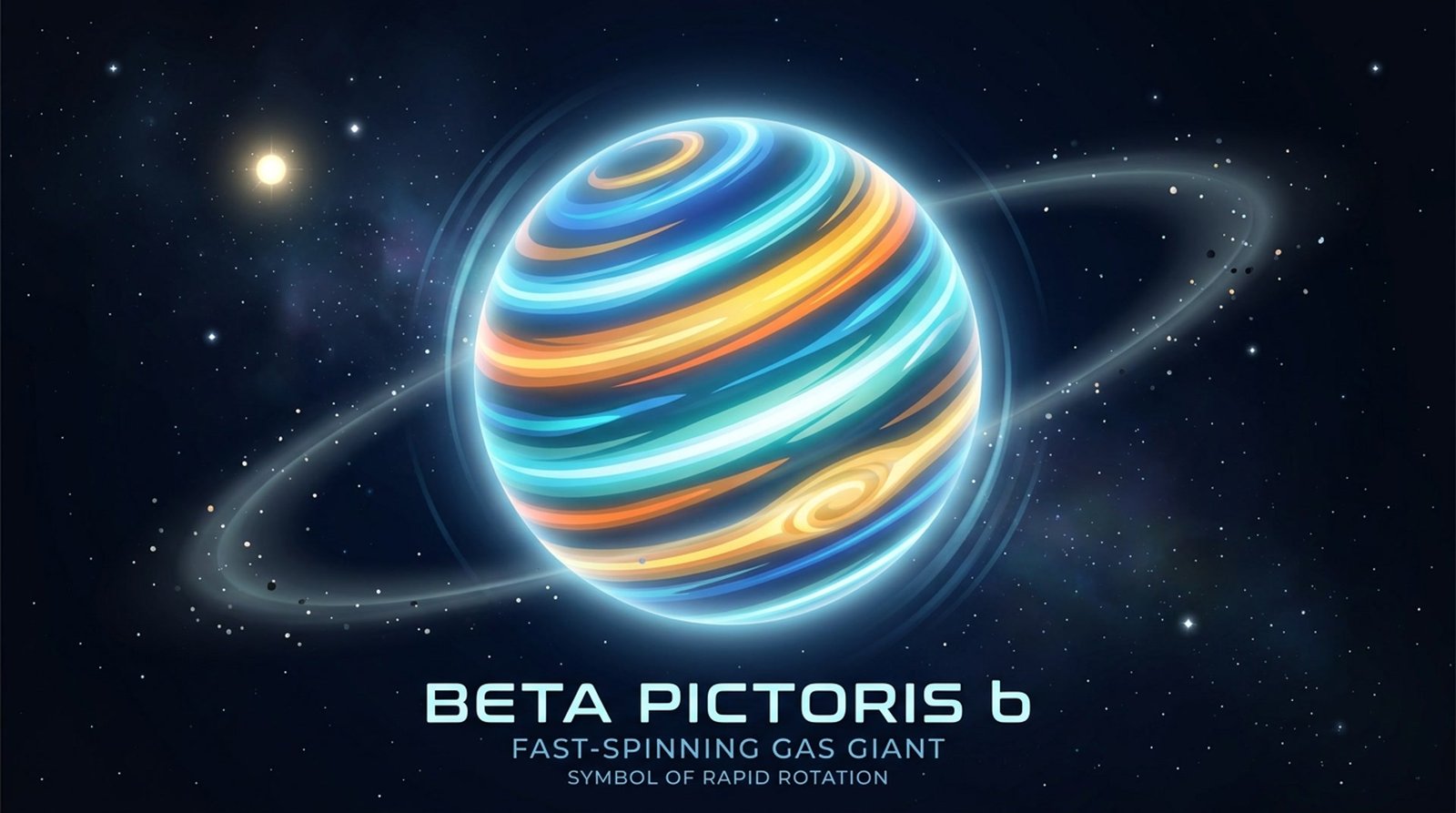
Reading the Weather and Spin of Beta Pictoris b
Summary
By the end of this article, you will understand how astronomers use an upgraded super-telescope to read the hidden light barcodes of a distant gas giant, revealing what it is made of and exactly how fast it spins.
Quick Facts
- Surprise: A full day on Beta Pictoris b lasts only 8.7 hours because it spins at nearly 20 kilometers per second!
- Surprise: Astronomers detected the planet's atmospheric signal in individual snapshots lasting just 2 minutes.
- Salient Idea: The planet's atmosphere contains water and carbon monoxide, but has slightly less carbon relative to oxygen than our sun.
- Surprise: The planet is so close to its blindingly bright star that it only contributes about 2 percent of the light in the telescope's view.
The Discovery: A Fast-Spinning Water World
In 2021, astronomers pointed the Very Large Telescope’s newly upgraded CRIRES+ instrument at the Beta Pictoris system. They weren’t just looking for a dot of light; they wanted its chemical recipe. They found a Surprise: the new instrument was so powerful they could confidently detect water and carbon monoxide in just two-minute exposures! By measuring how the light stretched and compressed, they also clocked its spin, discovering a blisteringly fast 8.7-hour day. This proved the new instrument is a powerhouse for unraveling the mysteries of giant exoplanets.
Original Paper: ‘Beta Pictoris b through the eyes of the upgraded CRIRES+’
Our results show that CRIRES+ is performing well and stands as a highly useful instrument for characterizing directly imaged planets.
— R. Landman and Team
The Science Explained Simply
How do you see water on a planet light-years away? This is NOT like looking through a magnifying glass. Instead, scientists use a spectrograph. The Salient Idea here is the ‘barcode.’ Gases like water and carbon monoxide absorb specific colors of starlight. By splitting the light into a rainbow, astronomers look for missing black lines, which form a barcode unique to that gas. Furthermore, as the planet spins, one side moves toward us and the other moves away. This Doppler effect stretches the barcode lines, allowing us to perfectly measure its rotational speed!
The Aurora Connection
Beta Pictoris b spins at a dizzying 20 kilometers per second. Why does this matter? On Earth, our planet’s rotation helps power our magnetic field, which creates beautiful auroras and shields us from the harsh solar wind. A giant planet spinning this incredibly fast likely has a massive magnetic dynamo. This invisible shield is essential. Without it, the planet’s water and carbon monoxide would be stripped away by the fierce stellar winds of its host star. Fast spin equals strong shields.
Planets and satellites: atmospheres, spin rotation, and magnetic braking.
— Research Core Themes
A Peek Inside the Research
Finding this planet is like trying to spot a firefly next to a searchlight. The host star is 100 times brighter than the planet at their specific separation. It comes down to Knowledge and Tools, not magic. The team used a custom Python software package called ‘pycrires’ to model and filter out the blinding starlight, Earth’s own atmospheric interference, and instrumental noise. Only after meticulously stripping away all this clutter could they isolate the tiny 2 percent signal of the planet’s actual atmosphere.
Since we are completely dominated by the stellar contribution… we estimate the noise and filter the stellar master spectrum directly from the data.
— The Analysis Framework
Key Takeaways
- High-resolution spectrographs act like prisms, splitting light into barcodes to reveal chemical fingerprints.
- Measuring a planet's Carbon-to-Oxygen ratio gives clues about where and how the planet originally formed in its star system.
- Upgraded tools like CRIRES+ let us see planetary weather and rotation with unprecedented clarity and speed.
- Fast-spinning gas giants can generate massive magnetic fields, which are crucial for protecting their atmospheres.
Sources & Further Reading
Frequently Asked Questions
Q: How can scientists tell how fast the planet is spinning?
A: They use the Doppler effect! As the planet spins, the side spinning toward us compresses light waves, and the side spinning away stretches them. This blurs the ‘barcode’ of light, and the amount of blur tells us the exact speed.
Q: Why is the Carbon-to-Oxygen (C/O) ratio important?
A: The C/O ratio acts like a fossil record. Depending on where a planet formed in its solar system, the amounts of available carbon and oxygen change. Measuring it helps us trace the planet’s origin story.

The Planet Where Elements Vanish: Unlocking WASP-76b
Summary
By the end of this article, you will understand how alien atmospheres trap specific metals, what causes thermal inversions, and why understanding these extreme worlds helps us decode the history of our own solar system.
Quick Facts
- Surprise: WASP-76b may have 'eaten' a Mercury-like planet, explaining its unusually high levels of nickel!
- Surprise: The planet has a stratosphere heated by Vanadium Oxide, acting similarly to Earth's ozone layer.
- Salient Idea: Elements that condense above 1,550 Kelvin are completely 'cold-trapped' on the dark side.
- Surprise: Astronomers detected a 'kink' in the light signal, showing winds blowing differently on the east and west sides.
The Discovery: The Missing Titanium
Astronomers pointed the MAROON-X spectrograph at WASP-76b, expecting a specific mix of metals. They found a Surprise: they clearly detected 14 elements, but highly refractory (heat-resistant) elements like titanium and aluminum were completely missing! This was not a glitch. It was the discovery of a cold-trap. On WASP-76b, the day side is blisteringly hot, but the night side drops below 1,550 Kelvin. Elements that condense at higher temperatures vaporize on the day side, but the moment winds carry them to the night side, they condense and fall out of the sky as heavy, mineral rain. They never make it back into the upper atmosphere. The team also detected Vanadium Oxide, a long-hunted molecule that acts like Earth’s ozone layer, absorbing starlight and creating a super-heated stratosphere. By looking at exactly what is in the air, and what has fallen out of it, scientists are finally mapping the precise temperatures of alien weather systems.
Original Paper: ‘Vanadium oxide and a sharp onset of cold-trapping on a giant exoplanet’
Temperature sequences of hot Jupiter spectra can show abrupt transitions wherein a mineral species is completely absent if a cold-trap exists.
— Stefan Pelletier
The Science Explained Simply
This is NOT just a simple case of metal rain falling straight down. When scientists looked closely at the absorption signals of elements like iron, they noticed a ‘kink’ in the data. The signal was progressively more blueshifted over the first half of the planet’s transit. What does this mean? The Salient Idea is that the planet’s atmosphere is completely asymmetrical. The morning side (east) and the evening side (west) look totally different. Because WASP-76b is tidally locked, the permanent day side heats up massively, driving winds that carry evaporated metals. As these metals hit the cooler evening terminator, they form high-altitude, optically thick clouds or condense into liquid. This means the starlight passing through the east side shows a completely different chemical fingerprint than the west side. It is a global weather engine permanently dumping heavy metals into the dark.
A global process affecting most species systematically must be responsible… substantial temperature asymmetry and unevenly distributed high-altitude clouds.
— The Research Team
The Aurora Connection
While WASP-76b is much too hot to host the kind of auroras we see in Iceland, studying its extreme atmosphere teaches us about planetary survival against stellar winds. Earth’s magnetic field protects our atmosphere from being stripped away. Ultra-hot Jupiters like WASP-76b are bombarded by intense, short-wavelength stellar irradiation that violently heats molecules like Vanadium Oxide, expanding the atmosphere. If WASP-76b did not have a massive gravitational pull and potentially a powerful magnetic field, its atmosphere would be blown entirely into space. The elements detected, like ionized calcium and barium, show that the planet’s upper atmosphere is enduring brutal radiation. Understanding how this giant world holds onto its heavy metal clouds helps astronomers understand the delicate balance required for our own magnetic shield to protect our relatively fragile, water-filled atmosphere.
Extreme worlds teach us about planetary survival against stellar bombardment.
— NorthernLightsIceland.com Team
A Peek Inside the Research
How do scientists find Vanadium Oxide light-years away? It requires incredible Knowledge and Tools. The light hitting the Gemini-North telescope in Hawaii is a messy mix of the host star, the Earth’s own atmosphere, and the tiny planet. To find the planet’s signal, researchers used a technique called Principal Component Analysis (PCA). Since the Earth and the star are not moving much relative to the telescope, their spectral lines stay mostly still. But the planet is whipping around its star at 100 kilometers per second! Its chemical ‘fingerprint’ rapidly shifts due to the Doppler effect. By writing algorithms that erase the stationary light, the team revealed the faint, shifting trail of the planet’s atmosphere. They then matched this clean data against computer models of how different gases absorb light, leading to the unambiguous detection of 14 elements.
We employ a PCA based algorithm which removes stellar and telluric contributions while leaving the rapidly Doppler shifting planetary signal largely unaffected.
— Methodology Section
Key Takeaways
- Alien atmospheres have chemical 'cold traps' where specific elements vanish from the gas phase.
- Vanadium oxide acts as a massive heater in the upper atmosphere of ultra-hot Jupiters.
- Planets can swallow other rocky bodies during their formation, leaving permanent chemical fingerprints.
- High-resolution spectroscopy allows us to separate a planet's light from its host star and the Earth's atmosphere.
Sources & Further Reading
Frequently Asked Questions
Q: Why is Nickel so important on this planet?
A: Scientists found unusually high amounts of Nickel. This suggests WASP-76b might have ‘eaten’ a smaller, rocky planet with a heavy iron-nickel core (similar to Mercury) during its formation!
Q: What is a ‘Cold-Trap’?
A: A cold-trap happens when an atmosphere has a region so cold that certain gases instantly turn to liquid or solid and fall out. Once they fall, they get ‘trapped’ below the atmosphere and can no longer be detected as gas.
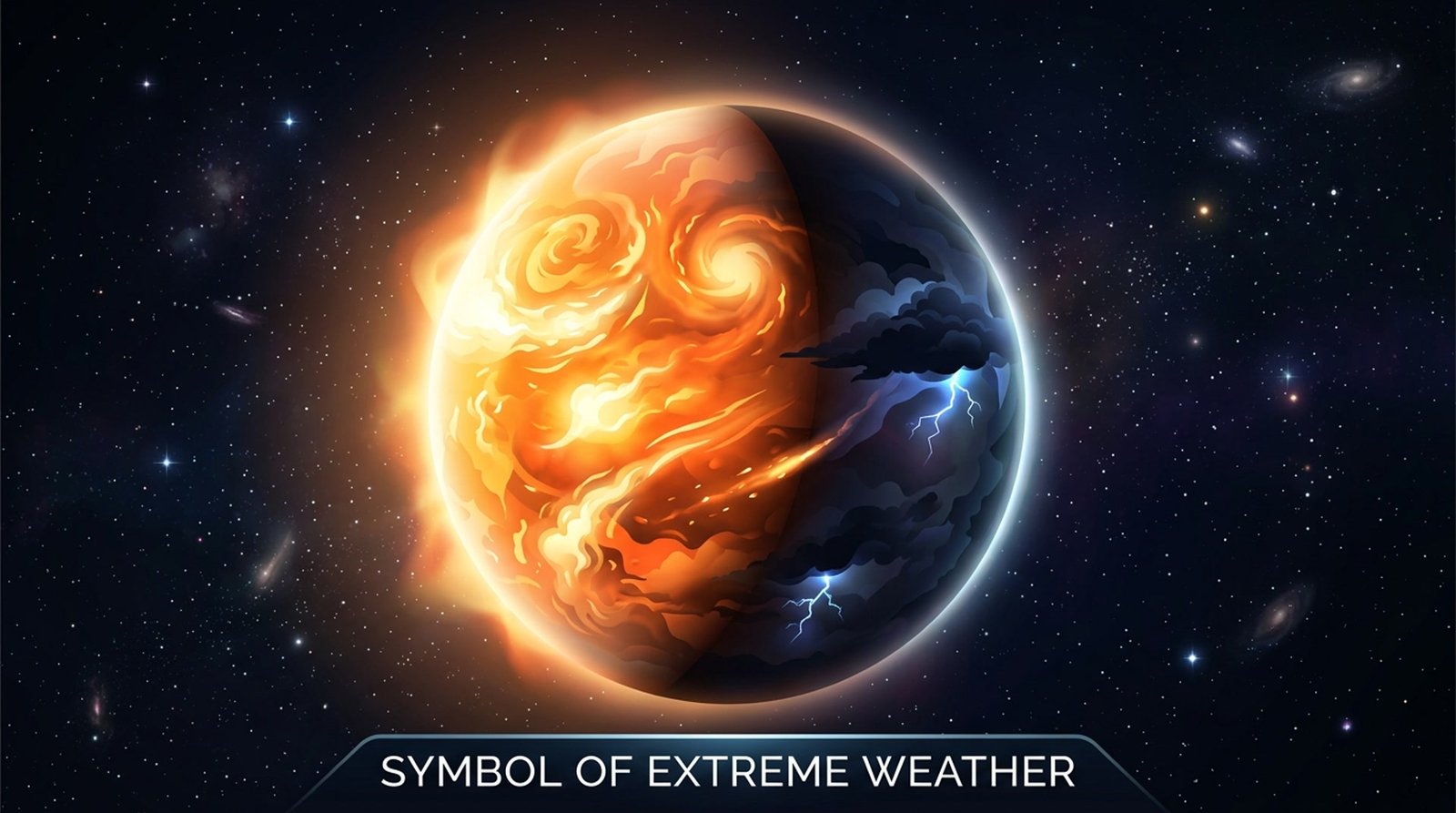
The Alien Worlds Where Heavy Metals Float in the Sky
Summary
By the end of this article, you will understand how astronomers read starlight to map 10,000 mph winds and liquid metal rain on giant, boiling alien planets.
Quick Facts
- Surprise: These gas giants are so hot (over 4,000 degrees Fahrenheit) that metals like iron and magnesium float as gases in their atmosphere.
- Salient Idea: Astronomers map these atmospheres by looking at the specific colors of light blocked by the planet during an eclipse.
- Surprise: Calcium and titanium are strangely 'missing' from the data—scientists think they condense into rock clouds and rain down on the night side!
- Surprise: High-resolution telescopes can actually measure 10,000 mph winds blowing from the day side to the night side.
The Discovery: Reading Alien Starlight
In a massive survey of six ultra-hot Jupiters (gas giants orbiting incredibly close to their stars), scientists used high-resolution telescopes to hunt for metals in the sky. By analyzing the starlight shining through the edges of these planets, they found a Surprise: a cocktail of vaporized metals like iron, magnesium, and chromium. But they also noticed something missing. Elements like calcium and titanium were mysteriously low. Where did they go? Scientists realized the fierce day-to-night temperature drops cause these specific metals to form solid clouds and rain out of the sky on the dark side. It is a brilliant example of decoding complex chemistry from light-years away.
This work highlights the importance of future high-resolution studies to further probe differences and trends between exoplanets.
— Dr. Siddharth Gandhi et al.
The Science Explained Simply
This is NOT just taking a picture of a planet. Exoplanets are too far away to see their clouds directly. Instead, scientists use spectroscopy. When a planet passes in front of its star, the planet’s atmosphere blocks specific colors of light. Think of it like a barcode. Every element, like iron or sodium, has a unique barcode. By looking at which barcodes are missing from the starlight, we know exactly what is floating in the alien sky. The Salient Idea here is that the telescope acts like a prism, splitting light to reveal the hidden, vaporized metals inside the planet’s extreme wind storms.
The Aurora Connection
These ultra-hot planets are constantly blasted by violent stellar winds. On Earth, our magnetic field protects our atmosphere and creates beautiful auroras by funneling charged solar particles to the poles. But on an ultra-hot Jupiter, the stellar winds are fiercely strong. If these extreme planets didn’t have massive magnetic fields of their own, their atmospheres—along with all that vaporized metal—would be completely stripped away into space. Studying the supersonic winds and atmospheric survival of these gas giants helps us understand the invisible magnetic shields that protect all planets, including our own.
High-resolution spectroscopy will therefore play a key role in exploring atmospheric chemistry and dynamics on exoplanets in upcoming years.
— The Research Team
A Peek Inside the Research
How do you measure wind speed on a planet you cannot even clearly see? The team used the Doppler effect. Just like a police siren changes pitch as it speeds past you, light waves get squished or stretched when the glowing gas moves. The researchers noticed the barcodes of the metals were slightly shifted toward the blue end of the spectrum. This ‘blueshift’ is the ultimate proof that fierce 10,000 mph winds are blasting from the hot day side toward the cooler night side, carrying vaporized metals along for the ride.
Key Takeaways
- Ultra-hot Jupiters act like extreme chemistry labs in space.
- We cannot just use iron to guess a planet's total makeup; different metals behave completely differently.
- The Doppler effect helps us track supersonic winds across light-years of space.
- Night-side 'rain-out' acts as a trap, removing certain metals from the sky permanently.
Sources & Further Reading
Frequently Asked Questions
Q: Why don’t all the metals vaporize equally?
A: Different metals have different boiling and condensation points. While iron stays a gas at these temperatures, titanium combines with oxygen to form heavy molecules that ‘rain out’ on the cooler night side.
Q: Could a spacecraft fly through these atmospheres?
A: No! The temperatures are thousands of degrees, the pressure is immense, and the supersonic winds of vaporized metal would destroy any probe we could currently build.
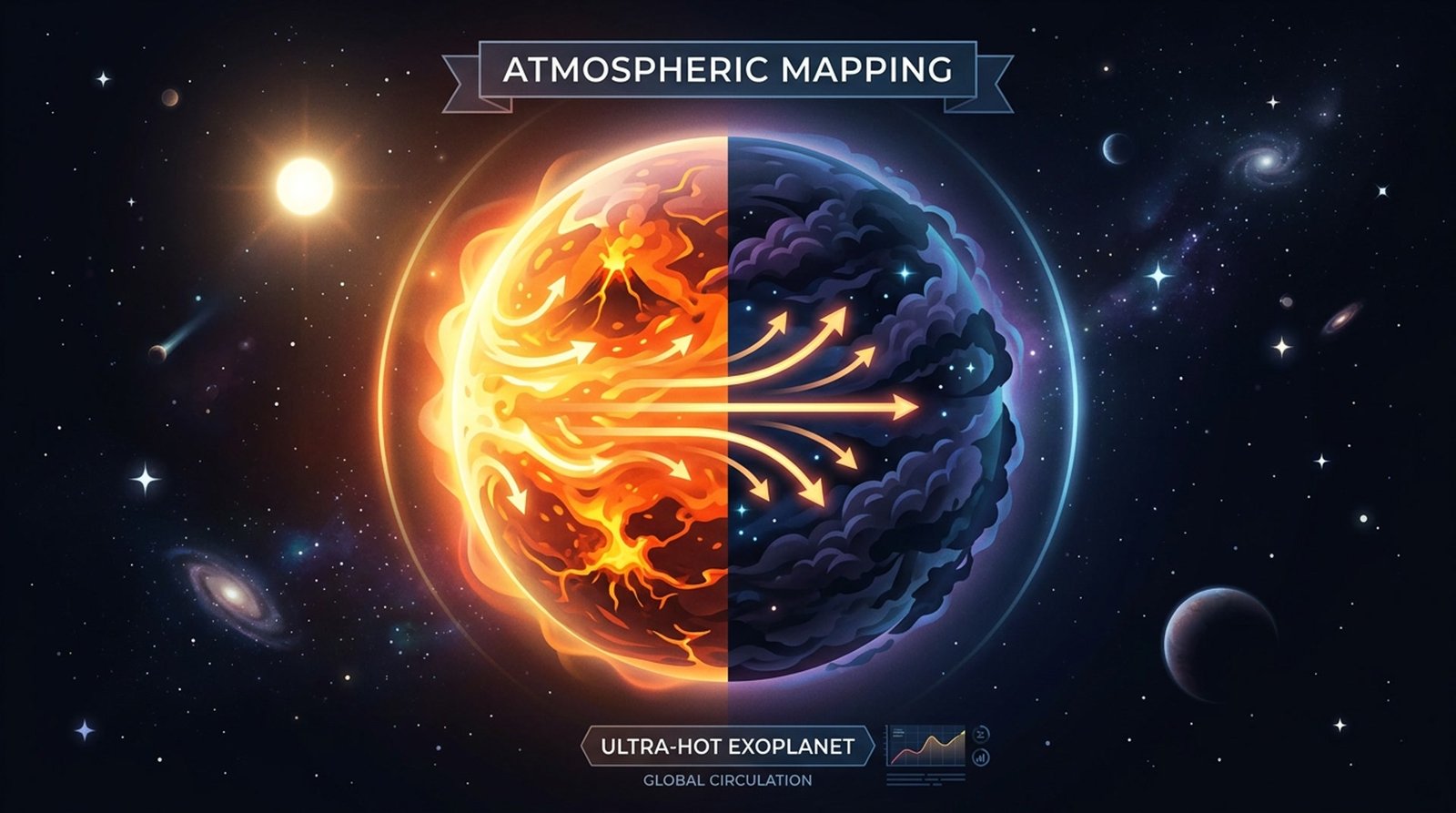
Mapping Morning and Evening on an Alien World
Summary
By the end of this article, you will understand how scientists map the separate morning and evening weather patterns on an extreme alien world located hundreds of light-years away.
Quick Facts
- Surprise: The planet's evening side has much faster winds than its morning side, reaching 9.8 kilometers per second.
- Salient Idea: Astronomers didn't take a picture; they mathematically separated the morning and evening using the speed of light.
- Surprise: Temperatures on this world reach nearly 3,000 Kelvin, hot enough to vaporize solid iron into a gas.
- Salient Idea: The new 'HyDRA-2D' model proves that alien atmospheres are inherently 3-dimensional, just like Earth's.
The Discovery: Splitting the Alien Shadow
For years, astronomers treated alien planets as single, uniform blobs of data. But planets, just like Earth, are complex 3-dimensional worlds with mornings, evenings, and wild weather patterns. In a breakthrough study, astronomers used the ESPRESSO instrument to observe WASP-76b, an ultra-hot Jupiter famous for raining molten iron. To understand its weather, the team introduced a powerful new model called HyDRA-2D. They uncovered a massive Surprise: the iron signal wasn’t the same everywhere. It was significantly stronger on the evening side of the planet. As the planet’s terminator—the twilight line dividing day and night—passed in front of its star, the researchers could actually tell the leading morning limb apart from the trailing evening limb. The scorching day side vaporizes the iron, and extreme day-night winds carry it into the evening twilight zone. By effectively splitting the exoplanet’s shadow into two distinct halves, they proved that alien atmospheres are incredibly dynamic, forever changing how we study distant worlds.
The evening side is the dominant source of the Fe signal, driven by a day-night wind of almost 10 kilometers per second.
— Dr. Siddharth Gandhi
The Science Explained Simply
To be incredibly clear, this is NOT like zooming in with a giant optical camera to take a high-resolution photograph of the planet’s surface. We cannot actually ‘see’ the planet WASP-76b directly. Instead, scientists use high-resolution spectroscopy to read the light from the host star as it filters through the planet’s atmosphere. Every chemical, like iron gas, blocks specific colors of light, creating a unique barcode. The Salient Idea here is the use of the Doppler shift. Just like a passing ambulance siren changes pitch as it drives by you, light changes its wavelength depending on how fast the glowing gas is moving. Because the planet’s evening side is rotating toward our telescopes and the morning side is rotating away from us, their light barcodes shift in opposite directions—one toward blue, one toward red. This tiny velocity shift allows researchers to mathematically untangle and separate the morning weather from the evening weather!
This isn’t a picture. It is a dynamic chemical barcode hidden inside ancient starlight.
— NorthernLightsIceland.com Team
The Aurora Connection
You might wonder what ultra-hot metal storms have to do with space weather phenomena on Earth. It all connects through atmospheric dynamics, stellar radiation, and magnetic fields. On Earth, our invisible magnetic shield catches the solar wind, safely funneling it toward the poles to create glowing auroras. On an ultra-hot Jupiter like WASP-76b, the planet is violently blasted by stellar radiation that is thousands of times stronger. The extreme temperature difference between the permanent day side and the permanent night side drives a ferocious day-to-night wind, clocked at an unbelievable 22,000 miles per hour! These incredibly fast winds interact with the planet’s atmospheric layers and its magnetic field. Studying how WASP-76b’s thick atmosphere is pushed, heated, and blown around helps scientists understand the extreme limits of space weather. This ultimately gives us vital clues about how planetary shields protect atmospheres from being entirely stripped away by angry host stars.
Studying extreme stellar winds teaches us how planetary shields hold onto the atmospheres we breathe.
— NorthernLightsIceland.com Team
A Peek Inside the Research
How did the research team calculate exact wind speeds without sending a probe or weather balloon? It required immense computational power and a Bayesian statistical framework. Traditional 1D atmospheric models assume the whole atmosphere is identical all the way around, which is much simpler to compute but far less accurate. The researchers built the HyDRA-2D framework to run millions of simulated 2-dimensional models, meticulously tweaking temperature profiles, iron abundances, and wind speeds until the simulated light exactly matched the real data from the VLT’s ESPRESSO spectrograph. They ultimately discovered that the evening side had a wind speed of nearly 9.8 kilometers per second, much faster than the 5.9 kilometers per second recorded on the morning side. This rigorous data filtering, cross-correlation, and statistical modeling proved that high-resolution retrievals can successfully uncover the hidden, 3-dimensional weather patterns of worlds located trillions of miles away.
Our new spatially- and phase-resolved treatment is statistically favored, demonstrating the power of such modeling for robust constraints.
— Research Team
Key Takeaways
- Alien atmospheres are 3-dimensional: Morning and evening have completely different chemical and thermal weather.
- The HyDRA-2D model allows scientists to split a planet's shadow to read different sides independently.
- Iron vapor gets aggressively pushed to the night side by intense day-night winds, creating an asymmetric atmospheric signal.
- High-resolution spectroscopy acts like an interstellar radar gun, using the Doppler shift to measure alien wind speeds.
Sources & Further Reading
Frequently Asked Questions
Q: How can scientists measure the wind speed if they can’t see the planet?
A: They use the Doppler effect. The incredibly fast winds push the iron gas toward us or away from us, which stretches or compresses the light waves. By measuring this tiny shift in the light’s ‘color’, they can calculate the exact speed of the wind.
Q: Why is the iron signal stronger in the evening than in the morning?
A: The day side of the planet is a giant furnace that vaporizes iron. Ferocious winds carry this iron gas to the evening twilight zone. By the time it reaches the morning side, much of it may have condensed and rained down into the deeper, unobservable layers of the atmosphere.
The Giant Space Whirlpools Hiding in Quiet Auroras
Summary
By the end of this article, you will understand how quiet auroras can secretly hide massive magnetic whirlpools stretching millions of miles into space.
Quick Facts
- Surprise: These aurora whirlpools happen when space weather seems almost completely quiet!
- Salient Idea: What looks like a tiny 150-mile swirl on Earth is powered by a region over 120,000 miles long in space.
- Surprise: The spirals always rotate counter-clockwise in the Northern Hemisphere.
- Surprise: The 'magnetotail' behind Earth stays highly active even after a solar storm has supposedly ended.
The Discovery: Catching the Space Spiral
In 1997, scientists using the Polar spacecraft and an all-sky camera in Svalbard spotted something weird. As a geomagnetic storm was dying down, a glowing vortex—an auroral spiral—appeared. This wasn’t a standard curtain of light; it was a perfect swirl. They mapped the spiral’s location on Earth backwards along magnetic field lines deep into the nightside of space (the magnetotail). The Surprise? The spiral’s power source was absolutely massive, stretching over 30 Earth radii (about 120,000 miles) long! It proved that even when storms appear to be over, space is still furiously active.
Extensive areas of the magnetotail are active enough to cause auroral spirals even during the late substorm recovery phase.
— Dr. Motoharu Nowada
The Science Explained Simply
This is NOT a regular auroral arc or a simple wavy band. Think of it like a whirlpool in a river, but made of plasma and magnetic fields. When intense field-aligned currents shoot upward from the ionosphere into space, they create a magnetic shear. The Salient Idea here is that these spirals form through instability—much like how different wind speeds create a tornado. In the Northern Hemisphere, these always spin counter-clockwise! Unlike other aurora shapes that happen during the peak of a storm, these specifically form when things are supposedly ‘quieting down.’
The Aurora Connection
To truly understand this, we have to look at Earth’s magnetic field. The solar wind stretches our magnetic shield on the night side into a long ‘magnetotail.’ During a substorm, magnetic lines snap and reconnect, sending particles crashing into our atmosphere to create auroras. But even after the main storm is over, the magnetotail doesn’t just go to sleep. The appearance of these giant spirals proves that the deep magnetic tail is still churning, bubbling, and highly active, quietly pouring energy into our sky.
What looks like a small local event in the ionosphere is actually a massive phenomenon in the distant magnetosphere.
— NorthernLightsIceland.com Team
A Peek Inside the Research
How do you measure a magnetic storm 100,000 miles away? It takes Knowledge and Tools. Researchers didn’t just look at pictures. They combined ultraviolet images from the Polar satellite in space with ground-based cameras in Svalbard. Then, they used an empirical mathematical model (the Tsyganenko 96 model) to trace the magnetic field lines from the exact pixels of the glowing spiral on Earth, all the way back to the equator of the magnetotail. It is a brilliant piece of cosmic detective work!
By projecting the auroral spiral along field lines… the spiral source region was found to be extensively distributed.
— Research Team
Key Takeaways
- Auroral spirals are rare vortex structures distinct from regular aurora arcs.
- Scientists trace magnetic field lines backward to find where auroras originate.
- The late recovery phase of a substorm hides massive unseen magnetic activity.
- Ground cameras and satellites must work together to see the full picture of space weather.
Sources & Further Reading
Frequently Asked Questions
Q: Are auroral spirals dangerous to us on Earth?
A: No! While they represent massive amounts of magnetic energy and electrical currents, this energy is safely absorbed high up in Earth’s ionosphere (about 60 miles above the surface). They are just beautiful, harmless light shows.
The Planet Where Heat Rips Water Apart
Summary
By the end of this article, you will understand how extreme temperatures can physically shred water molecules, and how astronomers detect this cosmic destruction light-years away.
Quick Facts
- Surprise: The day side of WASP-76b is over 2,200 degrees Celsius, hot enough to break chemical bonds.
- Salient Idea: Water does not just evaporate here; it is physically torn apart into OH (hydroxyl) and hydrogen.
- Surprise: These broken molecules are blown to the night side by winds moving at over 13 kilometers per second.
- Surprise: Astronomers detected these shattered molecules by catching the planet's shadow as it crossed its star.
The Discovery: Hunting Shattered Water
In 2021, astronomers aimed the CARMENES spectrograph at the ultra-hot exoplanet WASP-76b. They were not looking for water; they were looking for water’s shattered remains. Because the planet’s day side is a staggering 2,400 degrees Celsius, they suspected a violent process called thermal dissociation was occurring. They found a Surprise: a massive, fast-moving cloud of OH (hydroxyl radicals) blowing from the day side to the night side. They had caught the planet in the act of ripping water apart, proving that these ultra-hot worlds possess atmospheric chemistry unlike anything in our solar system.
Original Paper: ‘Detection of OH in the ultra-hot Jupiter WASP-76b’
Studying this molecule can provide insights into the molecular dissociation processes in the atmospheres of such planets.
— Dr. R. Landman
The Science Explained Simply
Let us build a fence around this concept: This is NOT boiling or evaporation. When water boils on Earth, it changes from a liquid to a gas, but it is still H2O. On WASP-76b, the heat is so violent that the actual chemical bonds holding the hydrogen and oxygen together snap. The Salient Idea here is ‘Thermal Dissociation’. The heat tears H2O into OH and a stray Hydrogen atom. These broken pieces are caught in screaming 11,000 mph winds and blown to the dark side of the planet, where it is finally cool enough for them to recombine back into whole water molecules.
The Aurora Connection
Earth protects its water using an invisible shield: our magnetic field. This magnetic bubble deflects the raging solar wind, creating beautiful auroras in the process. WASP-76b orbits incredibly close to its star, facing a stellar wind thousands of times deadlier than ours. Without a powerful magnetic field, the torn-apart water molecules (OH and H) high in its atmosphere would be completely blown away into space. By studying how planets like WASP-76b hold onto their shredded skies, we learn exactly how vital Earth’s magnetic shield is for protecting our own oceans.
Planetary survival depends on the invisible battle between stellar winds and magnetic shields.
— NorthernLightsIceland.com Team
A Peek Inside the Research
How do we see a broken molecule 640 light-years away? Astronomers use a technique called high-resolution transmission spectroscopy. When WASP-76b passes in front of its star, the starlight filters through the planet’s atmosphere. Different gases absorb very specific colors of light, leaving dark ‘fingerprints’ in the spectrum. The team found the exact barcode for OH. Interestingly, the signal was shifted (blueshifted), proving the gas was racing toward us on the evening terminator line—the twilight zone where the boiling day turns into the dark night.
Ground-based high-resolution spectroscopy during the primary transit is a powerful tool for detecting molecular absorption.
— The Research Team
Key Takeaways
- Ultra-hot Jupiters act like violent chemical refineries.
- Thermal dissociation happens when heat snaps the atomic bonds of molecules.
- The evening terminator (twilight zone) hosts extreme storms of shredded molecules.
- Spectroscopy allows us to read the chemical barcodes of distant, alien weather.
Sources & Further Reading
Frequently Asked Questions
Q: What exactly is the evening terminator?
A: It is the dividing line where day turns to night. Because WASP-76b is tidally locked (one side always faces the star), the evening terminator is a permanent zone where super-heated gas from the day side violently rushes into the cooler dark side.
Q: Why does water not break apart like this on Earth?
A: Earth simply never gets hot enough. To physically break water molecules apart using just heat, you need temperatures well over 2,000 degrees Celsius. Our hottest deserts barely reach 55 degrees Celsius.
Witnessing Moon Birth: The Tilted Disk of GQ Lupi B
Summary
By the end of this article, you will understand how astronomers detect the invisible disks where alien moons are born, and why a giant planet’s tilted orbit completely changes our understanding of solar systems.
Quick Facts
- Surprise: GQ Lupi B's orbit is tilted a massive 84 degrees compared to its host star's disk.
- Salient Idea: It is surrounded by a 'protolunar disk'—a dusty ring where alien moons are currently forming.
- Surprise: The disk has a giant 'donut hole' in the middle, likely swept clean by newly born moons.
- Surprise: It is actively eating gas from its surroundings, which glows brightly enough to be seen from Earth.
The Discovery: Spotting a Moon Factory
In 2021, astronomers turned the Very Large Telescope toward GQ Lupi B, a massive substellar object 500 light-years away. They weren’t just looking for the object itself; they wanted to see what surrounded it. By observing the system in mid-infrared light, they found a Surprise: extra heat radiating from the system. This wasn’t just atmospheric warmth. It was a ‘protolunar disk’—a ring of dust and gas swirling around the object. The heat was the signature of dust grains colliding and forming into moons. They had caught a moon factory in action!
Original Paper: ‘Characterizing the protolunar disk of the accreting companion GQ Lupi B’
We speculate that the disk is in a transitional stage in which the assembly of satellites has opened a central cavity.
— Dr. Tomas Stolker
The Science Explained Simply
This is NOT a circumstellar disk where planets form around a star. A protolunar disk is a smaller, secondary ring of material that orbits a giant planet or brown dwarf. The Salient Idea is that this is a system within a system. As GQ Lupi B eats material from its environment, it forms a spinning plate of debris. Over millions of years, the dust and pebbles in this plate clump together to form moons. The team even found a ‘cavity’—an empty gap in the disk. This gap is likely the exact spot where baby moons have already swept up all the nearby dust.
The Aurora Connection
How does a giant object like GQ Lupi B actually eat the gas to build its moons? It comes down to magnetic fields. Much like Earth’s magnetic field channels the solar wind to the poles to create the Northern Lights, GQ Lupi B uses its immense magnetic field to funnel gas from its disk down to its surface. This process, called magnetospheric accretion, causes hydrogen gas to heat up and glow brilliantly—a glow astronomers detected! Without these strong magnetic fields guiding the material, the precise formation of moons and the glowing ‘aurora-like’ accretion shocks would not happen.
Extreme worlds teach us the true power of magnetic fields in shaping the cosmos.
— NorthernLightsIceland.com Team
A Peek Inside the Research
How do you see a dusty disk that is too dark for normal telescopes? The researchers used spectroscopy and mid-infrared imaging. Normal visible light only shows the top layer of clouds, but infrared light lets us feel the ‘heat’ of the dust. By combining data from 15 years of observations, they didn’t just find the disk—they calculated its exact tilt. They discovered the orbit is tilted 84 degrees relative to the main star’s disk! This took precise math and long-term tracking, proving that sometimes the biggest discoveries require decades of patience.
Key Takeaways
- Protolunar disks are the specific places where moons, not planets, are born.
- Infrared light reveals 'hidden' heat from dust that optical telescopes cannot see.
- A severely tilted orbit suggests a chaotic, violent history of planetary pinball.
- Hydrogen emission lines act like a fingerprint for active feeding or accretion.
Sources & Further Reading
Frequently Asked Questions
Q: Could humans live on the moons forming around GQ Lupi B?
A: No. The system is extremely young, hot, and bathed in intense radiation from the accretion process. It will take millions of years for things to cool down and settle into stable moons.
The Mystery of Saturn's Missing X-Ray Auroras
Summary
By the end of this article, you will understand what a planetary magnetotail is, what happens when Saturn gets swallowed by Jupiter’s magnetic field, and why scientists are struggling to find X-rays on the ringed planet.
Quick Facts
- Surprise: Jupiter's magnetic tail is so massive it stretches over 400 million miles, reaching all the way to Saturn's orbit.
- Surprise: Every 19 years, Saturn's orbit aligns perfectly to plunge it into Jupiter's 'flapping' magnetic shadow.
- Salient Idea: While Jupiter and Earth have powerful X-ray auroras, Saturn's X-ray auroras have completely evaded detection.
- Surprise: Even during this extreme cosmic weather event, the Chandra Space Telescope detected zero X-ray auroras on Saturn.
The Discovery: A Rare Cosmic Alignment
In November 2020, scientists aimed the Chandra X-ray Observatory at Saturn. They were waiting for a Surprise: a rare event that happens only once every 19 years. Jupiter has a massive magnetic tail blown back by the solar wind. Because Jupiter is so huge, its tail stretches past Saturn’s orbit. For a few days, Saturn actually passes right through it! Inside this tail, the solar wind drops to almost zero, causing Saturn’s own magnetic field to expand. When Saturn pops back out into the normal solar wind, the sudden shock compresses its magnetic field violently. Scientists thought this massive shockwave might finally trigger X-ray auroras on Saturn. But after carefully analyzing the data, they found… nothing. The elusive X-ray auroras remained hidden, proving that Saturn’s magnetic response is completely different from Earth’s or Jupiter’s.
This is the first X-ray campaign of its kind to look at a planet’s magnetospheric response during such extreme conditions.
— D. M. Weigt
The Science Explained Simply
This is NOT just a shadow blocking light. A magnetotail is a giant, invisible teardrop of plasma shaped by the Sun’s radiation. Think of it like a windsock in a hurricane. The Salient Idea here is the ‘flapping’ motion. Because the solar wind is constantly changing, Jupiter’s massive tail flaps back and forth every 2 to 3 days. When Saturn is behind Jupiter, it gets repeatedly dunked in and out of this magnetic tail. Inside the tail, the environment is an incredibly empty and calm void. Outside, it is a chaotic blast of solar wind. Going from a calm, empty void back into a high-pressure solar storm is like stepping out of a quiet room straight into a hurricane. Scientists hoped this violent transition would energize particles enough to glow in X-rays, but Saturn’s atmosphere absorbed the punch without flashing.
The structure and movement of the tail are both determined by the variable solar wind dynamic pressure surrounding the jovian magnetosphere.
— Research Team
The Aurora Connection
Auroras on Earth are created when our magnetic field funnels charged particles from the solar wind into our atmosphere, lighting up the sky. Saturn has brilliant ultraviolet (UV) auroras, but X-ray auroras require way more energy. Jupiter makes X-ray auroras by stripping electrons off volcanic sulfur from its moon Io. Saturn is dominated by water and oxygen from its icy moon Enceladus. The mystery is why Saturn’s magnetic field can’t seem to generate enough voltage to charge these heavier ions to X-ray levels. Even with the massive shock of exiting Jupiter’s tail, the energy just wasn’t there. This teaches us that not all auroras are built the same, and a planet’s moons completely change how its magnetic shield reacts to space weather.
The field potentials at Saturn are too low to sufficiently charge strip magnetospheric plasma… to generate observable X-ray ion aurora.
— Hui et al., cited in study
A Peek Inside the Research
How do you measure something that isn’t there? It comes down to incredible precision and math. The team didn’t just snap a photo; they mapped a grid over the Chandra telescope’s detector to count individual X-ray photons hitting the pixels where Saturn was supposed to be. They had to filter out background noise caused by high-energy cosmic rays streaking through space. They calculated the ‘Signal-to-Noise’ ratio and found it was too low—the photons from Saturn were no higher than the random background radiation of space. Instead of giving up, they calculated an ‘upper limit’—the absolute maximum amount of X-rays Saturn *could* be producing without us seeing it. This sets the baseline for future, more powerful telescopes like Athena and Lynx to finally crack the case.
With the non-detection of Saturn throughout each of the observations, our analysis suggests that even with such a variable external driver, the dramatic compressions are still not enough.
— D. M. Weigt
Key Takeaways
- Planetary magnetic fields are not isolated bubbles; they can overlap and dramatically alter their neighbors.
- A drop in 'solar wind' pressure causes a planet's magnetosphere to expand like a balloon.
- Scientific 'non-detections' are valuable—they set limits and tell us our current tools need an upgrade.
- Saturn's lack of X-rays suggests its magnetic field lacks the high voltage needed to hyper-charge oxygen and water ions.
Sources & Further Reading
Frequently Asked Questions
Q: If scientists didn’t find X-rays, does that mean Saturn has no auroras at all?
A: Not at all! Saturn has massive, beautiful auroras that glow in ultraviolet (UV) and infrared light. X-rays require a much more violent, high-energy process, which seems to be missing on Saturn.
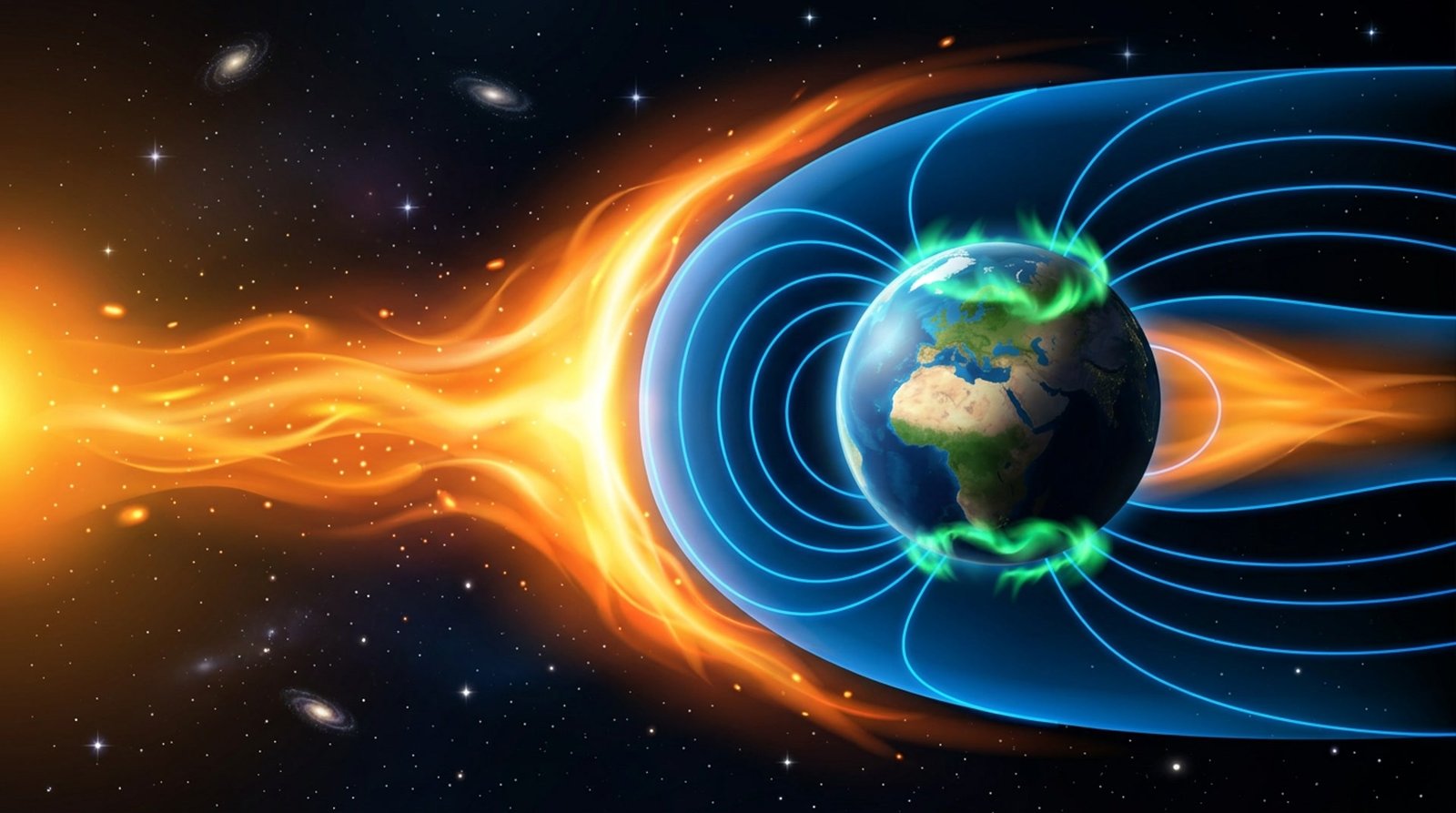
Space Plasma: The Invisible Force Powering Auroras
Summary
By the end of this article, you will understand how invisible clouds of solar plasma crash into Earth’s magnetic shield to create breathtaking auroras and dangerous space weather.
Quick Facts
- Surprise: Space isn't empty—it is packed with 'plasma,' a super-hot gas of electrified particles.
- Surprise: In 1859, a solar storm was so intense it made telegraph wires burst into flames.
- Salient Idea: Auroras are the result of Earth's magnetic tail snapping like a rubber band and firing electrons into our atmosphere.
- Surprise: Planets like Jupiter, Saturn, and even comets have their own magnetospheres and unique space weather.
The Discovery: The Telegraphs That Caught Fire
Before rockets and satellites, scientists didn’t know space weather existed. Then came the Carrington Event of 1859. Astronomer Richard Carrington saw a massive solar flare erupt on the Sun. Just 17 hours later, the Earth was slammed by a geomagnetic storm. It was a Surprise: auroras were seen as far south as the Caribbean, and telegraph systems—the high technology of the day—went completely haywire, sparking fires and shocking operators! This proved that the Sun and Earth are deeply connected by invisible forces. We now know this was caused by a Coronal Mass Ejection (CME)—a massive cloud of electrified gas called plasma, hurled through space.
Original Review Paper: ‘Space Plasma Physics: A Review’ by Tsurutani et al.
One swallow does not make a summer, but Carrington’s flare sparked the largest magnetic storm in 200 years.
— Historical context by Richard Carrington (paraphrased)
The Science Explained Simply
This is NOT the plasma found in your blood! In space physics, plasma is the fourth state of matter. If you heat a gas enough, its atoms break apart into a soup of negatively charged electrons and positively charged ions. Because they have an electrical charge, plasmas are pushed and pulled by magnetic fields. The Sun is basically a giant ball of plasma. It constantly breathes out a ‘solar wind’ that fills the entire solar system. When this solar wind carries a tangled magnetic field that crashes into Earth’s own magnetic bubble (the magnetosphere), the two fields can link up. This process, called magnetic reconnection, acts like a slingshot, releasing massive amounts of stored energy.
The Aurora Connection
When solar wind energy builds up in the long ‘tail’ of Earth’s magnetic field on the night side, the field lines stretch until they break and reconnect. This magnetic slingshot fires high-energy electrons down into Earth’s upper atmosphere. When these electrons smash into oxygen and nitrogen atoms, they glow, creating the beautiful light shows we call auroras! But there is a dark side: this exact same process creates Geomagnetically Induced Currents (GICs). These invisible currents can flow through the ground and blow up power grid transformers, proving that auroras are the beautiful warning signs of dangerous space weather.
Because of the bloody color of SAR arcs, red auroras have been omens for war and bloodshed in ancient times.
— Dr. Bruce T. Tsurutani & Team
A Peek Inside the Research
How do scientists study things they can’t even see? It requires incredible Knowledge and Tools. Today, researchers use fleets of satellites, like the Van Allen Probes and Voyager missions, packed with miniaturized instruments to measure the speed, density, and magnetic direction of plasma in space. They look for ‘whistler mode chorus waves’—electromagnetic waves that sound like chirping birds when converted to audio. By analyzing these waves, scientists can predict how ‘killer electrons’ will behave during a storm, helping us protect the satellites that run our GPS and communication networks.
Measurements of magnetic pulsations can be utilized for geophysical surveys to probe the subsurface conductivity structure of the Earth.
— Space Plasma Researchers
Key Takeaways
- The Sun constantly blows a 'solar wind' of plasma at 1 million mph.
- Coronal Mass Ejections (CMEs) are billion-ton plasma bombs that trigger magnetic storms.
- Magnetic reconnection is the secret engine that powers both auroras and solar flares.
- Space weather can disrupt GPS, satellite orbits, and global power grids.
Sources & Further Reading
Frequently Asked Questions
Q: If a massive solar storm hit today, what would happen?
A: Because we rely heavily on electricity and satellites, a massive storm could cause widespread power blackouts, disable GPS navigation, and disrupt global communications for days or even months.
The Planet Bleeding Iron Into Space
Summary
By the end of this article, you will understand how extreme stellar heat causes giant planets to literally boil their atmospheres away, dragging heavy metals like iron out into space.
Quick Facts
- Surprise: MASCARA-4b is an 'ultra-hot Jupiter' baking at an extreme 2,250 degrees Kelvin
- Salient Idea: The planet's atmosphere is split into two zones: a stable lower layer and a violently escaping upper layer
- Surprise: Heavy metals like ionized iron are found far out in space, dragged there by escaping hydrogen gas
- Surprise: Astronomers can track this 'bleeding' atmosphere by analyzing starlight filtered through the planet's edges
The Discovery: A Planetary Crime Scene
When astronomers aimed the Very Large Telescope at MASCARA-4b, they expected a hot world, but they found a cosmic escape act. Using a technique called high-resolution transmission spectroscopy, they analyzed starlight filtering through the planet’s atmosphere during a transit. They found a Surprise: the signal for ionized iron (Fe II) was massively stronger than physics predicted for a normal, stable atmosphere. This wasn’t just gas sitting in the sky. The extreme heat from its host star was causing a hydrodynamic outflow—a violent boiling effect that drags heavy metals like iron out of the planet’s gravitational grip and into space.
Original Paper: ‘Transmission spectroscopy of the ultra-hot Jupiter MASCARA-4 b’
The absorption strength of Fe II significantly exceeds the prediction from a hydrostatic atmospheric model.
— Dr. Yapeng Zhang
The Science Explained Simply
This is NOT a normal atmosphere like Earth’s. To understand MASCARA-4b, you have to split its sky into two distinct zones. The lower zone is hydrostatic, meaning it behaves like a normal gas being held down by gravity. Here, you find neutral metals like regular iron and magnesium. But the upper zone is an exosphere. Because the planet is so hot, stellar radiation literally boils the hydrogen gas at the very top. As this hydrogen violently escapes into space, it acts like a raging river, dragging ionized iron along with it. The Salient Idea is that the planet isn’t just hot; it is slowly evaporating.
The Aurora Connection
Why does a planet lose its atmosphere? It all comes down to space weather. Earth is bombarded by stellar winds, but our magnetic field catches these charged particles, funneling them to the poles to create glowing auroras. MASCARA-4b, however, is blasted by Extreme Ultraviolet (EUV) radiation so intense it overwhelms the system. Instead of gentle auroras, the stellar energy triggers catastrophic hydrodynamic escape. By studying how MASCARA-4b’s iron and hydrogen are stripped away, scientists learn exactly what happens when a planet lacks the magnetic shielding needed to survive its star’s deadly tantrums.
The dominant outflow drives the positive correlation between the hydrogen and iron absorption, tracing the exospheres of Ultra-Hot Jupiters.
— The Research Team
A Peek Inside the Research
How do you detect iron light-years away? It is NOT by taking a direct picture. It requires a mathematical tool called Cross-Correlation. Every chemical element absorbs specific colors of light, leaving dark lines in a spectrum like a barcode. Because MASCARA-4b’s signal is incredibly faint and buried in the star’s blinding light, scientists use algorithms to stack hundreds of these tiny barcode lines on top of each other. By separating the signals of different atoms, they can map out exactly which elements are sinking in the lower atmosphere, and which ones are flying away in the upper exosphere.
Studying the diverse atomic transmission signatures allows us to disentangle the hydrostatic and the exospheric regime.
— Astrophysics Research Team
Key Takeaways
- Ultra-hot Jupiters lose their atmospheres to space due to extreme stellar radiation
- Neutral metals stay in the stable lower atmosphere, while ionized metals shoot into the upper exosphere
- High-resolution spectroscopy lets us read the distinct chemical fingerprints of these two layers
- Without a strong magnetic shield, planetary atmospheres are vulnerable to violent stellar winds
Sources & Further Reading
Frequently Asked Questions
Q: If the iron is flying into space, will the planet eventually disappear?
A: While MASCARA-4b is losing millions of tons of gas, giant planets are so massive that it would take billions of years to completely evaporate. However, this process dramatically shrinks the planet’s atmosphere over time.
Q: Why is the iron ionized in the upper atmosphere?
A: The intense Extreme Ultraviolet (EUV) radiation from the host star knocks electrons off the iron atoms as they reach the upper atmosphere, turning them from neutral iron into ionized iron.
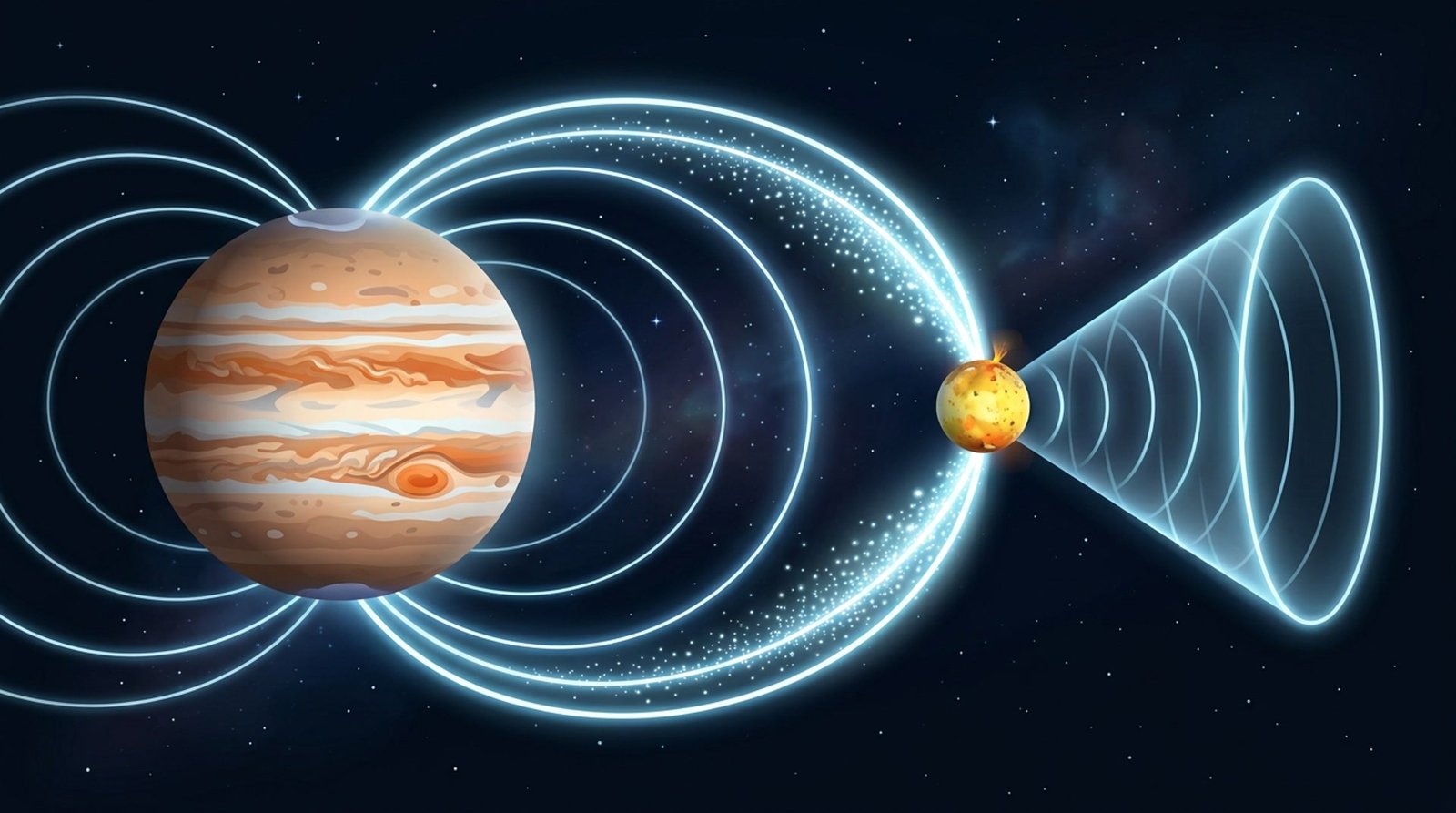
Listening to Jupiter's Auroras: The Moon Radio
Summary
By the end of this article, you will understand how Jupiter’s volcanic moon Io acts like a giant electric generator, creating invisible radio cones and auroras we can measure from Earth.
Quick Facts
- Surprise: Jupiter's moon Io moving through the planet's magnetic field generates a massive electrical current.
- Surprise: This current shoots electrons into Jupiter's atmosphere, creating glowing ultraviolet auroras.
- Salient Idea: These spiraling electrons blast out intense radio waves shaped like huge, hollow cones.
- Surprise: By measuring the exact angle of these invisible radio cones, scientists can calculate how much energy the electrons have.
The Discovery: Solving a Cosmic Mystery
Scientists have known for decades that Jupiter blasts out intense radio signals, but mapping exactly where they come from is incredibly difficult. A team of researchers recently solved this by using the Juno spacecraft, the Hubble Space Telescope, and massive Earth-based radio antennas. They found a Surprise: the radio waves and the glowing ultraviolet spots of Jupiter’s auroras perfectly matched up on the exact same magnetic field lines. By tracking these glowing aurora spots, they could precisely locate the active ‘wires’ connecting Jupiter to its moon Io. This allowed them to measure the exact angle of the radio beams pouring out of Jupiter’s poles, giving us an unprecedented look at how planets and moons interact.
Original Paper: ‘Determining the beaming of Io decametric emissions’
The simultaneous radio and UV observations reveal that multiple radio arcs are associated with multiple UV spots.
— Lamy et al., 2022
The Science Explained Simply
This is NOT just random space static like the crackle of a broken radio. It is a highly structured, laser-like beam called a ‘decametric emission.’ As Io orbits, it drags through Jupiter’s massive magnetic field, acting like an electric generator. It shoots high-energy electrons down magnetic wires toward Jupiter’s poles. As these electrons spiral downward, they blast out radio waves. The Salient Idea here is the shape: the waves are emitted in a thin, hollow cone. By measuring the width of this cone (the ‘beaming angle’, which they found to be between 70 and 80 degrees), scientists can use physics equations to calculate the exact speed and kinetic energy of the electrons driving the storm! It is essentially a cosmic speed-radar.
The Aurora Connection
On Earth, our auroras (the Northern and Southern Lights) are mostly caused by the solar wind crashing into our magnetic field. Jupiter has solar-wind auroras too, but it also features something entirely alien: moon-powered auroras! The massive electrical circuit between Io and Jupiter creates bright, permanent glowing footprints at Jupiter’s poles. Understanding how Io accelerates these electrons helps us decode the physics of auroras everywhere. It shows us how magnetic fields capture energy and create light, offering clues about space weather and how planetary shields might operate in other, far-off solar systems.
The kinetic energy of source electrons is inferred from the emission angle in the framework of the Cyclotron Maser Instability.
— Research Team
A Peek Inside the Research
How do you measure an invisible cone of radio waves from millions of miles away? It comes down to Knowledge and Tools. The researchers didn’t rely on just one instrument. They triangulated the radio cones using three distinct methods: mathematical models of Jupiter’s magnetic field, Hubble telescope pictures of the ultraviolet aurora spots, and simultaneous radio recordings from Earth (like the NenuFAR telescope) and the Juno spacecraft. By combining these viewpoints, they calculated that the electrons had energies between 3 and 16 keV, and discovered that this energy actually changes depending on the altitude of the radio source. It is a masterpiece of cosmic geometry.
Multi-point radio observations probe the sources at various altitudes, times and hemispheres.
— Lamy et al.
Key Takeaways
- The Io-Jupiter system acts as a gigantic natural particle accelerator.
- Radio telescopes on Earth and spacecraft around Jupiter can team up to 'triangulate' these radio beams.
- The angle of the radio beam changes depending on the altitude and the moon's position.
- Studying these radio waves helps us understand how magnetic fields protect planets and generate space weather.
Sources & Further Reading
Frequently Asked Questions
Q: Can we hear these radio waves on Earth?
A: Yes! While we can’t hear them with our ears directly, scientists can convert the radio frequencies into audio files. They often sound like ocean waves crashing or birds chirping!
Q: Why does Io create so much electricity?
A: Io is incredibly volcanic and ejects a ton of particles into space. These particles get trapped in Jupiter’s rapidly spinning magnetic field, creating a massive, conductive plasma ring that generates electrical currents.
The Invisible Ultraviolet Auroras of Comet 67P
Summary
By the end of this article, you will understand how an icy rock hurtling through space generates its own aurora, and how solar wind causes cometary atmospheres to glow in the dark.
Quick Facts
- Surprise: Comets can have auroras even though they have zero magnetic field.
- Salient Idea: The aurora on Comet 67P shines in far-ultraviolet light, which is completely invisible to the human eye.
- Surprise: In the comet's southern hemisphere, the aurora is fueled by carbon dioxide, not water.
- Surprise: The glowing light flares up when high-speed streams of solar wind hit the comet.
The Discovery: Finding Light in the Dark
During the amazing Rosetta mission, scientists pointed the Alice ultraviolet spectrograph at the shadowed, night side of Comet 67P. They expected to see nothing but pitch blackness. Instead, they found a Surprise: the comet was glowing brightly in far-ultraviolet light. Because the comet’s surface was completely in the shadows, this light couldn’t just be a simple reflection of the sun. The team realized they were looking at something spectacular: a true comet aurora. On Earth, we see auroras near the poles, but this glow was scattered all across the comet’s gassy envelope, known as the coma. They had discovered a brand new type of cosmic weather happening right in our solar neighborhood, proving that auroras aren’t just for planets.
Multi-instrument analysis of far-ultraviolet aurora in the southern hemisphere of comet 67P
The FUV emissions are auroral in nature.
— Research Team
The Science Explained Simply
This is NOT like the Northern Lights on Earth. On Earth, a powerful magnetic field funnels charged particles gracefully toward the north and south poles. Comets are completely unmagnetized. When high-speed electrons from the solar wind hit the comet’s gas cloud—which is mostly carbon dioxide in its southern hemisphere—they crash straight in. The Salient Idea here is a process called dissociative excitation. The electron acts like a wrecking ball, hitting the carbon dioxide molecule so hard that it breaks apart. The broken oxygen and carbon fragments are left energized, and to calm down, they release a flash of ultraviolet light. It is a permanent, chaotic crash-zone creating a diffuse bubble of light around the comet.
The Aurora Connection
Earth’s beautiful, ribbon-like Northern Lights are a product of our planet’s magnetic shield. Because Comet 67P lacks this shield, its aurora looks much more like the diffuse auroras found on Mars, where the solar wind slams directly into an unprotected atmosphere. By studying the aurora on Comet 67P, we get a front-row seat to how the solar wind behaves when there are no defenses in place. During events called Corotating Interaction Regions—powerful gusts of solar wind—the comet’s aurora flares up dramatically. It shows us that auroras are the universe’s way of making invisible space weather visible, teaching us about atmospheric survival and planetary protection.
These emissions are driven by electrons which have been accelerated on large scales rather than locally heated.
— Dr. Marina Galand
A Peek Inside the Research
How do we know the solar wind is pulling the trigger? It comes down to incredible Knowledge and Tools. The researchers couldn’t just rely on one camera. They used a multi-instrument analysis to build a complete picture of the comet. While the Alice spectrograph watched the flashes of ultraviolet light, another sensor called RPC/IES was physically counting the exact number and energy of the electrons hitting the comet. Meanwhile, the ROSINA mass spectrometer ‘sniffed’ the local gas to prove carbon dioxide was the main target. By perfectly lining up the spikes in electron counts with the spikes in ultraviolet brightness, the team mathematically proved that the electrons were causing the glow.
The close correlation observed between the FUV auroral brightness and the electron flux allows spectroscopy to be used as a measure of solar wind.
— Lead Researchers
Key Takeaways
- Solar wind electrons act like hammers, breaking apart comet gas to create light.
- Without a magnetic field to guide them, cometary auroras form a diffuse, shapeless glowing bubble.
- Multi-instrument spacecraft analysis is required to match electron spikes to flashes of light.
- Auroras are a universal sign of space weather interacting with planetary atmospheres.
Sources & Further Reading
Frequently Asked Questions
Q: What color is the comet’s aurora?
A: If you were standing next to the comet, you wouldn’t see it! It glows in far-ultraviolet light, a wavelength that is completely invisible to human eyes but easily seen by specialized space cameras.
Q: Why does the aurora behave differently in the southern hemisphere?
A: The comet has distinct seasons and different ice compositions. In the southern hemisphere, the comet outgasses mostly carbon dioxide, whereas the northern hemisphere outgasses mostly water. Different gases create different light patterns when smashed by electrons.

The Volcano Moon: Unlocking Io's Hidden Weather
Summary
By the end of this article, you will understand how scientists track the toxic, salty atmosphere of Jupiter’s most volcanic moon, and why its massive eruptions do not actually change its weather as much as we thought.
Quick Facts
- Surprise: Jupiter's moon Io has a thin atmosphere made mostly of sulfur dioxide and table salt (NaCl)!
- Salient Idea: Most gas from Io's volcanic plumes does not escape to space; it falls right back down to the surface.
- Surprise: Despite having massive, constantly erupting volcanoes, Io's overall atmosphere remains incredibly stable.
- Surprise: Io loses about 1 ton of material per second, which fuels Jupiter's giant magnetic field and auroras.
The Discovery: A Salty, Sulfuric Mystery
In 2016 and 2017, astronomers pointed the NOEMA radio telescope array at Io, Jupiter’s wildly volcanic moon. They were hunting for a Surprise: evidence that sudden volcanic eruptions instantly pump huge amounts of sulfur dioxide and table salt (NaCl) into the atmosphere. They measured the atmosphere on four different dates, tracking the thermal glow of hot spots like the massive volcano Loki Patera. But instead of wild fluctuations, they found something unexpected. The atmosphere was remarkably stable. Even when Loki Patera woke up and got incredibly hot, the amount of salt in the atmosphere did not spike. This forced scientists to rethink how this chaotic moon works.
Original Paper: ‘An attempt to detect transient changes in Io’s SO2 and NaCl atmosphere’
We find a stable NaCl column density in Io’s atmosphere on the four dates.
— Dr. Lorenz Roth
The Science Explained Simply
You might think that a giant volcano erupting would instantly fill the sky with gas. This is NOT how it works on Io. When an Io volcano erupts, the gas shoots up at incredible speeds. However, the Salient Idea here is the ‘canopy shock’. The gas hits the cold vacuum of space, freezes, and falls back to the surface like a toxic snowstorm. It does not easily escape into the upper atmosphere. Instead, Io’s global atmosphere is mostly created by sunlight slowly warming up frozen sulfur on the ground, a process called sublimation. The volcanoes provide the frost, but the sun controls the weather. It is a slow, steady leak, not a sudden explosion.
The Aurora Connection
Io is the main engine for Jupiter’s massive magnetosphere. Every second, a ton of sulfur and oxygen is stripped away from Io’s atmosphere. This material becomes electrified plasma and gets swept up by Jupiter’s magnetic field, ultimately creating Jupiter’s breathtaking polar auroras. Because Io’s atmosphere is the fuel line for these auroras, scientists used to think that a volcanic eruption on Io would cause a sudden, bright flare-up in Jupiter’s northern lights. But since this study proves Io’s atmosphere stays relatively stable, it means the sudden changes we see in Jupiter’s auroras are likely driven by complex magnetic space weather, not just an active volcano.
The mass loss from Io’s atmosphere is the main source of plasma for Jupiter’s huge magnetosphere.
— Research Team
A Peek Inside the Research
How do you measure salt in the air of a moon millions of miles away? The team did not use optical cameras. Instead, they relied on interferometry using the NOEMA radio telescope. They tuned into submillimeter wavelengths, specifically frequencies around 258 GHz, to catch the rotational emissions of sulfur dioxide and NaCl molecules. As these molecules spin in space, they emit specific, faint radio signals. By looking at the ‘line width’ and ‘contrast’ of these signals, the scientists could calculate the exact temperature and density of the gas. It is a brilliant way to take the temperature of a distant world without ever leaving Earth.
By fitting results from an atmosphere model to the extracted emission lines, we derive global abundances.
— Research Team
Key Takeaways
- Radio telescopes on Earth can measure the exact temperature and density of gases on a moon 400 million miles away.
- Volcanic hotspots like Loki Patera can surge in activity without adding extra salt to the global atmosphere.
- Jupiter's spectacular auroras rely on a steady feed of plasma from Io, rather than sudden volcanic bursts.
- Io's atmosphere is mostly sustained by the slow evaporation of sulfur frost, not just direct volcanic outgassing.
Sources & Further Reading
Frequently Asked Questions
Q: Why does Io have so many erupting volcanoes?
A: Jupiter’s massive gravity, along with the gravity of other moons, constantly squeezes and stretches Io. This intense friction heats up the moon’s interior, creating global oceans of churning magma.
Q: Could a human breathe the air on Io?
A: Absolutely not! The atmosphere is incredibly thin, freezing cold, and made of highly toxic sulfur dioxide and vaporized salt. You would need a heavy-duty, pressurized spacesuit to survive.

The 1859 Solar Storm That Set the Sky on Fire
Summary
By the end of this article, you will understand how a massive solar storm in 1859 pushed auroras all the way to the tropics, and how scientists use 160-year-old ship logs to predict future space weather.
Quick Facts
- Surprise: Auroras were seen as far south as Panama and Hawaii, just 20 degrees from the equator.
- Surprise: The auroras were so intensely bright that people thought neighboring cities were engulfed in massive fires.
- Salient Idea: The storm was likely a 'double punch' where a first solar eruption cleared out space debris for the second one.
- Salient Idea: The light from the aurora was equivalent to a full moon, earning an extremely rare Class IV brightness rating.
The Discovery: Decoding the 1859 Skies
In September 1859, the largest geomagnetic storm in recorded history slammed into Earth. But to understand exactly how big the ‘Carrington Event’ was, modern scientists had to become historians. They didn’t just look at old magnetic observatory data; they dug through U.S. Navy ship logs, Mexican newspapers, and ancient Japanese diaries. They found a Surprise: accounts of brilliantly red skies from places near the equator, like Panama and the Caribbean. By piecing together these forgotten records, researchers reconstructed the exact size of the storm. They discovered the auroral oval didn’t just expand; it violently stretched down to latitudes where auroras are practically a myth. This wasn’t just a pretty light show; it was a massive disruption of Earth’s magnetic field.
Low-Latitude Aurorae during the Extreme Space Weather Events in 1859
During the watch to the N & E was seen an aurora borealis, brilliantly red.
— Logbook of the USS Saranac, off the coast of Panama, 1859
The Science Explained Simply
This is NOT your standard solar flare. A normal space weather event sends a cloud of plasma—a Coronal Mass Ejection (CME)—toward Earth, where it gets slowed down by the gases in interplanetary space. But the Carrington Event was different. The Salient Idea here is the ‘snowplow’ effect. The Sun released an initial CME that acted like a cosmic snowplow, sweeping all the resistance out of the way. When a second, highly-charged CME erupted days later, it had a perfectly clear highway to Earth. It hit our magnetic field with zero deceleration. This extreme impact compressed Earth’s magnetic shield, allowing highly energetic particles to dive deep into our atmosphere and trigger blood-red auroras in the tropics.
The Aurora Connection
While the 1859 auroras were a beautiful, terrifying spectacle, they reveal a critical vulnerability in our modern world. Auroras are the visible footprint of Earth’s magnetic field interacting with solar wind. When auroras are pushed to the equator, it means our magnetic shield is under severe stress. During the Carrington storm, this magnetic chaos caused telegraph wires to spark and catch fire. If a ‘snowplow’ CME of this magnitude hit us today, it wouldn’t just give us tropical Northern Lights; it could melt down the global electrical grid. Studying these historical auroras helps us measure the true limits of Earth’s magnetic shield.
Extreme worlds teach us about planetary survival, and extreme historical events teach us how to protect our future.
— NorthernLightsIceland.com Team
A Peek Inside the Research
How do researchers know exactly where the aurora was 160 years ago? It comes down to clever geometry. They didn’t just log where the observer was standing; they looked for clues about the aurora’s elevation angle—how high it appeared in the sky. If a sailor in the Caribbean reported the red light ‘rising to the zenith’ (straight overhead), scientists could use trigonometry to calculate the storm’s true equatorward boundary. By assuming the aurora topped out around 400 kilometers in altitude, they mapped the exact footprint of the event. It is a brilliant example of using historical storytelling to generate hard, quantifiable physics data.
fiery light shone in the heaven and fiery light was seen for whole night until the dawn.
— Chikusai Nikki (Historical Diary, Japan, 1859)
Key Takeaways
- Historical diaries and naval ship logs contain hidden, highly valuable data for modern astrophysics.
- Calculating the 'elevation angle' of historical sightings reveals exactly how far the aurora reached in the atmosphere.
- The 'snowplow' effect happens when an initial coronal mass ejection (CME) clears a frictionless path for a follow-up CME.
- Not all red night-sky glows are normal auroras; some are Stable Auroral Red (SAR) arcs caused by heated electrons in Earth's inner magnetic field.
Sources & Further Reading
Frequently Asked Questions
Q: Why were the 1859 auroras mostly red instead of the usual green?
A: Red auroras occur much higher in the atmosphere than green ones and require lower-energy electrons. However, some of these 1859 sightings might actually have been Stable Auroral Red (SAR) arcs, which happen when Earth’s inner magnetic ring current heats up dramatically.
Q: Could a Carrington Event happen again today?
A: Yes. The Sun operates on cycles, and extreme Coronal Mass Ejections happen periodically. In fact, a similar ‘snowplow’ solar storm narrowly missed Earth in 2012.

The 1872 Storm That Set the Sky on Fire
Summary
By the end of this article, you will understand how ancient diaries and historical records uncovered a massive solar storm that rivaled the famous Carrington Event, and why this poses a hidden threat to our modern technology.
Quick Facts
- Surprise: The aurora was so bright in Japan that people could count trees in the mountains at midnight.
- Surprise: Observers thought the bright red skies were massive city-wide fires in neighboring towns.
- Salient Idea: The aurora was seen incredibly close to the equator, including in Bombay, India and Shanghai, China.
- Surprise: A Chinese observer recorded a massive sunspot with their naked eye, describing it as a 'crow in the sun'.
The Discovery: Decoding Ancient Diaries
For decades, scientists believed the ‘Carrington Event’ of 1859 was the undisputed king of solar storms. But researchers recently dug into 48 historical documents from China, Japan, and Korea from February 1872. They weren’t just reading history; they were tracking space weather. They found a Surprise: accounts of intense, fiery red skies that sent people into a panic. In Japan, some people rumored that Kyoto and Nagoya were entirely in conflagration—meaning they thought the cities were burning down! By mapping these diary entries, scientists realized the aurora had stretched incredibly far south, meaning the solar storm that caused it was an absolute monster.
Original Paper: ‘The Great Space Weather Event during February 1872 Recorded in East Asia’
Three bands of red vapor appeared in the western sky. Some rumored Nagoya was in conflagration.
— Tanaka Nagane, 1911 (from 1872 historical interviews)
The Science Explained Simply
This is NOT just a story about a colorful sky. A geomagnetic storm happens when the Sun spits out a massive cloud of charged particles, called a Coronal Mass Ejection, which slams into Earth’s magnetic field. The Salient Idea here is magnetic displacement. When a storm is this strong, it warps our magnetic field so violently that high-intensity, low-energy electrons are dumped into our atmosphere much closer to the equator than normal. In 1872, the magnetic disturbance was measured at roughly -830 nT in Bombay. For context, that is a catastrophic level of magnetic interference that would melt modern power grids.
The Aurora Connection
Normally, Earth’s magnetic field funnels solar particles to the North and South poles, creating the standard auroras we know and love. But the 1872 storm was so violent it pushed the auroral oval down to 18.7 degrees magnetic latitude. That means auroras were visible directly overhead in places like Shanghai! When you see an aurora creeping toward the equator, it is a visual warning that our planet’s magnetic shield is being pushed to its absolute limits by the stellar wind.
The bright arc extended almost for 50 degrees very close to the Zenith.
— Italian Consulate in Shanghai, 1872
A Peek Inside the Research
How do we prove a storm from 150 years ago was real? It comes down to cross-referencing. The researchers didn’t just trust the diaries. They took the exact times recorded in the Asian texts and compared them to ground magnetic field recordings taken by an observatory in Colaba, Bombay, during the exact same hours in 1872. The sudden drop in the magnetic field in Bombay lined up perfectly with the intense red skies seen in Japan and China. It is a brilliant triumph of combining humanities (history) with hard physics.
The aurora recorded in China and Japan approximately corresponds to the initial phase, main phase, and the early recovery phase of the magnetic storm.
— Hayakawa et al.
Key Takeaways
- The 1872 storm rivals or even surpasses the famous 1859 Carrington Event in strength.
- Historical records like diaries and local treaties are crucial scientific data for space weather.
- Massive solar storms might happen more frequently than we previously thought.
- Understanding past extreme events helps us protect modern power grids and satellites.
Sources & Further Reading
Frequently Asked Questions
Q: Why do we care about a solar storm that happened in 1872?
A: Because it proves that Carrington-level extreme solar storms happen more frequently than we thought. If a storm of that magnitude hit today, it could destroy satellites, internet cables, and global power grids.
Q: Why did people think the aurora was a fire?
A: Auroras caused by extreme space weather are often deep red. Before people understood the science of the Northern Lights, a glowing red horizon looked exactly like the glow of a massive city-wide fire.
The Mystery of Saturn's Missing X-Ray Auroras
Summary
By the end of this article, you will understand why Saturn’s atmosphere acts as a giant mirror, why its rings glow, and why its auroras are completely invisible to our best X-ray telescopes.
Quick Facts
- Surprise: Saturn's atmosphere acts like a massive mirror, reflecting X-rays from the Sun
- Salient Idea: The brightness of Saturn's X-rays fades and brightens with the 11-year solar cycle
- Surprise: Saturn's icy rings glow with their own unique oxygen X-ray light, possibly triggered by massive lightning storms
- Surprise: Unlike Earth and Jupiter, Saturn has completely invisible X-ray auroras
The Discovery: The Missing Polar Lights
Between 2002 and 2005, scientists pointed two massive space telescopes, Chandra and XMM-Newton, at Saturn. They were looking for powerful X-ray auroras, much like the intense light storms we see on Jupiter and Earth. But they found a Surprise: the poles were completely dark. Instead, they discovered that Saturn’s main disk was glowing in X-rays, and its iconic rings were emitting a specific ‘oxygen line’ of X-ray energy. The Salient Idea here is that Saturn does not generate its own massive X-ray storms like Jupiter. Instead, its atmosphere acts as a giant mirror, simply scattering the X-rays that travel all the way from the Sun. As the Sun’s X-ray output dipped over the years, Saturn’s X-ray glow dimmed right along with it.
Original Paper: ‘X-rays from Saturn: A study with XMM-Newton and Chandra’
Unlike Jupiter and Earth, we do not find evidence for X-ray aurorae on Saturn.
— Dr. Graziella Branduardi-Raymont
The Science Explained Simply
This is NOT like the auroras on Earth, where our magnetic field actively crashes solar particles into our atmosphere to generate light. On Saturn, the planet is passively reflecting the Sun’s X-rays. Think of it like shining a flashlight at a disco ball. The ball doesn’t make the light; it just bounces it back. Because the brightness of Saturn’s disk perfectly matches the Sun’s 11-year activity cycle, scientists know the X-rays are just bouncing off the upper atmosphere. However, the rings are a different story. The X-rays coming from the icy rings don’t perfectly match the Sun’s cycle. Scientists suspect this ring glow might be caused by giant lightning storms shooting electron beams into the ice!
The Aurora Connection
So why doesn’t Saturn have X-ray auroras like Earth or Jupiter? It all comes down to the magnetic field and the solar wind. Jupiter has a monstrous magnetic field filled with dense volcanic gas from its moon Io. When energetic particles get trapped there, they create blinding X-ray auroras. Saturn, however, has a magnetic field 20 times weaker than Jupiter’s, and much less gas floating around its magnetosphere. The auroras likely *are* happening, but they are thousands of times too faint for our current telescopes to see. It teaches us that having a magnetic field isn’t enough; you need the right cosmic ingredients to ignite a visible space weather storm.
Saturnian X-ray aurorae are likely to have gone undetected because they are below the sensitivity threshold of current Earth-bound observatories.
— The Research Team
A Peek Inside the Research
How do astronomers know where X-rays come from when Saturn is almost a billion miles away? They use spectroscopy. By breaking down the invisible X-ray light into a spectrum, they found a distinct ‘oxygen’ signature coming specifically from the rings, and a ‘coronal’ signature matching the Sun coming from the planet’s disk. It requires incredible patience. They had to observe the planet over three years to track how the X-rays faded exactly when the Sun’s X-ray output dipped. It is a triumph of long-term observation, proving that the solar system is deeply connected by the invisible solar wind.
We approach the study of Saturn and its environment in a novel way using X-ray data.
— The Research Team
Key Takeaways
- Planets can emit X-rays in two ways: reflecting solar rays or generating their own through auroras
- A planet needs a highly dense magnetosphere to produce easily visible X-ray auroras
- Jupiter's magnetic field is 20 times stronger than Saturn's, explaining the difference in their light shows
- Current Earth-bound telescopes are not powerful enough to see Saturn's faint polar X-rays
Sources & Further Reading
Frequently Asked Questions
Q: Will we ever be able to see Saturn’s X-ray auroras?
A: Yes, but likely not from Earth! Scientists believe we will need to send a dedicated X-ray telescope on a spacecraft directly to the Saturnian system to finally see these incredibly faint light shows.
Q: Why do Saturn’s rings glow in X-rays?
A: Scientists think it might be ‘fluorescence’ caused by the Sun hitting the icy rings, or possibly giant lightning storms called ‘spokes’ shooting electron beams into the ice.
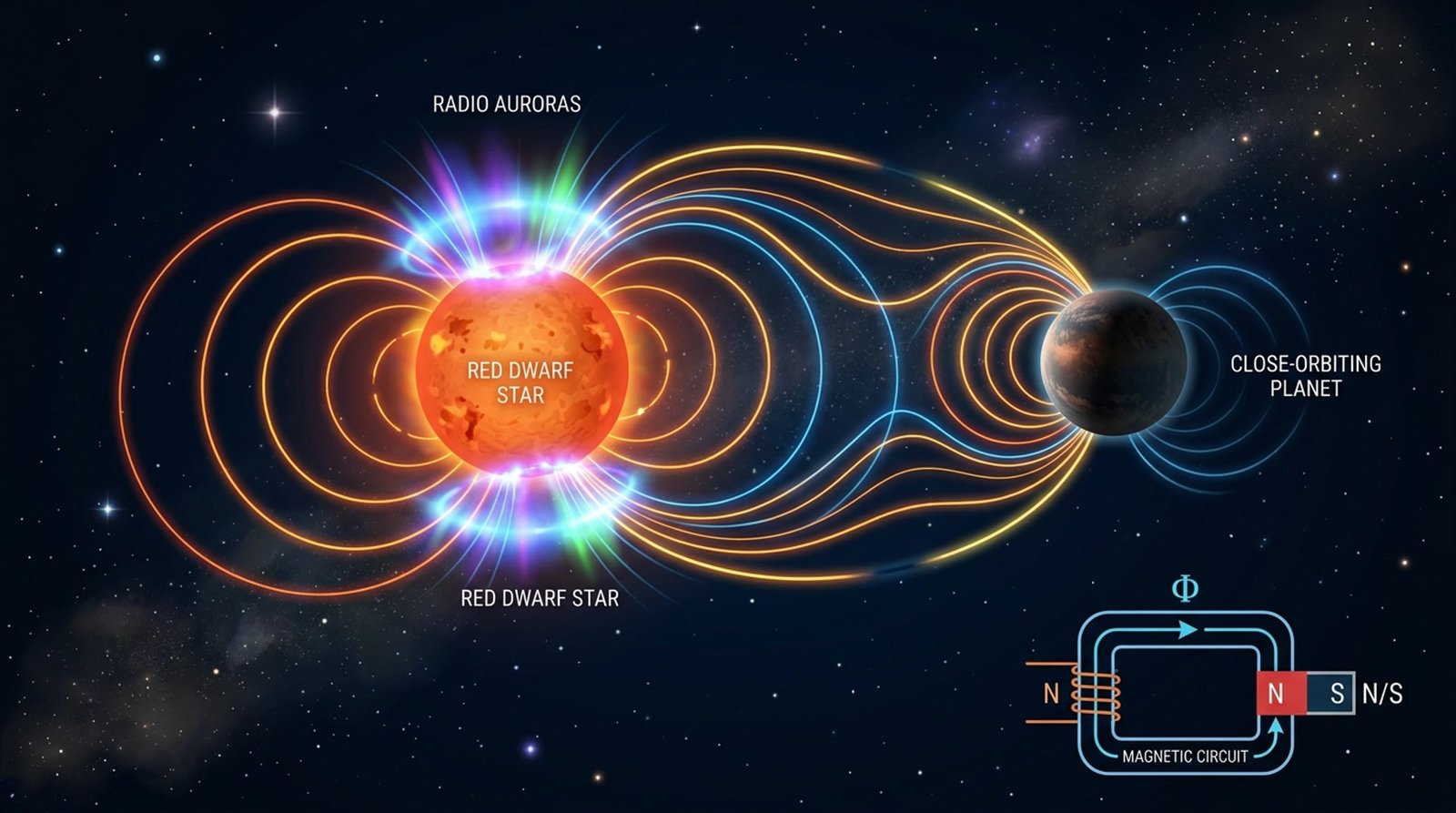
The Star with Auroras Sparked by a Hidden Planet
Summary
By the end of this article, you will understand how an invisible planet can act like a giant electric generator, sparking massive radio auroras on its host star.
Quick Facts
- Surprise: The star GJ 1151 is perfectly 'quiet' and inactive, yet it blasts out intense radio waves.
- Salient Idea: The radio waves are actually massive auroras happening on the star itself.
- Surprise: The auroras are powered by an invisible, Earth-sized planet orbiting the star in just 1 to 5 days.
- Surprise: We see this exact same phenomenon in our solar system between Jupiter and its volcanic moon, Io.
The Discovery: A Screaming Quiet Star
When astronomers look for radio waves in space, they usually point their telescopes at violent, active ‘flare stars.’ But when using the LOFAR radio telescope network, a team stumbled upon a Surprise: a perfectly quiet, inactive red dwarf star named GJ 1151 was blasting out a continuous, eight-hour-long radio signal. This made no sense. The star had no sunspots, no X-ray flares, and rotated incredibly slowly. It was a cosmic paradox. By analyzing the light, the team realized they were looking at an aurora, much like the Northern Lights. But a quiet star cannot generate auroras on its own. The Salient Idea emerged: the auroras were being sparked from the outside. An invisible, Earth-sized exoplanet orbiting extremely close to the star was acting as an electrical trigger.
Coherent radio emission from a quiescent red dwarf indicative of star-planet interaction
The characteristics of the emission are similar to those of planetary auroral emissions, suggesting a coronal structure dominated by a global magnetosphere.
— Dr. H. K. Vedantham
The Science Explained Simply
This is NOT a solar flare. Solar flares happen when a star’s magnetic fields get tangled and explode outward. This phenomenon, called a sub-Alfvénic interaction, is completely different. Imagine the star’s magnetic field as a web of invisible strings. As the Earth-sized planet orbits, it physically plows through these strings. Because the planet is moving so fast, it acts like the spinning rotor inside an electric generator. It creates millions of volts of electricity. This massive current of electrons gets funneled down the magnetic ‘strings’ straight into the star’s north and south poles. When the electrons crash into the star’s atmosphere, they release energy as radio waves. It is a permanent, one-way electrical circuit bridging millions of miles of empty space.
The Aurora Connection
To understand this alien solar system, we just have to look at our own. Jupiter has an incredibly powerful magnetic field, and its moon Io orbits right inside it. As Io moves, it generates an electrical current that travels down into Jupiter’s atmosphere, creating permanent, glowing auroras at Jupiter’s poles. The GJ 1151 system is doing the exact same thing, just scaled up to planetary and stellar sizes! Instead of a planet and a moon, it is a star and a planet. This teaches us that magnetic interactions are a universal rule of physics, operating across vast ranges of mass and scale, from terrestrial planets all the way up to main-sequence stars.
Our results show that large-scale currents that power radio aurorae operate over a vast range of mass and atmospheric composition.
— LOFAR Research Team
A Peek Inside the Research
How do we know it is an aurora and not just a hot burst of plasma? The secret is in circular polarization. When electrons spiral down a magnetic field line, they shoot out radio waves that twist in a specific corkscrew pattern. When the team looked at the LOFAR data, they saw the signal was 64% circularly polarized. Regular heat flares do not twist like that. Furthermore, the math proved that the star’s rotation was far too slow to generate this energy on its own. By eliminating the impossible, they proved the existence of the hidden planet. This marks a massive leap forward: scientists can now use low-frequency radio arrays to hunt for Earth-like planets around red dwarfs just by listening to the magnetic songs they sing.
Based on the positional co-incidence, transient nature, and high circularly polarised fraction, we conclusively associate the radio source with GJ 1151.
— Dr. J. R. Callingham
Key Takeaways
- Magnetic fields can physically link a star and a planet into a giant electrical circuit.
- Planets moving through strong magnetic fields generate massive currents of electrons.
- Highly polarized radio waves are the ultimate fingerprint for finding space auroras.
- Radio telescopes can now be used as a brand new tool to discover hidden exoplanets.
Sources & Further Reading
Frequently Asked Questions
Q: Why didn’t scientists just look at the planet through a telescope?
A: Exoplanets are incredibly small and faint compared to the blinding light of their host stars. We almost never see them directly; instead, we have to look for the gravitational or magnetic effects they have on their stars.
Q: Could this magnetic circuit happen to Earth?
A: No. Earth orbits too far away from the Sun, and the Sun’s stellar wind is too strong. This specific ‘sub-Alfvénic’ interaction requires a planet to be orbiting extremely close to a star with a specific type of magnetic field.
The Cosmic Pulse: How Giant Planets Control Earth's Climate
Summary
By the end of this article, you will understand how the slow, rhythmic dance of Jupiter, Saturn, Uranus, and Neptune acts as a giant magnetic pump, changing Earth’s climate and controlling the cosmic rays that hit our atmosphere.
Quick Facts
- Surprise: Cosmic rays from deep space constantly collide with our atmosphere to create radioactive Carbon-14
- Surprise: The entire solar system 'wobbles' and pulses based on the gravitational pull of Jupiter, Saturn, Uranus, and Neptune
- Salient Idea: These four giant planets sync up in a grand repeating pattern exactly every 2,318 years
- Surprise: This orbital dance physically expands and contracts the Sun's magnetic shield, ultimately altering Earth's weather
The Discovery: Solving an Ancient Climate Mystery
For decades, scientists studying ancient tree rings and ice cores noticed a mysterious pattern. Every 2,100 to 2,500 years, Earth experienced significant cooling periods, along with spikes in Carbon-14. They called this the Hallstatt cycle, but its origin remained unknown. Then, a team of researchers looked beyond Earth, out to the solar system’s center of mass. They discovered a Surprise: a mathematical resonance between the orbits of the four giant planets (Jupiter, Saturn, Uranus, and Neptune) creates a repeating gravitational pattern every 2,318 years. This massive planetary dance perfectly aligns with Earth’s ancient climate records, solving a multi-millennial puzzle.
The rhythmic contraction and expansion of the solar system… appear to work as a gravitational/electromagnetic pump.
— Dr. Nicola Scafetta and team
The Science Explained Simply
This is NOT astrology where planets magically influence your mood. This is pure orbital mechanics and astrophysics. As the giant planets orbit, their combined gravity pulls on the Sun, causing the entire solar system to ‘wobble’ around its center of mass. The Salient Idea here is the ‘breathing’ effect. When the planets align in a certain way, the solar system’s orbital footprint expands rapidly and contracts slowly. This physical motion changes the shape and strength of the heliosphere (our Sun’s protective magnetic bubble). Just like a pump, this breathing squishes and stretches the solar wind, deciding exactly how many high-energy cosmic rays are allowed to reach Earth to form clouds and alter our climate.
The Aurora Connection
The very same forces that create the Northern Lights in Iceland are at the heart of this 2,318-year cycle. Auroras occur when the solar wind interacts with Earth’s magnetic field. On a much grander scale, the Sun’s solar wind creates a massive magnetic shield called the heliosphere, which protects the entire solar system from deadly interstellar cosmic rays. When the giant planets alter the Sun’s movement, they change the intensity of this solar wind. Understanding this cycle helps us realize that our beautiful auroras are just the visible sparks of a massive, ancient magnetic defense system keeping our planet habitable.
The imploding-exploding dynamics revealed in our record could easily modulate the solar wind termination shock surface and, therefore, modulate the incoming cosmic ray flux.
— The Researchers
A Peek Inside the Research
How do we prove this planetary pulse exists? It comes down to incredible data and spectral analysis. The researchers didn’t just guess; they used NASA’s highly precise ephemeris data to track the exact gravitational pull of every planet going back 15,000 years. By calculating the Planetary Mass Center (the true balancing point of the solar system), they graphed its shifting eccentricity over millennia. The math revealed undeniable, sharp spikes at 159, 171, 185, and exactly 2,318 years. When they overlaid this gravitational graph with Earth’s Carbon-14 records, the peaks and valleys matched beautifully.
Since this resonance is perfectly coherent to the Hallstatt oscillation… this is unlikely a coincidence.
— The Research Team
Key Takeaways
- The 'Hallstatt cycle' is a 2,100 to 2,500-year climate pattern found in ancient ice cores and tree rings
- The orbital resonance of the gas giants acts like a massive pump for the solar wind
- When the solar system 'expands,' fewer cosmic rays hit Earth; when it 'contracts,' more cosmic rays get in
- Cosmic rays and space dust controlled by this cycle help form clouds, directly affecting Earth's long-term climate
Sources & Further Reading
Frequently Asked Questions
Q: How do cosmic rays actually change the weather?
A: When high-energy cosmic rays hit our atmosphere, they create tiny electrically charged particles. These particles act as ‘seeds’ that attract water vapor, helping to form dense clouds which reflect sunlight and cool the Earth.
Q: What is ‘orbital resonance’?
A: Orbital resonance happens when orbiting bodies exert a regular, periodic gravitational influence on each other because their orbital periods are related by a ratio of small integers. It is like a synchronized cosmic dance.
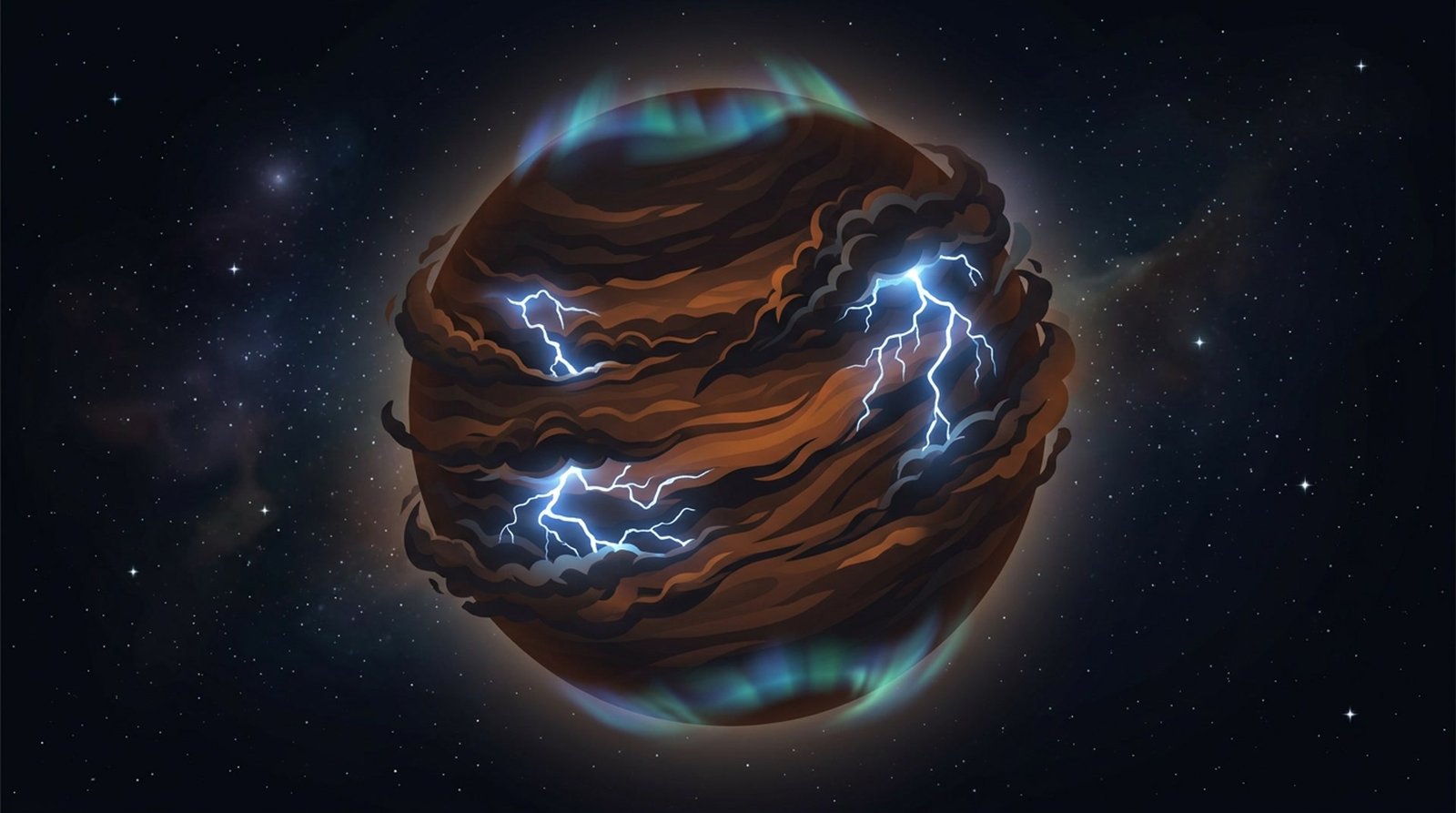
Sparking Clouds & Alien Auroras on Brown Dwarfs
Summary
By the end of this article, you will understand how alien planets grow clouds made of rock, and how cosmic rays trigger massive electrical storms and extraterrestrial auroras.
Quick Facts
- Surprise: Clouds on brown dwarfs are not made of water, they are made of vaporized rock and metal like iron and magnesium.
- Salient Idea: Cosmic rays from deep space crash into these alien atmospheres, creating massive 'air showers' of electricity.
- Surprise: If a rock cloud particle absorbs too many electrons, it violently explodes! Scientists call this a 'Coulomb explosion'.
- Surprise: Supersonic winds blowing through magnetic fields can act like giant generators, ripping electrons away from atoms.
The Discovery: Clouds of Sparking Rock
When we look at ultra-cool stars known as brown dwarfs and giant gas exoplanets, we see a Surprise: their clouds are not made of water. They are packed with vaporized minerals like iron and silicon. But the real discovery is how these alien clouds interact with electricity. Researchers wanted to know what happens when these mineral clouds are bombarded by cosmic rays or extreme winds. Using 3D computer simulations, they modeled how particles from deep space crash into the atmosphere, creating cascades of energy called air showers. They found that these alien clouds can build up massive amounts of static electricity. If a tiny dust grain gathers too many electrons, it will literally blow itself apart in a Coulomb explosion. It is an environment where the weather isn’t just stormy; it is electrically explosive.
Ionisation and discharge in cloud-forming atmospheres of brown dwarfs and extrasolar planets
Given a certain degree of thermal ionisation… cloud particles are destroyed electrostatically in regions with strong gas ionisation.
— Dr. Christiane Helling
The Science Explained Simply
Let’s be clear: this is NOT like a normal lightning storm on Earth. On our planet, ice and water rub together to create static electricity. On a brown dwarf, supersonic winds push rocky dust through strong magnetic fields, ripping electrons right off the gas in a process called Alfvén ionization. The Salient Idea here is the concept of a Coulomb explosion. Imagine a tiny grain of sand floating in this atmosphere. As it gets bombarded by free electrons, it gains a stronger and stronger negative charge. Eventually, the negative charges repel each other so violently that they overcome the physical strength of the rock itself. The particle shatters! This local destruction of cloud particles creates actual holes in the thick cloud cover.
The Aurora Connection
How does this connect to auroras? Just like Earth, brown dwarfs have magnetic fields. But a brown dwarf’s magnetic field can be thousands of times stronger! On Earth, the solar wind hits our magnetic shield and funnels down to the poles, lighting up the sky. On these alien worlds, the massive pool of free electrons created by cosmic rays and magnetic winds gets trapped. These trapped, spiraling electrons emit powerful radio waves and could generate spectacular extraterrestrial auroras. The same physics that paints the sky green over Iceland is responsible for generating brilliant, glowing displays across the galaxy on planets that do not even have a true sun to orbit!
Combined with a strong magnetic field… a chromosphere and aurorae might form as suggested by radio and X-ray observations.
— Helling et al. Research Team
A Peek Inside the Research
How do we study storms light-years away? We cannot send a weather balloon. Instead, the team relied on a 3D Monte Carlo radiative transfer code. They injected a simulated cosmic ray with a massive 10^20 electron-volts of energy into a virtual Jupiter-like atmosphere. The computer then tracked over a million secondary particles as they crashed and split, tracing their paths in three dimensions. By combining this with a specialized atmosphere model called DRIFT-PHOENIX, they could calculate exactly how many electrons would stick to a single piece of mineral dust. It is a masterful blend of quantum physics, fluid dynamics, and supercomputing.
Key Takeaways
- Alien clouds are formed by condensing minerals and they can hold massive electrical charges.
- Cosmic rays and stellar winds inject free electrons into the atmosphere, creating plasma.
- A 'Coulomb explosion' happens when electrostatic repulsion overcomes a particle's physical strength.
- Intense ionization can destroy patches of clouds, creating 'holes' that look like star spots from Earth.
Sources & Further Reading
Frequently Asked Questions
Q: What exactly is a brown dwarf?
A: It is often called a ‘failed star.’ It is an object larger than a giant planet like Jupiter, but not quite massive enough to ignite full nuclear fusion in its core like our Sun.
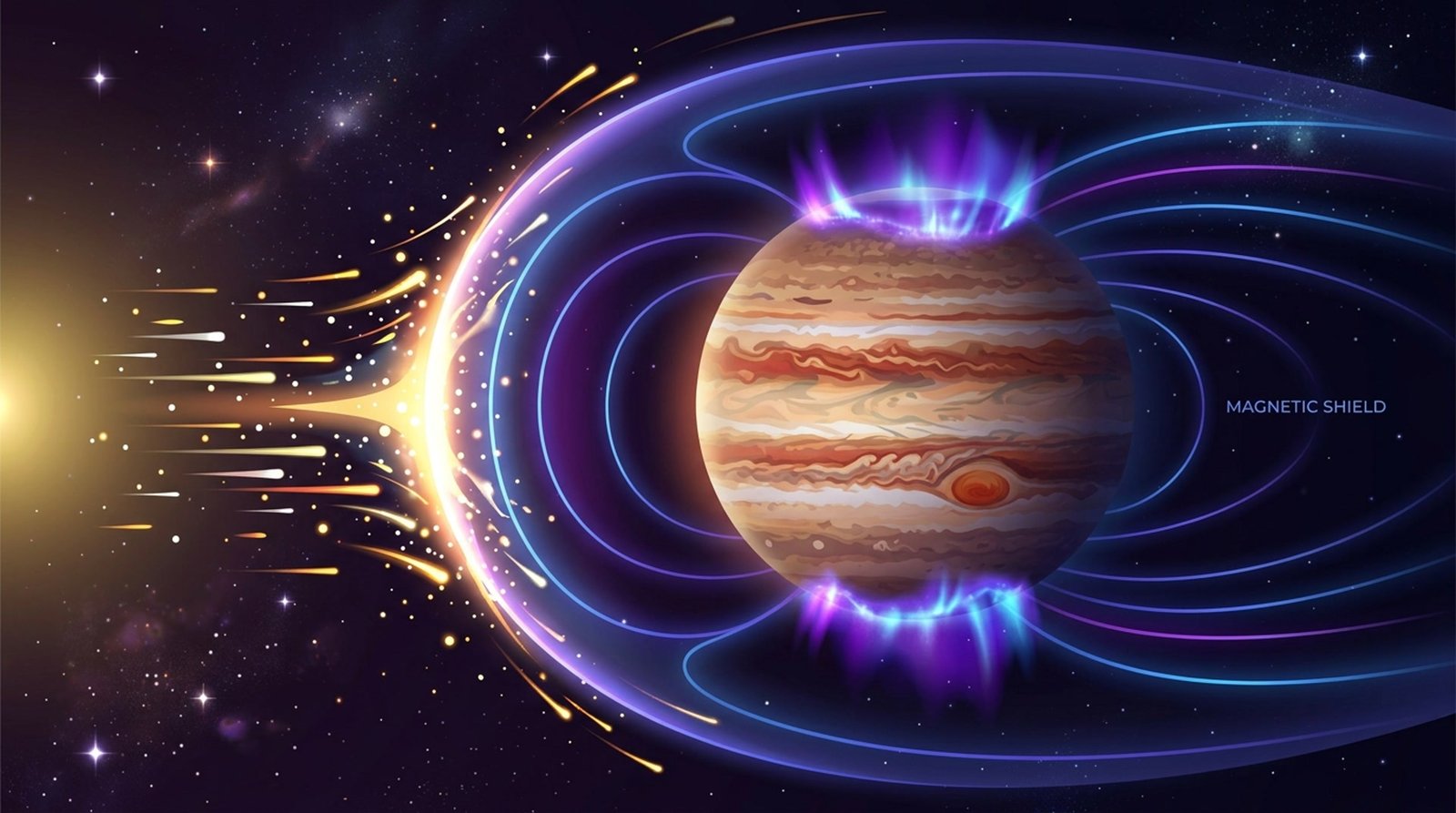
Jupiter's Auroral Engine: Supercharging the Giant
Summary
By the end of this article, you will understand how a sudden blast of solar wind can reverse Jupiter’s electrical currents, superheating its atmosphere and triggering the most powerful auroras in the solar system.
Quick Facts
- Surprise: A sudden solar wind shock can make Jupiter's auroras 4.5 times brighter in a matter of hours.
- Salient Idea: Unlike Earth, Jupiter's auroras are mostly powered by its own fast rotation, not just the Sun.
- Surprise: When compressed, the electrical currents between Jupiter's atmosphere and space actually run in reverse!
- Surprise: The solar storm dumps up to 2,000 Terawatts of power into Jupiter's upper atmosphere.
The Discovery: A 2,000 Terawatt Shock
In 2013, researchers modeled what happens when a violent burst of solar wind—like a Coronal Mass Ejection—slams into Jupiter. They didn’t just look at the magnetic field; they modeled the thermosphere, the upper layer of Jupiter’s atmosphere. They found a Surprise: when the solar wind compresses Jupiter’s massive magnetic shield, the electrical currents connecting space to the planet literally run in reverse. This injects a mind-bending 2,000 Terawatts of power into the atmosphere, triggering intense frictional heating and causing the planet’s auroras to flare up to 4.5 times their normal brightness.
Original Paper: ‘Response of the Jovian thermosphere to a transient pulse in solar wind pressure’
Transient compressions cause the reversal, with respect to steady state, of magnetosphere-ionosphere coupling currents…
— J. N. Yates et al.
The Science Explained Simply
This is NOT like wind blowing away smoke on Earth. Jupiter’s upper atmosphere acts like a massive, heavy flywheel. Because it is so massive, it has incredible inertia. When the solar wind suddenly crushes the magnetic field, the magnetic plasma spins up incredibly fast. But the heavy neutral atmosphere drags behind. This difference in speed creates massive friction, known as Joule heating. The Salient Idea is that this friction acts like a giant brake pad, transferring immense heat and energy from space directly into the planet’s sky, raising local temperatures by up to 175 degrees Kelvin.
The Aurora Connection
Earth’s auroras are directly powered by the solar wind hitting our magnetic field. Jupiter’s auroras, however, are mostly powered by the planet’s own insanely fast 10-hour rotation. But the solar wind still plays a crucial role. When a solar wind pulse hits, it acts as an amplifier. The sudden compression forces electrons down into the polar regions at terrifying speeds. This creates an ultraviolet light show 4.5 times brighter than normal. Studying this helps us understand how space weather interacts with magnetic shields, teaching us how atmospheres on Earth and other planets survive intense stellar radiation.
Extreme worlds teach us about planetary survival.
— NorthernLightsIceland.com Team
A Peek Inside the Research
How do you measure a storm on a planet 400 million miles away? You build a digital universe. The team used a Global Circulation Model (GCM) called ‘JASMIN’ to simulate Jupiter’s thermosphere. Instead of assuming the atmosphere instantly reacted to magnetic changes, they let the math simulate the delay. They mapped the flow of electrical currents, tracking how angular momentum transferred between the magnetosphere and the planet. It is a brilliant example of using complex fluid dynamics to predict phenomena we can eventually look for with space telescopes like Hubble.
We present the first study to investigate the response of the Jovian thermosphere to transient variations in solar wind dynamic pressure…
— The Research Team
Key Takeaways
- Solar wind compressions act like a giant switch, reversing energy flow into Jupiter's atmosphere.
- Jupiter's upper atmosphere acts like a massive flywheel, taking a long time to adjust to sudden magnetic changes.
- Joule heating (electrical friction) doubles during these solar storms, creating massive local temperature spikes.
- Understanding Jupiter's extreme space weather helps us model magnetic fields and atmospheric survival across the universe.
Sources & Further Reading
Frequently Asked Questions
Q: What happens when the solar wind expands instead of compresses?
A: The opposite happens! The atmosphere cools down slightly, and the auroral brightness drops, causing the planet to lose energy back into space as the system expands.

X-Ray Vision on Mars: How Rovers 'See' Underground
Summary
By the end of this article, you will understand how a Mars rover uses ground-penetrating radar to hunt for buried water, and how scientists use computer simulations to fix blurry data caused by a bumpy Martian ride.
Quick Facts
- Surprise: The ExoMars rover is designed to drill 2 meters underground to search for signs of life.
- Salient Idea: It uses a special radar called WISDOM that acts like an underground echo-locator.
- Surprise: If the rover drives over a bump and tilts even 13%, the radar signal gets badly distorted.
- Surprise: Scientists build virtual computer models of Martian dirt to test the radar before it even launches.
The Discovery: The Bumpy Ride Problem
To find traces of life on Mars, the European Space Agency’s ExoMars mission relies on the WISDOM radar. This instrument is designed to probe up to 2 meters beneath the Martian surface. However, researchers discovered a major Surprise: the data gets messy when the rover moves. As the rover drives over the uneven Martian topography, the angle of its radar antenna changes. The French research team realized that if the rover tilts by just 13 to 25 percent, the radar signal is thrown off by more than 2 decibels—enough to completely blur our picture of the underground. To solve this, they didn’t redesign the rover; they built a mathematical model to understand and correct the distortion.
Original Paper: ‘ETUDE DES SIGNAUX RECUEILLIS PAR UN RADAR EMBARQUE SUR UN VEHICULE EN DEPLACEMENT’
A correction of the incidence angle or a correction of the measurements could thus be considered.
— F. Demontoux and Team
The Science Explained Simply
This is NOT an optical camera that takes pictures of underground rocks. Ground-penetrating radar works more like a bat’s echolocation, but with light. The radar shoots high-frequency radio waves (between 500 MHz and 3 GHz) into the ground. When these waves hit different layers—like moving from dry dust to wet basalt—they bounce back. The Salient Idea here is that the echo depends entirely on the angle of the bounce. If the rover’s wheels are tilted on a rock, the ‘echo’ comes back crooked. By creating a parametric computer model using a software called HFSS, scientists can simulate exactly how the radio waves scatter when the terrain changes, allowing them to reverse-engineer a clear image from a crooked echo.
The Aurora Connection
Why are we looking underground in the first place? It all comes back to magnetic fields. Earth has a strong, active magnetic field that creates beautiful phenomena like auroras and protects our atmosphere from the harsh solar wind. Mars, however, lost its magnetic shield billions of years ago. Without it, the surface was bombarded by radiation, turning it into a sterile desert. If life—or liquid water—still exists on Mars, it had to hide deep underground. Understanding how to perfect subsurface radar allows us to explore the hidden safe havens on planets that lost their magnetic armor.
The subsurface of Mars remains unknown and seems the best place to harbor conditions favorable to life.
— F. Demontoux and Team
A Peek Inside the Research
Solving this problem required immense Knowledge and Tools. The researchers couldn’t test their theories on Mars yet, so they built a virtual one. Because calculating an entire Martian landscape at once would crash their computers, they used a clever workaround. They modeled just the radar antenna and the exact patch of ground beneath it, then mathematically shifted the properties (like rock size and soil ‘permittivity’) to simulate movement. By running thousands of ‘step-frequency’ simulations, they mapped exactly how a bump on the surface warps the data from below, creating a digital key to unlock real Martian mysteries.
Our problem therefore consisted of simulating this movement and thus that of the antenna above a geological structure whose properties vary.
— F. Demontoux and Team
Key Takeaways
- Searching for Martian life means looking underground, where it is safe from space radiation.
- Moving radars suffer from signal distortion when the ground is uneven or the soil composition changes.
- Computer simulations can predict how a rover's tilt affects radio waves, allowing us to correct the errors.
- Without a protective magnetic field, planetary surfaces are barren, making subsurface exploration critical.
Sources & Further Reading
Frequently Asked Questions
Q: Why can’t we just use cameras to look for life on Mars?
A: Cameras only see the surface! Because Mars has no magnetic field, the surface is blasted by harsh space radiation. Any surviving signs of life or liquid water would be hidden deep underground, requiring radar to ‘see’ them.
Q: What happens when the rover drives over a rock?
A: The tilt changes the angle of the radar antenna. This causes the radio echoes from underground to bounce back incorrectly, which makes the resulting data look blurry or distorted.
Volcanoes and Eclipses: Decoding the Hidden Auroras of Jupiter's Moon Io
Summary
By the end of this article, you will understand how scientists use Jupiter’s shadow to reveal invisible, glowing volcanic gases on its moon Io, and what that tells us about magnetic fields in space.
Quick Facts
- Surprise: Io is the most volcanically active world in our solar system, spewing out sulfur, salt, and potassium.
- Salient Idea: Astronomers have to wait until Io is completely hidden in Jupiter's shadow (an eclipse) to see its faint auroral glow.
- Surprise: Recent telescope observations discovered 13 brand new types of auroral light, tripling our previous knowledge of Io's visible auroras.
- Surprise: Io's auroras don't just happen at the poles like on Earth—they form glowing spots near the equator and light up the volcanic plumes themselves.
The Discovery: Tripling the Glow
In recent observations between 2022 and 2024, astronomers pointed the massive Keck telescope at Io right as it slipped into Jupiter’s dark shadow. They weren’t just taking pictures; they were using high-resolution spectroscopy to split the light into a rainbow. They found a Surprise: 13 brand new auroral emission lines that no one had ever seen before! This effectively tripled the number of known optical emissions for Io. By catching the moon in the dark, they could see the faint glow of oxygen, sodium, sulfur, and potassium atoms being excited by high-speed electrons. It is a brilliant example of how hiding from the sun can actually shed light on a planet’s deepest secrets.
Detection of New Auroral Emissions at Io and Implications for Its Interaction with the Plasma Torus
We observed Io’s optical aurora in eclipse… tripling the total number of optical emissions lines detected at Io.
— Zachariah Milby
The Science Explained Simply
This is NOT a normal atmosphere like Earth’s where gases stay gaseous. Because Io is so far from the sun, its sulfur dioxide atmosphere is incredibly fragile. The Salient Idea here is the concept of atmospheric collapse. When Io goes into an eclipse behind Jupiter, the temperature drops so fast that the volcanic gas literally freezes and falls back onto the surface as frost! But the auroras keep glowing. Why? Because the electrons slamming into the remaining high-altitude oxygen and sulfur atoms don’t care if the sun is shining. They are powered by Jupiter’s massive magnetic field, creating a constant, eerie glow even as the air below them freezes solid.
During eclipse SO2 can freeze back onto the surface, resulting in a thin exosphere.
— The Research Team
The Aurora Connection
Unlike Earth, where auroras are driven by the solar wind, Io is trapped deep inside Jupiter’s incredibly powerful magnetic field. Jupiter spins fast, sweeping a donut-shaped cloud of charged particles—called a plasma torus—right over Io. When these plasma electrons crash into the volcanic gases spewing from Io’s surface, they transfer their energy, causing the gas to glow. This isn’t just a pretty light show; these auroras map out the invisible magnetic web connecting Jupiter and its moons. Understanding how this giant magnetic engine works helps us understand space weather, radiation environments, and how magnetic fields protect or strip away planetary atmospheres.
We used high-resolution optical spectra… as a remote sensing window into the interaction between Io’s atmosphere and electrons within Jupiter’s magnetosphere.
— Study Authors
A Peek Inside the Research
How did scientists figure out exactly what gases were glowing? They didn’t just guess. They used a sophisticated tool called HIRES (High Resolution Echelle Spectrometer) on the Keck I telescope. It acts like a super-prism. Every chemical element emits a very specific wavelength of light—like a cosmic barcode. The team had to carefully subtract the scattered background light from Jupiter to isolate Io’s incredibly faint signals. They then compared these new barcodes to older images taken by the Cassini spacecraft in 2001. This brilliant detective work allowed them to prove that the glowing equatorial spots and limb glows were coming from distinct elements like sulfur and oxygen.
High-cadence observations leverage the large collecting areas of ground-based telescopes… to achieve high signal-to-noise.
— The Astronomers
Key Takeaways
- Io's fragile atmosphere is a mix of volcanic gas and frost that glows when hit by electrons from Jupiter's magnetic field.
- By analyzing different colors of light, scientists can identify exact atomic elements like Sodium and Sulfur in the alien air.
- The atmosphere actually 'collapses' and freezes back onto the surface when the sun goes down during an eclipse.
- Studying Io's auroras helps us measure the strength, energy, and density of Jupiter's massive plasma torus.
Sources & Further Reading
Frequently Asked Questions
Q: Why do astronomers have to wait for an eclipse to see Io’s auroras?
A: Sunlight completely washes out the faint glow of the auroras. By waiting until Io moves into the shadow of giant Jupiter, the background goes dark, allowing the sensitive telescopes to pick up the glowing gases.
Q: Are Io’s auroras the same colors as Earth’s?
A: Not exactly! Earth’s auroras are mostly green and red from oxygen. Io’s auroras include those, but also feature the bright yellow of sodium and the unique glows of volcanic sulfur and potassium.
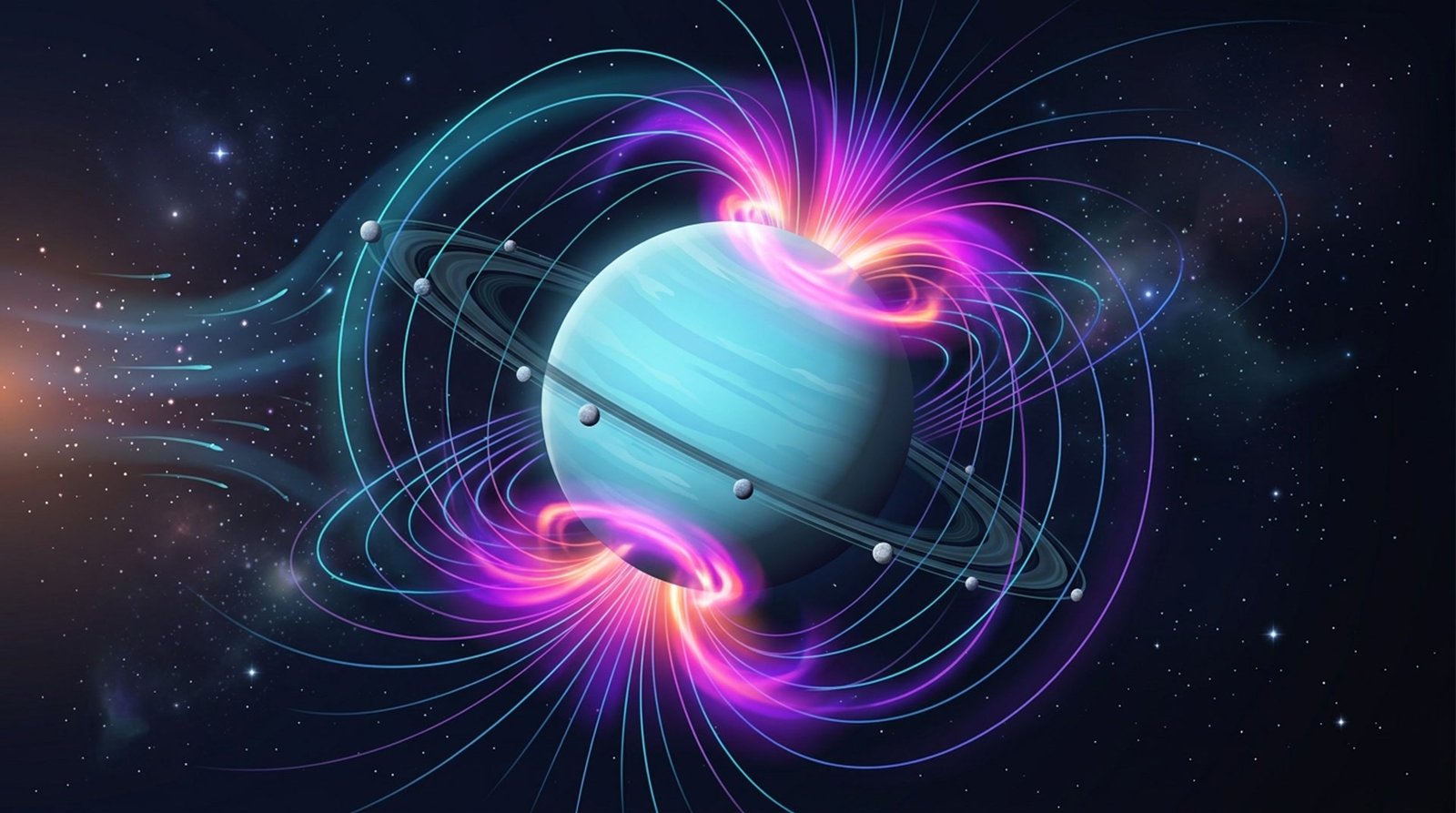
The Ice Giant's Hidden Space Heaters: Uncovering Uranus' Auroras
Summary
By the end of this article, you will understand why an ultra-cold planet is mysteriously cooling down, and how invisible magnetic auroras cause sudden, localized heat spikes in its upper atmosphere.
Quick Facts
- Surprise: Uranus' upper atmosphere is hundreds of degrees hotter than sunlight alone can explain, yet it has been steadily cooling since 1986.
- Salient Idea: The planet rolls on its side, and its magnetic poles are tilted entirely out of alignment with its spin.
- Surprise: In 2018, scientists saw the planet's temperature spike across two consecutive nights, matching the 8.7-hour gap between its two magnetic poles rotating into view.
- Surprise: Auroras on Uranus don't just glow; they physically heat the surrounding hydrogen gas.
The Discovery: A Cold Planet Gets Cooler
For decades, astronomers have been puzzled by Uranus. Despite being incredibly far from the Sun, its upper atmosphere is strangely hot—hundreds of degrees warmer than solar heating alone can explain. But here is the Surprise: since the Voyager 2 spacecraft flew by in 1986, the planet’s thermosphere has actually been steadily cooling down. To figure out why, scientists recently aimed a high-power spectrograph called IGRINS at the ice giant. In 2023, they confirmed the long-term cooling trend was still happening. But looking back at data from 2018, they noticed a massive, unexpected anomaly. Over two consecutive nights, the temperature of the planet’s hydrogen gas suddenly spiked by over 140 degrees. This was not a global climate shift; this was the signature of a localized space heater firing up as the planet rotated.
The consecutive-nights at elevated temperature… suggest that Uranus’ near-IR H2 aurora was detected over each of the northern and southern magnetic poles.
— L. M. Trafton & K. F. Kaplan
The Science Explained Simply
When we think of planetary heating, we usually think of sunlight. This is NOT solar heating. The sudden temperature spikes on Uranus are caused by auroral heating. On Earth, auroras (the Northern Lights) are beautiful ribbons of light. On Uranus, they are intense bursts of energy driven by charged particles slamming into the atmosphere. The Salient Idea here is that these particles transfer kinetic energy to the hydrogen gas, physically heating it up. Because Uranus is tilted 98 degrees on its side and its magnetic poles are wildly off-center, the planet’s rotation dragged first the northern aurora, and then the southern aurora, right across the telescope’s line of sight over a 26-hour period. The telescope wasn’t just seeing the atmosphere; it was looking directly down the barrel of an active magnetic storm.
The Aurora Connection
Auroras are the visible (or in this case, infrared) fingerprints of a planet’s magnetic field interacting with the solar wind. Earth’s magnetic field acts like a well-organized shield, funneling solar wind neatly to our north and south poles. Uranus’ magnetic field is a chaotic, tumbling mess. By measuring the exact temperature and location of these auroral heat spikes, scientists can map the invisible magnetic armor protecting the ice giant. Understanding how Uranus’ weird magnetic field catches and processes solar energy gives us vital clues about how magnetic shields operate on thousands of similar ‘ice giant’ exoplanets scattered across the galaxy. It reminds us that magnetic fields do not just protect atmospheres; they actively shape planetary weather.
The IR aurorae are thermalized by kinetic processes… so they persist according to the local heat capacity.
— Research Team
A Peek Inside the Research
How do you measure the exact temperature of a specific patch of gas 1.8 billion miles away? It comes down to high-resolution spectroscopy. The team used the IGRINS spectrograph, which splits incoming light into thousands of narrow bands. The challenge with observing Uranus is that Earth’s own atmosphere is full of glowing gases and water vapor that drown out the signal. IGRINS has such incredible resolution that it acts like a microscopic scalpel, separating the narrow emission lines of Uranus’ hydrogen from the noisy background of Earth’s sky. By comparing the strength of different light signatures from the hydrogen molecules, the team could calculate the exact rotational temperature of the gas, proving the existence of the auroral hot spots.
We report the first instance of high spectral resolution being used to observe Uranus… where the sky background is suppressed and narrow planetary emission lines stand out.
— The Authors
Key Takeaways
- High-resolution spectrometers act like cosmic thermometers, reading the exact temperature of gas molecules billions of miles away.
- Uranus is experiencing a decades-long cooling trend that defies simple seasonal explanations.
- Auroras create localized hot spots that can skew our measurements of a planet's overall climate.
- Tracking infrared auroras helps us map how the solar wind interacts with deeply weird magnetic fields.
Sources & Further Reading
Frequently Asked Questions
Q: Why is Uranus’ upper atmosphere cooling down?
A: Scientists aren’t entirely sure! It could be a delayed seasonal reaction to its 84-year orbit around the Sun, or it might be related to a long-term drop in the power of the solar wind since the 1980s.
Q: How are Uranus’ auroras different from Earth’s?
A: Earth’s auroras are aligned near our geographic poles. Uranus rolls on its side, and its magnetic poles are tilted 60 degrees away from its spin axis, meaning its auroras occur closer to its equator and wobble chaotically as it spins.